Status on 30 October 2026: The Commonwealth Master’s Scholarship round for study in 2027/28 closed at 16:00 BST (20:30 IST) on 20 October 2026. Indian applicants needed two applications: one on CSC Central and one through India’s Ministry of Education. The next open route is the Commonwealth Shared Scholarship, scheduled to open in early November and close in mid-December 2026. No 2028/29 Master’s dates had been published at the time of writing.
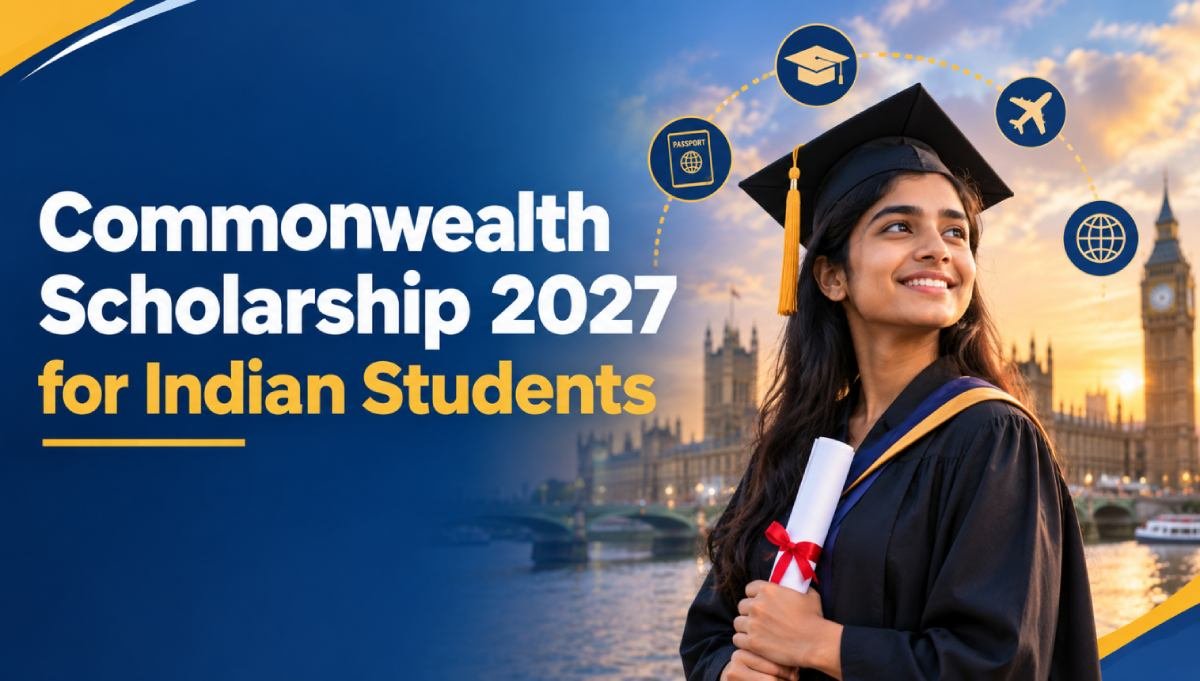
The Commonwealth Scholarship for Indian students is a UK government-funded award for one-year taught Master’s study in the UK. The Commonwealth Scholarship Commission in the UK (CSC) administers it for the Foreign, Commonwealth & Development Office (FCDO). This guide explains who qualifies, how the Indian two-step process works, what the award pays, and what to do now that the main 2027/28 window has closed.
Commonwealth Scholarship for Indian Students: Quick Facts
UK Foreign, Commonwealth & Development Office (FCDO)
Administrator
Commonwealth Scholarship Commission in the UK (CSC)
Level
One-year, full-time taught Master’s. No MBA
India eligible?
Yes. India is one of 43 eligible countries
Intake
September/October 2027
CSC deadline
16:00 BST, 20 October 2026 (closed)
Nominating agency for India
Ministry of Education, Government of India
Results
By July 2027
Stipend
GBP 1,712 per month (about 2,294 USD); GBP 2,000 (about 2,680 USD) in the London area
Application fee
None
Age limit
None
Renewable
No. One degree only
What Is the Commonwealth Scholarship for Indian Students?
The Commonwealth Master’s Scholarship is a fully funded UK Master’s award for talented people who could not otherwise afford to study in the UK. The FCDO funds it. The CSC delivers it under six development themes within the Commonwealth Scholarship and Fellowship Plan. India qualifies because it appears on the CSC’s list of eligible low- and middle-income Commonwealth countries.
The scheme has a development purpose, not only an academic one. The CSC expects scholars to return home after the award and apply their skills to development in their own country. Scholars sign an undertaking to return before their student visa expires, and switching to a Graduate visa is not permitted.
The CSC does not accept direct applications for this programme. A nominator puts forward an agreed number of candidates, and the CSC selects from that pool. For Indian citizens, the nominator is the Ministry of Education.
Which Commonwealth Scholarships Can Indian Students Get in 2027/28?
Indian students can access two Commonwealth Master’s routes: the agency-nominated Master’s Scholarship and the Shared Scholarship. The table below compares every award that appears on 2027/28 listings.
Award
Level
Open to Indian citizens?
How Indians apply
2027/28 status
Commonwealth Master’s Scholarship
One-year taught Master’s
Yes
CSC Central plus nomination by the Ministry of Education
Closed on 20 Oct 2026
Commonwealth Shared Scholarship
One-year taught Master’s on selected courses
Yes
CSC application form plus separate university admission
Scheduled to open early Nov 2026
Commonwealth PhD Scholarship
Doctoral study
No. The agency-nominated PhD route targets least developed countries and fragile states
Not applicable
Do not plan around it
Distance Learning and Split-site PhD
Varies
Reported as paused for 2027 entry
Not applicable
Verify on the CSC website
Who Should Apply for the Commonwealth Scholarship, and Who Should Not?
You should apply if you meet every CSC eligibility rule and can show that UK study depends on this funding. The CSC lists the following requirements.
Who should apply
You are an Indian citizen and permanently resident in India.
You hold, or will hold by September 2027, a first degree at upper second-class (2:1) standard. A lower second-class degree also qualifies if you hold a relevant postgraduate qualification, usually a Master’s degree.
You cannot afford to study in the UK without this scholarship.
You can start your UK studies in September 2027.
You have a clear plan linking your course to a development need in India.
You can provide every required document in the required format.
Indian guides often read a 2:1 as roughly 60 percent. Treat that as a rule of thumb and check the Ministry’s notice and your chosen university for the exact equivalence.
Who should not apply
Applicants who already studied a Master’s at a UK institution. The CSC treats them as ineligible.
Applicants who already received a Commonwealth Master’s Scholarship. The CSC treats them as ineligible.
Applicants who want an MBA, a two-year Master’s or a research degree. The CSC funds one-year taught Master’s programmes only.
Applicants who can fund UK study themselves. Financial need is an eligibility rule.
Applicants who plan to stay and work in the UK. Scholars commit to return home and cannot switch to a Graduate visa.
Applicants whose study plan supports the fossil fuel energy sector. The CSC does not provide new direct support for that sector overseas.
Current or former UK Government, British Council or Association of Commonwealth Universities employees, their relatives, and Commissioners. Former employees can apply three years after leaving.
The CSC would not normally fund a second Master’s degree. If you hold one already, you must justify why you need another.
Is there an age limit?
The CSC states there is no age limit for applications. Check your employer’s rules on leave if you work full time.
What if I have a disability and did not achieve a 2:1?
The CSC recognises that disabled people often face barriers that affect academic results. Disabled applicants who show potential to contribute to international development may be considered for a contextualised nomination through the Commonwealth Disabled People’s Forum.
What Does the Commonwealth Scholarship Pay?
A Commonwealth Master’s Scholarship covers tuition, a monthly stipend, return airfare and a study travel grant. The CSC publishes amounts in GBP. The USD figures below use 1 GBP = 1.34 USD, the rate on 25 October 2026. Exchange rates change daily.
Benefit
Official amount (GBP)
Approximate USD
Notes
Tuition fees
Full fees
Full fees
Agreed between the CSC and the UK university. You pay no part
Stipend outside London
1,712 per month
2,294 per month
About 27,529 USD over 12 months
Stipend in the London area
2,000 per month
2,680 per month
About 32,160 USD over 12 months
Return airfare
Approved fare
Approved fare
Home country to the UK and back. No fares for dependants
Study travel grant
Set by the CSC
Set by the CSC
For study-related travel within the UK or overseas
Child allowance, first child
622 per month
834 per month
Only for widowed, divorced or single-parent scholars with the child in the UK
Child allowance, second and third child
154 per month each
206 per month each
Children under 16 living with the scholar
The CSC describes family allowances as a contribution only. True family costs are likely to be higher. You cannot hold another award that covers the same costs at the same time.
What Is the 2027/28 Timeline for Indian Applicants?
The CSC Central deadline was 16:00 BST on 20 October 2026, and the Ministry of Education sets its own nomination dates.
Stage
Date
Confidence
CSC Central opens
Early September 2026 (reported as 8 September)
Reported
CSC Central closes
16:00 BST, 20 October 2026 (20:30 IST)
Official
Ministry of Education nomination window
Set by the Ministry. Sources disagree on the date
Check the Ministry notice
Ministry shortlisting and interviews
Reported between November 2026 and March 2027
Reported
Nominators send nominations to the CSC
By December 2026
Official
Shared Scholarship applications
Scheduled early November to mid-December 2026 (trackers report 10 November to 8 December, 16:00 GMT)
Official window, reported dates
Shared Scholarship nominations process
Early 2027
Official
Master’s outcomes
By July 2027
Official
Course start
September/October 2027
Official
How Do Indian Students Apply for the Commonwealth Scholarship? (Step-by-Step)
Indian students apply twice: on CSC Central and through the Ministry of Education. The CSC rejects any application or document sent outside CSC Central. Use this sequence for the 2028/29 cycle, and use it as a checklist if you already submitted for 2027/28.
Step 1: Confirm eligibility
Check citizenship, residence, degree class, financial need and prior UK Master’s study against the rules above. Stop here if any rule excludes you.
Step 2: Read the Ministry of Education notice
The Ministry of Education, Government of India acts as India’s nominating agency and sets its own closing date and extra criteria. The CSC advises applicants to check each nominator’s rules. Reports mention a six-month-abroad rule and an admission-letter requirement, so read the current notice before you plan.
Step 3: Shortlist three UK courses
List three courses in order of preference and explain each choice. The CSC makes the final placement decision. It will not change your university, course or order of preference after selection unless exceptional information emerges. If you list fewer than three and the CSC cannot place you, the scholarship cannot proceed.
Step 4: Start your university admission
Apply for admission before you apply for the scholarship, because many courses have strict deadlines. If you are selected without an application and acceptance, the scholarship may not proceed.
Step 5: Write the Development Impact statement
The statement has four parts. Explain how your course relates to development issues at global, national and local level. Explain how you will apply your skills afterwards. State the outcomes, timeframe and beneficiaries. Describe how your impact can be measured and evidenced.
Step 6: Prepare the remaining answers offline
The CSC recommends drafting answers outside the system and pasting them in. The form also asks for your award objectives, a five-year career plan, a long-term career plan, a detailed plan of study, a personal statement, up to 10 publications and prizes, employment history, and voluntary and leadership activity.
Step 7: Collect your referees
Name three referees. One must be your current employer, if you are employed. At least two references must be uploaded as PDFs by the deadline.
Step 8: Submit on CSC Central, then complete the Ministry nomination
CSC Central uses two-factor authentication each time you log in, so keep a smartphone or second email account available. Use the save function, avoid refreshing the browser, and submit early because the CSC does not accept late applications and you cannot edit after submission. Then complete the Ministry’s nomination application. Indian guides report that you upload your CSC application PDF there.
Which Documents Do You Need?
The CSC marks an application ineligible if any required document is missing by the closing date.
Document
Requirement
Practical tip
Passport or national ID
Valid copy showing photograph, date of birth and country of citizenship
Use a clear scan of the photo page
Transcripts
Full transcripts for all higher education qualifications, including to-date transcripts for current study
Missing pages make the application ineligible. Add certified translations if not in English
Reference letters
At least two, as signed PDFs on institutional letterhead or an email showing the sender’s details
Referees must write in their own words. Upload by the deadline, because the CSC accepts no other route
Explanation for missing transcripts
Needed if to-date transcripts are unavailable
State why they are unavailable
Ministry nomination documents
Set by the Ministry
Follow the current Ministry notice
Referees should comment on how long they have known you, your analytical ability, original thinking, motivation, strengths and weaknesses, and your potential to make a development impact.
How Does the Selection Process Work?
Selection happens in two stages: nomination by the Ministry of Education, then assessment by the CSC.
Stage 1: Eligibility check
The CSC first checks that your application and documents are complete and eligible.
Stage 2: Ministry of Education nomination
The Ministry runs its own selection process and nominates an agreed number of candidates by December 2026. Reports say it may shortlist and interview candidates. The CSC states that a nomination is no guarantee of selection.
Stage 3: CSC assessment
The CSC scores applications against three criteria: candidate merit, including academic experience; quality of the research proposal; and potential impact on the development of the candidate’s home country. Link every answer on the form to these criteria.
Stage 4: Outcome and award
The CSC emails outcomes by July 2027. Check junk and spam folders, because an offer may be withdrawn if you do not respond in time. The CSC then issues a provisional selection, agrees admission terms with the university, sends a Notification of Award and finally a Confirmation of Award. You must submit a health and disability form and meet UK visa rules.
What Are the Most Common Mistakes Applicants Make?
Most rejections come from avoidable process errors, not weak profiles. Avoid these mistakes.
Applying on one portal only. Indian applicants need CSC Central and the Ministry nomination. Complete both.
Confusing the two deadlines. The CSC and the Ministry set separate dates. Work back from the earlier one.
Uploading incomplete transcripts. Missing pages make the application ineligible. Check every page and every qualification.
Sending references late or by email. The CSC accepts references only through CSC Central before the deadline. Brief referees early.
Writing a generic impact statement. Name outcomes, a timeframe, beneficiaries and a measurement method.
Listing one course only. Provide three ranked choices with reasons.
Choosing an ineligible programme. MBA, two-year and research degrees fall outside the scheme.
Ignoring financial need. State clearly why you cannot fund UK study.
Starting admission late. Many courses close early, and a selection without admission may not proceed.
Submitting on the final day. The system gets very busy near the deadline, and the CSC accepts no late applications.
Missing the outcome email. Check spam and respond within the stated time.
What Do Previous Years Show? Commonwealth Scholarship Trends for Indian Applicants
The pattern points to an autumn CSC window, a December nomination step and July results.
Signal
Evidence
Confidence
CSC Central deadline
14 October 2025 for 2026/27 (reported); 20 October 2026 for 2027/28 (official)
Mixed
Results timing
July in both cycles
Official wording for both
Nomination timing
Nominators forward candidates by December 2026
Official
Eligible countries
43 countries for the 2027/28 Master’s route, including India
Official
Shared Scholarship volume
The CSC expects around 180 new Shared Scholarships for 2027/28
Official
Ministry portal timing
One tracker reports the most recent Indian window closed on 30 November and was extended to 24 December. Other trackers report earlier dates
Conflicting
India’s nomination volume
Third-party guides report about 39 nominations from over 4,500 submissions, roughly 1 in 115
Unverified. No official figure found
What the trends mean for you:
Expect the CSC window to open in early September and close in October, but treat that as a pattern, not a promise.
Treat the Ministry’s date as separate and variable, and check it early.
Start admission and referee work months before the portal opens, because they take the longest.
Research Notes: What We Verified and What You Should Double-Check
Several widely repeated claims conflict with the official CSC pages. This table separates them.
Claim in circulation
What the official CSC source says
How to treat it
Shared Scholarship candidates apply directly to the university and skip nomination
All candidates apply through the CSC online application form, and universities use that form to nominate. Candidates apply separately for course admission
Do both. Apply for the course and on the CSC form
Stipend is GBP 1,378 or GBP 1,690 per month
Current CSC rates are GBP 1,712 and GBP 2,000 per month
Older figures still appear on third-party pages. Use the CSC rates
An upper age limit of 40 applies
The CSC states there is no age limit
Ignore age-limit claims
India can apply for Commonwealth PhD scholarships
India appears on the Master’s and Shared lists. PhD routes target other country groups
Do not plan on a PhD route
The Ministry nominates only with an admission letter
Not stated on the CSC page. Nominators set their own rules
Check the Ministry notice
Candidates abroad over six months need two years back in India
Not stated on the CSC page. Reported from the Ministry’s notification
Check the Ministry notice
The CSC requires IELTS
The CSC requires no IELTS test
UKVI and the university may still set English rules
Extra Shared Scholarship rules that few guides mention:
Candidates must not have studied or worked for one academic year or more in a high-income country, as defined by the OECD DAC list.
The CSC asks universities to keep no more than 50 percent of their nominations to candidates from Ghana, India, Nigeria and Pakistan combined.
The CSC pays tuition up to GBP 22,500 (about 30,150 USD). The university pays the stipend of GBP 1,712 or GBP 2,000 per month.
Shared Scholars must be fluent enough in English to begin studies immediately, and universities must confirm this.
Commonwealth Scholarship vs Chevening vs Shared Scholarship
The three awards differ most in how you apply and whether financial need counts. See also our Chevening Scholarship guide for Indian students.
Feature
Commonwealth Master’s
Commonwealth Shared
Chevening
Funder
FCDO via the CSC
FCDO and host university
FCDO via the Chevening Secretariat
Application route
CSC Central plus Ministry nomination
CSC form plus university nomination and course admission
Direct application
Financial need rule
Yes
Yes
Not a formal criterion
Work experience requirement
None stated
None stated
Required
Return home commitment
Yes
Yes
Yes
2027/28 deadline
16:00 BST, 20 Oct 2026 (closed)
Scheduled early Nov to mid-Dec 2026
6 Oct 2026, 11:00 UTC (reported)
Course scope
Any approved one-year taught Master’s, no MBA
Selected courses only
Eligible UK Master’s courses
Missed the 2027/28 Deadline? Your Options Now
You still have three practical options: the Shared Scholarship, early preparation for 2028/29, and parallel UK scholarships.
Option 1: Target the Commonwealth Shared Scholarship
The CSC plans to publish the list of eligible 2027/28 Shared courses in November 2026. Read the Commonwealth Shared Scholarship rules first, then follow these steps:
Check the published course list for your subject.
Apply for admission to the university course.
Submit the CSC online application form within the window.
Confirm you meet the extra high-income-country rule.
Option 2: Prepare for the 2028/29 Master’s cycle
Build a timeline from the 2026 pattern. This is a planning inference, not an official schedule.
When
Action
Now to January 2027
Shortlist three courses and check admission deadlines
February to May 2027
Draft the Development Impact statement and plan of study
June to August 2027
Brief referees and gather transcripts
September 2027 onward
Monitor CSC and Ministry notices daily
Option 3: Apply to parallel awards
Explore our UK scholarships for Indian students hub for Chevening, GREAT Scholarships and university awards.
If you already submitted
Check your Ministry portal status and your email, including spam. Nominators send candidates to the CSC by December 2026, and the CSC expects to announce outcomes by July 2027.
Frequently Asked Questions
Is the Commonwealth Scholarship 2027 still open for Indian students?
The Commonwealth Master’s Scholarship for 2027/28 closed at 16:00 BST on 20 October 2026. The Commonwealth Shared Scholarship is the next route, with applications scheduled to open in early November and close in mid-December 2026. Indian students should also prepare early for the 2028/29 Master’s cycle.
Can I apply directly to the CSC from India?
No, not for the Master’s Scholarship. The CSC does not accept direct applications for this programme. Indian applicants apply on CSC Central and are nominated by India’s Ministry of Education, which sends an agreed number of candidates to the CSC. A nomination does not guarantee selection.
What is the SAKSHAT portal?
SAKSHAT is the Ministry of Education’s portal that Indian applicants use for the nomination part of the Commonwealth application. It is separate from CSC Central, and missing either application ends your chances. Candidates should confirm the current portal address and deadline on the Ministry’s notice each year.
Who is eligible for the Commonwealth Scholarship in India?
Applicants must be Indian citizens and permanent residents of India, hold at least a 2:1 first degree by September 2027 (or a lower second plus a relevant postgraduate qualification), and be unable to afford UK study without the scholarship. They must also be available to start in the UK in September 2027.
Is there an age limit?
No. The CSC states there is no age limit for applications. Applicants should still check whether their employer restricts leave by age. Some older guides mention an upper limit of 40, but the current CSC page does not include it.
Do I need IELTS?
The CSC does not require an IELTS test for the Master’s Scholarship. However, UK Visas and Immigration sets English language rules for student visas, and UK universities set their own admission requirements. Check your chosen course’s English requirement before applying, because admission is a separate process.
Can I apply with a 2:2 degree?
Only if you also hold a relevant postgraduate qualification, usually a Master’s degree. The CSC accepts a lower second-class degree plus that qualification. Disabled applicants who miss the 2:1 may be considered through a contextualised nomination via the Commonwealth Disabled People’s Forum. Work experience cannot replace the academic minimum.
Does the scholarship cover an MBA?
No. The CSC funds one-year taught Master’s programmes only and does not fund MBA degrees through the agency-nominated route. Shared Scholarships support MBA courses only in exceptional cases with a clear development focus. Two-year Master’s and research degrees also fall outside the scheme.
How much is the stipend in USD?
The stipend is GBP 1,712 per month, about 2,294 USD, or GBP 2,000 per month, about 2,680 USD, for scholars at London-area universities. Conversions use 1 GBP = 1.34 USD on 25 October 2026. Tuition, return airfare and a study travel grant are paid in addition.
Can my family come with me?
Family members may accompany you, but the CSC does not pay their airfare. Scholars who are widowed, divorced or single parents can receive a child allowance: GBP 622 per month (about 834 USD) for the first child and GBP 154 (about 206 USD) for the second and third child under 16.
Is there a Commonwealth PhD scholarship for Indians?
Indian citizens should not plan around a Commonwealth PhD scholarship. Eligibility lists show India as eligible for the Master’s and Shared awards but not the PhD awards, which target least developed countries and fragile states. Confirm this on the CSC website before relying on it.
What is the difference between the Master’s and Shared Scholarship?
The Master’s Scholarship uses national nominating agencies, so Indian applicants apply to CSC Central and to the Ministry of Education. The Shared Scholarship is co-funded by selected UK universities, covers selected one-year courses, and uses the CSC application form with university nomination. Shared candidates also need separate course admission and extra eligibility checks.
Can I reapply next year?
Yes, the CSC page lists no limit on reapplying. The main bars are prior UK Master’s study, a previous Commonwealth Master’s award, and a bribery conviction, which can trigger a ban of up to five years. Check eligibility each year, because dates, nominator rules and country lists can change.
How competitive is the Commonwealth Scholarship for Indians?
Highly competitive, but official Indian-specific figures are limited. Third-party guides report that India’s Ministry nominates about 39 candidates from over 4,500 submissions, roughly 1 in 115, but the CSC page does not publish this figure. Selection also depends on the CSC’s final assessment of nominated candidates.
What happens after I am selected?
The CSC first issues provisional selection, then agrees admission terms with the university and sends a Notification of Award. After you meet its conditions, the CSC issues a Confirmation of Award. You must submit a health and disability form, sign a return-home undertaking and meet UK visa requirements.
Is there an application fee?
No. The CSC does not charge to apply for any of its scholarships or fellowships through its online application system. Be cautious of anyone who asks for payment to secure a nomination, because the CSC treats bribery seriously and can ban offenders for up to five years.
Conclusion: Your Next Step
The Commonwealth Scholarship for Indian students funds one-year taught Master’s study in the UK through a two-step route: CSC Central and nomination by the Ministry of Education. The 2027/28 Master’s window closed on 20 October 2026. Your best next moves are the Commonwealth Shared Scholarship this winter and early preparation for 2028/29. Continue with our guide to writing a strong Development Impact statement to start building your next application.




 Scholarships4 months ago

 Scholarships3 months ago
 By Country4 months ago
 Scholarships4 months ago
 By Country4 months ago

 Scholarships3 months ago
 Scholarships4 months ago

 Scholarships3 months ago