Connect with us

Scholarships

Turkey Burslari Scholarship 2026: Eligibility, Benefits, Deadline, Interview, and Results

Published

on

Turkey Burslari Scholarship 2026: Eligibility, Benefits, Deadline, Interview, and Results
Türkiye Scholarships 2026, commonly searched as the Turkey Burslari Scholarship 2026, are government-funded scholarships for international students. The program supports associate, bachelor’s, master’s, and PhD study in Türkiye. The package includes university placement, tuition, a monthly stipend, accommodation support, health insurance, Turkish-language education, and flight support.

The official 2026 announcement set the general application period from January 10 to February 20, 2026. Applications are now closed. The official application calendar lists evaluation in March-April, interviews in April-June, and results in early August.

The answer applicants need now: Do not follow pages that still show the scholarship as open. Applicants who submitted before February 20 should check TBBS and email. Students who missed the deadline should prepare documents and program research for the next general cycle instead of paying an agent.

Türkiye Scholarships 2026 at a Glance

AttributeVerified information
Official nameTürkiye Scholarships / Türkiye Bursları
FunderGovernment of the Republic of Türkiye
AdministratorPresidency for Turks Abroad and Related Communities (YTB)
Host countryTürkiye
Eligible applicantsCitizens of all countries who meet the program criteria, excluding the official ineligible groups
Study levelsAssociate, bachelor’s, master’s, and PhD
2026 application periodJanuary 10-February 20, 2026
Current statusGeneral applications closed; result stage follows the published calendar
Expected resultsEarly August 2026
Application feeNo official fee
Application platformTürkiye Scholarships Information System (TBBS)
University preferencesUp to 12 choices in the online system
Funding typeComprehensive government-funded scholarship with cash and in-kind benefits

What Is Türkiye Scholarships?

Türkiye Scholarships is a public higher-education scholarship program for international students. YTB coordinates the program on behalf of the Republic of Türkiye. The scholarship combines financial support with university and department placement, which separates it from awards that only transfer money to a student after admission.

YTB describes the program as part of Türkiye’s international-student strategy. The YTB international students department states that the package includes placement, stipend, tuition, insurance, accommodation, language education, flight support, and academic or cultural opportunities.

The scholarship application and the university-placement process are connected. Applicants do not submit a general scholarship form and then choose any institution independently. TBBS displays the programs available to each applicant according to educational background, level, and the conditions attached to each program.

Official source: Official full-time scholarship programs
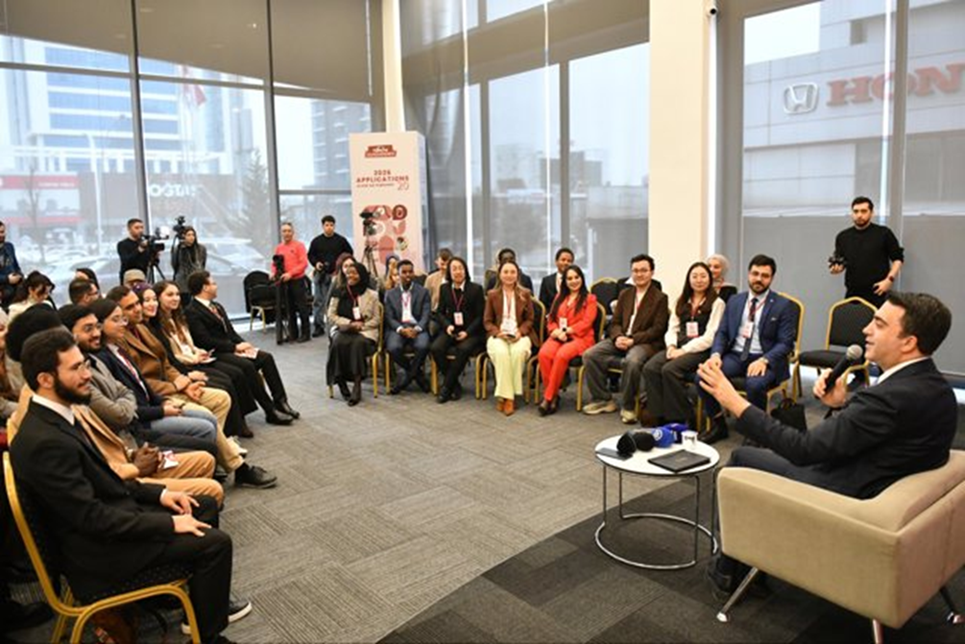
Türkiye Scholarships

International students at a YTB Türkiye Scholarships event. Source: YTB

Is the Turkey Burslari Scholarship 2026 Still Open?

No. The general Türkiye Scholarships 2026 application period closed on February 20, 2026. The application opened on January 10, 2026. The official announcement stated that the general cycle would accept applications in one period.

As of July 1, 2026, the published April-June interview window has ended or is concluding. The next major milestone is the early-August result announcement. YTB does not publish one universal interview day because schedules differ by country, applicant group, and operational arrangements.
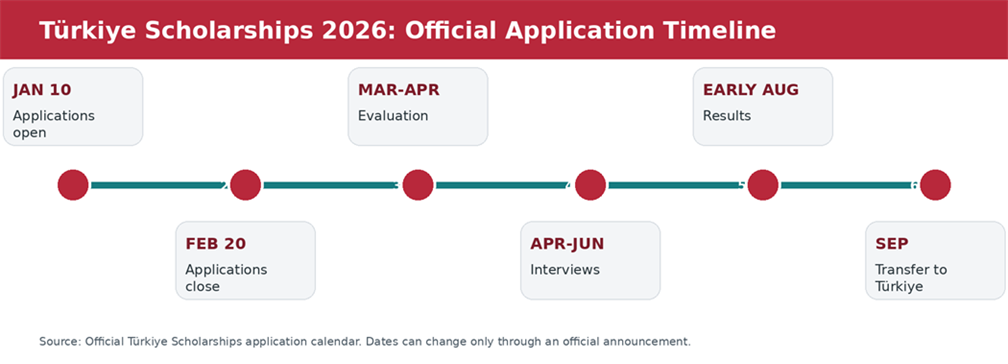
Officially published general-cycle timeline, redrawn for this guide. Check the official calendar

Applicants who already applied should:

  • Check the email address registered in TBBS, including spam and promotions folders.
  • Log in to TBBS to review notifications or status changes.
  • Keep original academic and identity documents available.
  • Avoid assuming that silence before early August means rejection.
  • Ignore individuals who request payment to influence an interview or result.

Students who missed the deadline should:

  • Prepare identity, graduation, and transcript files in clear digital form.
  • Research teaching language and program-specific tests before the next portal opens.
  • Strengthen academic evidence, social activities, and field-related experience.
  • Monitor only the official Türkiye Scholarships and YTB channels for the next announcement.

How Competitive Is Türkiye Scholarships?

Türkiye Scholarships is not an automatic award for applicants who meet the minimum grade and age rules. YTB reported nearly 200,000 applications in 2026. The same authority states that approximately 5,000 international students receive scholarships in a typical year.

A simple comparison of 5,000 annual awards with nearly 200,000 applications produces a rough award-to-application ratio near 2.5%. This figure is an analytical estimate, not an official 2026 acceptance rate. The number of awards, valid applications, countries, fields, and study levels can change the real probability for each applicant.

Minimum eligibility is only the first filter: Selection also considers academic status, prior qualifications, academic interests, career goals, preference consistency, letter-of-intent content, social activities, testing where applicable, and interview performance.

Turkey Burslari Scholarship 2026 Eligibility Requirements

An applicant must satisfy every mandatory criterion for the selected study level. Strong grades do not override an age violation. A valid age does not compensate for a missing diploma or an ineligible enrollment status.

Minimum academic achievement

Applicant categoryOfficial minimum
Associate and bachelor’s candidates70%
Master’s and PhD candidates75%
Medicine, dentistry, and pharmacy candidates90%

These percentages are entry thresholds. They do not describe a competitive score. Applicants should present the strongest transcript available and explain the academic direction of the proposed study through consistent program choices and motivation answers.

Age criteria

Study levelOfficial age rulePractical reading
Associate and bachelor’sUnder 21An applicant who has already reached 21 does not meet the stated rule.
Master’sUnder 30An applicant who has already reached 30 does not meet the stated rule.
PhDUnder 35An applicant who has already reached 35 does not meet the stated rule.
Research ScholarshipUnder 50This is a separate short-term program with its own periods.

The official wording uses “under,” not “maximum age.” Applicants should rely on the eligibility shown in TBBS and the current official criteria rather than third-party age converters.

Eligible and ineligible groups

Eligible groups include:

  • Citizens of all countries who are not excluded by the citizenship rules.
  • Graduates and students who will graduate before August at the end of the current academic year.
  • Researchers and academics for applicable scholarship programs.

Ineligible groups include:

  • Turkish citizens and individuals who have lost Turkish citizenship.
  • Applicants currently enrolled in a Turkish university at the same level for which they are applying.

Official source: Official criteria and scholarship programs

Available Study Levels and Fields

The 2026 general announcement covered associate, bachelor’s, master’s, and doctoral study. Available universities and departments are not identical for every applicant. TBBS filters options according to the applicant’s previous education and the rules attached to each program.

Program typeTypical scopeImportant limitation
Associate degreeTwo-year technical and vocational educationAvailability depends on the official program list.
Bachelor’sEngineering, social sciences, health sciences, basic sciences, arts, and other listed fieldsHealth-science applicants face the 90% academic threshold.
Master’sSocial sciences, humanities, natural sciences, engineering, and listed fieldsThe standard graduate scholarship does not fund health sciences.
PhDAdvanced study and research in listed graduate fieldsA research-topic proposal and a writing sample are required uploads.
Art ScholarshipSelected undergraduate, graduate, and PhD arts programsThe official page lists specific institutions and departments.
Research and Success ScholarshipsSeparate short-term or current-student programsApplication periods differ from the general January-February cycle.

Applicants should use the official scholarship program search to check the teaching language, university, department, degree level, and special conditions. A general list on a blog cannot replace the options displayed to the individual applicant in TBBS.

Graduate health-science warning: The official full-time program page states that Türkiye Scholarships does not award the standard graduate scholarship in health sciences. Applicants should not assume that the 90% health-science threshold means every master’s or PhD medical field is available.

What Does Turkey Burslari Scholarship Cover?

Türkiye Scholarships combines cash support with services that applicants would otherwise arrange separately. The package is comprehensive, but each benefit has a defined scope. Flight support is not an annual travel allowance. Graduate accommodation changes after the first year under the published housing rules.
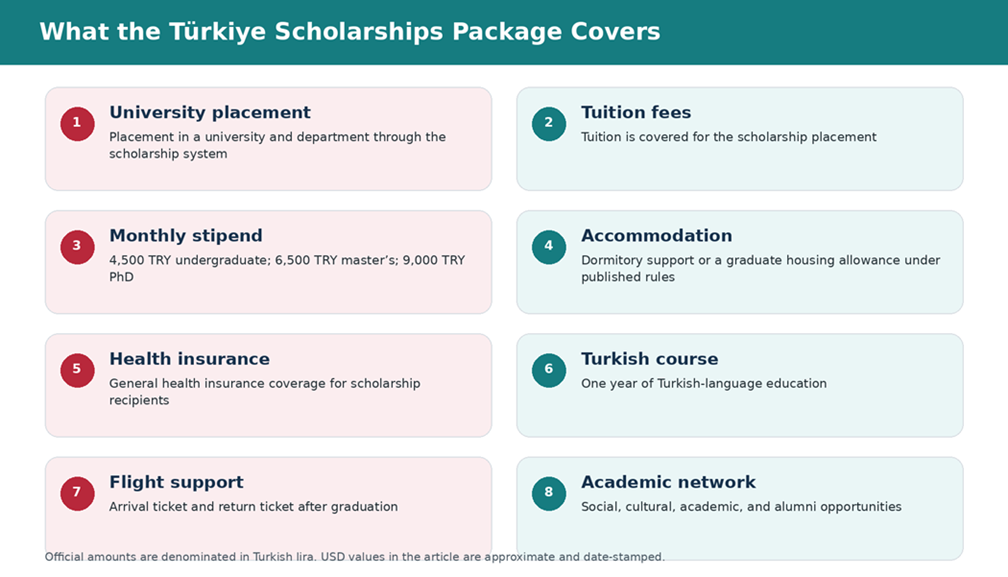
Summary of the official scholarship package. Verify benefits on the official page

Monthly stipend in TRY and approximate USD

Study levelOfficial monthly stipendApproximate monthly value in USD
Associate and bachelor’s4,500 TRYApproximately USD 96
Master’s6,500 TRYApproximately USD 139
PhD9,000 TRYApproximately USD 193

USD conversions are approximate as of July 1, 2026, using about 46.67 TRY per USD. The scholarship is officially denominated in TRY, so the USD value changes with the exchange rate. See the market-rate reference used for the conversion.

Accommodation rules

RecipientPublished accommodation support
Undergraduate scholarsDormitory accommodation can be covered for the duration of study.
Master’s and PhD scholars: first yearDormitory entitlement is available during the first year.
Master’s and PhD scholars: later years in Istanbul or AnkaraPublished housing allowance of 6,000 TRY per month, approximately USD 129 at the stated conversion rate.
Master’s and PhD scholars: later years in other citiesPublished housing allowance of 5,000 TRY per month, approximately USD 107 at the stated conversion rate.

The scholarship also covers tuition fees, general health insurance, one year of Turkish-language education, and supported travel at the beginning of education and after graduation. It also provides access to academic, cultural, social, and alumni activities.

Official source: Official Türkiye Scholarships benefits

Budget reality: A fully funded scholarship removes major education costs, but it does not guarantee unlimited personal spending. Applicants should still plan for discretionary purchases, deposits, optional travel, electronics, and expenses that fall outside published scholarship procedures.

Does Turkey Burslari Require IELTS, TOEFL, SAT, GRE, or GMAT?

Türkiye Scholarships does not impose one universal IELTS requirement on every applicant. This does not mean that every program is available without a language certificate. A selected university or department may require TOEFL or another accepted language result. A program may also require SAT, GRE, GMAT, or another academic examination.

The official application instructions tell applicants to upload international exam scores and language-test results when the chosen university or program requires them. The teaching language and special conditions appear during program selection.

Applicant situationLikely application implicationRequired check
Turkish-medium program without an English testAn English test may not be a scholarship-wide requirement.Read the exact program conditions in TBBS.
English-medium program without a language scoreEligibility depends on the selected program.Confirm the accepted examination and minimum score.
Program requiring an academic admission testThe application may require SAT, GRE, GMAT, or another listed score.Upload a valid result that satisfies the program rule.
Applicant has IELTS onlyAcceptance cannot be assumed.Check whether the university accepts IELTS or requires another test.
Applicant has TOEFLA valid score may satisfy some programs.Check the university’s accepted format, validity, and minimum score.

University rules can change independently. For example, Istanbul Technical University publishes its own accepted English tests and minimum scores on an official .edu.tr page. This university-level evidence explains why “no IELTS or TOEFL required” is an unreliable universal claim.

Documents Required for Turkey Burslari Scholarship

TBBS accepts digital uploads during the application stage. Applicants should upload complete, readable, and truthful files. A document should not be altered to improve grades, dates, identity information, or examination results.

The official application page lists these documents:

  • A valid identity document, national identity card, or passport.
  • A recent applicant photograph taken within the previous year.
  • National examination results, when available.
  • A diploma or temporary graduation certificate.
  • An academic transcript.
  • International examination results such as GRE, GMAT, or SAT when required by the selected university or program.
  • International language-test results such as TOEFL or DELF when required by the selected university or program.
  • A proposed research topic and a writing sample from previous research for PhD applications.

Final-year students may apply when they will graduate before August. Such applicants should provide the documents accepted by TBBS for their current status. Applicants should update or present final evidence when the scholarship authority requests it.

Do not add invented universal requirements: The official standard upload list does not identify recommendation letters or a medical certificate as universal mandatory application documents. A program or later procedure may request additional evidence, but a third-party checklist should not present it as compulsory for everyone.

Official source: Official application documents and important details

How to Apply Through the TBBS Portal

The general 2026 application window has closed. The following process explains how the official application works and helps future applicants prepare. The application is completed online and does not require an official application fee.
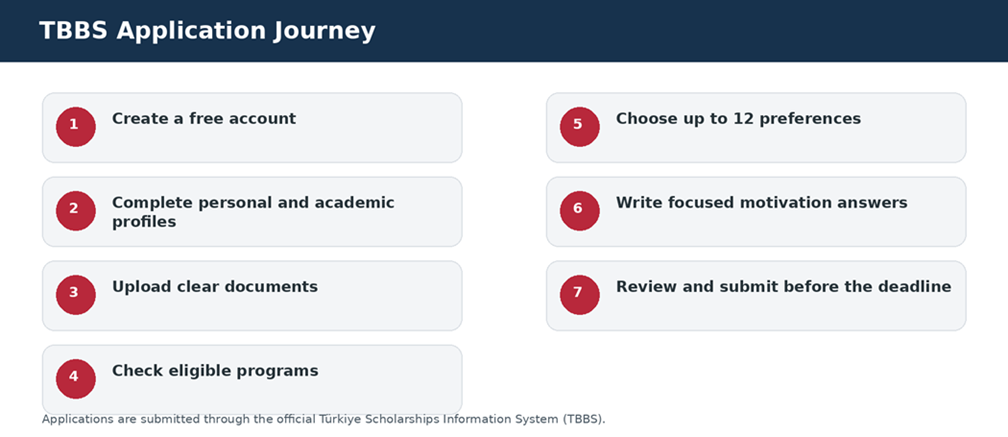
The core TBBS application journey. Open the official TBBS portal

  1. Create a free TBBS account. Use an email address that will remain active throughout evaluation, interviews, results, and placement.
  2. Complete the personal profile. Enter identity, citizenship, contact, family, and other requested information exactly as supported by documents.
  3. Complete the academic profile. Add education history, grades, examinations, language ability, achievements, and activities.
  4. Upload required documents. Use clear scans or photographs. Check that names, dates, grades, and page edges are visible.
  5. Review eligible programs. Study the teaching language, degree level, university, department, and special conditions.
  6. Select up to 12 preferences. Choose programs that form a coherent academic direction rather than an unrelated list.
  7. Complete motivation and goal questions. Connect previous study, the chosen field, Türkiye, future plans, and expected impact.
  8. Review and submit. Correct errors before the deadline. Keep a record of the submitted information.
  9. Monitor TBBS and email. Interview invitations and later instructions can arrive through the registered channels.

Use only the official TBBS portal. Türkiye Scholarships states that applications are submitted online free of charge. An intermediary cannot guarantee eligibility, an interview, placement, or selection.

How to Choose Up to 12 Universities and Programs

TBBS allows applicants to select up to 12 choices. More choices do not automatically create a stronger application. The expert evaluation considers the consistency of preferences, so every selection should support one defensible academic and career direction.

Decision factorQuestion to answer before selecting a program
Academic continuityDoes the program logically follow the applicant’s previous education or credible transition plan?
Career relevanceDoes the curriculum support the stated long-term goal?
Teaching languageCan the applicant satisfy the university’s language conditions?
Admission testsDoes the program require SAT, GRE, GMAT, TOEFL, or another result?
Research fitFor graduate study, do the field and available academic resources match the proposed topic?
LocationIs the city acceptable for the applicant’s academic, personal, and practical needs?
RecognitionWill the degree and field be recognized for the applicant’s intended profession in the home country?
Narrative consistencyCan the applicant explain why all listed choices belong in one focused application?

An applicant with a computer-science background can select related data science, artificial intelligence, software engineering, or information-systems programs when the progression is credible. A list that mixes unrelated medicine, architecture, law, music, and computer science without evidence can weaken the application’s coherence.

Türkiye Scholarships Selection Process

The selection process moves from basic eligibility to comparative assessment. Passing one stage does not guarantee advancement to the next stage.

StageWhat happensWhat the applicant should demonstrate
1. Preliminary assessmentThe authority checks minimum grades, age, documents, and other basic criteria.Accurate information and complete evidence.
2. Expert evaluationEligible applications are compared across academic status, qualifications, interests, goals, preferences, letter-of-intent content, and social activities.A focused academic direction and credible impact.
3. Test where applicableUndergraduate candidates may complete a quantitative test before a face-to-face interview.Mathematics, geometry, logic, and sufficient comprehension.
4. InterviewA committee checks documents, purpose, academic knowledge, and career goals.Consistency, clarity, subject knowledge, and honest answers.
5. Final assessmentEvidence from the earlier stages informs final scholarship decisions and placement.Overall comparative strength and program fit.

Official source: Official evaluation and selection process

Türkiye Scholarships Undergraduate Quantitative Test

The official selection page describes a 30-question quantitative test for undergraduate candidates before face-to-face interviews. The standard test includes mathematics, geometry, and logic. Candidates receive 60 minutes in the standard format.

The test format is not identical in every country. The official page describes different arrangements for Azerbaijan, Greece, the Turkish Republic of Northern Cyprus, Afghanistan, and Sudan. Applicants should follow the format stated in their own invitation instead of relying on one universal sample shared online.

Preparation priorities:

  • Practice arithmetic, algebra, basic geometry, patterns, and logic under time limits.
  • Use the official mock examination and answer key linked from the selection page.
  • Review mathematical vocabulary in English when applying to science, engineering, or health-related undergraduate fields.
  • Bring the identity and academic documents stated in the interview invitation.
  • Do not assume that a strong test score replaces weak eligibility or inconsistent program choices.

Turkey Burslari Interview Questions and Preparation

The official interview normally lasts 15-30 minutes. The published structure includes a welcome, document check, discussion of the application purpose, assessment of academic knowledge and career goals, and a closing opportunity for the candidate’s questions.

Questions can address:

  • Why did you select this academic field?
  • How does your previous education prepare you for the proposed degree?
  • Why did you choose Türkiye and the listed programs?
  • How are your 12 preferences connected?
  • What problem do you want to solve after graduation?
  • Which academic or social activities support your application?
  • What are the main concepts in your field?
  • For PhD applicants, what is the research question, method, feasibility, and expected contribution?

A strong interview answer should:

  • Answer the question directly before adding context.
  • Match the information submitted in TBBS.
  • Use specific evidence instead of generic praise for Türkiye.
  • Explain academic fit without memorized marketing language.
  • Acknowledge limitations honestly rather than inventing an achievement.
  • Connect the degree to a realistic post-study plan.
Interview invitation does not equal final selection: An invitation means the application advanced to another comparative stage. The committee still evaluates documents, motivation, academic knowledge, goals, and overall consistency.

Türkiye Scholarships Results 2026

The official general calendar places the announcement of results in early August. It does not provide one guaranteed date for every applicant. Candidates should monitor TBBS and the email address used during registration.

A successful result can be followed by commitment procedures, university placement confirmation, document checks, travel arrangements, accommodation instructions, and transfer to Türkiye. The calendar places initial procedures in August and the transfer of grantees in September.

After a successful result:

  • Read every official instruction before accepting or signing a commitment.
  • Verify the university, department, teaching language, and degree level.
  • Prepare originals and any certified or translated documents requested for enrollment.
  • Follow visa, travel, health, and accommodation instructions from official channels.
  • Do not purchase non-refundable travel until the responsible authority confirms the required process.

Applicants who are not selected should not interpret the result as proof that they were academically weak. Türkiye Scholarships compares a very large international pool across multiple criteria. A future application should correct specific gaps rather than copy the same program choices and motivation answers.

Common Reasons an Application Becomes Uncompetitive

The applicant fails a basic criterion. An age, academic, citizenship, enrollment, or document rule can stop the application before comparative evaluation.

The program choices are unrelated. A scattered list can conflict with the applicant’s academic background and stated goals.

The applicant ignores language or examination conditions. A program-specific requirement can make an otherwise attractive choice unrealistic.

The motivation answers are generic. Statements such as “Türkiye has good universities” do not prove fit, preparation, or expected impact.

The application contains contradictions. Different career goals, dates, fields, or achievements reduce credibility.

Documents are incomplete or unreadable. Missing pages, cropped grades, blurred files, or inconsistent names create verification problems.

The applicant exaggerates achievements. Unsupported claims can fail document checks or create difficult interview questions.

The applicant submits at the last minute. Late research increases the risk of weak program choices, upload errors, and unfinished answers.

The applicant treats minimum grades as a winning score. The minimum only establishes basic eligibility for further comparison.

Common Claims That Need Correction

Common online claimMore accurate guidance
“No IELTS or TOEFL is required.”There is no universal scholarship-wide IELTS rule, but selected programs can require an accepted language test.
“The maximum undergraduate age is 21.”The official criterion says under 21. A person who has already turned 21 does not meet that wording.
“Two recommendation letters are mandatory for everyone.”Recommendation letters do not appear in the official universal upload list. Follow TBBS and program-specific instructions.
“A medical certificate is mandatory at application.”A medical certificate does not appear in the official standard application-document list.
“All master’s and PhD health programs are funded.”The official full-time page states that the standard graduate scholarship does not award health-science scholarships.
“The stipend equals a fixed USD amount.”The award is paid in TRY. Any USD value changes with the exchange rate and must be date-stamped.
“Accommodation is identical at every level.”Undergraduate dormitory support and later-year graduate housing support follow different published rules.
“An agent can improve the result.”The official application is free. No intermediary can guarantee selection or placement.

How to Prepare for the Next Türkiye Scholarships Cycle

Future applicants should prepare before the next official announcement. Historical timing is useful for planning, but only the new announcement can confirm the next cycle’s dates, amounts, criteria, and available programs.

Preparation areaAction
EligibilityCalculate age carefully and compare grades with the official percentage threshold.
DocumentsScan identity, diploma, transcript, examinations, and research evidence in clear files.
LanguageIdentify programs that require a recognized certificate and schedule the test early.
Academic testsPrepare SAT, GRE, GMAT, or other results only where relevant to intended programs.
Program researchCreate a shortlist based on field, teaching language, university conditions, and career fit.
MotivationBuild one coherent argument linking background, proposed study, Türkiye, and future contribution.
ExperienceDocument academic projects, research, employment, volunteering, leadership, and social activities.
InterviewReview core subject knowledge and practice concise evidence-based answers.
Official monitoringFollow Türkiye Scholarships, YTB, TBBS, and university .edu.tr pages rather than recycled social posts.

Frequently Asked Questions About Turkey Burslari Scholarship 2026

Is the Turkey Burslari Scholarship 2026 still open?

No. The general application period ran from January 10 to February 20, 2026. As of July 1, 2026, applications are closed. Applicants who submitted on time should monitor TBBS and email for result-related updates. Students who missed the window should prepare for the next officially announced cycle.

What was the deadline for Türkiye Scholarships 2026?

The official deadline was February 20, 2026. The application opened on January 10, 2026. Türkiye Scholarships stated that general applications would be accepted in one period. Research, Success, and other specialized scholarships can use different calendars, so their dates should not be confused with the main full-time cycle.

When will Türkiye Scholarships 2026 results be announced?

The official general calendar places the result announcement in early August 2026. It does not guarantee one exact date for every applicant. Candidates should check their registered email and TBBS account. Initial procedures are scheduled for August, while transfer of selected grantees to Türkiye is scheduled for September.

What percentage is required for the Turkey Burslari Scholarship?

The official minimum is 70% for associate and bachelor’s candidates, 75% for graduate candidates, and 90% for medicine, dentistry, and pharmacy candidates. These are minimum eligibility thresholds. Selection remains competitive and also considers qualifications, goals, motivation, program-choice consistency, social activities, tests, and interviews.

What is the age limit for Turkey Burslari?

Applicants must be under 21 for associate or bachelor’s programs, under 30 for master’s programs, and under 35 for PhD programs. Research Scholarship applicants must be under 50. The wording “under” is important. A person who has already reached the stated age does not meet the published criterion.

Can I apply for Türkiye Scholarships without IELTS?

Possibly. Türkiye Scholarships does not apply one universal IELTS requirement to every applicant. The selected university or program may require TOEFL, IELTS, or another accepted language test. Applicants must review the teaching language and special conditions in TBBS before choosing a program or assuming that no certificate is needed.

Is TOEFL compulsory for English-medium programs?

Not universally. Each university and program defines its accepted proof of English proficiency. Some programs require TOEFL or another listed examination. Others may use an institutional examination or a different condition. Applicants should check the scholarship program details and the university’s current official .edu.tr language requirements.

Can final-year students apply for Turkey Burslari?

Yes, when they will graduate at the end of the current academic year before August. Final-year applicants should upload the academic and temporary documentation accepted by TBBS. They must later provide final graduation evidence when requested. A student who cannot complete the required qualification on time may lose eligibility.

Can a student already studying in Türkiye apply?

The official criteria exclude people currently enrolled in a Turkish university at the same level for which they are applying. This wording matters. An applicant should not generalize it to every possible level or situation. The safest approach is to enter accurate enrollment details and follow the eligibility shown in TBBS.

How many universities can I choose in Türkiye Scholarships?

TBBS allows applicants to select up to 12 program preferences. Applicants should not treat the number as a target that must be filled randomly. The expert evaluation considers preference consistency. Each choice should align with the applicant’s previous education, teaching-language ability, research interests, and realistic career direction.

Does Turkey Burslari cover accommodation for the full degree?

Undergraduate scholarship recipients can use covered dormitory accommodation for the duration of study under the published rules. Master’s and PhD recipients receive dormitory entitlement in the first year. Later, graduate students can receive a housing allowance that differs between Istanbul or Ankara and other Turkish cities.

Is medicine available under Türkiye Scholarships?

Bachelor’s-level health-science programs can appear among the available choices, and medicine, dentistry, and pharmacy candidates require at least 90% academic achievement. Graduate applicants must be careful. The official full-time program page states that the standard Graduate Scholarship Program does not award scholarships in health sciences.

What documents should I bring to the interview?

Bring the original documents identified in the interview invitation and the evidence used in the application. These usually include identity, diplomas or graduation evidence, transcripts, and relevant examination or language results. Requirements can vary by location. Follow the invitation rather than relying only on a general third-party checklist.

Is there an application fee for Türkiye Scholarships?

No official application fee applies to the online Türkiye Scholarships application. Candidates submit through TBBS free of charge. A private consultant may charge for an unrelated service, but that payment is not an official scholarship fee. No consultant, agent, or social-media account can guarantee an interview, award, or placement.

Conclusion

The Turkey Burslari Scholarship 2026 is officially called Türkiye Scholarships. The program offers a broad package that combines university placement, tuition, stipend, accommodation support, insurance, language education, travel support, and academic or cultural opportunities.

The 2026 general application period is closed. Current applicants should monitor official channels for the early-August result stage. Future applicants should use the remaining time to verify eligibility, research program conditions, prepare documents, and build a coherent academic narrative.

The next semantic step is a detailed scholarship application document checklist, followed by a guide to writing evidence-based motivation answers. Those internal resources should link back to this page with the anchor text “Turkey Burslari Scholarship 2026 requirements.”

Continue Reading
Click to comment

Leave a Reply

Your email address will not be published. Required fields are marked *

Scholarships

Scholarship for J&K Students: Eligibility, Amount, Deadlines, and How to Apply

Published

on

By

Scholarship for J&K Students

A scholarship for J&K students is financial aid for students who belong to Jammu and Kashmir and need support for school, college, professional, medical, or higher education. The strongest option for many Class 12 students is the PM USP Special Scholarship Scheme for Jammu Kashmir and Ladakh, also known as PMSSS or SSSJKL. The mistake is to treat PMSSS as the only option. J&K students may also qualify for National Scholarship Portal schemes, SC scholarships, ST scholarships, OBC/EBC/DNT support, disability scholarships, university scholarships, and course-specific aid.

This guide explains the major scholarships, eligibility rules, approximate USD values, documents, application steps, rejection reasons, and official links. All USD conversions are approximate. Indian government schemes pay in INR. The USD figures below use INR 94.97 as approximately USD 1 for reader comparison, based on a July 7, 2026 Reuters currency report. Reuters currency reference.

Key factDirect answer
Main region-specific schemePM USP Special Scholarship Scheme for Jammu Kashmir and Ladakh, also called PMSSS or SSSJKL.
Main administratorAll India Council for Technical Education under the Ministry of Education.
Main application ecosystemAICTE SSSJKL portal and National Scholarship Portal, depending on the scholarship stage and year.
Most important eligibility attributeJ&K or Ladakh domicile, plus the scheme-specific study level, income, category, and course rules.
Deadline ruleCheck AICTE, NSP, and district notices before publishing or applying. Scholarship windows change by academic year.

What Is a Scholarship for J&K Students?

A scholarship for J&K students is an education-funding benefit for students who meet a Jammu and Kashmir domicile condition or another J&K-linked eligibility condition. The scholarship may cover tuition fee, academic fee, maintenance allowance, hostel expenses, books, stationery, or other education costs.

The term includes four scholarship types:

  • Region-specific scholarships such as PMSSS/SSSJKL for students from Jammu, Kashmir, and Ladakh.
  • National Scholarship Portal schemes that accept J&K students based on category, income, disability, or course level.
  • Social welfare scholarships for SC, ST, OBC, EBC, DNT, minority, and other eligible groups.
  • University and institutional scholarships for enrolled students who meet merit, means, or course-specific rules.

Quick Comparison of Scholarships for J&K Students

The best scholarship depends on the student profile. A Class 12 student planning undergraduate study outside J&K needs a different route from an SC student in Class 10 or an ST student in a recognised post-matric course.

Scholarship routeBest forCore eligibilityBenefit and portal
PM USP SSSJKL / PMSSSClass 12 or eligible diploma-route students seeking UG study outside J&K/LadakhJ&K/Ladakh domicile; family income usually capped at INR 8 lakh; admission/course rules applyAcademic fee cap plus maintenance allowance. Apply/check through AICTE SSSJKL and NSP-related processes.
NSP central/state schemesStudents who match national welfare, merit, disability, or ministry scheme rulesNSP OTR, Aadhaar/EID, domicile/category/income/course rulesApply through National Scholarship Portal. Track application and payment status online.
SC pre-matric scholarshipSC students in Classes 9 and 10SC category; full-time study; income ceiling of INR 2.5 lakh for Component 1Academic allowance through state/UT implementation and NSP-linked process.
SC post-matric scholarshipSC students after matriculationSC category; post-matric/post-secondary study; state/UT domicile selectionFinancial aid to support higher education in India.
ST pre/post-matric scholarshipST students in Class 9 onward and recognised post-matric coursesST category; income ceiling generally INR 2.5 lakh; recognised course/institutionFee and maintenance support through State/UT or NSP route, with DBT.
University scholarshipsEnrolled UG, PG, diploma, law, or research studentsUniversity-specific merit, means, renewal, or course rulesApply through the university scholarship office or official university portal.

PM USP Special Scholarship Scheme for Jammu Kashmir and Ladakh

PM USP SSSJKL is the central region-specific scholarship for students from Jammu and Kashmir and Ladakh. AICTE describes the scheme as a Special Scholarship Scheme for students of the Union Territories of Jammu & Kashmir and Ladakh under Pradhan Mantri Uchchatar Shiksha Protsahan. The AICTE J&K bureau page states that the scheme supports 5,000 fresh scholarships per year for higher studies outside the UTs. AICTE J&K scholarship page.

The scheme matters because it connects domicile, higher education access, academic fee support, maintenance allowance, and admission outside J&K/Ladakh. It is not a general cash grant. It is linked to course, institution, verification, and scholarship renewal rules.

Who Is Eligible for PMSSS / SSSJKL?

  • The student should be a domicile of Jammu and Kashmir or Ladakh, as required by the scheme year.
  • The student should usually have passed Class 12 from the relevant board/school route, or qualify through an eligible diploma lateral-entry route where allowed.
  • The family income limit is commonly stated as INR 8 lakh per year. This equals about USD 8,424 for comparison, but the official rule is in INR.
  • The student should take admission in an eligible course and institution, generally outside J&K and Ladakh, under the applicable AICTE/SSSJKL process.
  • The student should not claim another overlapping government scholarship if the scheme rules prohibit duplicate benefits.

How Much Does PMSSS Provide?

The PMSSS benefit has two major parts: academic fee support and maintenance allowance. The exact amount depends on the course stream and current scheme notification. The table below uses commonly cited official scheme ceilings and approximate USD equivalents for reader understanding. Always verify the live AICTE specification PDF before publishing exact numbers. AICTE/NSP PM USPY scheme specification PDF.

StreamAcademic fee capApprox. USD equivalentMaintenance allowance
General degreeINR 30,000 per yearUSD 316INR 1,00,000 per year, about USD 1,053
Professional / engineering / nursing / pharmacy / architecture / HMCT / eligible law routesINR 1,25,000 per yearUSD 1,316INR 1,00,000 per year, about USD 1,053
Medical / BDS / equivalent medical streamINR 3,00,000 per yearUSD 3,159INR 1,00,000 per year, about USD 1,053

Who Is Usually Not Eligible for PMSSS?

  • Students admitted through management quota, if excluded by the current scheme rules.
  • Students studying in colleges or courses not listed or accepted under the AICTE/SSSJKL process.
  • Students pursuing postgraduate or diploma programmes when the scheme year is limited to undergraduate routes.
  • Students receiving another scholarship where duplicate benefits are not allowed.
  • Students whose documents are not verified by the required facilitation or verification authority.
  • Students who miss registration, choice filling, counselling, joining, or renewal deadlines.

NSP Scholarships for J&K Students

The National Scholarship Portal is the main Indian government portal for many scholarship registrations, scheme searches, application status checks, and payment tracking. The NSP homepage provides student links for One Time Registration, scholarship application, NSP scheme list, application status, and payment tracking. National Scholarship Portal.

What Is NSP OTR?

NSP One Time Registration is a unique 14-digit number based on Aadhaar or Aadhaar Enrolment ID. NSP states that OTR is applicable for the student’s entire academic career and is required to apply for scholarships on NSP. It reduces repeat registration across academic years.

How J&K Students Should Use NSP

  1. Generate NSP OTR using Aadhaar or Aadhaar Enrolment ID.
  2. Use the “Schemes on NSP” and scholarship eligibility tools to identify active schemes.
  3. Open only the schemes that match domicile, category, income, study level, and course rules.
  4. Submit a fresh or renewal application before the closing date.
  5. Track institute verification, district/state verification, and payment status from the official portal.

Category-Based Scholarships for J&K Students

Category-based schemes matter because many students search only for “J&K scholarship” and miss social welfare scholarships. A J&K domicile student may qualify through region, caste/category, disability, income, course, or institution. The correct scheme depends on the strongest eligibility attribute.

SC Scholarships

The Post-Matric Scholarship for SC students supports Scheduled Caste students at the post-matriculation or post-secondary stage. The Department of Social Justice and Empowerment states that the scheme aims to increase SC gross enrolment in higher education and applies to studies in India, with awardees selected by the State Government or Union Territory to which the applicant belongs. Post-Matric Scholarship for SC Students.

The Pre-Matric Scholarship for SC students covers full-time students in Classes 9 and 10. The same department states that Component 1 requires SC status and parental or guardian income not exceeding INR 2.5 lakh per year. INR 2.5 lakh equals about USD 2,632 for comparison. Pre-Matric Scholarship for SC Students.

ST Scholarships

The Ministry of Tribal Affairs lists pre-matric and post-matric scholarship support for Scheduled Tribe students. For pre-matric ST scholarships, the ministry lists Classes 9 and 10, parental income up to INR 2.5 lakh per year, and monthly support for day scholars and hostellers. For post-matric ST scholarships, the ministry lists recognised courses after Class 10, compulsory fee support, and maintenance amounts that vary by course. Ministry of Tribal Affairs Scholarship & DBT page.

OBC, EBC, and DNT Scholarships

OBC, EBC, and DNT students from J&K should check PM-YASASVI and related social justice schemes through NSP and district social welfare notices. These schemes change by academic year. A student should confirm the live notice, income limit, category certificate requirement, and application deadline before applying.

Minority, Disability, and Girl Student Scholarships

Minority, disability, and girl student scholarships may also apply to J&K students when the student matches the scheme rules. Students should search NSP by ministry, category, study level, and active application period. Engineering and technical education students should also check AICTE scholarship pages such as Pragati, Saksham, and Swanath when relevant.

Scholarships by Study Level

Student levelBest scholarship directionWhat to verify first
Class 9-10Pre-matric SC/ST/OBC/EBC/DNT or other welfare schemesCategory certificate, income certificate, school recognition, NSP/state notice.
Class 11-12Post-matric or state/UT welfare scholarshipsDomicile, category, income, recognised school, application deadline.
Diploma studentsPMSSS lateral-entry route where allowed, or post-matric schemesDiploma eligibility, lateral-entry rules, AICTE portal status.
Undergraduate studentsPMSSS, NSP schemes, university scholarshipsCourse stream, institution recognition, scholarship overlap rule.
Engineering/medical/law/nursing/pharmacy studentsPMSSS professional/medical stream, AICTE schemes, category-based aidEntrance exam, institution approval, stream-specific fee cap.
Postgraduate/research studentsNSP, university, fellowship, category-based schemesPG eligibility, renewal, merit, income, and institute rules.

Which Scholarship Should a J&K Student Choose?

Student situationBest first optionReason
Passed Class 12 and wants UG study outside J&K/LadakhPMSSS / SSSJKLThis is the main region-specific higher education scholarship route.
Belongs to SC category and studies after Class 10SC Post-Matric ScholarshipThe scheme targets SC post-matric and post-secondary education in India.
Belongs to SC category and studies in Class 9 or 10SC Pre-Matric ScholarshipThe scheme covers full-time Class 9 and 10 SC students with income conditions.
Belongs to ST category and studies in Class 9 or aboveST pre/post-matric routeThe Ministry of Tribal Affairs supports ST students through pre and post-matric schemes.
Belongs to OBC/EBC/DNT groupPM-YASASVI or relevant NSP welfare schemeEligibility depends on live NSP and district notices for the academic year.
Already enrolled in a universityUniversity scholarship office plus NSPInstitutional scholarships may have separate merit, means, and renewal rules.
Needs payment status or renewalNSP application status and PFMS payment trackingNSP links application status and payment tracking tools for students.

Documents Required for J&K Scholarship Applications

Document errors cause avoidable rejection. Students should prepare documents before starting the portal form. The exact list changes by scheme, but most J&K scholarship applications ask for the following:

  • J&K or Ladakh domicile certificate, where required.
  • Aadhaar number or Aadhaar Enrolment ID for NSP OTR.
  • NSP OTR number.
  • Recent passport-size photograph and signature image, if the portal asks for uploads.
  • Class 10 marksheet and Class 12 marksheet, or diploma certificate for lateral-entry routes.
  • Family income certificate issued by the competent authority.
  • SC, ST, OBC, EBC, DNT, disability, or other category certificate where applicable.
  • Admission letter, bonafide certificate, fee receipt, and institute details.
  • Bank account details in the student’s name, with Aadhaar seeding where DBT requires it.
  • Entrance exam result where the course route requires NEET, JEE, CLAT, NATA, CUET, or another test.

How to Apply for Scholarships for J&K Students

Step 1: Identify the Correct Scholarship

Start with the student profile. A J&K domicile student seeking undergraduate study outside J&K should check PMSSS first. A category-based applicant should check NSP and the relevant ministry scheme. An enrolled university student should check the university scholarship office and NSP renewal options.

Step 2: Generate NSP OTR

Generate NSP OTR from the official National Scholarship Portal. Do not use unofficial login pages. OTR is required for NSP scholarships and remains valid across the student’s academic career.

Step 3: Register on the Correct Portal

Use the portal named in the live scheme notice. PMSSS students should check AICTE SSSJKL notices and NSP-linked instructions. Welfare scheme applicants should check NSP and state/UT social welfare instructions. University applicants should use the institution portal or scholarship office process.

Step 4: Upload Documents Carefully

Upload clear documents. Names, dates, Aadhaar details, bank details, marks, category, and domicile should match across the form. If the portal shows a defective application notice, correct the issue before the defective-verification deadline.

Step 5: Track Verification

Scholarship submission is not the final step. The application may require institute verification, district or state verification, ministry-level processing, or PFMS payment processing. Students should track status regularly until the scholarship is sanctioned or rejected with a reason.

Common Reasons J&K Scholarship Applications Get Rejected

  • The student applies for the wrong scheme or wrong study level.
  • The domicile certificate is missing, expired, unreadable, or inconsistent with portal data.
  • The income certificate is older than the acceptable period or exceeds the scheme limit.
  • The student claims duplicate scholarship benefits that are not allowed.
  • The college, course, or admission mode is not accepted by the scheme.
  • Bank account details, Aadhaar seeding, or PFMS data fail validation.
  • The institute does not verify the application before the deadline.
  • The student misses counselling, choice filling, joining, renewal, or defective-correction dates.
  • The applicant relies on an agent, NGO, or unofficial portal instead of the official scheme portal.

Deadlines and Application Status: What Students Should Check

Scholarship deadlines are academic-year specific. Do not rely on social media posts, old PDFs, or copied blog dates. For PMSSS/SSSJKL, check the AICTE SSSJKL notice page and the AICTE J&K scholarship portal. For NSP schemes, check the scheme page after login or through the NSP public scheme tools. For district-level J&K welfare schemes, check the district portal or social welfare office notice.

TaskOfficial place to check
PMSSS registration and noticesAICTE SSSJKL page and AICTE J&K scholarship portal.
NSP OTR and application statusNational Scholarship Portal student dashboard.
Payment trackingNSP payment tracking link or PFMS, where linked by NSP.
Category-based J&K noticesDistrict social welfare offices, J&K district portals, and NSP scheme notices.
University renewalUniversity scholarship office and official university page.

Official External Links for J&K Scholarship Applicants

FAQs About Scholarships for J&K Students

Who is eligible for scholarships for J&K students?

Eligibility depends on the scheme. The common requirements are J&K domicile, correct study level, recognised institution, income certificate, and category certificate where applicable. PMSSS focuses on J&K and Ladakh students seeking eligible higher education outside the UTs. NSP schemes may use category, disability, income, merit, or course-based rules.

Is PMSSS only for students studying outside J&K?

PMSSS is designed mainly for students from Jammu, Kashmir, and Ladakh who pursue eligible higher education outside their home UTs. The exact study-location and institution rules are published by AICTE for each academic year. Students should verify the live AICTE SSSJKL notice before choosing a college or course.

What is the amount of PMSSS in USD?

PMSSS academic fee support is commonly structured by stream. General degree support is around INR 30,000, about USD 316. Professional stream support is around INR 1,25,000, about USD 1,316. Medical stream support is around INR 3,00,000, about USD 3,159. Maintenance support is around INR 1,00,000, about USD 1,053.

Can J&K students apply through NSP?

Yes. J&K students can apply through NSP when a scholarship scheme is active and the student matches the eligibility rules. NSP is used for many central, welfare, and renewal scholarship processes. Students should generate OTR, search active schemes, submit the form, and track verification through the official portal.

Is NSP OTR mandatory?

NSP states that One Time Registration is required to apply for scholarships on the National Scholarship Portal. OTR is a unique 14-digit number based on Aadhaar or Aadhaar Enrolment ID. It is valid for the student’s academic career and reduces repeated registration across scholarship years.

Can a student apply for more than one scholarship?

A student can search and submit applications only where the scheme rules allow it. Many schemes do not permit duplicate financial benefits for the same course or expense. NSP may allow one merit-based scheme and welfare schemes in some contexts, but students must follow the live rule displayed for the scheme year.

What documents are required for J&K scholarships?

Most applications require domicile certificate, Aadhaar or Aadhaar Enrolment ID, NSP OTR, income certificate, marksheets, admission proof, bank account details, and photograph. Category-based schemes also require SC, ST, OBC, EBC, DNT, minority, or disability certificates. PMSSS may also require course and counselling-related documents.

Are there scholarships for SC students from J&K?

Yes. SC students from J&K may qualify for pre-matric or post-matric SC scholarships when they meet class, income, domicile, and institution rules. The Department of Social Justice and Empowerment publishes official scheme pages. Applications are usually routed through NSP or the State/UT implementation process.

Are there scholarships for ST students from J&K?

Yes. ST students from J&K may qualify for pre-matric and post-matric ST scholarships. The Ministry of Tribal Affairs lists income conditions, class levels, DBT-linked disbursement, and maintenance support. Students should verify whether the application is through NSP, state portal, or district social welfare instructions.

Are OBC, EBC, and DNT students from J&K eligible for PM-YASASVI?

OBC, EBC, and DNT students may qualify when the scheme is active for the academic year and the student meets category, income, institution, and study-level rules. Students should check NSP and district J&K social welfare notices because deadlines, documents, and implementation details can change by year.

Can medical students from J&K get PMSSS?

Medical, BDS, and equivalent medical-stream students may receive PMSSS support when they satisfy the course, entrance exam, admission, institution, and scheme rules. Medical support has a higher academic fee cap than general degree routes. Students should confirm NEET or other entrance requirements in the current AICTE notice.

How can a student check scholarship payment status?

Students should first check the application status in NSP or the AICTE scholarship portal, depending on the scheme. NSP also links payment tracking and PFMS-related tools. If payment is delayed after approval, students should verify bank details, Aadhaar seeding, institute verification, and district/state approval status.

What happens if institute verification is delayed?

Institute verification delay can block scholarship approval even when the student submitted the form on time. The student should contact the institute nodal officer, keep the application number ready, and check portal messages. A submitted application is not complete until the required verification chain is finished.

Can diploma students apply for PMSSS lateral entry?

Diploma students may be considered only when the current PMSSS rules allow a lateral-entry route and seats are available. Students should not assume eligibility from old notices. They should read the live AICTE SSSJKL specification, check the portal option, and confirm documents before registration.

What should students do if the scholarship deadline is closed?

If the deadline is closed, students should not use unofficial agents or fake extension notices. They should check official AICTE, NSP, and district portals for extension or defective-correction notices. They should also prepare documents early for the next cycle and explore university or category-based alternatives.

Conclusion

The phrase scholarship for J&K students does not refer to one scholarship only. It refers to a scholarship ecosystem built around domicile, study level, category, income, institution, course, and renewal status. PMSSS is the most important region-specific scheme for many Class 12 students from Jammu and Kashmir. NSP schemes, SC/ST/OBC/EBC/DNT welfare schemes, and university scholarships can also support eligible students.

Continue Reading

By Country

Scholarships for Indian Students in Canada: Verified 2026-27

Published

on

By

Scholarships for Indian Students in Canada
QUICK
ANSWER
Direct answer Indian students can receive scholarships from Canadian universities, foundations, and selected federal programs. The strongest awards can cover tuition and living costs, but most scholarships are partial. Eligibility depends on study level, admission status, grades, leadership, financial need, research record, and the application route.

Verification note. This guide excludes two commonly misreported options: the Vanier program no longer accepts applications, and the current Study in Canada Scholarships program does not list India as an eligible country. Always confirm the current intake on the official page before applying.

Currency method: The official awards are denominated in Canadian dollars. Approximate USD figures in this guide use the Bank of Canada daily rate published for July 3, 2026. Exchange-rate movements will change the USD equivalent. Bank of Canada rate source

1. Can Indian students get scholarships in Canada?

Yes. Indian citizens can compete for Canadian university awards, institutional bursaries, foundation scholarships, research funding, and a limited number of federal programs. The phrase “scholarship in Canada” covers several funding types. Each type has a different selection process and financial value.

A full-cost scholarship pays most major study expenses. A full-tuition scholarship pays tuition but may exclude housing, food, insurance, travel, and personal costs. A partial scholarship reduces the bill but does not make the degree free. Applicants should compare confirmed funding with the entire cost of attendance.

Funding typeWhat it paysPractical meaning
Full-cost awardMay cover tuition, compulsory fees, books, residence, and living costsVery limited; highly competitive
Renewable entrance scholarshipPays a fixed amount in the first year and may continue if academic conditions are metCommon at selected universities
Automatic admission awardRequires no separate scholarship form; admission results trigger considerationUseful for broad shortlists
Need-based international awardUses family resources and the documented funding gap in selectionOften requires financial disclosure
Research scholarshipFunds research-predominant graduate studyUsually requires an eligible Canadian institution
AssistantshipProvides paid teaching or research work; it is not always a scholarshipMore common in research graduate programs

Use the Government of Canada’s EduCanada scholarship search to screen official opportunities by applicant country, study level, and host institution. A government listing is a discovery tool. The final eligibility rules on the provider’s page control the application.

2. Best verified scholarships at a glance

The table separates full-cost opportunities from partial awards and closed cycles. “Upcoming” means the next application window has been announced but is not yet open. “Verify next cycle” means the provider has not published the next complete schedule.

ScholarshipLevel and routeApproximate funding in USDCurrent status
Lester B. Pearson International ScholarshipUndergraduate; school nominationFull tuition, books, fees, and residence for four years2026 cycle closed; verify 2027 dates
UBC International Scholars ProgramUndergraduate; nomination + separate applicationNeed-adjusted; selected awards can reach full academic and living costs2027 applications open September 2026
York President’s International Scholarship of ExcellenceUndergraduate; separate applicationApprox. USD 126,756 over four years2026 deadline passed
York automatic international entrance awardsUndergraduate; automaticApprox. USD 3,521 to USD 26,408 totalAvailable for 2026-27 admission bands
Waterloo International Student Entrance ScholarshipUndergraduate; automaticApprox. USD 7,042, one yearPublished for September 2026 entry
Waterloo Mathematics International Awards – IndiaUndergraduate mathematics; automaticApprox. USD 14,084 to USD 28,168Published for eligible Indian entrants
University of Calgary International Entrance ScholarshipUndergraduate; separate prestige-award applicationApprox. USD 14,084 per year; renewableVerify portal deadline
McGill major entrance scholarshipsUndergraduate; separate applicationUp to approx. USD 7,042 per year for eligible international studentsOpens October 1; deadline varies
University of Saskatchewan International Excellence AwardUndergraduate; automaticApprox. USD 7,042Admission deadline listed as February 15
Dalhousie Indian Scholarship for CommerceUndergraduate commerce; entrance-award applicationApprox. USD 10,5632027-28 application opens October 1, 2026
Canada Graduate Research Scholarship – DoctoralDoctoral; institutional or agency routeApprox. USD 28,168 annually for 36 monthsAgency deadline October 17; internal dates earlier
COMPAREDo not rank scholarships by headline value alone A renewable award can be worth less than expected if the student loses eligibility after one year. A full-tuition award can still leave a large housing and living-cost gap. Compare duration, covered costs, renewal conditions, stacking rules, and the amount that remains unpaid.

3. Full-cost and near-full undergraduate scholarships

Full-cost undergraduate awards are rare. These competitions evaluate more than marks. Selection commonly includes school nomination, leadership, sustained community contribution, financial need, and evidence that the applicant will contribute to the university community.

Lester B. Pearson International Scholarship

The Lester B. Pearson International Scholarship is the University of Toronto’s flagship award for exceptional international secondary-school students. It covers tuition, books, incidental fees, and full residence support for four years. The university selects approximately 37 scholars each year.

The application has three linked stages. The student’s school must nominate the applicant. The student must apply for undergraduate admission to the University of Toronto. The nominee must then complete the scholarship application by the published deadline. A school may nominate only one student each year.

The official page currently displays the September 2026 entry cycle, which is closed. Students seeking 2027 entry should not copy old deadlines. They should ask their school to complete the University of Toronto nominator process and monitor the official page for the next cycle.

WARNINGFraud and authorship warning The University of Toronto states that it does not work with recruitment agents for the Pearson Scholarship. Applicants should never pay an agent to secure a nomination. The university also prohibits generative artificial intelligence in the undergraduate award application and may disqualify applicants who use it.

Official source: University of Toronto – Lester B. Pearson International Scholarship

UBC International Scholars Program

The University of British Columbia International Scholars Program combines academic excellence, leadership, community impact, and significant financial need. UBC lists four award categories. The Vantage One Excellence Award can cover up to the full cost of the academic program and living expenses for eligible students in the Vantage One pathway.

Applicants must enter UBC directly from an accredited secondary school, pursue a first undergraduate degree, and satisfy the program’s academic and financial requirements. The process requires a school or nonprofit nominator and an academic referee. Nomination capacity is limited, so students should secure support months before the university deadline.

UBC states that 2026 applications are closed and that applications for 2027 entry will open in September 2026. The International Scholars application deadline is November 15, and required documents are due by January 31. Applicants to this need-based program are not also considered for UBC’s merit-based international awards.

Official source: UBC – International Scholars Program

York President’s International Scholarship of Excellence

York University’s President’s International Scholarship of Excellence provides approximately USD 31,689 per year for four years, or approximately USD 126,756 in total. The award targets international applicants with outstanding academics, volunteering, extracurricular involvement, and leadership.

The displayed 2026 competition closed in January 2026. Applicants for a later intake must wait for the next published cycle. York does not permit recipients to combine this scholarship with its automatic entrance scholarships, so the student should compare the final offer rather than adding both values together.

Official source: York University – International scholarships

4. Automatic and partial undergraduate scholarships

Automatic awards reduce application workload. The university reviews the admission record without a separate scholarship form. However, automatic consideration does not always mean guaranteed payment. Program exclusions, full-time enrolment, tuition status, and grade thresholds still apply.

York University automatic international entrance awards

York University publishes automatic award bands for international students entering in Fall 2026 or Winter 2027. Students with a 90% or higher final admission average can receive approximately USD 26,408 over four years. Students in the 80% to 89.9% band can receive approximately USD 17,605 over four years. The 75% to 79.9% band receives approximately USD 3,521 once.

Renewal requires at least 24 credits in the academic year and a 7.5 York GPA. A student who falls below the requirement may be able to regain a renewable award after restoring the required standing. The official offer letter controls the exact value and renewal terms.

Official source: York University – Automatic international entrance scholarships

University of Waterloo International Student Entrance Scholarship

Eligible international fee-paying students entering a first-year degree program in September 2026 receive automatic consideration for an award of approximately USD 7,042. Waterloo states that no separate application is required and that there is no recipient cap for students who satisfy the published conditions.

The award is paid across the first two study terms and does not renew. Transfer students, several collaborative routes, and specific program structures are excluded. Students should read the program-specific conditions before treating the amount as confirmed funding.

Official source: University of Waterloo – International scholarships

Waterloo Mathematics International Awards for students from India

The University of Waterloo Faculty of Mathematics lists up to 15 awards for eligible students from India. The published range is approximately USD 14,084 to USD 28,168. Consideration is automatic for qualifying applicants in selected mathematics programs, which makes this one of the most directly relevant India-specific university opportunities.

Program eligibility matters. Students should confirm that the intended degree appears in the official mathematics award listing and should not assume that every Waterloo program qualifies. The admission offer and award notice provide the final amount and payment schedule.

Official source: University of Waterloo – International scholarships and faculty awards

University of Calgary International Entrance Scholarship

The University of Calgary International Entrance Scholarship provides approximately USD 14,084 for the first year. The award can renew for years two through four, producing a potential total of approximately USD 56,336 when all renewal requirements are satisfied. The university normally offers two awards.

Applicants must enter first-year undergraduate study, pay international tuition, and meet the English-language admission requirement. Renewal requires a minimum 2.60 GPA over at least 24 units in the previous academic year and continued international fee status. Students apply through the university’s high-school prestige-award process.

Official source: University of Calgary – International Entrance Scholarship

McGill University entrance scholarships

McGill automatically considers eligible first-time, full-time undergraduate applicants for a one-year entrance scholarship of approximately USD 2,113. Major entrance scholarships require a separate application. Eligible international students can compete for renewable awards up to approximately USD 7,042 per year.

The highest published major-award tier is restricted to Canadian citizens and permanent residents, so international applicants should not cite that level as an available maximum. Academic achievement is the primary criterion, and leadership is secondary. Meeting the minimum profile does not guarantee an award.

Official source: McGill University – Entrance scholarships

University of Saskatchewan entrance awards

The University of Saskatchewan International Excellence Award provides approximately USD 7,042 to one selected international student, with automatic consideration after a qualifying admission application. The International Baccalaureate Excellence Award provides approximately USD 14,084 to one eligible IB student. The official page lists February 15 as the admission deadline for these international awards.

The university also offers automatic general entrance awards and separately applied competitive awards. Applicants should verify which category matches their curriculum and intake because admission deadlines and award competitions can use different dates.

Official source: University of Saskatchewan – Scholarships and awards

Dalhousie scholarship specifically for Indian commerce students

Dalhousie University lists the CorpFinance International Limited Indian Scholarship for students from India entering the Bachelor of Commerce program. The award provides approximately USD 10,563. Applicants must be in good academic standing and submit Dalhousie’s General Entrance Award application.

Dalhousie states that its 2027-28 General Entrance Award program opens on October 1, 2026. International applicants can use the same entrance-award process for a broader range of awards. This is more reliable than searching only for opportunities containing the word “India.”

Official source: Dalhousie University – Entrance awards

5. Scholarships in Canada for Indian students after Class 12

“After Class 12” usually means a first-entry undergraduate applicant completing CBSE, CISCE, an Indian state board, or the International Baccalaureate. Canadian universities evaluate the school curriculum, required subjects, predicted or final marks, English-language evidence, and program prerequisites.

There is no universal Canadian percentage that guarantees a scholarship. Automatic awards may use published grade bands. Major full-cost awards use broader evidence. A 95% result can be insufficient without nomination, leadership, or financial-need evidence, while an 85% applicant may receive a program-specific or automatic award at another institution.

A practical 18-month preparation timeline

PeriodAction
April-June before Class 12Choose degree areas, compare total costs, and identify scholarships requiring school nomination.
July-AugustPrepare an activities record with dates, hours, responsibilities, measurable outcomes, and verifier contacts.
September-OctoberAsk the school about nomination limits. Open university applications. Request references and official transcripts.
October-NovemberSubmit early nomination-based and full-cost scholarship applications. Do not wait for final board results when predicted grades are accepted.
December-FebruaryComplete university-specific award forms and automatic-admission applications before their relevant deadlines.
March-MayCompare offers, verify renewal conditions, calculate the funding gap, and prepare study-permit finances.

Evidence that strengthens an undergraduate application

  • Academic performance in the subjects required for the intended degree.
  • Sustained leadership with clear responsibility, not a long list of one-day activities.
  • Community impact measured through participants reached, funds raised, processes improved, or outcomes achieved.
  • Independent initiative, such as creating a program, research project, service, publication, or verified solution.
  • References that describe specific actions and results rather than repeating adjectives.
  • A consistent narrative connecting past work, the Canadian program, and a realistic future contribution.

6. Master’s and MBA funding for Indian students

Master’s funding differs sharply by program type. Research-based programs may combine a supervisor’s grant, a university award, a teaching assistantship, and a research assistantship. Course-based master’s and MBA programs more often provide partial entrance awards. Applicants should request a written funding breakdown from the department.

Course-based versus research-based funding

Program typeAcademic structureCommon funding sourcesTypical funding pattern
Course-based master’sPrimarily classes and professional trainingEntrance awards, bursaries, limited assistantshipsOften partial
Research-based master’sThesis or substantial research componentSupervisor funding, assistantships, institutional awardsMore likely to include a package
MBAManagement curriculum and professional developmentMerit awards, leadership scholarships, employer sponsorshipUsually partial relative to total tuition

The federal master’s award is not open to most Indian international students

The Canada Graduate Research Scholarship – Master’s provides approximately USD 19,013 for 12 months. However, eligibility requires Canadian citizenship, permanent residence, or protected-person status. An Indian citizen studying in Canada solely on a study permit is therefore not eligible under the current rules.

Official source: Government of Canada – Canada Graduate Research Scholarship – Master’s

How to evaluate a master’s or MBA funding offer

  • Separate guaranteed funding from funding that depends on securing work after arrival.
  • Confirm whether the amount is before or after tuition and compulsory fees.
  • Check the number of funded terms and whether summer support is included.
  • Ask whether assistantship hours reduce the time available for research or internships.
  • Check whether an external scholarship reduces the university’s existing package.
  • For an MBA, compare the award with the entire program tuition, not one semester.

7. PhD scholarships and research funding

Doctoral funding can combine a national scholarship, university fellowship, supervisor funding, and paid assistantships. The most useful comparison is the guaranteed annual net amount after tuition and mandatory fees, together with the number of guaranteed years.

Canada Graduate Research Scholarship – Doctoral

The Canada Graduate Research Scholarship – Doctoral is the current federal doctoral competition administered through Canada’s research funding agencies. It provides approximately USD 28,168 per year for 36 months, or approximately USD 84,504 in total.

International applicants must already be enrolled in an eligible doctoral program at a Canadian institution by the application deadline. Up to 15% of awards may go to international applicants. The program supports research-predominant doctoral study and evaluates research potential alongside relevant experience and achievements.

The direct agency deadline is October 17. Universities usually set earlier internal deadlines because they must review and forward selected applications. A student should contact the graduate-awards office before relying on the public agency date.

Official source: Government of Canada – Canada Graduate Research Scholarship – Doctoral

Pierre Elliott Trudeau Foundation Doctoral Scholarship

The Pierre Elliott Trudeau Foundation competition accepts foreign doctoral students only when they are enrolled at a Canadian university. Applicants must normally be in the first or second year of a relevant doctoral program. The scholarship focuses on humanities and social-science research connected to issues important to Canada and society.

The 2026 competition closed on November 17, 2025. Applicants should use the foundation’s official page for the next competition date and funding terms rather than copying values from older third-party articles.

Official source: Pierre Elliott Trudeau Foundation – Become a Scholar

What replaced the Vanier Scholarship?

The Vanier Canada Graduate Scholarships program no longer accepts applications. The official Vanier website directs applicants to the harmonized Canada Graduate Research Scholarship – Doctoral program. Any article that describes Vanier as a current open competition is outdated.

Official source: Government of Canada – Vanier program status

Questions to ask about a university PhD package

  • Is the quoted amount gross funding or the amount remaining after tuition and fees?
  • How many years are guaranteed, and what milestones control continuation?
  • Are teaching and research assistantships guaranteed or merely possible?
  • Does external funding replace part of the university package or add to it?
  • Are health insurance, conference travel, and research expenses included?
  • How does the package compare with housing costs in the university’s city?

8. Government scholarship routes Indian students can actually use

Canadian government funding is not one universal scholarship. Programs can be restricted by nationality, immigration status, research field, study level, or current enrolment in Canada. The applicant must verify each condition rather than assuming that “international students” includes every country and applicant type.

Use EduCanada as the official discovery layer

EduCanada is the Government of Canada’s official international education portal. Its scholarship search can filter opportunities by applicant country, study level, and host institution. The tool helps students locate current government-supported programs, but the detailed provider page remains the controlling source for eligibility and deadlines.

Official source: Government of Canada – EduCanada scholarship search

Why Study in Canada Scholarships is not currently an India option

The current Study in Canada Scholarships program does not list India among the eligible countries. It also funds short-term study or research exchanges rather than a complete Canadian degree. Canadian post-secondary institutions submit applications; students cannot apply directly to the Government of Canada.

A student from India should therefore not include this program in a personal full-degree funding plan. Eligibility may change in a future competition, so the official country list should be checked again when a new call opens.

Official source: Government of Canada – Study in Canada Scholarships

9. Eligibility requirements and documents

Each scholarship has its own rules, but most applications test the same core attributes: academic readiness, admission eligibility, applicant status, evidence of achievement, and the ability to meet all deadlines. A candidate should build one verified document set and then adapt it to each competition.

Common eligibility requirements

AttributeWhat to verify
Nationality or statusIndian citizenship may be eligible, but some federal awards require Canadian status or current Canadian enrolment.
Study levelThe applicant must match undergraduate, master’s, MBA, or doctoral rules.
Admission stageSome awards require an admission application; others require an offer or current enrolment.
Academic resultThe provider may use a percentage, GPA, class rank, or holistic academic assessment.
Leadership or impactMajor awards often require sustained responsibility and measurable outcomes.
Financial needNeed-based programs may request household income, assets, dependants, and available sponsorship.
Language requirementThe university may require English or French evidence for admission even when the scholarship itself has no separate test rule.
Program restrictionsCertain faculties, collaborative programs, transfers, or second degrees may be excluded.

Master document checklist

  • Passport identity page and current contact details.
  • Official or school-certified transcripts and the institution’s grading scale.
  • Predicted grades when final Class 12 results are not yet available.
  • Admission application number and program choice.
  • Curriculum vitae or activities record with dates, hours, responsibilities, and outcomes.
  • Personal statement or scholarship essay written for the stated criteria.
  • Reference letters from people who directly observed the claimed work.
  • School nomination form when required.
  • Household financial documents for need-based awards.
  • Research proposal, publication list, research CV, and supervisor correspondence for graduate competitions.
  • English or French proficiency evidence when the university requires it.
ESSAYDo not reuse one generic essay A scholarship essay should answer the provider’s actual selection criteria. Academic-merit evidence, financial-need evidence, leadership evidence, and research-potential evidence are different. Repeating the same personal statement without changing the proof usually weakens the application.

10. How to apply for Canadian scholarships from India

1. Choose the degree and intake first. Scholarships are attached to a study level, institution, and admission cycle. A funding search without a defined program produces many irrelevant results.

2. Build a verified shortlist. Use official government and university pages. Record nationality rules, program restrictions, funding, duration, deadline, and application route.

3. Classify the application route. Mark each opportunity as automatic, separate application, school nomination, or institutional nomination. The route determines the lead time.

4. Apply for admission early. Many awards require an active admission application before the scholarship form becomes available. Nomination-based awards can close before regular admission deadlines.

5. Secure nominations and references. Give nominators a concise evidence sheet and enough time. A late school or referee submission can invalidate an otherwise complete application.

6. Submit criteria-matched evidence. Use examples that prove the exact attribute being assessed. Quantify outcomes and identify your personal role.

7. Track decisions and conditions. Save the award notice, acceptance deadline, payment schedule, renewal GPA, credit requirement, and any restriction on combining funds.

A scholarship tracking sheet should contain

Tracking fieldWhat to record
Provider and scholarshipUse the exact official name.
Official linkLink directly to the current provider page.
Study level and programRecord every eligible and excluded program.
Application routeAutomatic, separate, school nomination, or institutional nomination.
DeadlinesAdmission, nomination, referee, document, and scholarship dates.
Approximate USD valueRecord annual and total value separately.
CoverageTuition, fees, residence, living, books, travel, or research costs.
Renewal conditionsGPA, credits, full-time status, conduct, and maximum duration.
Current statusOpen, upcoming, automatic, closed, replaced, or not eligible.

11. Scholarship deadline calendar for 2026-27 and 2027 entry

Deadline planning should begin with the earliest dependency, not the final scholarship date. School nominations and graduate internal reviews can close weeks before the public deadline. The calendar below reflects dates currently published on official pages and identifies where the next cycle still requires verification.

Date or periodOpportunityStatus
September 2026UBC International Scholars applications for 2027 entry are expected to open.Upcoming
October 1, 2026Dalhousie 2027-28 General Entrance Award program opens.Upcoming
October 17CGRS-D direct agency deadline; university internal deadlines are normally earlier.Annual agency date
November 15UBC International Scholars application deadline.Published annual date
December 1CGRS-M deadline, but most Indian study-permit holders are not eligible.Annual federal date
January 31UBC required supporting documents deadline.Published annual date
February 15University of Saskatchewan admission deadline for listed international excellence awards.Verify intake year
Date not yet postedUniversity of Toronto Pearson 2027-entry nomination and application dates.Monitor official page
PassedYork President’s International Scholarship of Excellence 2026 competition.Closed

How to compare scholarships by real net cost

A scholarship’s headline amount does not show whether the student can afford the degree. Calculate the annual funding gap before accepting an offer.

FORMULANet annual funding-gap formula Tuition + compulsory fees + housing and living costs + health insurance + travel – guaranteed scholarship – confirmed assistantship = remaining annual funding gap.

Use guaranteed amounts only. Do not subtract a future part-time job, an unconfirmed assistantship, or another scholarship that has not been awarded. Repeat the calculation for every year because tuition, housing, exchange rates, and renewal conditions can change.

TermDefinitionDecision use
Headline awardThe amount advertised by the providerMay be annual or total; may exclude major costs
Guaranteed fundingFunding confirmed in writing and not dependent on future selectionSafe to use in the base calculation
Conditional renewalFuture payment subject to GPA, credits, enrolment, or conductModel a risk case in which renewal is lost
Estimated living costHousing, food, transport, phone, clothing, and personal costsUse city-specific estimates
Funding gapTotal annual cost minus confirmed fundingMust be covered by family funds, loans, savings, or other verified support

12. Study-permit proof of funds, competitiveness, and scam prevention

Can a scholarship support proof of funds?

Yes. Immigration, Refugees and Citizenship Canada accepts proof of a Canadian-funded scholarship as one form of financial evidence. The applicant must still show enough money for tuition, living costs, and transportation, together with a plan for the full study period.

For applications submitted on or after September 1, 2025, the official living-expense requirement for one applicant outside Quebec converts to approximately USD 16,123. This amount excludes tuition and transportation. A partial scholarship therefore does not automatically satisfy the entire financial requirement.

The scholarship letter should identify the provider, recipient, amount, duration, covered expenses, payment schedule, and conditions. The student should add bank statements, loan documents, sponsor evidence, tuition receipts, or other accepted proof for any remaining gap.

Official source: Government of Canada – Proof of financial support for a study permit

Graduate applicants and PAL or TAL rules

From January 1, 2026, students applying to public-institution master’s or doctoral degree programs do not need a provincial or territorial attestation letter. Quebec maintains separate provincial requirements. This immigration rule does not create scholarship eligibility and does not reduce the proof-of-funds obligation.

Official source: Government of Canada – Graduate study permit guide

How to improve scholarship competitiveness

  • Match every example to a published selection criterion.
  • Use measurable outcomes, dates, scope, and independent verification.
  • Explain the decision you made, not only the activity you joined.
  • Show sustained commitment and progression in responsibility.
  • Connect the Canadian program to a credible academic or social objective.
  • Submit early enough to correct missing documents or referee problems.
  • Follow authorship and artificial-intelligence rules stated by each provider.

Common mistakes and scholarship scams

  • Applying to a discontinued program, especially Vanier, because an old article still ranks in search results.
  • Assuming that every Government of Canada program accepts applicants from India.
  • Treating an admission offer as proof that a separate scholarship will follow.
  • Calling a partial tuition reduction a fully funded scholarship.
  • Missing a school-nomination deadline while focusing only on the student deadline.
  • Paying an agent who claims to guarantee a scholarship or nomination.
  • Submitting invented achievements, unverifiable impact figures, or generic reference letters.
  • Ignoring renewal conditions and calculating four years of funding as guaranteed.
VERIFYVerification rule Trust the current official government, university, or foundation page. Check the page date, applicant country, study level, application route, and competition status. Save a PDF or screenshot of the rules used for the application because pages can change between cycles.

13. Frequently asked questions

Can Indian students get a full scholarship in Canada?

Yes, but full-cost scholarships are scarce and highly competitive. The University of Toronto Pearson Scholarship and selected UBC International Scholars awards can cover most major expenses. Applicants usually need exceptional academics, leadership, community impact, nomination support, and, for some programs, demonstrated financial need.

Which scholarship is best for Indian students after Class 12?

No single scholarship is best for every student. Pearson and UBC suit applicants with strong academics and major leadership evidence. Waterloo’s India-specific mathematics awards suit eligible mathematics applicants. York, Calgary, McGill, Saskatchewan, and Dalhousie provide alternatives based on grades, program, application route, and funding need.

What Class 12 percentage is required for a scholarship in Canada?

Canada has no universal scholarship percentage. Some automatic university awards use admission-average bands, while major scholarships assess academics together with leadership, impact, nomination, and financial need. A student should compare the official threshold with the grading system used by the university for the relevant Indian board.

Can a student with 80% receive a Canadian scholarship?

Yes. An 80% result can qualify for some automatic or program-specific awards, depending on the university, degree, and final admission average. It is less competitive for the largest full-cost scholarships. Students should build a broad shortlist instead of relying on one highly selective national or flagship competition.

Does a 90% score guarantee a scholarship in Canada?

No. A published automatic award band may provide predictable consideration, but program exclusions and final admission conditions still apply. Full-cost scholarships do not use marks alone. A 90% applicant can lose to a candidate with stronger leadership, community impact, financial-need evidence, research potential, or nomination support.

Can Indian students study in Canada for free?

A small number of students can reduce most costs through a full-cost award, but “free study” is not a realistic baseline. Even strong scholarships may exclude travel, insurance, personal expenses, or annual increases. Applicants should calculate the remaining cost for every year and maintain a backup funding plan.

Which Canadian scholarships do not require a separate application?

Examples include York’s automatic international entrance awards, Waterloo’s International Student Entrance Scholarship, selected Waterloo faculty awards, McGill’s one-year entrance scholarship, and certain University of Saskatchewan awards. Admission must still be submitted on time, and each provider can exclude specific programs, transfers, or applicant categories.

Are there Canadian government scholarships for Indian students?

Some federal research programs can support qualified international students, but eligibility is narrow. The CGRS-D can consider international doctoral students already enrolled at an eligible Canadian institution. EduCanada should be used to search current programs. The current Study in Canada Scholarships country list does not include India.

Is the Vanier Canada Graduate Scholarship still open?

No. The Vanier Canada Graduate Scholarships program no longer accepts applications. The official website directs doctoral applicants to the Canada Graduate Research Scholarship – Doctoral program. Scholarship pages that continue to advertise a new Vanier competition should be treated as outdated until an official Government of Canada source states otherwise.

Can Indian students apply for Study in Canada Scholarships?

Not under the current published country list. India is not included. The program also supports short-term study or research exchanges, not a complete Canadian degree, and Canadian institutions submit applications. Students should recheck the official EduCanada page when a future competition opens because country eligibility can change.

Do Canadian scholarships cover living expenses?

Some do, but many do not. Pearson includes residence support, and selected UBC International Scholars awards can reach full academic and living costs. Fixed entrance awards often cover only part of tuition. Read the coverage terms and calculate housing, food, transport, insurance, travel, and personal expenses separately.

Is IELTS required for a Canadian scholarship?

A scholarship may not name IELTS as a separate requirement, but the university can require English-language proof for admission. Some applicants qualify for an exemption or can submit another accepted test. The controlling rule is the university’s current admission policy for the applicant’s curriculum and program.

Can a scholarship be used as proof of funds for a Canadian study permit?

Yes. IRCC accepts evidence of a Canadian-funded scholarship as part of financial support. The award letter should state the amount, duration, covered costs, and conditions. The applicant must provide additional evidence for tuition, living costs, transportation, or later years that the scholarship does not fully cover.

When should Indian students apply for Canadian scholarships?

Preparation should begin 12 to 18 months before enrolment. Nomination-based undergraduate awards can close in October or November, well before some regular admission deadlines. Graduate institutions may set internal deadlines before federal agency dates. Build a calendar for admission, nomination, references, documents, and the scholarship form.

Can a scholarship be combined with a research or teaching assistantship?

Sometimes. Universities can allow stacking, reduce the institutional package, or prohibit combinations above a funding ceiling. The offer letter and graduate funding policy control the result. Ask whether an external scholarship adds to the package, replaces part of it, changes assistantship duties, or affects tuition support.

Which extracurricular activities improve a scholarship application?

No activity guarantees selection. Strong evidence shows sustained responsibility, initiative, and measurable impact. Examples include leading a community program, conducting verified research, building an educational project, improving an organization, or mentoring others. Selection committees usually value depth and outcomes more than a long list of brief participation certificates.

Conclusion

A successful scholarship search starts with eligibility, not award value. Indian students should separate full-cost awards from partial entrance scholarships, identify the application route, verify current deadlines, and calculate the remaining annual cost. The strongest shortlist contains several realistic automatic awards, selected competitive scholarships, and a complete backup funding plan.

The next semantic step is to compare this shortlist with a detailed guide to the cost of studying in Canada and a separate Canada study-permit proof-of-funds checklist. Those two calculations determine whether an attractive scholarship offer is financially workable.

14. Official government and provider sources

The article uses official government, university, and foundation pages rather than scholarship aggregators. Check each page again before submitting because deadlines, values, and eligibility can change between admission cycles.

Government of Canada sources

University and foundation sources

Continue Reading

By Country

Korean Government Scholarship for Indian Students: GKS Eligibility, Benefits, Deadlines and Application

Published

on

By

Korean Government Scholarship for Indian Students

A verified guide to GKS-U and GKS-G for Indian applicants, including funding, India-specific quotas, application tracks, documents, selection stages, and official links.

Current status: The confirmed 2026 application windows are closed. The 2026 GKS-G Embassy Track deadline in India was 25 February 2026. The 2026 GKS-U online window closed in 2025. No 2027 GKS guideline had been published by the official sources reviewed on 5 July 2026.

1. Korean Government Scholarship for Indian Students: Quick Facts

The Korean Government Scholarship is officially called the Global Korea Scholarship. NIIED administers the degree program under South Korea’s Ministry of Education. Indian applicants can compete through the routes and quotas listed in each annual guideline.

AttributeVerified information
Official nameGlobal Korea Scholarship, abbreviated as GKS
Older nameKorean Government Scholarship Program, abbreviated as KGSP
AdministratorNational Institute for International Education, or NIIED
Study destinationParticipating higher-education institutions in the Republic of Korea
Undergraduate divisionGKS-U for eligible associate and bachelor’s degree routes
Graduate divisionGKS-G for eligible master’s, doctoral, research, and specialist routes
Main application tracksEmbassy Track and University Track
Core fundingAirfare, tuition support, Korean-language training support, and living allowance under the annual rules
2026 statusClosed for the confirmed India application windows
Where to verify updatesStudy in Korea, NIIED, the Embassy of the Republic of Korea in India, and participating universities

Official sources: NIIED GKS Degree Program | Study in Korea

2. What Is the Global Korea Scholarship?

The Global Korea Scholarship is a South Korean government scholarship for international students. The program supports study at participating Korean universities. Its stated purpose is to expand international educational exchange and strengthen relationships between South Korea and participating countries.

GKS is not a single application form with one deadline. NIIED publishes separate guidelines for undergraduate and graduate recruitment. Each guideline defines the available programs, participating universities, country quotas, documents, benefits, and selection schedule.

Is GKS the same as KGSP?

Yes. KGSP is the older name used for the Korean Government Scholarship Program. NIIED integrated and branded the program as the Global Korea Scholarship in 2010. Many students still search for “KGSP scholarship,” but current official documents use GKS.

Who administers GKS?

NIIED administers the GKS degree program. Korean embassies and designated universities conduct first-round screening. NIIED conducts the central evaluation. Universities review Embassy Track candidates for admission at a later stage.

Official sources: NIIED program overview and selection process

3. GKS-U vs GKS-G: Which Program Applies to You?

GKS-U and GKS-G serve different education levels. Applicants should identify the correct division before checking age, degree, deadline, or university rules.

FeatureGKS-UGKS-G
Target applicantHigh-school graduates and eligible associate-degree applicantsApplicants with the prior degree required for a master’s, doctoral, or research route
Main awardsAssociate degree and bachelor’s degreeMaster’s degree, doctoral degree, research program, and selected specialist routes
General age benchmarkUnder 25 under the applicable annual guidelineUnder 40 under the applicable annual guideline, with limited exceptions defined in the guideline
Typical periodOne Korean-language year plus two to three associate years or four to six bachelor’s yearsOne Korean-language year plus two master’s years or three doctoral years; research and specialist programs differ
Academic evidenceHigh-school or eligible prior-program transcriptBachelor’s, master’s, or other relevant prior-degree transcript
Recruitment timingUsually announced in the second half of the preceding calendar yearUsually announced near the beginning of the intake year
Controlling documentLatest GKS-U application guidelineLatest GKS-G application guideline
Do not combine the rules: A student applying after Class 12 should not use a GKS-G age limit, quota, or deadline. A master’s or PhD applicant should not use the GKS-U benefit table without checking the graduate guideline.

4. Current Deadlines and India-Specific Quotas

Latest confirmed application status

The 2026 India application windows are closed. The next application can only be treated as open after NIIED, Study in Korea, the Korean Education Centre in India, the Korean embassy, or a participating university publishes the relevant annual notice.

Program and routeConfirmed 2026-cycle timingStatus on 5 July 2026
GKS-U Embassy Track15 September to 30 September 2025, Korea Standard TimeClosed
GKS-U University Track15 September to 31 October 2025, Korea Standard TimeClosed
GKS-G Embassy Track in IndiaOnline application deadline: 25 February 2026Closed
GKS-G University TrackDeadline set by the participating university within the annual scheduleClosed for the 2026 recruitment cycle
2027 recruitmentNo official guideline verified at the time of this updateNot yet announced

The undergraduate schedule above came from the 2026 GKS-U guideline. The graduate India deadline came from the Embassy of the Republic of Korea in India. The Indian notice required applicants to create a Study in Korea account and submit online. It stated that offline submission was not accepted for that Embassy Track round.

Official sources: 2026 GKS-U Application Guidelines | 2026 GKS-G India Embassy Notice

India quota: what the latest confirmed figures mean

Country quotas change by year. They are not permanent seat guarantees. Applicants should quote the year whenever they mention an India quota.

2026 allocationLatest confirmed figureInterpretation
GKS-U India Embassy Track4 places: 2 General and 2 R-GKSIndia-specific undergraduate Embassy Track allocation in the 2026 guideline
GKS-G India Embassy Track26 placesCountry allocation reported in the 2026 graduate guideline attached to the official India notice
GKS-G India country-specific University Track47 placesCountry-specific University Track allocation reported for the 2026 graduate cycle
Global specialist poolsSeparate from India-only allocationsPrograms such as UIC, R&D, or Global Network may use separate global or institution-based pools

A quota does not reveal the acceptance rate. The official sources do not publish a verified denominator for every India route, subject, and university. Any website that divides seats by an unverified application count is presenting an estimate, not an official acceptance rate.

5. GKS Eligibility for Indian Students

Eligibility begins with the annual guideline. Meeting the minimum standard does not guarantee selection. A participating university or department may impose additional language, portfolio, research, or academic requirements.

Nationality

Applicants must hold citizenship of a country invited by NIIED for the relevant program. Indian citizens can apply when India appears in the annual country and quota documents. Applicants and both parents generally must not hold Korean citizenship. Dual Korean citizenship can make an applicant ineligible unless the guideline allows and documents a qualifying renunciation process.

Age

The 2026 GKS-U guideline required applicants to be under 25 and born after 1 March 2001. The general NIIED graduate rule requires applicants to be under 40 by the date stated in the inviting year. A limited higher age ceiling may apply to certain academic professors from eligible ODA-recipient countries. Applicants must use the exact birth-date boundary in the current guideline.

Academic qualification

GKS-U applicants must satisfy the prior-education requirement for the selected associate or bachelor’s route. GKS-G applicants must hold the prior degree required for the selected master’s, doctoral, or research program by the specified final-document date.

Expected graduates may apply when the annual guideline permits it. They must submit an expected-graduation certificate and later provide the final graduation certificate and transcript by the stated deadline. Missing that deadline can cancel a selection.

Minimum grades

The standard GKS academic threshold is not simply “80 percent or nothing.” The latest undergraduate guideline accepted either a score percentile of at least 80 percent, a class rank within the top 20 percent, or an accepted equivalent CGPA.

Accepted academic routeMinimum benchmark shown in the 2026 GKS-U guideline
100-point scale80 percent or higher
Class rankWithin the top 20 percent of the class
4.0 scale2.64 or higher
4.3 scale2.80 or higher
4.5 scale2.91 or higher
5.0 scale3.23 or higher

An applicant whose transcript uses another grading scale should obtain an official explanation of the institution’s grading system. A private online conversion is not enough unless the issuing school or a competent authority validates the conversion as required by the guideline.

Health and travel eligibility

Applicants must be able to study in South Korea for the full scholarship period. The guideline can require a personal medical assessment during application and a comprehensive medical examination after selection. Applicants also need to meet legal travel and visa conditions.

Restrictions that require careful review

  • Previous Korean government degree-scholarship history can restrict a new application.
  • Graduation from certain Korean schools or degree programs can create ineligibility under the relevant route.
  • Duplicate applications can cause disqualification.
  • Applicants must select only universities and departments listed for the chosen track.
  • An applicant can meet NIIED’s minimum requirements but still fail a university’s additional requirement.

Official sources: 2026 GKS-U eligibility and FAQ | NIIED general qualification summary

6. What Does the Korean Government Scholarship Cover?

GKS covers the major costs of an eligible study program. The word “fully funded” is useful shorthand, but it should not be read as “every personal expense is paid.” Scholars can still face document, visa, housing, travel-insurance, equipment, and personal-spending costs.

2026 GKS-U benefit benchmark

The table below uses the official 2026 GKS-U figures. USD values are planning estimates calculated at KRW 1,500 per USD. Exchange rates change. NIIED pays and administers benefits in KRW under the annual rules.

BenefitOfficial KRW benchmarkApproximate USDImportant condition
Tuition supportUp to KRW 5,000,000 from NIIEDAbout USD 3,333The university covers the amount above the NIIED limit and the admission fee under the 2026 guideline
Korean-language training feeKRW 5,200,000 for four quartersAbout USD 3,467Paid through the administering institution
Annual allowance during language studyKRW 12,840,000About USD 8,560All-inclusive annual support under the guideline
Annual allowance during degree studyKRW 13,680,000About USD 9,120All-inclusive annual support under the guideline
AirfareEconomy-class ticket at actual eligible expenseVariesDomestic travel in the home country and international travel insurance were not covered by the 2026 GKS-U rule

2026 GKS-G planning benchmark

The 2026 graduate guideline attached to the official India notice used annual support bands that varied by language, degree, and research status. The following figures should be checked again in the next GKS-G guideline before publication or application.

Graduate support category2026 KRW benchmarkApproximate USD at KRW 1,500/USD
Korean-language year allowanceKRW 14,400,000 per yearAbout USD 9,600
Graduate degree-year allowanceKRW 16,560,000 per yearAbout USD 11,040
Research-program allowanceKRW 20,880,000 per yearAbout USD 13,920
Tuition support ceilingKRW 5,000,000About USD 3,333
Korean-language training feeKRW 5,200,000About USD 3,467
Eligible airfareEconomy-class airfare under the annual rulesActual eligible expense

What the annual allowance includes

The undergraduate guideline describes the annual allowance as an all-inclusive subsidy. It incorporates living expenses and several program-related items, including health-insurance support, Korean-proficiency grants, TOPIK application fees, settlement support, and degree-completion support. The exact composition can differ by annual and program guideline.

Costs applicants should budget before selection

  • Academic transcripts, duplicate originals, and courier charges.
  • Notarization, apostille, consular confirmation, or certified translation when required.
  • Language tests, passport renewal, and local travel.
  • Visa-related incidentals not covered by the award notice.
  • Housing deposits, bedding, devices, winter clothing, and personal travel.
  • Exchange-rate risk when comparing KRW benefits with family expenses in INR or USD.

Official sources: 2026 GKS-U benefit table | Official 2026 GKS-G India notice and guideline attachment

7. Embassy Track vs University Track

Embassy Track and University Track are different application channels. They lead into the same GKS system, but the first evaluator, university-choice rules, quota structure, and later review stages differ.

Decision factorEmbassy TrackUniversity Track
First-round evaluatorKorean embassy or the designated education office for the applicant’s countryThe selected GKS-designated Korean university
Submission channelStudy in Korea or the method stated by the embassy noticeStudy in Korea or the method stated by the university and annual guideline
University choicesThe annual guideline may allow multiple universities, subject to Type A and Type B rulesUsually one university and one department for the selected route
Later admission reviewUniversities review candidates who pass the NIIED roundThe university has already completed its first-round review before NIIED evaluation
Best fitApplicants who need the permitted range of university choices and can build a balanced listApplicants with a strong, specific match to one participating university or specialist program
Main riskIncorrect university combinations or broad competitionDependence on one institutional choice and one department

Can an applicant use both tracks?

An applicant must not submit prohibited duplicate applications. The 2026 GKS-U guideline allowed an unsuccessful first-round Embassy Track applicant to apply later through University Track because the schedules were separated. It did not allow simultaneous applications through both tracks. The next guideline can change the sequence, so applicants must recheck the rule.

How many universities can Embassy Track applicants select?

Under the 2026 GKS-U General and Overseas Korean Embassy Track, applicants could select up to three universities and had to include at least one Type B institution. R-GKS applicants could select up to two Type B universities. University Track applicants could apply to one university and one department.

Track-selection framework

1. Confirm whether the desired degree and department appear in the annual university-information file.

2. Check whether the program is available through Embassy Track, University Track, or a specialist route.

3. Compare the number of permitted university choices.

4. Compare the India-specific quota with any global or institution-based quota.

5. Assess academic, research, and language fit at department level.

6. Select one compliant application route and document the reason for that choice.

7. Recheck the duplicate-application rule before submitting.

8. How to Choose a GKS University and Study Field

Applicants cannot treat every Korean university as a GKS option. They can apply only to the institutions and departments listed for the relevant year, program, and track. A university may participate in one route but not another. A department may impose conditions beyond the central GKS minimum.

Use the official university-information file

The annual GKS post includes a university-information file. Applicants should verify the degree level, department name, language of instruction, available track, faculty profile, laboratory resources, portfolio requirements, and contact information. The general university website is not a substitute for the GKS-specific file.

Type A and Type B do not mean good and bad

Type A and Type B are administrative classifications used in track rules. Type B often includes regional institutions. The classification does not measure teaching quality, research strength, employability, or personal fit. Applicants should compare departments rather than choose only by city or brand recognition.

University-fit scorecard

CriterionSuggested editorial weightWhat to verify
Department eligibilityPass or failThe exact department appears in the annual file for the selected track
Academic or research fit30 percentCurriculum, faculty, laboratory, thesis field, and prior preparation
Language readiness15 percentMedium of instruction and departmental language expectations
Applicant competitiveness15 percentGrades, portfolio, publications, projects, and subject preparation
Career relevance15 percentHow the degree connects to a realistic India, Korea, or international pathway
Location and living practicality10 percentHousing, climate, transport, and personal support needs
Evidence for application essays15 percentSpecific facts that can justify the university choice
Information gain: A strong university list is not a ranking list. It is an evidence-based match between the applicant’s preparation, the department’s resources, the track rules, and the proposed study outcome.

Official sources: Study in Korea university and program search

9. Are TOPIK, IELTS, or TOEFL Required?

No single language answer applies to every GKS applicant. NIIED’s central rule, the annual guideline, and the selected university can set different expectations. A language score can be optional for central eligibility but valuable or compulsory for a department.

TOPIK

TOPIK measures Korean-language proficiency. A high TOPIK score can strengthen evaluation and can affect Korean-language training. The 2026 GKS-U guideline exempted applicants with TOPIK Level 5 or 6 from the Korean-language year. Scholars who reached Level 5 or 6 during the first six months could move into degree study under the stated schedule.

IELTS and TOEFL

English-language scores can demonstrate readiness for English-medium programs. The 2026 undergraduate guideline awarded language-evaluation points for specified TOPIK, TOEFL iBT, and IELTS bands. A department can still set its own minimum. An applicant should not assume that an English-medium prior degree automatically replaces an official test.

Practical language strategy

  • Check the GKS guideline first.
  • Check the university-information file second.
  • Check the department’s current admission page third.
  • Submit only scores that remain valid under the guideline.
  • Do not claim fluency that the interview or score report cannot support.
  • Begin Korean study even when TOPIK is not mandatory. Daily life and the language year still require sustained learning.

Official sources: Official TOPIK website | Study in Korea language information

10. Documents Required from Indian Applicants

The annual application forms control the document list. Applicants should not reuse a form from an older cycle. A document can be factually correct but still unacceptable because it lacks the required original signature, seal, certification, translation, or apostille.

Document groupPurposeCommon failure
GKS application formsRecords personal data, track, university choices, and declarationsUsing an old form or leaving a required signature blank
Personal statementExplains preparation, motivation, evidence, and future directionGeneric claims that could apply to any country or degree
Study plan or research proposalShows academic feasibility and planned outcomesA plan that does not match the chosen department
Recommendation letterProvides an external assessment of academic ability and characterA vague letter from a referee who cannot verify the applicant’s work
Graduation or expected-graduation certificateProves degree statusSubmitting a provisional document without checking the final-document deadline
Academic transcriptProves grades and curriculumSubmitting a portal screenshot or an unverified conversion
Applicant and parental citizenship evidenceProves nationality eligibilityMissing a parent document or inconsistent names
Family-relationship evidenceConnects applicant and parental records when requiredName or date differences without supporting explanation
Language scoreSupports Korean or English readinessSubmitting an expired or unofficial score
Awards, portfolio, publications, or certificatesSupports claimed achievementUploading irrelevant volume instead of strong evidence
Medical formScreens ability to undertake the programIncomplete disclosure or missed post-selection examination

Apostille, notarization, and translation in India

An apostille authenticates the origin of a public document for use between countries covered by the Apostille Convention. It does not prove that the document’s academic content is correct. It verifies the signature, seal, or official capacity behind the document.

Indian applicants should follow the current GKS guideline before starting certification. The guideline may distinguish originals, copies, apostilled documents, consularly confirmed documents, and certified translations. Applicants should not apostille every paper automatically. They should prepare the exact form and number of sets requested.

India’s e-Sanad platform is an official Ministry of External Affairs initiative for online verification, attestation, and apostille of eligible documents. Availability depends on the issuing authority and digital repository. Applicants with documents outside the supported system should follow the current MEA process.

Document-preparation sequence

1. Download the current application forms and document checklist.

2. Match every name, date, institution, and degree title across records.

3. Ask the issuing school or university for sealed or official copies where required.

4. Obtain an official grading explanation when the transcript uses an unaccepted scale.

5. Arrange certified translation for documents that are not in an accepted language.

6. Complete apostille or consular confirmation only as the guideline requires.

7. Scan every page clearly and preserve the physical originals.

8. Create a final index that matches the upload or submission order.

Official sources: e-Sanad: MEA attestation and apostille platform | 2026 GKS-U document and FAQ guidance

11. How to Apply for GKS from India

Step 1: Find the correct annual notice

Start with the GKS notice board and the India-specific announcement. Confirm the program year, degree level, track, quota, and submission deadline. Ignore copied deadlines that do not link to the controlling notice.

Step 2: Create or update the Study in Korea account

The 2026 India graduate notice required an account and online submission through Study in Korea. Applicants should use an email address they monitor daily. Names and birth dates should match the passport and academic documents.

Step 3: Select the program and track

Choose GKS-U or GKS-G. Then choose Embassy Track, University Track, or an eligible specialist route. Confirm that the desired department participates through that route.

Step 4: Build the university shortlist

Use the annual university-information file. Apply the Type A and Type B rules where relevant. Remove any university that does not offer the intended department or language pathway.

Step 5: Verify eligibility with documents

Do not rely on memory. Calculate the accepted CGPA or rank route. Confirm the age boundary. Check applicant and parental citizenship. Verify graduation status and final-document dates.

Step 6: Draft the personal statement and study plan

Write from evidence. Connect prior study, projects, research, work, language learning, and the selected Korean program. Keep the personal statement and study plan consistent.

Step 7: Obtain the recommendation

Choose a referee who can assess academic ability with specific examples. Give the referee the current prompt and deadline. Do not write unsupported praise for the referee to sign.

Step 8: Authenticate and translate documents

Complete the required certification early. Indian university records can take weeks to issue. Apostille and courier steps can create additional delays.

Step 9: Complete the online application

Enter information exactly as it appears in the evidence. Upload readable files in the required format. Review university choices before final submission. Korea Standard Time can place the deadline several hours ahead of India Standard Time.

Step 10: Save submission evidence

Download or capture the application confirmation. Keep the final essays, files, and reference numbers. Monitor Study in Korea, email, embassy updates, and university messages until the process ends.

Official sources: Study in Korea portal | Embassy of the Republic of Korea in India: 2026 GKS-G notice

12. How the GKS Selection Process Works

GKS uses multiple selection stages. Embassy Track normally includes one more university-admission stage than University Track because the first Embassy Track evaluation occurs outside the university.

StageEmbassy TrackUniversity Track
ApplicationApplicant submits through the official embassy routeApplicant submits to the selected participating university route
First roundEmbassy or designated education office screens and nominatesUniversity screens and nominates
Central roundNIIED evaluates nominated candidatesNIIED evaluates nominated candidates
University admission reviewUniversities review candidates who passed the NIIED stageCompleted as part of the university’s first round
Final decisionNIIED announces final scholars after required admission and verificationNIIED announces final scholars after central review and verification

What evaluators can assess

The official guidelines do not publish a complete public scoring formula for every reviewer. Applicants should therefore avoid claims about secret weightings. The application does provide evidence for several defensible evaluation dimensions.

  • Academic performance and subject preparation.
  • Feasibility of the study or research plan.
  • Fit with the selected department and university.
  • Language readiness and learning capacity.
  • Quality and credibility of recommendations.
  • Consistency across forms, essays, transcripts, and interview answers.
  • Potential contribution to the applicant’s field and to international exchange.
  • Compliance with every administrative rule.

Interview preparation

An interview can test whether the applicant understands the proposed degree, university, field, and life in South Korea. Answers should be direct. Applicants should support claims with evidence and acknowledge weaknesses without inventing excuses.

  • Explain why the selected field requires the proposed Korean program.
  • Defend each university choice with department-level facts.
  • Describe a realistic study schedule and career outcome.
  • Explain a low grade, gap, or field change with evidence of recovery.
  • Demonstrate basic awareness of Korean academic and social expectations.
  • Prepare to discuss every award, publication, project, and test score listed in the file.

Official sources: NIIED selection procedure

13. Personal Statement, Study Plan, and Research Proposal

Personal statement

A GKS personal statement explains the applicant’s development. It should not function as a tourism essay about South Korea. It should show how previous education, work, projects, service, language learning, or research produced the current academic goal.

Weak approachStronger approach
“I love Korean culture and want to study in Korea.”Name the academic problem, relevant Korean expertise, and evidence that the applicant has prepared for the field.
A list of awards without contextExplain the challenge, action, measurable result, and skill developed.
Generic leadership claimsDescribe one situation, the applicant’s decision, and the outcome.
A career promise without a pathwayConnect the degree, specific competencies, target sector, and next professional step.
The same essay for every universityUse university-specific faculty, curriculum, laboratory, or regional evidence where the form permits.

Study plan

The study plan explains what the applicant will do after selection. It should include language preparation, academic objectives, course or research progression, expected outputs, and a realistic post-study pathway. The plan should match the selected department’s resources.

Research proposal for graduate applicants

A research proposal should define the problem, explain why it matters, identify the knowledge gap, state the research question, outline the method, and name the expected contribution. The proposal should fit the available supervisor, laboratory, data, ethics requirements, and degree duration.

Evidence chain: Previous preparation → defined problem → selected Korean department → feasible method → expected output → contribution after graduation.

14. Common Reasons GKS Applications Fail

Many failures are administrative rather than academic. A strong applicant can be rejected before substantive review if the file violates a track rule or lacks valid evidence.

RiskWhy it mattersPrevention
Outdated guidelineForms, quotas, documents, and dates can changeDownload the current annual package from the official notice
Wrong program divisionGKS-U and GKS-G use different rulesConfirm the degree level before preparing the file
Ineligible university or departmentNIIED accepts only listed choicesUse the annual university-information file
Duplicate applicationProhibited duplication can cancel selectionFollow the exact track and timing rule
Unsupported grade conversionThe committee cannot verify eligibilityObtain an official grading explanation or accepted conversion
Incomplete citizenship evidenceNationality eligibility cannot be confirmedPrepare applicant, parent, and relationship documents together
Certification errorA correct document may be formally invalidFollow the original, apostille, and translation instructions
Generic essaysThe file shows weak academic fitUse specific evidence and a department-level rationale
Contradictory applicationReviewers cannot reconcile the applicant’s goalAlign forms, essays, university choices, and interview answers
Late final degree documentExpected-graduate eligibility remains incompleteTrack the final certificate and transcript deadline
Missed time-zone deadlineThe portal closes on Korea Standard TimeConvert the deadline to India Standard Time and submit early
Unverified third-party adviceThe applicant follows a rule that does not existUse unofficial websites only to discover official sources

15. What Happens After Final Selection?

Final selection starts a new compliance process. Scholars must follow NIIED, embassy, university, language-institute, medical, visa, and travel instructions. A final result is not permission to ignore later deadlines.

1. Submit any final original or authenticated documents requested by NIIED or the university.

2. Complete the required medical examination and disclose relevant conditions accurately.

3. Apply for the appropriate Korean student visa using the current embassy and Korea Visa Portal instructions.

4. Follow the official airfare and arrival process. Do not purchase a ticket on the assumption that every itinerary will be reimbursed.

5. Attend pre-departure or arrival orientation when scheduled.

6. Register with the assigned Korean-language institution unless formally exempted.

7. Complete immigration and residence procedures after arrival.

8. Maintain the academic, language, conduct, reporting, and attendance conditions required to continue the scholarship.

Official sources: Korea Visa Portal | Hi Korea immigration services

16. Final GKS Checklist for Indian Students

AreaChecklist
EligibilityIndian citizenship confirmed; parental citizenship checked; age boundary checked; accepted academic threshold proved; prior degree and expected-graduation rules checked
ProgramCorrect GKS-U or GKS-G division selected; eligible degree route selected; annual quota verified
TrackEmbassy or University Track selected; duplicate rule checked; university-choice limit checked
UniversityInstitution and department listed; language of instruction checked; additional requirements checked; faculty or curriculum fit documented
DocumentsCurrent forms used; signatures complete; transcript and degree evidence official; citizenship and family evidence consistent; recommendation obtained
CertificationTranslation, notarization, apostille, or consular confirmation completed only as required
EssaysPersonal statement uses evidence; study plan is feasible; research proposal fits the department; all documents tell the same story
SubmissionDeadline converted to IST; files readable; online confirmation saved; email and portal monitored
InterviewUniversity choices justified; study plan defendable; weaknesses explained honestly; every claim verifiable
Post-selectionMedical, visa, airfare, original-document, language-study, and arrival instructions tracked

17. Frequently Asked Questions

Can Indian students apply for the Korean Government Scholarship?

Yes. Indian citizens can apply when India is included in the relevant annual GKS country and quota documents. Applicants must also satisfy the age, education, grade, citizenship, health, document, and track requirements. The current annual guideline and the India-specific official notice control eligibility.

Is GKS the same as KGSP?

Yes. KGSP is the former name of the Korean Government Scholarship Program. NIIED has used the Global Korea Scholarship, or GKS, branding since 2010. Students searching for KGSP should use current GKS forms, deadlines, quotas, and terminology rather than older application materials.

Is GKS fully funded for Indian students?

GKS covers the principal scholarship costs, including eligible airfare, tuition support, Korean-language training support, and a living allowance. “Fully funded” does not mean every expense is reimbursed. Applicants can still pay for documents, apostille, translation, local travel, deposits, equipment, and personal spending.

How much does GKS provide in USD?

The value depends on the program and exchange rate. The 2026 GKS-U degree-year allowance was KRW 13,680,000, about USD 9,120 at KRW 1,500 per USD. Tuition support reached KRW 5,000,000, about USD 3,333. Always retain the official KRW figure.

What percentage or CGPA is required for GKS?

The standard route requires at least 80 percent on a 100-point scale, placement within the top 20 percent of the class, or an accepted equivalent CGPA. The 2026 GKS-U minimums included 2.64/4.0, 2.80/4.3, 2.91/4.5, and 3.23/5.0.

Can I apply with less than 80 percent?

Possibly. The guideline can accept an applicant below 80 percent when the applicant ranks within the top 20 percent of the class. The applicant must submit an official rank certificate or institutional letter with the transcript. A self-calculated rank or unsupported online conversion is insufficient.

What is the age limit for GKS-U and GKS-G?

GKS-U generally requires applicants to be under 25 by the annual cutoff. The 2026 rule required birth after 1 March 2001. GKS-G generally requires applicants to be under 40 by the stated cutoff, with limited exceptions. Use the exact birth-date rule in the new guideline.

Is TOPIK compulsory for GKS?

TOPIK is not universally compulsory for every route and department. A valid score can improve evaluation and affect Korean-language training. The 2026 GKS-U guideline exempted selected scholars with TOPIK Level 5 or 6 from the language year. Universities can impose additional Korean-language requirements.

Is IELTS compulsory for GKS?

IELTS is not a universal central requirement for every GKS application. An English-medium department may require IELTS, TOEFL, or another form of evidence. A valid score can strengthen the file even when optional. Applicants must check the annual guideline and the selected department’s requirements.

Which is better: Embassy Track or University Track?

Neither track is automatically better. Embassy Track can offer the university-choice range allowed by the guideline. University Track can suit an applicant with a strong match to one institution or specialist program. The better route is the one that is eligible, compliant, and supported by evidence of fit.

Can I apply through Embassy Track and University Track at the same time?

Applicants must follow the annual duplicate-application rule. The 2026 GKS-U schedule allowed an applicant rejected in the Embassy Track first round to apply later through University Track. It did not allow simultaneous applications. Future schedules can differ, so verify the new guideline before submitting.

How many universities can I choose?

The number depends on the program and track. The 2026 GKS-U General Embassy Track allowed up to three universities and required at least one Type B choice. R-GKS allowed up to two Type B universities. University Track applicants generally selected one university and one department.

How many GKS places are available for Indian students?

The figure changes annually. The 2026 GKS-U guideline assigned four India Embassy Track places. The 2026 GKS-G guideline reported 26 India Embassy Track places and 47 country-specific University Track places. These numbers do not guarantee future quotas or reveal an official acceptance rate.

Can final-year students apply for GKS?

Expected graduates can apply when the annual guideline allows it. They must submit an expected-graduation certificate and later provide the final graduation certificate and transcript by the stated deadline. Failure to submit the final records can cancel selection even after the applicant passes an earlier round.

Which Indian documents need an apostille?

The GKS guideline decides which documents require apostille, consular confirmation, originals, copies, or certified translation. Educational certificates, transcripts, citizenship documents, and family records can receive different treatment. Do not apostille everything by default. Follow the current checklist and use India’s official e-Sanad or MEA process.

Is there a GKS application fee?

NIIED does not describe a central scholarship application fee in the core GKS process. Applicants can still incur costs for tests, certified documents, translations, apostille, courier, and university-specific supplementary materials. A university should be checked directly before assuming that every related admission service is free.

Does GKS cover accommodation?

The scholarship provides an annual allowance rather than a universal separate promise to pay every dormitory bill. Universities can deduct or charge housing costs according to their arrangements. Scholars should compare the allowance with dormitory fees, deposits, meals, utilities, and city-level living costs before departure.

When will the next GKS application open in India?

No 2027 guideline was verified by the official sources reviewed on 5 July 2026. Undergraduate and graduate recruitment follow separate schedules. Applicants should monitor Study in Korea, NIIED, the Embassy of the Republic of Korea in India, the Korean Education Centre in India, and participating universities.

Conclusion

The Global Korea Scholarship is the principal South Korean government degree-scholarship route for eligible Indian students. The central decision is not simply whether to apply. The applicant must identify GKS-U or GKS-G, select the correct track, prove every eligibility attribute, and build a department-specific application.

The next semantic step is a focused comparison of Embassy Track and University Track. That comparison should use the new annual quota, university list, and duplicate-application rule as soon as NIIED releases the next guideline.

Recommended internal link: GKS Embassy Track vs University Track: Which Application Route Should You Choose?

18. Official Source Directory

Official sourceUse in this guideLink
NIIED: GKS Degree ProgramProgram purpose, qualification summary, periods, selection procedure, and core benefitsOpen official source
Study in KoreaGKS notices, online application, university information, scholarships, and study-planning resourcesOpen official source
Embassy of the Republic of Korea in India: 2026 GKS-GIndia Embassy Track deadline, online-only instruction, and official graduate application attachmentsOpen official source
2026 GKS-U Application GuidelinesUndergraduate quota, eligibility, deadlines, university-choice rules, benefits, selection schedule, and FAQOpen official source
TOPIKOfficial Korean-language proficiency test informationOpen official source
e-SanadGovernment of India online verification, attestation, and apostille platformOpen official source
Korea Visa PortalOfficial Korean visa guidance and navigatorOpen official source
Hi KoreaOfficial immigration, residence, and foreigner-services portalOpen official source

Continue Reading

Trending

Copyright © 2026 The Student Scholarships. All rights reserved.