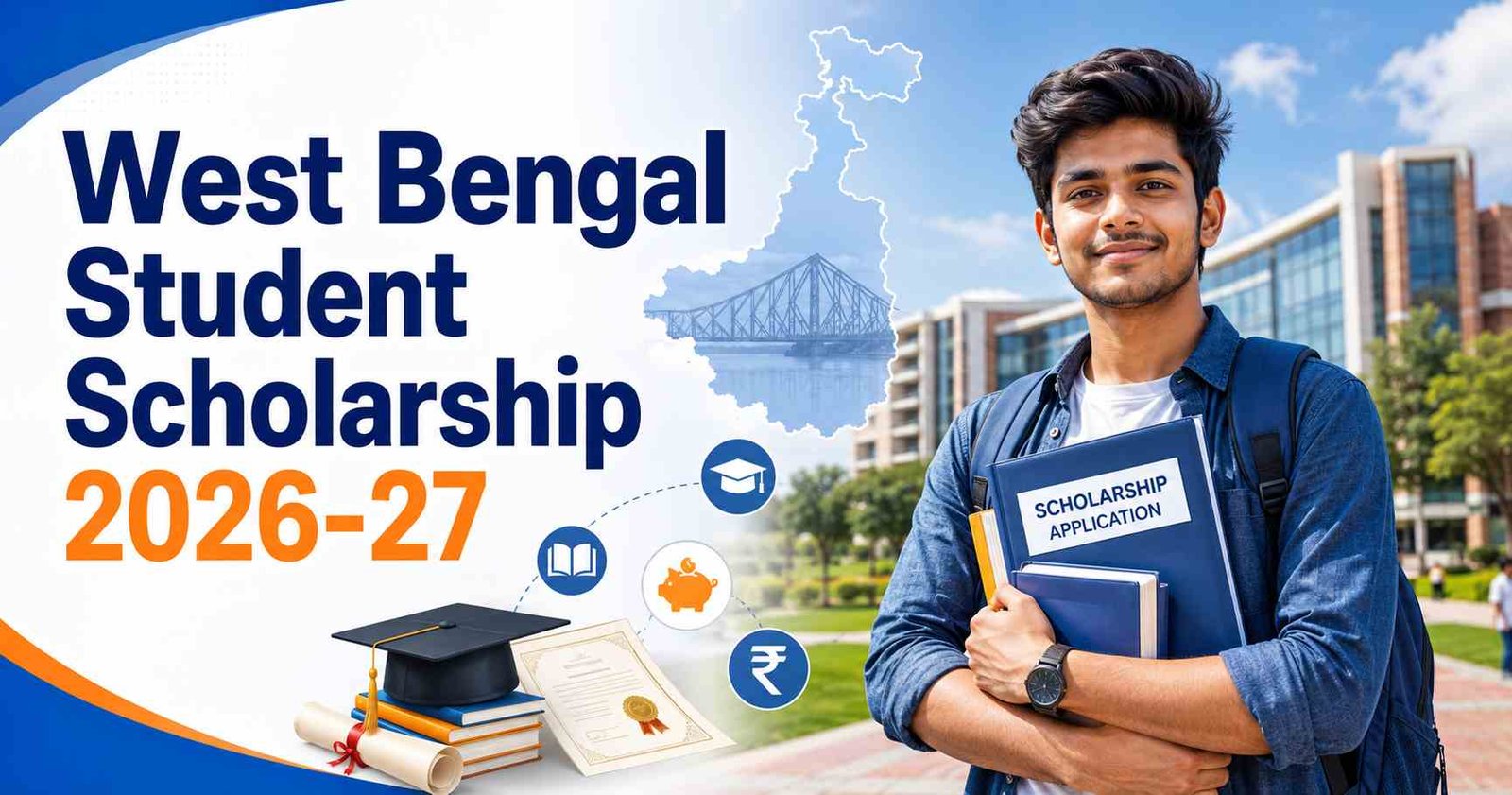
West Bengal students can apply for several state, central government, and private scholarships in 2026-27. The main options include the Swami Vivekananda Merit-cum-Means Scholarship, OASIS, Aikyashree, Kanyashree, Chief Minister’s Relief Fund Educational Assistance, National Scholarship Portal schemes, JBNSTS, and the GP Birla Scholarship.
Each scholarship uses different marks, family income, social category, gender, course, and domicile requirements. Students should therefore select a scholarship according to their individual profile instead of applying to every available scheme.
Current update: OASIS and the National Scholarship Portal are open for the 2026-27 academic year. The GP Birla Scholarship deadline is July 31, 2026. The SVMCM portal is currently processing fresh and renewal applications for the 2025-26 session. JBNSTS has published its 2026 eligibility instructions, but its application process has not started as of July 30, 2026.
West Bengal Student Scholarships at a Glance
Scholarship
Best suited for
Main eligibility
Approximate benefit
Current application status
Swami Vivekananda Merit-cum-Means Scholarship
Meritorious school, diploma, UG, PG, professional, and research students
West Bengal domicile, qualifying marks, and generally annual family income up to INR 250,000
Approximately USD 125 to USD 1,003 per year, depending on course
Fresh and renewal applications are active for 2025-26
OASIS Scholarship
SC, ST, and OBC students
West Bengal residence, valid category documents, course and income conditions
Scheme, course, fee, and residential-status based
Open for 2026-27
Aikyashree
Muslim, Christian, Sikh, Buddhist, Jain, and Parsi students
West Bengal domicile, minority status, marks, income, and course requirements
Up to approximately USD 627 per year
Applications normally run from August to October; confirm the 2026-27 notice
Kanyashree K1 and K2
Unmarried girl students
West Bengal residence, age, education, and marital-status conditions
Approximately USD 10 yearly or USD 261 one time
Applications are generally processed through institutions
Kanyashree K3
Female postgraduate students
West Bengal education history, UG marks, and PG admission
Approximately USD 251 to USD 314 per year
Processed through SVMCM
CMRF Educational Assistance
Low-income students with marks below the SVMCM threshold
50 to below 60 percent for HS or UG assistance; 50 to below 53 percent for PG assistance
No fixed amount is published on the official portal
Registration is available throughout the year, subject to its 365-day rule
National Scholarship Portal
Students eligible for central government schemes
Scheme-specific marks, income, category, disability, course, or merit criteria
Varies by scheme
Open for 2026-27
JBNSTS Junior and Senior Scholarships
High-performing science students
Examination year, science subjects, institution location, test, and interview conditions
Senior award is approximately USD 554 yearly, excluding research support
2026 instructions published; applications not started
GP Birla Scholarship
Meritorious Class 12 graduates with financial need
West Bengal or Jharkhand residence, Class 12 marks, admission, and income requirements
Approximately USD 627
Deadline: July 31, 2026
The USD values use an indicative conversion of 1 USD to INR 95.68 on July 30, 2026. Actual USD equivalents will change with the foreign-exchange rate.
Which West Bengal Scholarship Should You Apply For?
The correct scholarship depends on the applicant’s marks, category, income, gender, study level, and course.
Apply for SVMCM if you have strong academic marks
The Swami Vivekananda Merit-cum-Means Scholarship is the primary option for meritorious students pursuing Higher Secondary, diploma, undergraduate, postgraduate, engineering, medical, and other recognized courses.
Most taught-course applicants need at least 60 percent marks at the Higher Secondary or undergraduate entry level. Postgraduate applicants generally need 53 percent in the honours subject. Engineering postgraduate applicants may need 55 percent in graduation. The annual family-income ceiling is generally INR 250,000.
Different rules apply to board toppers, Kanyashree K3 applicants, and eligible MPhil or PhD researchers.
Apply through OASIS if you belong to SC, ST, or OBC
OASIS is the dedicated West Bengal scholarship portal for eligible SC, ST, and OBC students.
The portal covers pre-matric and post-matric schemes. The exact award depends on the scholarship component, course group, compulsory fees, category, and whether the student is a hosteller or day scholar.
The official OASIS scholarship portal confirms that applications for seven pre-matric and post-matric schemes are open for the 2026-27 session. ST students must generate a National Scholarship Portal One-Time Registration number before submitting an OASIS application.
Apply for Aikyashree if you belong to a minority community
Aikyashree provides scholarships to eligible students from notified minority communities in West Bengal. These communities include Muslims, Christians, Sikhs, Buddhists, Jains, and Parsis.
The program includes several financial-aid categories:
Aikyashree scheme
Academic level
Main academic condition
Income ceiling
Maximum benefit
Pre-Matric Scholarship
Class I to X
50 percent in the previous examination, except Class I
INR 200,000
Approximately USD 115
Post-Matric Scholarship
Class XI to PhD
50 percent in the previous examination
INR 200,000
Approximately USD 172
Merit-cum-Means Scholarship
Professional and technical UG or PG courses
50 percent in Higher Secondary or graduation
INR 250,000
Approximately USD 345
Talent Support Program
Class XI to PhD
Less than 50 percent in the previous examination
INR 200,000
Approximately USD 51
Minority SVMCM
Class XI to postgraduate level and specified courses
Normally 60 percent, 53 percent, or 55 percent depending on level
INR 250,000
Approximately USD 627
The official guidelines state that Aikyashree applications are usually accepted from August to October. Applicants should not treat the historical application window as a confirmed 2026-27 deadline until WBMDFC publishes the live notice.
Apply for Kanyashree if you are an eligible girl student
Kanyashree Prakalpa uses conditional cash transfers to support girls’ education and delay marriage until adulthood.
The two principal benefits are:
Kanyashree K1: An annual benefit of approximately USD 10, officially INR 1,000.
Kanyashree K2: A one-time benefit of approximately USD 261, officially INR 25,000.
K1 generally supports unmarried girls aged 13 to 18 who study in Class VIII or above in a recognized institution. K2 generally supports eligible unmarried girls after reaching 18 while continuing an educational, vocational, technical, or other qualifying pursuit.
Applications are usually initiated and verified by the school, college, or institution. Students can use the official Kanyashree portal to review the scheme and access tracking services.
Apply for CMRF Educational Assistance if your marks fall below SVMCM thresholds
The Chief Minister’s Relief Fund Educational Assistance is commonly called the Nabanna Scholarship. The official program name is Financial Assistance for Education from the Chief Minister’s Relief Fund and Chief Minister’s Discretionary Fund.
The program targets West Bengal students who meet the following marks bands:
50 percent or above but below 60 percent in Madhyamik for Higher Secondary assistance.
50 percent or above but below 60 percent in Higher Secondary for undergraduate assistance.
50 percent or above but below 53 percent in graduation for postgraduate assistance.
The annual family income must not exceed INR 120,000. The applicant must not receive another government or non-government scholarship for the same course or stage of study.
The official portal does not publish a fixed award amount. Websites claiming that every successful applicant receives one standard amount should not be treated as authoritative.
Apply for JBNSTS if you are a high-performing science student
Jagadis Bose National Science Talent Search offers examination-based scholarships for science students.
The Junior Talent Search Test is intended for eligible Class XI science students. The published 2026 instructions currently refer to students who passed Class 10 in 2025 with at least 75 percent and are studying science in a West Bengal school. However, the same page says that the 2026 application process has not started. Applicants should recheck the final notification because the referenced qualifying year may be revised when the form opens.
The Senior Talent Search Test is for students who passed the 10+2 examination in 2026 and plan to pursue eligible basic science, BS-MS, medicine, or engineering courses in West Bengal. Diploma, BSc Pass, and BSc Nursing students are excluded under the current instructions.
Senior scholars receive approximately USD 42 per month and a yearly book grant of approximately USD 52. The combined standard annual benefit is approximately USD 554. Certain basic-science scholars may also receive separate annual research support of approximately USD 836.
The SVMCM amount depends on the course and administering directorate.
Course or level
Official monthly rate
Approximate annual value
Higher Secondary
INR 1,000
USD 125
D.El.Ed
INR 1,000
USD 125
UG Arts
INR 1,000
USD 125
UG Commerce
INR 1,000
USD 125
UG Science
INR 1,500
USD 188
Other UGC-approved professional UG courses
INR 1,500
USD 188
PG Arts
INR 2,000
USD 251
PG Commerce
INR 2,000
USD 251
PG Science
INR 2,500
USD 314
Other UGC-approved professional PG courses
INR 2,500
USD 314
Polytechnic diploma
INR 1,500
USD 188
Medical diploma
INR 1,500
USD 188
Engineering or AICTE-approved professional courses
INR 5,000
USD 627
Medical degree
INR 5,000
USD 627
Eligible non-NET MPhil
INR 5,000
USD 627
Eligible non-NET PhD
INR 8,000
USD 1,003
These figures are annualized from the monthly rates in the official SVMCM guidelines. Actual sanction and payment remain subject to eligibility, verification, allocation, and continuation rules.
West Bengal Scholarship Last Dates and Current Status
Scholarship deadlines are not uniform. Students must distinguish a confirmed deadline from a historical or expected application period.
Scholarship
Current date or status as of July 30, 2026
OASIS
Applications are open for the 2026-27 academic year
National Scholarship Portal
Portal open from June 1, 2026
GP Birla Scholarship
Extended deadline is July 31, 2026
SVMCM
Fresh and renewal applications active for the 2025-26 session
Aikyashree
Official guidance states that applications usually run from August to October; confirm the live 2026-27 notice
CMRF Educational Assistance
No fixed annual closing date displayed; an applicant can register once in 365 days
JBNSTS Junior and Senior
2026 application instructions available, but applications have not started
Kanyashree
Institution-led processing; students should ask their school or college for the applicable schedule
The National Scholarship Portal has also announced an October 31, 2026 student deadline for specific PM-USP renewal schemes. That date does not automatically apply to every NSP scheme.
General Eligibility Requirements
No single eligibility rule applies to every West Bengal student scholarship. However, most programs evaluate the following attributes.
West Bengal domicile or residence
State scholarships generally require the applicant to be a permanent resident or domicile of West Bengal.
Some programs also require the student to attend an institution located in West Bengal. Aikyashree pre-matric and post-matric scholarships normally exclude students studying outside the state. Merit-cum-Means has limited exceptions for listed institutions.
OASIS allows certain applications involving institutions outside West Bengal, but the institution or course details may require additional district-level processing.
Minimum academic marks
Common marks thresholds include:
Less than 50 percent for the Aikyashree Talent Support Program.
50 to below 60 percent for CMRF Higher Secondary and undergraduate assistance.
50 to below 53 percent for CMRF postgraduate assistance.
At least 50 percent for Aikyashree pre-matric, post-matric, and Merit-cum-Means schemes.
At least 60 percent for many SVMCM levels.
At least 53 percent for specified postgraduate SVMCM applicants.
At least 55 percent for specified postgraduate engineering applicants.
At least 75 percent for the published JBNSTS Junior criteria.
Students should calculate aggregate marks according to the scholarship’s own rules. Optional, additional, practical, or honours-subject marks may be treated differently by different schemes.
Family-income ceiling
The family-income limit can determine which scholarship fits the applicant.
Annual family income
Potential scholarship route
Up to INR 120,000
CMRF Educational Assistance, subject to marks and other rules
Up to INR 200,000
Aikyashree pre-matric, post-matric, and Talent Support Program
Up to INR 250,000
SVMCM and Aikyashree Merit-cum-Means or minority SVMCM
Up to INR 800,000
GP Birla Scholarship, subject to academic and admission criteria
Scheme-specific
OASIS and National Scholarship Portal schemes
An income certificate must come from an authority accepted by the relevant scholarship. A certificate accepted by one portal may not satisfy another portal’s format or issuing-authority rule.
Recognized course and institution
Scholarship authorities normally require admission to a recognized school, college, university, technical institute, professional program, or research institution.
Applicants should verify approval or affiliation through the relevant board, university, UGC, AICTE, Pharmacy Council of India, Council of Architecture, or state technical council where applicable.
Bank and DBT readiness
Most government scholarships transfer benefits through Direct Benefit Transfer.
The student should use an active bank account that can receive DBT payments. The name on the bank account should match the applicant’s identity and academic records.
OASIS instructs applicants to check the DBT-enabled status when Aadhaar is not visible in NPCI. The National Scholarship Portal also directs students to Aadhaar-seeding services through the Bharat Aadhaar Seeding Enabler.
Documents Required for West Bengal Scholarships
The exact document list varies by program. Most applicants should prepare the following documents before registration:
Aadhaar card or Aadhaar enrolment details
Passport-size photograph
Applicant signature
West Bengal domicile or residential proof
Previous qualifying-examination marksheet
Current admission receipt
Course or institution verification certificate
Annual family-income certificate
Caste certificate for SC, ST, or OBC schemes
Minority-related details where required
Student bank passbook
Bank account number and IFSC
Entrance-examination rank card for professional courses
Admission or allotment letter
Active mobile number
Active email address
CMRF Educational Assistance additionally requires a signed prayer addressed to the Chief Minister, a recommendation from the local MLA or MP, a student self-declaration countersigned by the institution head, and supporting academic and admission documents. Each uploaded CMRF PDF must remain below the portal’s stated size limit.
Avoid submitting Aadhaar, bank, password, or OTP information on unofficial websites.
Step 3: Complete registration or OTR
Create a fresh account when applying for the first time.
Use the renewal option when the student already has a valid previous-year applicant ID. Creating a second fresh registration can produce duplicate records or delay verification.
NSP applicants need One-Time Registration. ST applicants using OASIS must generate NSP OTR before completing the state-portal application.
The applicant’s name, date of birth, parent or guardian name, Aadhaar details, marksheet data, and bank-account information should be consistent.
Small differences in spelling, initials, account-holder names, or dates can delay institute verification and DBT validation.
Step 5: Upload clear documents
Upload complete and readable files in the required format.
Do not upload cropped marksheets, blurred income certificates, expired category documents, or bank images that hide the account number, IFSC, or account-holder name.
Step 6: Submit the application for verification
Most scholarships require verification by the school, college, university, institution head, district authority, or nodal officer.
Online submission alone does not always complete the application. Aikyashree guidelines, for example, require applicants to print and submit the signed form and bank-passbook copy to the institution for specified schemes.
Step 7: Save the application ID
Save the:
Applicant ID
Registered mobile number
Password
OTR number
Submitted form
Acknowledgement receipt
Institution-submission proof
These details are required for status checking, corrections, grievances, and renewal.
How to Check West Bengal Scholarship Status
Scholarship status can be checked through the portal used for the original application.
Common status labels include:
Status
Meaning
Draft
The form has not been finally submitted
Submitted
The applicant has completed online submission
Pending at institution
The school or college has not completed verification
Forwarded
The institution has sent the application to the next authority
Verified
The responsible authority has accepted the submitted details
Defected or returned
The application needs correction or another document
Sanctioned
The scholarship authority has approved financial assistance
Payment processed
The payment file has entered the DBT process
Rejected
The application did not meet a condition or failed verification
A “sanctioned” status does not always mean that money has already reached the bank. DBT processing, bank validation, NPCI mapping, and funding release can create an additional waiting period.
How to Renew a West Bengal Scholarship
A renewal applicant is a student who received or validly registered for the scholarship in the previous academic stage and is continuing the same eligible course progression.
Renewal commonly requires:
Promotion to the next academic year or semester
Minimum renewal marks
Continued enrollment
Updated admission receipt
Current marksheet
Active bank account
Previous application ID
Institution verification
SVMCM does not permit students receiving the scholarship to simultaneously enjoy another central or state government scholarship for the same course or stage. However, one-time assistance and free or partly free institutional studentship may not automatically disqualify an applicant.
Aikyashree applicants who received the benefit in the previous year and have an application ID must select the renewal category rather than registering as fresh applicants.
Can You Receive Two Scholarships at the Same Time?
There is no universal yes or no answer.
SVMCM generally prohibits another central or state government scholarship or stipend for the same course or stage. Aikyashree guidelines state that a student is eligible for scholarship support from one source only. CMRF assistance also excludes applicants receiving another government or non-government scholarship for the same course or study stage.
The National Scholarship Portal allows students in 2026-27 to apply for one merit-based scheme and one or more welfare-based schemes, subject to each scheme’s eligibility rules. This portal-level facility does not override restrictions written into an individual scholarship’s guidelines.
Students should disclose all existing scholarships during application and request written clarification when the combination rule is unclear.
Common Scholarship Rejection Reasons
Marks do not meet the required range
A student with 58 percent may be ineligible for a 60-percent SVMCM category but potentially eligible for CMRF assistance, depending on education level, income, and other conditions.
Family income exceeds the ceiling
The authority can reject an application when the submitted income exceeds the scheme limit or when the certificate comes from an unauthorized issuer.
Fresh and renewal categories are confused
A previous beneficiary who registers as a fresh applicant may create duplicate records.
Domicile or institution location is invalid
Some West Bengal schemes require both state domicile and study within West Bengal.
Bank information does not match
An incorrect account number, IFSC, account-holder name, inactive account, or incomplete Aadhaar-NPCI mapping can delay payment.
Institution verification is incomplete
An application may remain pending when the institution has not checked admission, course, marks, documents, or student identity.
The student receives duplicate financial aid
Some schemes prohibit another scholarship for the same course or study stage.
Documents contain inconsistent information
Different names, dates of birth, marks, income amounts, course names, or admission years can trigger a defect or rejection.
Frequently Asked Questions
1. Which scholarship is best for students in West Bengal?
The best scholarship depends on the student’s profile. SVMCM suits high-merit students. OASIS supports eligible SC, ST, and OBC students. Aikyashree supports minority students. Kanyashree supports eligible girls. CMRF assistance may suit low-income students whose marks fall below standard SVMCM thresholds.
2. Can general-category students apply for a West Bengal scholarship?
Yes. General-category students may apply for programs such as SVMCM, CMRF Educational Assistance, JBNSTS, GP Birla, and eligible National Scholarship Portal schemes. They cannot apply for scholarships restricted to SC, ST, OBC, or notified minority communities unless they belong to the specified category.
3. Which West Bengal scholarships are open for 2026-27?
OASIS and the National Scholarship Portal are open for 2026-27 as of July 30, 2026. GP Birla applications remain open until July 31, 2026. Other programs use different sessions or have not yet published a confirmed 2026-27 application notice.
4. How much scholarship money can a West Bengal student receive?
The amount varies significantly. Kanyashree K1 is approximately USD 10 yearly. GP Birla offers approximately USD 627. SVMCM ranges from approximately USD 125 to USD 1,003 annually. JBNSTS Senior provides approximately USD 554 annually, with possible additional research support for qualifying scholars.
5. Can CBSE or ISC students apply for SVMCM?
Eligibility depends on the SVMCM category and study level. The current general SVMCM guideline excludes non-WBBSE candidates at the Higher Secondary entry level. Minority SVMCM guidance includes certain CBSE and ISC applicants from institutions situated in West Bengal. Students must check the exact directorate and category.
6. Can a gap-year student apply for SVMCM?
A gap does not always cause automatic rejection. Current SVMCM guidelines mention specified recent passing years and allow consideration where admission was delayed for unavoidable reasons. The applicant may need supporting documents. Students should verify the current advertisement and contact the SVMCM helpdesk before submitting.
7. Which scholarship is available below 60 percent marks?
Students with 50 to below 60 percent may qualify for CMRF assistance for Higher Secondary or undergraduate study. Minority students with at least 50 percent may qualify for Aikyashree pre-matric, post-matric, or Merit-cum-Means. Minority students below 50 percent may consider the Talent Support Program.
8. Can a student apply for both SVMCM and OASIS?
A student may be technically eligible for both, but SVMCM generally prohibits another central or state government scholarship for the same course or stage. The applicant should not accept conflicting benefits without written clarification from both authorities. Undisclosed duplicate aid can lead to cancellation or recovery.
9. Can a minority student apply for SVMCM?
Yes. Eligible minority students generally apply for the minority SVMCM category through the WBMDFC Aikyashree portal rather than the main SVMCM registration route. Marks, income, domicile, course, institution location, fresh or renewal status, and document requirements still apply.
10. Is NSP OTR required for OASIS?
NSP OTR is specifically mandatory for ST students applying for OASIS pre-matric or post-matric scholarships under the current official announcement. Other OASIS applicants should follow the registration instructions displayed for their scheme and academic session on the official portal.
11. Why is my scholarship application pending at the institution?
The institution may still be verifying enrollment, course details, marks, income documents, category records, attendance, bank information, or applicant identity. Contact the scholarship nodal officer or head of institution with the application ID. Do not submit a duplicate application unless the portal instructs you to do so.
12. How can I check whether the scholarship money was credited?
Check the scholarship portal for sanction and payment status. Then check the applicant’s bank statement or passbook. Confirm that the account is active and DBT-enabled. When Aadhaar mapping is incomplete, contact the bank and verify the account’s NPCI and DBT status.
13. What happens if Aadhaar and bank details do not match?
A mismatch can delay identity validation or DBT payment. Correct the name or demographic data through the appropriate Aadhaar, bank, or academic-record process. Ask the bank to verify Aadhaar seeding and NPCI mapping. Do not replace the account during processing unless the scholarship portal permits an update.
14. Can a student change courses after receiving a scholarship?
A course change may affect eligibility, scholarship rate, directorate, fresh or renewal status, and continuation. The student should obtain guidance from the scholarship authority before submitting another form. Registering as fresh without approval can create duplicate or inconsistent records and may delay verification.
15. Can students studying outside West Bengal apply?
The answer depends on the scheme. Aikyashree pre-matric and post-matric programs generally exclude institutions outside West Bengal. OASIS may process eligible outside-state institutions with additional course verification. SVMCM and JBNSTS use course-specific location rules. Check the official guidelines before applying.
Final Application Checklist
Before submitting a West Bengal student scholarship application:
Confirm the scholarship matches your marks and category.
Confirm the official academic session.
Check the verified opening and closing dates.
Prepare valid income, domicile, category, admission, and bank documents.
Complete OTR where required.
Use matching personal and bank information.
Save the application ID and acknowledgement.
Confirm institution verification.
Monitor correction and grievance notices.
Do not accept conflicting scholarships without written confirmation.
Conclusion
The West Bengal student scholarship system includes merit-based, income-based, social-category, minority, gender-focused, science, central government, and private opportunities.
Students with strong marks should check SVMCM. SC, ST, and OBC students should prioritize OASIS. Minority students should compare all Aikyashree categories. Eligible girls should check Kanyashree. Students in the middle marks band should assess CMRF Educational Assistance. Science students should monitor JBNSTS. Recent Class 12 graduates should review GP Birla and eligible National Scholarship Portal schemes.





 Scholarships2 months ago
 By Country3 months ago
 By Country3 months ago
 Scholarships2 months ago
 Scholarships3 months ago