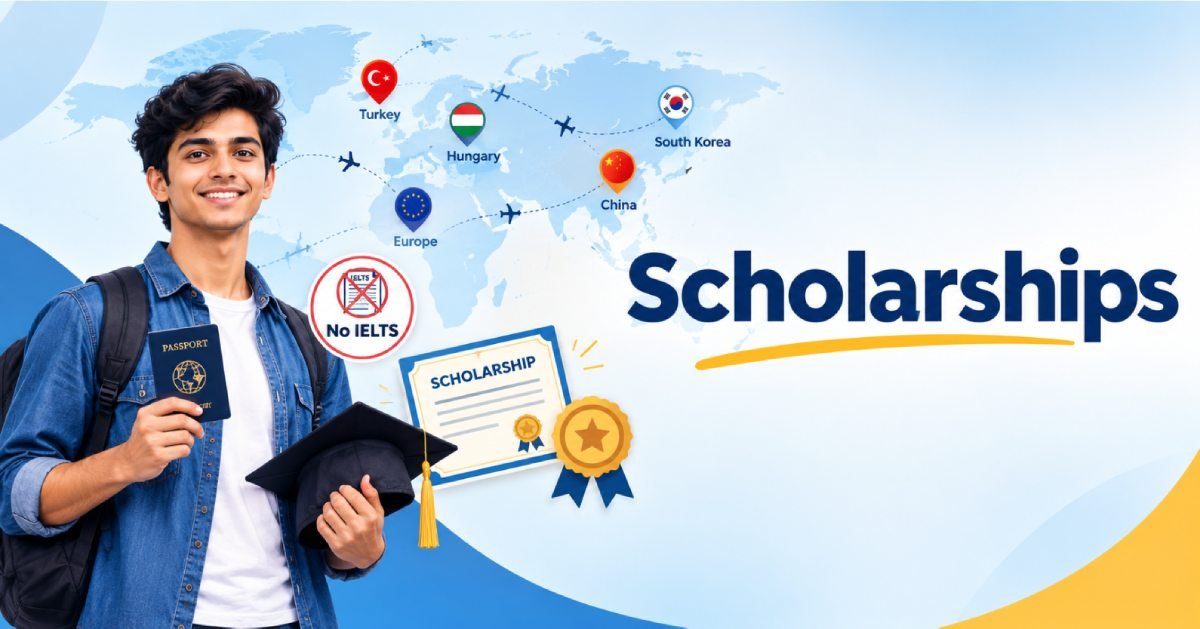
Yes, Indian students can win funded scholarships without taking IELTS. Most of these awards still ask for English proof. That proof can be a medium-of-instruction (MOI) certificate, a university-specific check, or an optional certificate that earns extra selection points. This guide separates those four cases so you do not apply under a wrong assumption.
Scholarships without IELTS for Indian students are study-abroad awards that do not make an IELTS score a compulsory part of the application. Governments, the European Union, and individual universities offer them. They fund tuition, living costs, or both. This article covers the 2027 intake. If you want awards inside India, read our guide to scholarships for Indian students in India.
Quick Comparison: Scholarships Without IELTS for Indian Students (2027)
Scholarship
Country
Level
English proof for Indian applicants
2027 window
Türkiye Burslari
Türkiye
Bachelor’s, Master’s, PhD
IELTS not listed as universal; proof only where applicable
Expected 10 January – 20 February 2027
Global Korea Scholarship (GKS)
South Korea
Bachelor’s, Master’s, PhD
Optional but scored in graduate selection
Embassy track from September 2026 and university track from October 2026 (reported)
Stipendium Hungaricum
Hungary
Bachelor’s, Master’s, PhD
B2 level needed; MOI may replace a test at some universities
Expected opening November 2026; deadline expected mid-January 2027
Chinese Government Scholarship (CSC)
China
Bachelor’s, Master’s, PhD
Set by each host university
Usually December 2026 – March 2027, by university
Erasmus Mundus Joint Masters
Europe
Master’s
Waiver only in some programmes
October 2026 – February 2027, by programme
MEXT
Japan
Bachelor’s, Master’s
Embassy-track exam reported; verify
Varies by track
What “Without IELTS” Actually Means
What does “without IELTS” mean in a scholarship context? It means the scholarship does not force you to submit an IELTS score. It does not always mean you can skip English proof. The host university, the funder, or the visa office may still ask you to prove your English.
The four categories of “no IELTS”
Category
Meaning
Where you see it
1. Not requested at application
The application does not demand a language certificate
Türkiye Burslari (language proof only where applicable)
2. Waived with an MOI certificate
Your university confirms English was the language of instruction
Some CSC host universities, some Erasmus Mundus programmes, some Hungarian universities
3. Optional but scored
You can apply without a score, but a certificate adds points
GKS graduate selection
4. Required
A test certificate is compulsory for Indian applicants
DAAD-type awards (see the myth-check below)
This article lists categories 1 to 3 as real routes. It flags category 4 so you can avoid wasted applications.
Scholarship stage versus visa stage
Does a scholarship offer remove the visa language rule? No. A scholarship decides your funding and admission. The embassy decides your visa. Admission to a university without IELTS does not guarantee a visa, and each country sets its own rules. Check the immigration rules of your destination separately.
Why Indian students look for this route
Cost drives most searches. Reports said the IELTS fee in India would rise to INR 19,000 from 1 April 2026. That is more than USD 200. Preparation courses and retakes add to the bill. A scholarship that accepts an MOI certificate or treats the test as optional saves real money.
Scholarships Without IELTS for Indian Students: The 2027 Shortlist
Türkiye Burslari (Türkiye Scholarships)
What is Türkiye Burslari? Türkiye Burslari is the Turkish government’s scholarship programme for international students. The Presidency for Turks Abroad and Related Communities (YTB) runs it. Applications go through the official Türkiye Scholarships portal, and they are free.
Levels: Bachelor’s, Master’s, PhD.
Covers: Tuition, accommodation, a monthly stipend, health insurance, airfare, and a Turkish language course.
English proof: The official guidance asks for language proof only where applicable. Scholars placed in Turkish-medium programmes start with a one-year language course. Scholars in English-medium programmes begin their degree directly.
Age limits (reported, verify): Under 21 for Bachelor’s, under 30 for Master’s, under 35 for PhD.
Application limit (reported): One application per cycle.
Dates: The 2026 window ran from 10 January to 20 February 2026. The 2027 window is Expected to follow the same pattern.
Verdict: The strongest category 1 option. The main hurdle is competition, not language.
Global Korea Scholarship (GKS)
What is GKS? The Global Korea Scholarship is the South Korean government scholarship run by the National Institute for International Education (NIIED). It funds undergraduate and graduate degrees.
Covers: Tuition, a monthly stipend, airfare, and a Korean language training year (the language year can be exempted with proof).
English proof: Graduate selection awards extra points for English certificates and for TOPIK (Korean) results. You can apply without one, but a certificate improves your score.
Two tracks: The embassy track runs through the Korean embassy in your country. The university track runs through a GKS-designated Korean university. Each track has its own deadline.
Reapplication: Previous GKS scholars cannot reapply to the graduate programme.
Verdict: A category 3 route. Applying without a certificate is possible, but you may score lower against applicants who submit one.
Stipendium Hungaricum (Hungary)
What is Stipendium Hungaricum? Stipendium Hungaricum is the Hungarian government scholarship managed by the Tempus Public Foundation. It covers Bachelor’s, Master’s, and PhD study at Hungarian universities.
Covers: Full tuition, a monthly stipend, accommodation support, and health insurance.
English proof: Tempus requires B2 level (CEFR) from non-native English speakers. A B2 requirement does not always mean IELTS. Some programmes accept an MOI certificate if your previous degree was English-medium.
India route: Indian applicants are reported to need a national nomination through India’s designated sending partner (UGC) in addition to the online Tempus application. Confirm this in the current call for applications.
Dates: The 2026/27 round closed on 15 January 2026. The 2027–28 round is Expected to open in November 2026, with a deadline around mid-January 2027.
Verdict: A category 2 route. Check each university’s own English rule before you list it.
Chinese Government Scholarship (CSC)
What is the Chinese Government Scholarship? The Chinese Government Scholarship is a funded award from China’s Ministry of Education, administered by the China Scholarship Council. Applicants use the Chinese Government Scholarship Information System and, for university-route applications, each university’s own portal.
Covers: Tuition, accommodation, a living stipend, and medical insurance at most host universities.
English proof: The rule changes by university. Some host universities accept an MOI certificate for English-taught programmes. Others publish IELTS or TOEFL minimums, such as IELTS 6.0. One university notice states that an English-medium degree is not a blanket exemption.
Fees: Some universities charge a separate application fee. Confirm it before you pay.
Dates: Many universities close university-route nominations between February and 31 March. Some open as early as December.
Verdict: A conditional route. Shortlist only universities that publish MOI acceptance in writing.
Erasmus Mundus Joint Masters (EMJM)
What is Erasmus Mundus? Erasmus Mundus Joint Masters is an EU-funded master’s programme taught across two or more European universities. There is no central portal. You apply to each programme separately through the EMJM catalogue.
Covers: A tuition waiver, insurance, and a stipend of EUR 1,400 per month for 24 months in the standard case (programme details differ).
English proof: Most programmes ask for IELTS, TOEFL, or an equivalent. Some waive the requirement if your bachelor’s degree was taught in English. Each consortium decides.
Dates: Most 2027 deadlines fall between October 2026 and February 2027. Reported examples include 1 December 2026, 7 January 2027, and 1 February 2027. Some of these are close, so check them now.
Other rule: Read each programme’s residency rule before applying.
Verdict: A category 2 route. It rewards applicants who check every programme page individually.
Other options to verify
MEXT (Japan): One guide reports that embassy-track applicants take a local English or Japanese exam instead of submitting a test score. Confirm this with the Embassy of Japan in India.
Yenching Academy (China): One source says applicants with an English-taught degree can apply without IELTS. Confirm this on the programme page.
KAIST (South Korea): KAIST lets applicants request an English-test waiver under stated conditions. Read the current conditions before you apply.
Scholarships Often Listed as “No IELTS” That Need English Proof
Many lists tag awards as “no IELTS” without checking the rules. Use this table before you commit time.
Scholarship
Common claim
What the sources show
What to do
DAAD (Germany)
“IELTS often waived”
A DAAD-linked document from 2021 said applicants from India, Nepal, Bangladesh, and Pakistan must provide a test certificate in all cases. A German university also states that an MOI certificate is not enough for admission.
Treat DAAD as test-required until the current call says otherwise
Stipendium Hungaricum
“IELTS not required”
Tempus requires B2 English
Read this as “no specific test”, not “no English proof”
CSC
“No IELTS for any programme”
Rules differ by university
Check the host university’s notice
Erasmus Mundus
“Waived for everyone”
Only some programmes waive it
Read each programme page
GKS
“IELTS not required”
Graduate selection awards points for English certificates
Apply without one only if the rest of your profile is strong
Who Should Apply and Who Should Not
Who is the right applicant? The best-fit applicant has a strong academic record, an English-medium degree with an obtainable MOI certificate, and flexibility on country and course. The applicant can also wait seven to nine months for results.
Who should apply
Students with a high GPA or class rank in their degree.
Students whose bachelor’s or school education was in English and who can obtain an MOI certificate.
Students who accept a language preparation year, such as Turkish in Türkiye or Korean in South Korea.
Students who are flexible about country, since the best-funded awards sit in Türkiye, Hungary, China, South Korea, and Europe.
Students who can start preparing documents now for early 2027 deadlines.
Who should not apply
Students who need to start studying in January or February 2027. Most selection cycles run through mid-2027.
Students who want to avoid all English proof. Almost every award asks for some form of it.
Students whose degree was not taught in English and who cannot get an MOI certificate.
Students who exceed the age limit of the award.
Students who plan to pay an agent for “guaranteed selection”. Official portals are free, and no agent can guarantee a government award.
IELTS Alternatives That Scholarship Bodies Accept
What can replace IELTS? Five proofs commonly replace it, depending on the host.
MOI certificate
An MOI certificate is a letter from your university stating that English was the language of instruction for your degree. Indian students usually request it from the university’s examination office or registrar. A strong certificate names you, your degree, your years of study, and the language of instruction, and it carries a signature and an official seal. Ask for it early, and confirm that the host university accepts it before you pay any fee.
Other accepted evidence
Secondary or bachelor’s English-medium records: Some hosts accept school or degree transcripts that show English as the medium.
Other tests: TOEFL, PTE Academic, or university-approved tests. The Duolingo English Test is not accepted everywhere.
Interviews and embassy exams: Some tracks assess English during an interview or a local written exam.
Preparatory language years: Türkiye, South Korea, and China fund a language year for programmes taught in the local language, which removes the need for English proof at entry.
Step-by-Step Application Guide
How do you apply for a scholarship without IELTS? Follow eight steps in order. Each step protects you from a common rejection reason.
Choose your level and country. Decide between Bachelor’s, Master’s, or PhD, then pick two or three countries from the shortlist above.
Read the official call. Use the funder’s own portal. The Ministry of Education, Government of India also publishes public notices on foreign government scholarships through its External Scholarship Division.
Check the English rule for each host. Write down whether each university wants a test, accepts an MOI certificate, or scores optional certificates.
Request your MOI certificate. Apply to your university’s examination office or registrar with your enrolment details.
Prepare the document set. Scan every document clearly and keep certified or attested copies where the portal asks for them.
Submit through the official portal only. Submit one complete application before the deadline. Do not wait for the final day.
Track nomination, shortlist, and interview messages. Check your email and portal account every week during the selection months.
Plan the visa separately. Read the destination country’s student visa rules and confirm whether they ask for a language test.
Required Documents Explained
Which documents do scholarship committees ask for? Most ask for identity, academic, and motivation documents. Each document answers a different committee question.
Document
What it proves
India-specific note
Passport
Identity and nationality
Check validity against the scholarship start date
Academic transcripts and degree certificate
Academic level and GPA
Some portals want certified or attested copies
MOI certificate
English was your language of instruction
Request it from the university registrar or examination office
Motivation letter
Why you fit the course and country
Write a fresh letter for each scholarship
Recommendation letters
Academic credibility
Ask professors early; give them your CV and target course
CV or resume
Experience and achievements
Keep it to one or two pages, in a clean format
Medical certificate
Fitness to study
Use the format the scholarship supplies (for example, Hungary)
Research proposal
Research direction
Required mainly for PhD applications
Passport-size photograph
Identification
Follow the portal’s size and background rules
Nomination form
National endorsement
Hungary reportedly requires a UGC nomination for Indian applicants
If an Indian document must be recognised abroad, a portal may ask for attestation or an apostille. Read the call for applications and do not assume.
Selection Process Explained
How do committees select winners? They screen documents first, shortlist by merit, and then interview or rank the shortlist. The details differ by scholarship.
Scholarship
Typical stages
Notes
Türkiye Burslari
Online application, document screening, shortlist, interview (online or at Turkish missions), results, placement
Reported timeline: shortlist in April–June, interviews in June–July, results from July to August. Treat it as Expected for 2027.
GKS
First screening, second screening, final selection through the embassy or university track
Language certificates earn extra points in graduate selection
Stipendium Hungaricum
National nomination for Indian applicants, online Tempus application, university assessment
Some universities run entrance exams or interviews
CSC
University review, interview for some applicants, then final CSC decision
The university recommends you; the CSC makes the final decision
Erasmus Mundus
Consortium ranking, possible online interview, reserve list
Ranking criteria differ by programme
Previous Years’ Trends
Is competition rising? Yes, at least for the largest programme. Türkiye Burslari application numbers climbed sharply by 2026, while the number of awards stayed near 5,000 a year.
Year
Türkiye Scholarships applications
Application window
Source type
2022
More than 165,000
Not stated
News report quoting a Turkish minister
2024
121,830
Not stated
Programme summary
2025
125,668 from 171 countries
10 January – 20 February 2025
YTB announcement
2026
Nearly 200,000
10 January – 20 February 2026
YTB announcement
What the trends tell Indian applicants
Selectivity is tightening. Around 5,000 awards against 125,668 applications in 2025 gives a rough success rate of 4 percent. If awards stay near 5,000 and applications reach nearly 200,000, the rate falls to about 2.5 percent. These are our estimates, not official figures.
Windows are stable. The Türkiye window ran 10 January to 20 February in 2025 and 2026. Stipendium Hungaricum closed on 15 January in the 2026/27 round. Erasmus Mundus programmes cluster between October and February. CSC university deadlines cluster between December and March. GKS tracks open in September and October.
Early preparation wins time. Because windows repeat each year, you can prepare your MOI certificate, transcripts, and motivation letter before the portals open.
Common Mistakes Applicants Make
Reading “no IELTS” as “no English proof”. Most awards still want some evidence of English.
Trusting unconfirmed 2027 dates. Many third-party pages publish expected dates as if they were official. Verify on the funder’s portal.
Paying agents for free portals. Türkiye Burslari applications are free and run only through the official system.
Sending one generic motivation letter. Committees compare letters across applicants. Write a specific one for each programme.
Ignoring the Indian nomination step. Missing a national nomination deadline can end a Hungary application before it starts.
Applying to CSC without checking the host university. One university may accept an MOI certificate while another asks for IELTS 6.0.
Submitting an MOI certificate without a signature and seal. An unofficial letter can be rejected.
Forgetting the visa stage. A scholarship offer does not remove the visa language rule.
Applying on the last day. Portals slow down near deadlines, and fixing a missing document takes time.
Application Calendar: October 2026 to September 2027
Period
What to do
October–November 2026
Request your MOI certificate; shortlist Erasmus Mundus programmes; check GKS embassy and university tracks
November–December 2026
Watch for the Stipendium Hungaricum call; draft motivation letters; collect recommendation letters
December 2026 – February 2027
Submit Erasmus Mundus and CSC applications; Hungary deadline expected mid-January
10 January – 20 February 2027 (Expected)
Türkiye Burslari window
March–June 2027
Respond to interviews and nominations; finish CSC university deadlines
June–August 2027
Receive results; begin visa applications
September 2027
Arrive for the 2027 intake
Our Research Notes
These notes show how this guide was checked and where sources disagree.
Date of research: 28 October 2026.
Official sources used: Türkiye Scholarships and YTB announcements, the Tempus-linked Hungarian programme pages, Korean mission notices, and a German university FAQ.
Conflict 1: One third-party guide claims more than 250,000 Türkiye applicants in 2025. YTB reported 125,668 for 2025, so this guide uses the official figure.
Conflict 2: One source says the 2025 Türkiye deadline was extended to 23 February. The official announcements reviewed list 20 February, so this guide uses 20 February.
Conflict 3: Several lists say Hungary needs no IELTS. The Tempus requirement is B2 English, with the proof method set by the university.
Conflict 4: Several lists say DAAD waives IELTS. A DAAD-linked document and a German university FAQ point the other way, so DAAD sits outside the shortlist.
Not yet verified: Chevening, Fulbright-Nehru, and Commonwealth awards. We did not check their English rules for this update.
Expected dates: Every 2027 date marked Expected comes from previous cycles or third-party pages. Check each date on the official portal before you plan around it.
Frequently Asked Questions
Can Indian students get a scholarship without IELTS?
Yes. Several government-funded scholarships do not require an IELTS score from Indian applicants, including Türkiye Burslari at the application stage. Others replace IELTS with an MOI certificate or treat English certificates as optional points. Each scholarship and host university sets its own rule, so confirm it in the official call before applying.
Which fully funded scholarships do not require IELTS for Indians?
Türkiye Burslari, the Global Korea Scholarship, Stipendium Hungaricum, selected Chinese Government Scholarship universities, and some Erasmus Mundus programmes offer routes without IELTS. Conditions differ: some need B2-level English proof, some score optional certificates, and some accept an MOI certificate. None should be treated as a blanket no-English-proof option.
What is an MOI certificate and how do I get one in India?
An MOI certificate is a letter from your university stating that English was the language of instruction for your degree. Indian students usually request it from the university’s examination office or registrar. It should name the degree and years of study and carry a signature and seal. Not every host accepts it, so check first.
Is Türkiye Burslari available without IELTS for Indian students?
Türkiye Burslari does not list IELTS as a universal requirement. The official guidance asks for language proof only where applicable. Scholars placed in Turkish-medium programmes begin with a one-year language course. Applications are free and run only through the official portal, so confirm programme-specific English checks in the current announcement.
Does the Global Korea Scholarship require IELTS?
GKS graduate selection awards extra points for English certificates, so IELTS is not always mandatory but can improve your score. Requirements also depend on the host university and track. Read the current guidelines for the embassy or university track you choose before deciding to skip the test.
Do I need IELTS for Stipendium Hungaricum?
Stipendium Hungaricum requires B2-level English under Tempus Public Foundation rules, but that does not always mean IELTS. Some Hungarian universities accept an MOI certificate or their own assessment. Indian applicants also need a national nomination, so check both the university requirement and the Indian-side deadline.
Does the Chinese Government Scholarship accept an MOI certificate?
It depends on the host university. Some Chinese universities accept an MOI certificate for English-taught programmes, while others state IELTS or TOEFL minimums such as IELTS 6.0. Read the university’s own CSC notice before you pay any application fee or prepare documents.
Is IELTS required for Erasmus Mundus?
Most Erasmus Mundus programmes ask for English proof, but some waive it when your bachelor’s degree was taught in English. There is no central rule, so each consortium decides. Read the programme page and its waiver conditions before skipping the test.
Does DAAD waive IELTS for Indian students?
Do not assume so. A DAAD-linked document from 2021 required test certificates from Indian applicants in all cases, and some German universities reject an MOI certificate. DAAD rules change by programme and year, so verify the current call before relying on any waiver claim.
Can I get a student visa without IELTS if I win a scholarship?
A scholarship does not automatically cancel a visa language rule. Admission without IELTS does not guarantee a visa, and each country sets its own requirements. Check the destination country’s immigration rules separately from the scholarship rules, ideally before you accept an offer.
Are there PhD scholarships without IELTS?
Yes, some PhD routes do not require IELTS at application. Türkiye Burslari, Stipendium Hungaricum, CSC, and Global Korea Scholarship graduate programmes cover doctoral study. Host universities may still ask for English proof, a supervisor’s acceptance, or a research proposal, so confirm the doctoral conditions separately from master’s rules.
How can I tell a genuine no-IELTS scholarship from a scam?
Legitimate scholarships publish their rules on an official government or institutional site. Red flags include paid guaranteed selection, fees for free portals, and promises that no English proof is ever needed. Türkiye Burslari applications, for example, are free and made only through the official system.
Conclusion
Scholarships without IELTS for Indian students exist, and the strongest 2027 options are Türkiye Burslari, the Global Korea Scholarship, Stipendium Hungaricum, selected CSC universities, and some Erasmus Mundus programmes. Each one asks for English proof in a different way. Read the official call, secure your MOI certificate early, and treat every Expected date as provisional.




 Scholarships4 months ago

 Scholarships3 months ago
 By Country4 months ago
 Scholarships4 months ago
 By Country4 months ago

 Scholarships3 months ago
 Scholarships4 months ago

 Scholarships3 months ago