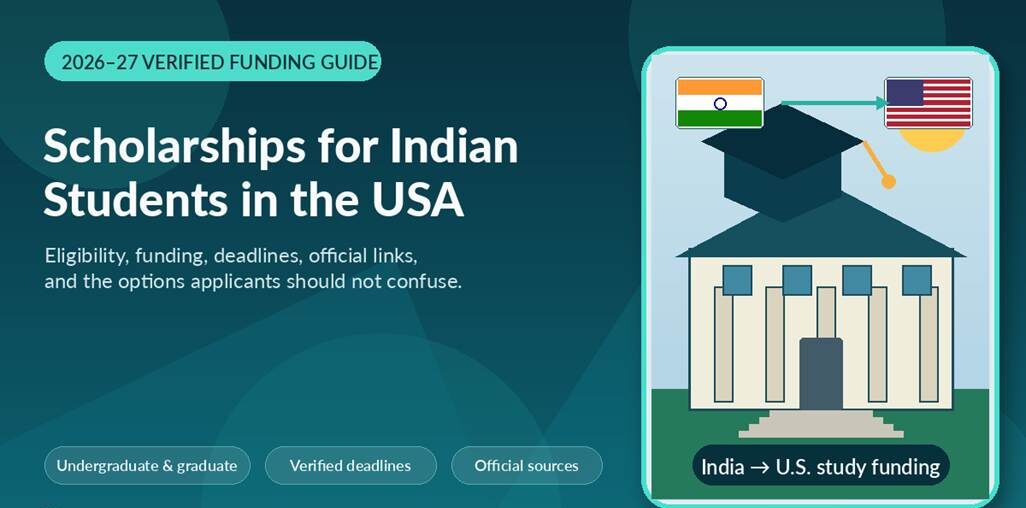
Indian students can receive scholarships, fellowships, university grants, tuition waivers and graduate assistantships for study in the United States. The difficult part is not finding a long list. The difficult part is separating true grants from repayable loan scholarships, identifying awards that match the degree level, and checking whether the funding covers tuition only or the full cost of attendance.
This guide compares major verified opportunities and explains how undergraduate, master’s, MBA and PhD applicants should build a realistic funding plan. Scholarship status and deadlines reflect official information available on 5 July 2026. Applicants should recheck the linked provider page before applying because annual rules can change.
Direct answer: A full scholarship is possible, but it is uncommon for taught master’s programs. Undergraduate applicants usually depend on university need-based aid or major merit awards. PhD applicants have the strongest access to complete funding through departmental fellowships, research assistantships and teaching assistantships.
At a Glance
Best current deadline: Hubert H. Humphrey Fellowship applications close on 9 July 2026, but the program is non-degree professional study.
Best broad graduate award: Knight-Hennessy Scholars funds eligible Stanford graduate degrees for up to three years.
Largest India-based grant in this guide: Inlaks provides up to USD 120,000, subject to field exclusions and prior admission.
Best undergraduate India-specific option: Tata Scholarship at Cornell provides need-based support to eligible students educated in India.
Best route for most PhD applicants: apply to programs that guarantee tuition remission, a stipend and health coverage through the admission offer.
Can Indian Students Get Scholarships to Study in the USA?
Yes. Indian citizens can apply for India-specific awards and scholarships open to international students. Funding may come from the Government of India, the United States-India Educational Foundation, Indian trusts, US universities, academic departments and private foundations.
Competition is high because admission and financial-aid decisions often occur together. EducationUSA advises international applicants to begin financial planning early and compare tuition, fees and living costs before selecting universities. EducationUSA financial-planning guidance also notes that living costs vary substantially by location.
How US Scholarship Funding Works
Scholarship, fellowship, grant and assistantship
Scholarship: Non-repayable funding awarded for merit, financial need, identity, field of study, leadership or another defined criterion.
Fellowship: Funding for graduate study, research or professional development. A fellowship may support a degree or a non-degree exchange.
Institutional grant: Need-based funding awarded directly by a university. The award commonly reduces the family’s expected contribution.
Assistantship: Funding tied to teaching, research or administrative work. An assistantship may include a stipend, tuition waiver and health insurance.
Loan scholarship: Repayable educational funding. It should not be treated as a free grant even when the interest rate is low.
Fully funded, full tuition and full ride
Term
Usually covers
Common gap
Fully funded
Tuition plus essential living expenses
Dependants, personal costs or expenses above the provider limit
Full tuition
Tuition charges
Housing, food, insurance, books, travel and university fees
Full ride
Tuition and most published cost-of-attendance items
Personal spending or costs outside the award policy
Partial scholarship
A fixed amount or percentage
Remaining tuition and most living costs
Tuition waiver
Some or all tuition
Fees, insurance and living costs
Loan scholarship
Approved study costs
Repayment under the agreement
FAFSA and CSS Profile are not the same
Most Indian citizens studying on international student status are not eligible for US federal student aid through FAFSA. Some US colleges still award institutional need-based aid to international applicants. Those colleges may require the CSS Profile, their own financial-aid form or both.
The College Board states that international applicants can enter family income, assets and expenses in their home currency through the CSS Profile. CSS Profile information for international applicants explains the process and lists participating institutions.
Quick Comparison of Verified Scholarships
Currency note: Approximate USD conversions for awards published in Indian rupees use 1 USD = INR 95.21, the closing rate reported on 3 July 2026. Converted values are planning estimates, not guaranteed payment amounts.
Program
Level
Funding
Status
Key condition
Fulbright-Nehru Master’s
Master’s
Tuition, fees, living costs, travel and health coverage
Closed; annual
55% and 3 years of relevant paid work
Hubert H. Humphrey
Non-degree professional
Tuition, maintenance, travel and professional costs
Closes 9 Jul 2026
5 years of full-time experience
Inlaks Scholarship
Postgraduate
Up to USD 120,000
2026 closed
Admission required; major field exclusions
Tata Scholarship at Cornell
Undergraduate
Need-based; amount varies
Admission-linked
Schooling in India and financial need
Knight-Hennessy Scholars
Stanford graduate
Tuition, stipend and annual travel
Closes 6 Oct 2026
Separate KHS and Stanford applications
AAUW International Fellowship
STEM master’s/doctorate
USD 20,000 / USD 25,000
17 Aug–17 Sep 2026
Woman, non-US citizen, 3.5 GPA
National Overseas Scholarship
Master’s/PhD
Tuition plus defined allowances
First round closed
Eligible categories, income and age rules
J. N. Tata Endowment
PG/PhD/postdoc
Up to approx. USD 21,000 loan
2026 closed
60%, Indian degree, age 45 or below
K. C. Mahindra
Postgraduate
Approx. USD 10,500 or USD 5,250 loan
2026 closed
First-class degree
1. Fulbright-Nehru Master’s Fellowship
The Fulbright-Nehru Master’s Fellowship supports selected Indian professionals for up to two years of master’s study at US colleges and universities. The published 2026–27 competition is closed, so future applicants should monitor USIEF for the next cycle rather than relying on an old deadline.
Funding and eligibility
J-1 visa support, round-trip economy airfare, tuition and fees, living costs, and accident and sickness coverage.
At least 55% in an eligible Indian degree pathway.
At least three years of full-time paid professional experience related to the proposed field by the deadline.
Leadership and community-service evidence.
No previous US university degree and no current enrollment in a US degree program.
Eligible fields are limited and include economics, environmental studies, higher education administration, international legal studies, journalism, public health, sustainability and urban planning.
USIEF warns that its funding may not cover every cost. Applicants should therefore calculate the remaining gap before accepting an offer.
The Hubert H. Humphrey Fellowship is a Fulbright exchange for mid-career professionals. It provides master’s-level academic and professional development, but it does not award a degree. Applicants who need an MS, MBA or other academic credential should not treat it as a substitute for degree funding.
Funding, deadline and eligibility
Tuition and fees, monthly maintenance, books and supplies, round-trip international travel, health coverage and professional-activity allowances.
At least five years of full-time professional experience before August 2026.
Management or policy responsibilities, leadership potential and a record of public service.
A qualifying four-year degree, completed master’s degree or eligible postgraduate diploma route.
Application deadline: 9 July 2026 at 23:59:59 IST for the 2027–28 program.
The fellowship does not support dependants and the stipend is not designed to support family members.
The Inlaks Scholarship supports young Indian graduates pursuing eligible postgraduate courses in the United States, the United Kingdom or Europe. The 2026 competition is closed.
Funding and major restrictions
Up to USD 120,000 for courses lasting nine months to four years.
Funding may cover tuition, living expenses, one-way travel, visa costs and a health allowance.
The applicant must hold an Indian passport and reside in India at the time of application.
The 2026 age rule required a birth date on or after 1 January 1996.
Prior admission was mandatory. Conditional offers were accepted, but conditions had to be cleared before the final interview.
Minimum academic thresholds were 65% or equivalent for specified humanities and related fields, and 70% or equivalent for specified science and mathematics fields.
The most important limitation is the subject list. The 2026 rules excluded business and finance, computer science, most engineering programs, fashion design, most film and animation programs, hospitality, MBA and management studies, medicine, dentistry and most music programs. Applicants should check the current exclusions before building a funding plan around Inlaks.
The Tata Scholarship is an undergraduate need-based award for eligible students who attended secondary school in India and receive admission to Cornell University. Cornell’s USD 25 million Tata endowment supports approximately 20 scholars at any point in time.
How students qualify
Attend secondary school in India.
Receive an undergraduate admission offer from Cornell.
Qualify for Cornell need-based financial aid.
Submit the admission application and CSS Profile by Cornell’s international financial-aid deadline.
Cornell is need-aware for international admission. An international applicant who may need aid at any point must request it during the admission application. A student admitted without requesting aid cannot later apply for Cornell undergraduate financial aid.
The Tata selection process gives preference to specified programs, including architecture, engineering, applied economics and management, biological and physical sciences, other sciences and social sciences. Funding can continue for up to eight semesters, or ten semesters for the five-year architecture program, while the student continues to demonstrate need.
5. Knight-Hennessy Scholars at Stanford University
Knight-Hennessy Scholars funds graduate study across Stanford University. Indian citizens are eligible because the program accepts applicants regardless of nationality.
Funding and application sequence
A fellowship applied to tuition and associated fees.
A stipend for room, board, books, academic supplies, local transport and reasonable personal expenses.
An annual travel stipend for an economy-class trip to and from Stanford.
A one-time relocation stipend for new scholars.
Funding for up to three years, subject to degree-specific rules for longer programs.
The application deadline for the 2027 KHS cohort is 6 October 2026 at 1:00 p.m. Pacific Time. Applicants must also submit a separate Stanford graduate-program application by the earlier of the program’s KHS deadline or 1 December 2026. Stanford MBA applicants must use Round 1.
AAUW International Fellowships support women who are not US citizens or permanent residents. The 2027–28 cycle focuses on first master’s or doctoral degrees in eligible STEM disciplines.
Award, eligibility and timeline
USD 20,000 for a master’s degree and USD 25,000 for a doctorate.
The applicant must identify as a woman and pursue full-time study at an accredited US institution.
The applicant must have at least a 3.5 cumulative GPA on a 4.0 scale for the highest degree earned.
The applicant must be admitted or enrolled in the first master’s or an academic or professional doctorate in an eligible STEM field.
Applications open on 17 August 2026 at 9:00 a.m. Eastern Time.
Applications close on 17 September 2026 at 5:00 p.m. Eastern Time.
The award is a stipend rather than a promise to meet the full cost of attendance. AAUW expects applicants to show confirmed or pending funding and a remaining financial gap.
The National Overseas Scholarship is a Government of India program for eligible low-income students from Scheduled Castes, Denotified Nomadic and Semi-Nomadic Tribes, Landless Agricultural Labourer families and Traditional Artisan families. The scheme supports master’s and PhD study abroad. It does not cover bachelor’s degrees.
2026–27 requirements and benefits
At least 60% in the qualifying degree.
Maximum age of 35 on the first day of April in the selection year.
Gross annual family income no higher than approximately USD 8,400 under the July 2026 conversion basis.
125 fresh awards, subject to funding, with 30% earmarked for women.
For US study: actual tuition, annual maintenance of USD 15,400, annual contingency of USD 1,500, eligible medical insurance, visa fees and approved economy airfare.
Maximum support of three years for a master’s degree and four years for a PhD.
The first 2026–27 application round ran from 24 April to 2 June 2026, followed by a correction period. The guidelines state that a second round may open in September or October if slots remain. First-round selection prioritizes candidates with unconditional offers from eligible top-500 QS-ranked institutions.
The J. N. Tata Endowment supports full-time postgraduate, PhD and postdoctoral study overseas. This award is a merit-based loan scholarship, not a grant.
Value, eligibility and repayment
Up to approximately USD 21,000 under the July 2026 conversion basis.
Indian citizenship and an age limit of 45 as of 30 June 2026.
At least 60% on average in undergraduate or postgraduate study at a recognized Indian university.
Applicants may apply before receiving an admission offer, but admission must be secured before the interview stage.
The selection process includes application screening, an aptitude test, a subject-expert interview and final selection.
The official FAQ states a simple interest rate of 2% per year, subject to trustee discretion on rebates or exemptions.
Repayment occurs in equal installments from the third through the seventh year after disbursement.
Selected scholars may also become eligible for a criteria-based travel grant and gift award from allied Tata Trusts. A guarantor is mandatory, although the Endowment does not normally require collateral.
9. K. C. Mahindra Scholarship for Postgraduate Studies
The K. C. Mahindra Education Trust awards interest-free loan scholarships to Indian students pursuing postgraduate education. The 2026 application cycle is closed.
Award and eligibility
Up to approximately USD 10,500 for the top three K. C. Mahindra Fellows.
Up to approximately USD 5,250 for other awardees.
At least 50 students receive awards each year under the published program description.
The applicant must be an Indian citizen with a first-class degree or equivalent diploma from a recognized university.
For the 2026 cycle, overseas programs had to begin between August 2026 and February 2027.
The 2026 deadline was 30 April 2026 at 6:00 p.m.
The award reduces the funding gap but will rarely finance an entire US postgraduate degree. Applicants should calculate repayment together with any commercial education loan.
Undergraduate funding is usually university-specific. Indian applicants should compare each university’s policy for international students before applying.
Need-blind admission means the institution does not consider the ability to pay during admission. This policy is rare for international applicants.
Need-aware admission means the university may consider the amount of aid requested when making the admission decision.
Full demonstrated need means the university calculates an affordable family contribution and fills the remaining eligible need. The calculation belongs to the university, not the applicant.
Merit scholarships may be automatic, nomination-based or require a separate application.
A student seeking major undergraduate funding should create a college list around aid policy, not rankings alone. The Tata Scholarship at Cornell is a strong India-specific example, but it remains tied to admission and demonstrated financial need.
Master’s and MS scholarships
A fully funded taught master’s degree is possible but uncommon. External programs such as Fulbright-Nehru and Inlaks are highly selective. University merit awards often reduce tuition without paying living costs. Thesis-based programs may offer assistantships, but funding depends on the department, supervisor and available grants.
Ask whether the scholarship is automatic or requires a separate form.
Ask whether an assistantship is guaranteed in the admission letter or only available after enrollment.
Compare the total award across the full degree, not the first semester alone.
Check whether international health insurance and mandatory fees are included.
MBA scholarships
MBA funding is mainly university merit aid, need-based aid at selected schools, employer sponsorship and loan funding. Several external scholarships exclude MBA or management study. Inlaks explicitly excluded management studies and MBA programs in its 2026 rules, so applicants should not assume a general postgraduate scholarship covers business school.
PhD and research funding
Many US PhD programs admit students with a funding package rather than a separate scholarship. A competitive offer may include tuition remission, an annual stipend, health insurance and teaching or research duties. Applicants should ask how many years are guaranteed, whether summer funding is included and what academic progress is required for renewal.
PhD funding test: Do not call a PhD “fully funded” unless the written offer states the tuition support, stipend amount, health-insurance contribution, funding duration and work conditions. A verbal promise from a professor is not a substitute for the official offer.
Eligibility Requirements Applicants Should Check
Attribute
What to verify
Citizenship and residence
Indian passport, residence in India, NRI status, US permanent residence or prior study abroad
Academic record
Minimum percentage, CGPA, GPA method and semester transcripts
Study level
Undergraduate, master’s, MBA, doctorate, postdoctoral or non-degree
Field
Eligible disciplines and subject exclusions
Admission status
No offer required, conditional offer accepted or unconditional offer mandatory
Tests
GRE, GMAT, SAT, ACT, TOEFL, IELTS or Duolingo requirements
Work experience
Paid full-time duration and relevance to the proposed field
Financial need
Income ceiling, assets, family contribution and proof documents
Age
Cut-off date and permitted exceptions
Return condition
Requirement or expectation to return to India
Renewal
GPA, enrollment, need and annual reapplication conditions
Documents Commonly Required
Valid passport and identity documents.
Admission offer or evidence of university applications.
Academic transcripts and degree certificates.
Official CGPA-to-percentage conversion formula when required.
Standardized-test and English-language scores.
Statement of purpose, scholarship essay or study plan.
Recommendation letters submitted through the official system.
Résumé or curriculum vitae.
Employment letters and work-experience certificates.
Family-income documents, tax returns and bank statements.
Cost-of-attendance statement from the university.
Research proposal, writing sample or portfolio where relevant.
Category, disability or community certificates for targeted schemes.
Proof of other funding when the scholarship does not cover the full cost.
How to Apply for Scholarships from India
Calculate the full cost of attendance. Include tuition, university fees, housing, food, health insurance, books, travel, visa costs and personal expenses.
Classify funding by degree level. Remove opportunities that do not support the intended course.
Separate admission-linked aid from independent scholarships. Record which application must be submitted first.
Create a deadline calendar in Indian Standard Time and the provider’s stated time zone.
Prepare transcripts, identity documents, financial evidence and recommendation contacts before portals open.
Write a scholarship-specific essay. Connect past evidence, the proposed course and measurable future impact.
Submit only through the official university or provider portal.
Prepare for interviews with concrete examples of leadership, academic judgment and financial planning.
Compare award letters using the remaining funding gap rather than the headline scholarship amount.
Keep a backup plan that does not depend on an unconfirmed assistantship or future campus job.
Recommended Application Timeline
Time before enrollment
Priority action
18–15 months
Research universities, aid policies, external scholarships and total costs.
15–12 months
Take required tests and prepare transcripts, essays and financial records.
12–9 months
Submit early university applications and major external scholarship applications.
9–6 months
Complete CSS Profile or institutional aid forms and attend interviews.
6–3 months
Compare admission offers, scholarships, assistantships and remaining gaps.
3–1 months
Finalize proof of funds, visa documents, housing and travel.
Scholarship Fit Matrix
Applicant profile
Best route to prioritize
Class 12 applicant with high financial need
Universities with strong international need-based aid; Tata Scholarship if applying to Cornell.
Master’s applicant with 3+ years of experience
Fulbright-Nehru and eligible external fellowships.
Young postgraduate applicant in an eligible Inlaks field
Inlaks plus university aid and personal gap funding.
Woman pursuing a first STEM graduate degree
AAUW plus university funding and assistantships.
Eligible low-income applicant from a covered community
National Overseas Scholarship.
Stanford graduate applicant
Knight-Hennessy plus the relevant Stanford degree application.
PhD applicant
Programs with guaranteed departmental funding, RA or TA support.
Applicant with a modest shortfall
Partial scholarship or loan scholarship after repayment analysis.
How to Calculate the Real Value of a Scholarship
Funding-gap formula: Remaining funding gap = total cost of attendance − confirmed grants and scholarships − guaranteed assistantship funding − confirmed family contribution.
A USD 30,000 tuition scholarship may still leave a larger gap than a USD 20,000 award at a lower-cost university. Compare the net amount owed across the entire degree. Include annual tuition increases, insurance, exchange-rate movement and taxes on stipends.
Confirm whether the award is one-time or renewable.
Confirm whether the amount is applied to tuition or paid as a stipend.
Check whether external scholarships reduce university grants.
Check whether housing, summer terms and health insurance are included.
Budget for taxes where a fellowship or assistantship stipend is taxable.
Can Multiple Scholarships Be Combined?
Sometimes. The answer depends on the university and scholarship rules. Universities may reduce institutional aid when a student receives an external award. Providers may also prohibit duplicate funding for the same expense. Applicants must report external awards to the financial-aid office and request a written explanation of how the package will change.
A grant may be combined with a loan scholarship if both providers permit it.
An assistantship may reduce the demonstrated financial gap used by a need-based award.
Two providers may refuse to pay the same tuition charge.
Total aid may be limited to the institution’s official cost of attendance.
Scholarships, Visa Proof of Funds and Tax
A formal scholarship or assistantship letter can support the financial documentation used for a US student visa and the university’s immigration record. The letter should state the amount, duration and covered costs. The applicant must still show reliable funding for any remaining amount required by the institution.
Scholarships are not automatically tax-free in the United States. Tuition applied directly to qualified educational costs may receive different treatment from cash stipends used for living expenses. International students should use the university’s tax office or qualified tax guidance rather than assuming the entire award is exempt.
Mistakes and Scholarship Scams to Avoid
Treating a tuition discount as a fully funded scholarship.
Using a deadline from an old blog post instead of the official provider page.
Ignoring field exclusions, age cut-offs or residence conditions.
Assuming a high GRE score guarantees financial aid.
Assuming admission guarantees an assistantship.
Paying an agent who promises a guaranteed full scholarship.
Submitting copied or fabricated essays and recommendation letters.
Failing to report an external award to the university.
Accepting an unaffordable offer based on a campus job that is not guaranteed.
What to Do Without a Full Scholarship
A partial scholarship is useful only when the remaining cost is manageable. Applicants who do not receive complete funding should reduce the gap before committing.
Compare lower-cost universities and locations with lower living expenses.
Target thesis programs with documented assistantship opportunities.
Ask the university whether the award can be reconsidered after a stronger competing offer.
Combine grants with a carefully evaluated loan scholarship where permitted.
Defer enrollment when the plan depends on uncertain future funding.
Reject offers that require debt beyond a realistic post-study repayment capacity.
Frequently Asked Questions
Can Indian students get a full scholarship in the USA?
Yes, but full funding is selective. Undergraduate students may receive comprehensive university aid. Master’s applicants usually combine external scholarships, institutional awards and personal funding. PhD applicants have the strongest access to complete packages because many departments provide tuition remission, a stipend and health coverage through the admission offer.
How can an Indian student study in the USA for free?
The applicant needs funding that covers the full cost of attendance, not tuition alone. The most realistic routes are major need-based undergraduate aid, a competitive external fellowship, Knight-Hennessy at Stanford, or a funded PhD offer. Applicants must still budget for excluded costs, visa requirements and personal expenses.
Which scholarship is best for Indian students in the USA?
No single scholarship is best for every applicant. Fulbright-Nehru suits experienced master’s candidates in eligible fields. Inlaks suits young graduates outside excluded subjects. Tata supports eligible Cornell undergraduates. Knight-Hennessy suits Stanford graduate applicants. The best option is the one matching the degree, field and eligibility profile.
Can Indian students get scholarships after Class 12?
Yes. Undergraduate applicants can receive university merit scholarships or need-based financial aid. The Tata Scholarship at Cornell is an India-specific example. Students should review each university’s international-aid policy before applying because some institutions provide no aid, some are need-aware and a small group may meet substantial demonstrated need.
What GPA is required for a scholarship in the USA?
There is no universal GPA. Requirements vary by provider and program. AAUW requires a 3.5 GPA on a 4.0 scale for the relevant highest degree. Fulbright-Nehru uses an Indian percentage requirement. Universities may evaluate academic rigor, class rank and context rather than applying one conversion formula.
Is the GRE required for scholarships in the USA?
Not always. The GRE may be required by the degree program, considered after nomination or waived entirely. A scholarship can have different test rules from the university. Applicants should check both sources. A strong GRE score may support academic evidence, but it does not create an automatic right to funding.
Can Indian students apply for FAFSA?
Most Indian citizens studying as international students are not eligible for US federal student aid. FAFSA eligibility depends on citizenship or specified eligible-noncitizen status. International applicants can still receive university grants, private scholarships and assistantships. Some institutions use the CSS Profile or their own financial form to assess need.
Can I apply for a scholarship before receiving admission?
It depends on the program. Inlaks required an admission offer for the 2026 application. J. N. Tata allowed applicants to apply before admission but required an offer before the interview. University financial aid is commonly submitted with the admission application. Applicants should record the exact sequence for every opportunity.
Are master’s programs in the USA fully funded?
Most taught master’s programs are not fully funded. Some students receive external fellowships, merit awards or assistantships. Research-oriented programs may offer stronger support than coursework-only programs. Applicants should distinguish a guaranteed assistantship in the offer letter from a general statement that assistantships may become available after enrollment.
Are PhD programs in the USA fully funded for Indian students?
Many research PhD programs fund admitted students regardless of nationality, but the package varies. A complete offer should identify tuition remission, stipend, health coverage, duration, summer funding and teaching or research duties. Applicants should compare guaranteed years and local living costs rather than relying on the phrase “fully funded.”
Do scholarships cover airfare and health insurance?
Some do. Fulbright-Nehru and the National Overseas Scholarship include defined travel and health-related support. Inlaks may include one-way travel and a health allowance. Many university merit scholarships cover tuition only. The provider’s benefits section should identify each covered expense and any maximum amount or reimbursement condition.
Can I combine two scholarships?
Sometimes. Scholarship stacking depends on provider and university rules. An external award may reduce institutional need-based aid. Two providers may refuse to fund the same cost. Students should disclose every award, request a revised financial-aid package and confirm whether the combined funding exceeds the official cost of attendance.
Can a scholarship letter be used as proof of funds for a US visa?
A formal award letter can support proof of funds when it clearly states the amount, duration and covered expenses. The university may use it when preparing immigration documents. The student must still show funding for any uncovered balance. A conditional or informal promise may not satisfy the institution’s documentation standard.
When should Indian students start applying for scholarships?
Start research 12 to 18 months before enrollment. Major fellowships and university priority deadlines can occur long before the academic term begins. Early planning leaves time for tests, transcripts, recommendations, financial documents and admission applications. Applicants should track deadlines in both Indian Standard Time and the provider’s stated time zone.
How can I verify that a scholarship is genuine?
Use the official government, university, foundation or scholarship-body website. Confirm the application portal from that site. Check the provider’s contact details and current cycle. Genuine programs do not guarantee selection in exchange for a fee. Treat copied pages, messaging-app offers and urgent payment requests as warning signs.
Conclusion
Scholarships for Indian students in the USA fall into four practical groups: university aid, external grants, work-linked assistantships and repayable loan scholarships. Applicants should first match the opportunity to the degree and field. They should then verify the official deadline, calculate uncovered costs and assess whether funding is guaranteed for the full program.
The next useful planning step is to compare the total cost of studying in the USA with the net cost after confirmed aid. That comparison prevents a large headline award from hiding an unaffordable remaining balance.
Editorial note: This article provides general scholarship-planning information. It does not replace the eligibility rules, financial-aid decision, immigration guidance or tax advice issued by the responsible institution.





 By Country2 months ago
 Scholarships1 month ago
 By Country2 months ago
 Scholarships2 months ago
 Scholarships1 month ago