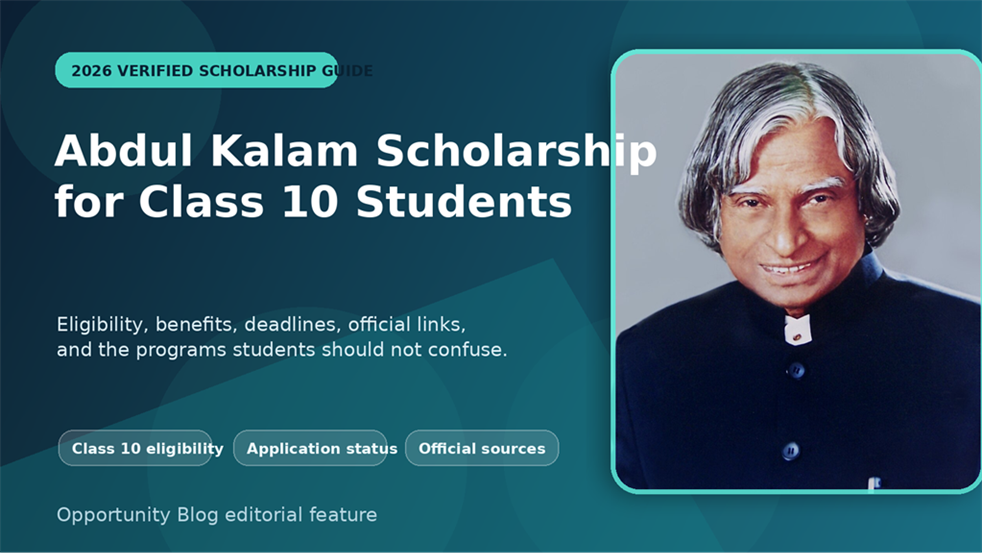
Several unrelated scholarships use Dr. A.P.J. Abdul Kalam’s name. This guide separates the programs, explains which ones include Class 10 students, and links to the most authoritative available sources.
Quick answer: Yes, some scholarships carrying Dr. A.P.J. Abdul Kalam’s name include Class 10 students. The clearest current example is the Agnipankh Scholarship Exam. However, there is no single national “Abdul Kalam Scholarship” for every Class 10 student. Each program has a different provider, location, benefit, deadline, and selection process.
Current-status warning: The Agnipankh 2026 application window has closed. The GIIS Pune page also shows its current cycle as closed. A verified 2026 notification for the Bright Student Award was not located. Students should not submit payment or personal documents through an old social-media post or an unverified messaging number.
Dr. A.P.J. Abdul Kalam was India’s 11th President and a prominent aerospace scientist. He also worked extensively with students and young people. Multiple private organizations, schools, and government departments now use his name for independent education programs. The shared name does not mean that the programs have the same administrator or official affiliation. (President of India profile).
Is There an Abdul Kalam Scholarship for Class 10 Students?
A Class 10 student may be eligible for one of several different programs. Eligibility depends on the student’s state, school, board, academic record, examination performance, and technology achievements. The program name alone is not enough to determine eligibility.
The most relevant program for a general Class 10 search is the Agnipankh Dr. APJ Abdul Kalam Scholarship. Its official information states that students in Classes 1 to 10 can take the examination. The published 2026 cycle opened on 15 February 2026, closed on 31 March 2026, and accepted late applications until 15 April 2026. (Agnipankh official website).
The GIIS Dr. APJ Abdul Kalam Global Skills Scholarship is different. It is an institutional tuition-fee waiver for students with technology, science, coding, robotics, or innovation achievements. The GIIS Pune page covers eligible grades at specified campuses and currently marks the cycle as closed. (GIIS Pune official scholarship page).
Abdul Kalam Scholarships for Class 10 Students: Quick Comparison
Program
Class 10 fit
Benefit
Status on 3 July 2026
Agnipankh Dr. APJ Abdul Kalam Scholarship
Yes. Official FAQ includes Classes 1–10.
Published Class 9–10 fund: INR 500,000–800,000, about USD 5,250–8,400. Official pages conflict on annual instalments.
2026 applications closed after 15 April.
Dr. APJ Abdul Kalam Bright Student Award
Historically yes. Secondary reports include Classes 4–10.
Historically reported cash awards of INR 10,000–100,000, about USD 105–1,050.
Current official 2026 cycle not verified.
GIIS Global Skills Scholarship, Pune
Yes at eligible GIIS campuses and grades.
6%–20% tuition-fee waiver for one year.
Official page shows closed.
Kerala APJ Abdul Kalam Scholarship
No for students currently in Class 10.
Government-linked financial assistance for eligible polytechnic diploma students.
Check the current Kerala or myScheme notice.
USD amounts are approximate and rounded. The INR-to-USD rate changes daily. The conversion in this article uses about INR 95.21 per USD on 3 July 2026. Exchange-rate source.
1. Agnipankh Dr. APJ Abdul Kalam Scholarship for Class 10
What is the Agnipankh Scholarship?
The Agnipankh Scholarship Exam is a two-stage, merit-based examination. The provider describes the test as an assessment of academic knowledge, aptitude, and analytical ability. The official FAQ states that students in Classes 1 to 10 can apply. (Agnipankh FAQ).
The provider is Kalams Agnipankh International Foundation. Its website states that the organization is an independent NGO. The website also states that the foundation is not affiliated with or endorsed by an official organization or by Dr. Kalam’s family. This disclosure matters because the scholarship name can otherwise create an incorrect impression of government or family sponsorship. (Agnipankh scholarship terms and disclaimer).
Who can apply?
The official FAQ includes students in Classes 1 to 10. The 2026 materials use Maharashtra state, district, taluka, and school-level prize structures. Students outside Maharashtra should therefore obtain written confirmation from the provider before registering. The site does not provide one simple national eligibility statement that clearly covers every state.
The student must be studying in an eligible class during the stated cycle.
Class 10 students take an objective examination with negative marking.
Selection is merit-based.
The published terms state that caste, religion, gender, region, and income do not create preference in the Class 9–10 selection process.
The student must provide academic and identity documents when the provider requests verification.
Scholarship amount and the important inconsistency
The official website publishes a total Class 9–10 scholarship fund of INR 500,000 to INR 800,000, which is about USD 5,250 to USD 8,400. It also says that one Class 9 student and one Class 10 student are selected in the stated category, while another line mentions a minimum of six state-level selections. These statements should be reconciled by the provider before a student relies on a specific number of winners.
The benefit amount is also inconsistent across the provider’s pages. One section states INR 50,000 per year from Class 11 until graduation. Another terms section states INR 50,000 per year for Class 9 and Class 10, followed by INR 100,000 per year from Class 11 until graduation. The homepage states INR 100,000 per year from Class 11 onward. These differences affect the expected value of the award. (Official scholarship details).
Verification required before payment: Ask the provider to confirm the annual amount, the total number of Class 10 winners, the examination date, the fee, and the written renewal schedule. Save the response and the current notification.
Application dates for the 2026 cycle
Event
Published date
Applications opened
15 February 2026
Regular deadline
31 March 2026
Late-fee period
1–15 April 2026
Final acceptance date
15 April 2026
Examination date
The official FAQ said it would be announced on the official platform
The 2026 application window is closed. A student who missed the deadline should not use an old registration form unless the provider publishes a new cycle or an official extension.
Exam pattern for Class 10
The official material describes Paper 1 and Paper 2 as objective examinations for Classes 9 and 10. Paper 1 acts as a screening stage. The marks from Paper 1 do not carry forward to the final merit list. The Class 9–10 papers deduct 0.25 marks for each incorrect answer. Unanswered questions do not receive a deduction. (Official exam FAQ).
Use a blue or black ballpoint pen on the OMR answer sheet.
Review the exact syllabus and sample material published for the cycle.
Do not guess indiscriminately because Class 10 has negative marking.
Keep the OMR carbon copy when the examination centre provides one.
Check the official merit list and document-verification instructions after the test.
Renewal and discontinuation
The published terms describe the Class 9–10 award as annual and renewable. A recipient must maintain attendance, conduct, discipline, and academic progression. The student must submit the previous year’s marksheet and a bonafide certificate each year. An academic gap, discontinuation, false documents, or serious misconduct may end the scholarship. (Agnipankh renewal conditions).
How to apply when a new cycle opens
1. Open the official Agnipankh website and locate the current-year notification.
2. Confirm that the notification includes the student’s class and location.
3. Read the scholarship amount, fee, examination date, and refund conditions.
4. Complete the online form with the student’s name, school, class, and contact details.
5. Upload only the documents requested by the official form.
6. Pay only through the method named in the current official notification.
7. Save the registration number, receipt, notification, and screenshots of the submitted form.
8. Download the admit card from the official website when it becomes available.
2. Dr. APJ Abdul Kalam Bright Student Award
The Bright Student Award is a separate merit examination. Historical education reports describe it as an award for students in Classes 4 to 10. Those reports state that the test uses Mathematics and Science questions and ranks students for cash awards. The reported award range is INR 10,000 to INR 100,000, or about USD 105 to USD 1,050. (Historical CollegeDekho overview).
The weakness is current verification. The available detailed page refers to the 2025 cycle and uses tentative dates. The listed application domain could not be confirmed as an authoritative current 2026 source during this review. A student should not treat an old WhatsApp number, email address, transaction instruction, or social-media post as a live application channel.
Historically reported eligibility and test pattern
Students in Classes 4 to 10 were reported as eligible.
No minimum marks or family-income ceiling was reported for appearing in the test.
The test was reported as 100 multiple-choice questions completed in two hours.
Mathematics and Science questions were based on class-level CBSE, ICSE, and state-board material.
A score of 60 out of 100 was reported as the passing threshold.
Award values varied by rank rather than paying every selected student the same amount.
What to verify before applying
A current-year notification on a functioning provider-controlled website.
The provider’s legal name, physical address, and registration details.
The exact application fee and the account that receives it.
The exam centre, date, language, result method, and refund policy.
A privacy policy explaining how student information will be stored and used.
A written list of awards and the number of winners.
Until those points are verified, the Bright Student Award should be described as a historically reported opportunity rather than an open 2026 scholarship.
3. GIIS Dr. APJ Abdul Kalam Global Skills Scholarship
The GIIS Global Skills Scholarship is an institutional scholarship for students with demonstrated achievement in science and digital technology. It is not a general cash scholarship that any Class 10 student can use at any school. The benefit reduces tuition at the relevant GIIS campus. (GIIS Pune scholarship page).
Class and campus eligibility
The GIIS Pune page lists campus-specific grade ranges. The Balewadi campus includes Grades 6 to 12. The Hadapsar information includes Grade 10 in one part of the page. Students must check the campus that they attend or plan to join. The scholarship lasts one year, and the current page shows the start and end dates as closed.
Benefit categories
Category
Illustrative achievement level
Tuition benefit
A
Top ranks in specified national or international science, robotics, space, and innovation competitions
20% off tuition fees
B
Next qualifying ranks in specified competitions
15% off tuition fees
C
Specified top ranks in technology-company competitions or robot olympiads
10% off tuition fees
D
Specified international ranks in SOF, STEM, robotics, or GK olympiads
6% off tuition fees
Additional selection conditions
The applicant must show recognized national, international, or regional achievement.
The applicant may submit evidence of a paper, thesis, publication, tool, application, or technology project.
The Pune page requires at least 70% marks or equivalent grades during the previous two years.
The applicant completes a one-to-one online interview.
The page also states a moderate-income-family condition.
The application process includes an online form, supporting documents, an interview, approval, and email notification. The page states that successful applicants receive a decision within four weeks after the scholarship cycle closes.
Abdul Kalam Scholarships That Do Not Directly Apply to Current Class 10 Students
Kerala APJ Abdul Kalam Scholarship
The Kerala APJ Abdul Kalam Scholarship is commonly associated with eligible minority students pursuing polytechnic diploma courses. A Class 10 marksheet may appear in the document list, but that does not make the scheme a scholarship for students currently studying in Class 10. The student must satisfy the current diploma, domicile, community, income, and institution rules in the official notice. (Government myScheme listing).
Secondary summaries have reported annual assistance of INR 6,000, or about USD 63, for eligible diploma students. The precise year, duration, and application dates should be taken from the current Kerala notification rather than copied from an older article.
A.P.J. Abdul Kalam and Maulana Abul Kalam Azad are different entities
A.P.J. Abdul Kalam was an aerospace scientist and former President of India. Maulana Abul Kalam Azad was India’s first Education Minister. Scholarships carrying “Maulana Azad” or “Abul Kalam Azad” in their title are not A.P.J. Abdul Kalam scholarships. Search results often combine the names incorrectly.
Which Program Should a Class 10 Student Check?
Student situation
Best next step
Current Class 10 student looking for a general merit examination
Monitor the next official Agnipankh cycle and verify state eligibility.
Class 10 student with robotics, coding, science-fair, or innovation achievements
Check the scholarship page for the relevant GIIS campus.
Student considering the Bright Student Award
Wait for a verified current-year provider notification before sharing data or paying.
Student who has completed school and joined a Kerala polytechnic
Check the current Kerala APJAK rules through the official government portal.
Student who does not match any named program
Search the National Scholarship Portal and state scholarship portals for verified alternatives.
The National Scholarship Portal is open for academic year 2026–27. The portal includes scheme discovery, eligibility tools, One Time Registration, application status, and payment tracking. It does not establish that every privately named Abdul Kalam scholarship is a government scheme. (National Scholarship Portal).
Documents Commonly Required
The exact checklist depends on the provider. Students should prepare clear copies but upload them only through a verified application channel.
Recent passport-size photograph.
Student identity proof, such as Aadhaar where lawfully required.
Birth-date proof.
School identity card or bonafide certificate.
Previous-year marksheet and current enrollment proof.
Board registration number, if requested.
Address, domicile, or residence proof.
Parent or guardian details.
Income and community certificates when the scheme uses financial or category criteria.
Bank account details for direct payment, where applicable.
Competition certificates, project evidence, papers, applications, or innovation portfolios for a talent scholarship.
Application receipt and transaction reference for any official fee.
How to Verify an Abdul Kalam Scholarship Before Paying
A recognizable name is not proof of official status. Verification must focus on the provider, the current notification, the payment destination, and the published selection rules.
1. Identify the provider’s complete legal or institutional name.
2. Confirm that the website domain belongs to the provider.
3. Find a notification that clearly names the current academic year.
4. Match the address, telephone number, and email across multiple official pages.
5. Check whether the program is government-funded, privately administered, or institution-specific.
6. Read the eligibility, fee, refund, privacy, result, and disbursement terms.
7. Confirm that payment goes through an official gateway or named organizational account.
8. Save the notification, filled form, receipt, and correspondence.
9. Never share an OTP, card PIN, banking password, or complete account credentials.
Warning signs
Guaranteed selection or a guaranteed rank.
Pressure to pay immediately through a personal account or wallet.
No current-year notification.
No physical address or provider identity.
A form that requests excessive personal or banking information.
Government endorsement claims without a government source.
A social-media post that cannot be matched to an official website.
4. Compare the award value with the application or examination fee.
5. Collect only the documents named in the notification.
6. Complete the application through the official portal or verified method.
7. Review names, dates, marks, bank details, and contact information before submission.
8. Save the acknowledgement and track the admit card or application status.
9. Attend the examination or interview under the stated rules.
10. Verify the result and award communication through the provider’s official channel.
Other Scholarships to Consider After Class 10
A student should not wait for one scholarship name. Class 10 results can open several funding routes. Availability changes by state, category, course, and academic year.
National Scholarship Portal schemes for eligible school, college, disability, minority, merit, or welfare categories.
State merit scholarships for students entering Class 11.
Scholarships based on Class 10 board marks.
Vidyadhan and other verified nonprofit programs for eligible low-income students.
School-specific tuition concessions and entrance scholarships.
STEM, coding, robotics, Olympiad, and science-fair scholarships.
Diploma and polytechnic scholarships after admission to an eligible course.
Scholarships for single girl children and students with disabilities, where current rules permit.
The next semantic step for this topic is a dedicated comparison of scholarships after Class 10 in India. That article should filter opportunities by state, course, income, board marks, category, and application month.
Frequently Asked Questions
Can Class 10 students apply for an Abdul Kalam Scholarship?
Yes. The Agnipankh official FAQ includes students in Classes 1 to 10. GIIS also includes eligible Grade 10 students at specified campuses. The Bright Student Award historically included Class 10, but a verified current 2026 cycle was not located. Eligibility must be checked against the exact provider and current notification.
Which Abdul Kalam Scholarship is most relevant to a general Class 10 search?
The Agnipankh Dr. APJ Abdul Kalam Scholarship is the clearest examination-based program that explicitly includes Class 10 on its official website. Its 2026 application window has closed. Students should monitor the official website for a new cycle and confirm the benefit amount because the provider’s pages contain conflicting annual-payment descriptions.
Is the Abdul Kalam Scholarship a Government of India scholarship?
Not as a single national scheme. Several independent programs use Dr. Kalam’s name. Agnipankh identifies itself as an independent NGO. GIIS operates an institutional tuition scholarship. Kerala has a government-linked diploma scholarship. Students should verify the provider instead of assuming that every program with the name is government-funded.
What is the scholarship amount for Class 10 students?
Agnipankh publishes a Class 9–10 total fund of INR 500,000 to INR 800,000, about USD 5,250 to USD 8,400. Its pages conflict on annual instalments. The Bright Student Award historically reported INR 10,000 to INR 100,000. GIIS offers a percentage tuition waiver rather than a general cash payment.
What was the Agnipankh application deadline in 2026?
The official website states that applications opened on 15 February 2026 and closed on 31 March 2026. A late-fee period ran from 1 April to 15 April 2026. Applications after 15 April were not accepted. Students should wait for a new official cycle rather than reuse the closed application link.
What is the official website for the Agnipankh Scholarship?
The provider’s website is agnipankh.in. Students should use the official homepage, scholarship-details page, and FAQ page. The provider states that it is an independent NGO and is not affiliated with an official organization or Dr. Kalam’s family. That disclaimer should be read before registration or payment.
Can CBSE, ICSE, and state-board students apply?
Board eligibility depends on the program. Historical Bright Student Award information refers to CBSE, ICSE, and state-board material. Agnipankh requires students to follow its current class-level notification. GIIS is campus-specific. Students should not infer board eligibility from an old article when the current official notification states different conditions.
Is there a minimum percentage requirement?
Agnipankh selection is examination-based, and its Class 9–10 terms focus on merit and continued academic progression. The GIIS Pune page requires at least 70% marks or equivalent grades in the previous two years. Historical Bright Student Award information said no minimum marks were required to appear, but current rules need verification.
Is there an income limit?
Agnipankh’s published Class 9–10 terms say that income does not create selection preference. The GIIS Pune page uses a moderate-income-family condition. Kerala’s diploma scheme applies income and category rules. Historical Bright Student Award summaries reported no income restriction. Each provider defines income differently, so one answer cannot cover every program.
Does the Agnipankh Scholarship require an examination?
Yes. The provider describes a two-stage scholarship examination. Paper 1 acts as a screening stage, and its marks do not carry into the final merit list. Classes 9 and 10 face objective questions with a deduction of 0.25 marks for each incorrect answer. Students should read the current exam notice before preparing.
What is the Class 10 syllabus?
The syllabus depends on the program. Agnipankh directs students to its current examination material and tests academic knowledge, aptitude, and analytical ability. Historical Bright Student Award information lists Mathematics, Physics, and Chemistry topics at Class 10 level. Students should use the current provider syllabus rather than rely on a generic online list.
Is there an application fee?
Agnipankh confirms that an application fee applies, but its FAQ says the exact amount appears in the official notification. The current fee should be verified before payment. GIIS uses an institutional scholarship process. The Bright Student Award fee and payment route should not be trusted without a current official notification and provider-controlled payment instructions.
Which documents are usually required?
Common documents include a photograph, identity proof, school ID, bonafide certificate, marksheets, address proof, parent details, and a registration receipt. Income, community, domicile, bank, or technology-achievement documents may apply to specific schemes. Submit sensitive records only through a verified portal and retain copies of every uploaded file.
Is the scholarship available outside Maharashtra?
The Agnipankh 2026 materials use Maharashtra state, district, taluka, and school-level prize structures. The website does not present a clear nationwide eligibility statement. Students outside Maharashtra should obtain written confirmation before registering. GIIS operates in several locations, but eligibility and benefits differ by campus and cannot be transferred automatically.
Is the scholarship renewable until graduation?
Agnipankh describes the Class 9–10 award as annual and renewable, with support connected to later study. Renewal requires continued enrollment, promotion without an academic gap, attendance, conduct, and annual documents. However, the official pages conflict on the annual amount. Students should request a written award schedule before treating the maximum fund as guaranteed.
How are students selected?
Agnipankh uses examination merit, negative marking, and document verification. GIIS evaluates competition ranks, technology achievements, academic marks, supporting evidence, income context, and an interview. The Bright Student Award was historically rank-based. A student must read the provider’s tie-breaking, verification, disqualification, and result rules for the current cycle.
How can a student check whether the scholarship is genuine?
Check the provider’s legal identity, domain, current-year notification, physical address, contact details, fee, privacy policy, selection rules, and official payment method. Match government claims to a government website. Avoid personal payment accounts and guaranteed-selection promises. Save the notification, screenshots, receipt, application number, and all written correspondence.
Can a student apply after passing Class 10?
Yes, but the correct scholarship may change. A student entering Class 11 should search for post-Class 10 merit and need-based schemes. A student joining a diploma should search for polytechnic funding. A student entering a specific school should check institutional fee waivers. The student’s next course matters more than the scholarship’s name.
Conclusion
The phrase “Abdul Kalam Scholarship for 10th students” does not identify one universal scholarship. It refers to several independent programs. Agnipankh directly includes Class 10 students but has closed its 2026 application window and publishes conflicting benefit details. GIIS offers a campus-specific technology scholarship. The Bright Student Award requires current-cycle verification. Kerala’s APJAK scheme serves eligible diploma students rather than current Class 10 students.





 By Country2 months ago
 Scholarships1 month ago
 By Country2 months ago
 Scholarships1 month ago
 Scholarships1 month ago