
By Country
Korean Government Scholarship for Indian Students: GKS Eligibility, Benefits, Deadlines and Application

Published
2 months agoon
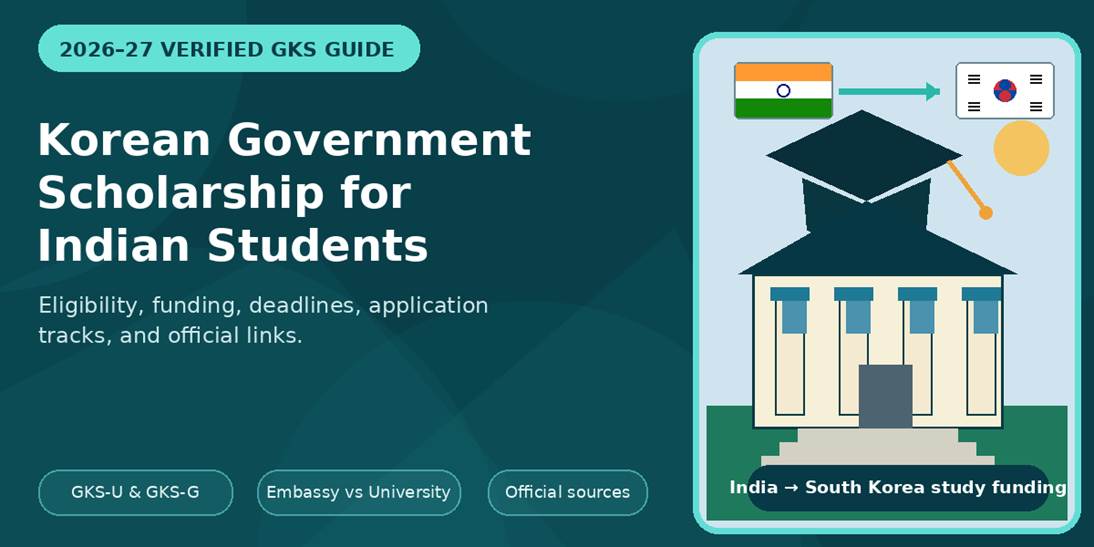
A verified guide to GKS-U and GKS-G for Indian applicants, including funding, India-specific quotas, application tracks, documents, selection stages, and official links.
| Current status: The confirmed 2026 application windows are closed. The 2026 GKS-G Embassy Track deadline in India was 25 February 2026. The 2026 GKS-U online window closed in 2025. No 2027 GKS guideline had been published by the official sources reviewed on 5 July 2026. |
1. Korean Government Scholarship for Indian Students: Quick Facts
The Korean Government Scholarship is officially called the Global Korea Scholarship. NIIED administers the degree program under South Korea’s Ministry of Education. Indian applicants can compete through the routes and quotas listed in each annual guideline.
| Attribute | Verified information |
| Official name | Global Korea Scholarship, abbreviated as GKS |
| Older name | Korean Government Scholarship Program, abbreviated as KGSP |
| Administrator | National Institute for International Education, or NIIED |
| Study destination | Participating higher-education institutions in the Republic of Korea |
| Undergraduate division | GKS-U for eligible associate and bachelor’s degree routes |
| Graduate division | GKS-G for eligible master’s, doctoral, research, and specialist routes |
| Main application tracks | Embassy Track and University Track |
| Core funding | Airfare, tuition support, Korean-language training support, and living allowance under the annual rules |
| 2026 status | Closed for the confirmed India application windows |
| Where to verify updates | Study in Korea, NIIED, the Embassy of the Republic of Korea in India, and participating universities |
Official sources: NIIED GKS Degree Program | Study in Korea
2. What Is the Global Korea Scholarship?
The Global Korea Scholarship is a South Korean government scholarship for international students. The program supports study at participating Korean universities. Its stated purpose is to expand international educational exchange and strengthen relationships between South Korea and participating countries.
GKS is not a single application form with one deadline. NIIED publishes separate guidelines for undergraduate and graduate recruitment. Each guideline defines the available programs, participating universities, country quotas, documents, benefits, and selection schedule.
Is GKS the same as KGSP?
Yes. KGSP is the older name used for the Korean Government Scholarship Program. NIIED integrated and branded the program as the Global Korea Scholarship in 2010. Many students still search for “KGSP scholarship,” but current official documents use GKS.
Who administers GKS?
NIIED administers the GKS degree program. Korean embassies and designated universities conduct first-round screening. NIIED conducts the central evaluation. Universities review Embassy Track candidates for admission at a later stage.
Official sources: NIIED program overview and selection process
3. GKS-U vs GKS-G: Which Program Applies to You?
GKS-U and GKS-G serve different education levels. Applicants should identify the correct division before checking age, degree, deadline, or university rules.
| Feature | GKS-U | GKS-G |
| Target applicant | High-school graduates and eligible associate-degree applicants | Applicants with the prior degree required for a master’s, doctoral, or research route |
| Main awards | Associate degree and bachelor’s degree | Master’s degree, doctoral degree, research program, and selected specialist routes |
| General age benchmark | Under 25 under the applicable annual guideline | Under 40 under the applicable annual guideline, with limited exceptions defined in the guideline |
| Typical period | One Korean-language year plus two to three associate years or four to six bachelor’s years | One Korean-language year plus two master’s years or three doctoral years; research and specialist programs differ |
| Academic evidence | High-school or eligible prior-program transcript | Bachelor’s, master’s, or other relevant prior-degree transcript |
| Recruitment timing | Usually announced in the second half of the preceding calendar year | Usually announced near the beginning of the intake year |
| Controlling document | Latest GKS-U application guideline | Latest GKS-G application guideline |
| Do not combine the rules: A student applying after Class 12 should not use a GKS-G age limit, quota, or deadline. A master’s or PhD applicant should not use the GKS-U benefit table without checking the graduate guideline. |
4. Current Deadlines and India-Specific Quotas
Latest confirmed application status
The 2026 India application windows are closed. The next application can only be treated as open after NIIED, Study in Korea, the Korean Education Centre in India, the Korean embassy, or a participating university publishes the relevant annual notice.
| Program and route | Confirmed 2026-cycle timing | Status on 5 July 2026 |
| GKS-U Embassy Track | 15 September to 30 September 2025, Korea Standard Time | Closed |
| GKS-U University Track | 15 September to 31 October 2025, Korea Standard Time | Closed |
| GKS-G Embassy Track in India | Online application deadline: 25 February 2026 | Closed |
| GKS-G University Track | Deadline set by the participating university within the annual schedule | Closed for the 2026 recruitment cycle |
| 2027 recruitment | No official guideline verified at the time of this update | Not yet announced |
The undergraduate schedule above came from the 2026 GKS-U guideline. The graduate India deadline came from the Embassy of the Republic of Korea in India. The Indian notice required applicants to create a Study in Korea account and submit online. It stated that offline submission was not accepted for that Embassy Track round.
Official sources: 2026 GKS-U Application Guidelines | 2026 GKS-G India Embassy Notice
India quota: what the latest confirmed figures mean
Country quotas change by year. They are not permanent seat guarantees. Applicants should quote the year whenever they mention an India quota.
| 2026 allocation | Latest confirmed figure | Interpretation |
| GKS-U India Embassy Track | 4 places: 2 General and 2 R-GKS | India-specific undergraduate Embassy Track allocation in the 2026 guideline |
| GKS-G India Embassy Track | 26 places | Country allocation reported in the 2026 graduate guideline attached to the official India notice |
| GKS-G India country-specific University Track | 47 places | Country-specific University Track allocation reported for the 2026 graduate cycle |
| Global specialist pools | Separate from India-only allocations | Programs such as UIC, R&D, or Global Network may use separate global or institution-based pools |
A quota does not reveal the acceptance rate. The official sources do not publish a verified denominator for every India route, subject, and university. Any website that divides seats by an unverified application count is presenting an estimate, not an official acceptance rate.
5. GKS Eligibility for Indian Students
Eligibility begins with the annual guideline. Meeting the minimum standard does not guarantee selection. A participating university or department may impose additional language, portfolio, research, or academic requirements.
Nationality
Applicants must hold citizenship of a country invited by NIIED for the relevant program. Indian citizens can apply when India appears in the annual country and quota documents. Applicants and both parents generally must not hold Korean citizenship. Dual Korean citizenship can make an applicant ineligible unless the guideline allows and documents a qualifying renunciation process.
Age
The 2026 GKS-U guideline required applicants to be under 25 and born after 1 March 2001. The general NIIED graduate rule requires applicants to be under 40 by the date stated in the inviting year. A limited higher age ceiling may apply to certain academic professors from eligible ODA-recipient countries. Applicants must use the exact birth-date boundary in the current guideline.
Academic qualification
GKS-U applicants must satisfy the prior-education requirement for the selected associate or bachelor’s route. GKS-G applicants must hold the prior degree required for the selected master’s, doctoral, or research program by the specified final-document date.
Expected graduates may apply when the annual guideline permits it. They must submit an expected-graduation certificate and later provide the final graduation certificate and transcript by the stated deadline. Missing that deadline can cancel a selection.
Minimum grades
The standard GKS academic threshold is not simply “80 percent or nothing.” The latest undergraduate guideline accepted either a score percentile of at least 80 percent, a class rank within the top 20 percent, or an accepted equivalent CGPA.
| Accepted academic route | Minimum benchmark shown in the 2026 GKS-U guideline |
| 100-point scale | 80 percent or higher |
| Class rank | Within the top 20 percent of the class |
| 4.0 scale | 2.64 or higher |
| 4.3 scale | 2.80 or higher |
| 4.5 scale | 2.91 or higher |
| 5.0 scale | 3.23 or higher |
An applicant whose transcript uses another grading scale should obtain an official explanation of the institution’s grading system. A private online conversion is not enough unless the issuing school or a competent authority validates the conversion as required by the guideline.
Health and travel eligibility
Applicants must be able to study in South Korea for the full scholarship period. The guideline can require a personal medical assessment during application and a comprehensive medical examination after selection. Applicants also need to meet legal travel and visa conditions.
Restrictions that require careful review
- Previous Korean government degree-scholarship history can restrict a new application.
- Graduation from certain Korean schools or degree programs can create ineligibility under the relevant route.
- Duplicate applications can cause disqualification.
- Applicants must select only universities and departments listed for the chosen track.
- An applicant can meet NIIED’s minimum requirements but still fail a university’s additional requirement.
Official sources: 2026 GKS-U eligibility and FAQ | NIIED general qualification summary
6. What Does the Korean Government Scholarship Cover?
GKS covers the major costs of an eligible study program. The word “fully funded” is useful shorthand, but it should not be read as “every personal expense is paid.” Scholars can still face document, visa, housing, travel-insurance, equipment, and personal-spending costs.
2026 GKS-U benefit benchmark
The table below uses the official 2026 GKS-U figures. USD values are planning estimates calculated at KRW 1,500 per USD. Exchange rates change. NIIED pays and administers benefits in KRW under the annual rules.
| Benefit | Official KRW benchmark | Approximate USD | Important condition |
| Tuition support | Up to KRW 5,000,000 from NIIED | About USD 3,333 | The university covers the amount above the NIIED limit and the admission fee under the 2026 guideline |
| Korean-language training fee | KRW 5,200,000 for four quarters | About USD 3,467 | Paid through the administering institution |
| Annual allowance during language study | KRW 12,840,000 | About USD 8,560 | All-inclusive annual support under the guideline |
| Annual allowance during degree study | KRW 13,680,000 | About USD 9,120 | All-inclusive annual support under the guideline |
| Airfare | Economy-class ticket at actual eligible expense | Varies | Domestic travel in the home country and international travel insurance were not covered by the 2026 GKS-U rule |
2026 GKS-G planning benchmark
The 2026 graduate guideline attached to the official India notice used annual support bands that varied by language, degree, and research status. The following figures should be checked again in the next GKS-G guideline before publication or application.
| Graduate support category | 2026 KRW benchmark | Approximate USD at KRW 1,500/USD |
| Korean-language year allowance | KRW 14,400,000 per year | About USD 9,600 |
| Graduate degree-year allowance | KRW 16,560,000 per year | About USD 11,040 |
| Research-program allowance | KRW 20,880,000 per year | About USD 13,920 |
| Tuition support ceiling | KRW 5,000,000 | About USD 3,333 |
| Korean-language training fee | KRW 5,200,000 | About USD 3,467 |
| Eligible airfare | Economy-class airfare under the annual rules | Actual eligible expense |
What the annual allowance includes
The undergraduate guideline describes the annual allowance as an all-inclusive subsidy. It incorporates living expenses and several program-related items, including health-insurance support, Korean-proficiency grants, TOPIK application fees, settlement support, and degree-completion support. The exact composition can differ by annual and program guideline.
Costs applicants should budget before selection
- Academic transcripts, duplicate originals, and courier charges.
- Notarization, apostille, consular confirmation, or certified translation when required.
- Language tests, passport renewal, and local travel.
- Visa-related incidentals not covered by the award notice.
- Housing deposits, bedding, devices, winter clothing, and personal travel.
- Exchange-rate risk when comparing KRW benefits with family expenses in INR or USD.
Official sources: 2026 GKS-U benefit table | Official 2026 GKS-G India notice and guideline attachment
7. Embassy Track vs University Track
Embassy Track and University Track are different application channels. They lead into the same GKS system, but the first evaluator, university-choice rules, quota structure, and later review stages differ.
| Decision factor | Embassy Track | University Track |
| First-round evaluator | Korean embassy or the designated education office for the applicant’s country | The selected GKS-designated Korean university |
| Submission channel | Study in Korea or the method stated by the embassy notice | Study in Korea or the method stated by the university and annual guideline |
| University choices | The annual guideline may allow multiple universities, subject to Type A and Type B rules | Usually one university and one department for the selected route |
| Later admission review | Universities review candidates who pass the NIIED round | The university has already completed its first-round review before NIIED evaluation |
| Best fit | Applicants who need the permitted range of university choices and can build a balanced list | Applicants with a strong, specific match to one participating university or specialist program |
| Main risk | Incorrect university combinations or broad competition | Dependence on one institutional choice and one department |
Can an applicant use both tracks?
An applicant must not submit prohibited duplicate applications. The 2026 GKS-U guideline allowed an unsuccessful first-round Embassy Track applicant to apply later through University Track because the schedules were separated. It did not allow simultaneous applications through both tracks. The next guideline can change the sequence, so applicants must recheck the rule.
How many universities can Embassy Track applicants select?
Under the 2026 GKS-U General and Overseas Korean Embassy Track, applicants could select up to three universities and had to include at least one Type B institution. R-GKS applicants could select up to two Type B universities. University Track applicants could apply to one university and one department.
Track-selection framework
1. Confirm whether the desired degree and department appear in the annual university-information file.
2. Check whether the program is available through Embassy Track, University Track, or a specialist route.
3. Compare the number of permitted university choices.
4. Compare the India-specific quota with any global or institution-based quota.
5. Assess academic, research, and language fit at department level.
6. Select one compliant application route and document the reason for that choice.
7. Recheck the duplicate-application rule before submitting.
8. How to Choose a GKS University and Study Field
Applicants cannot treat every Korean university as a GKS option. They can apply only to the institutions and departments listed for the relevant year, program, and track. A university may participate in one route but not another. A department may impose conditions beyond the central GKS minimum.
Use the official university-information file
The annual GKS post includes a university-information file. Applicants should verify the degree level, department name, language of instruction, available track, faculty profile, laboratory resources, portfolio requirements, and contact information. The general university website is not a substitute for the GKS-specific file.
Type A and Type B do not mean good and bad
Type A and Type B are administrative classifications used in track rules. Type B often includes regional institutions. The classification does not measure teaching quality, research strength, employability, or personal fit. Applicants should compare departments rather than choose only by city or brand recognition.
University-fit scorecard
| Criterion | Suggested editorial weight | What to verify |
| Department eligibility | Pass or fail | The exact department appears in the annual file for the selected track |
| Academic or research fit | 30 percent | Curriculum, faculty, laboratory, thesis field, and prior preparation |
| Language readiness | 15 percent | Medium of instruction and departmental language expectations |
| Applicant competitiveness | 15 percent | Grades, portfolio, publications, projects, and subject preparation |
| Career relevance | 15 percent | How the degree connects to a realistic India, Korea, or international pathway |
| Location and living practicality | 10 percent | Housing, climate, transport, and personal support needs |
| Evidence for application essays | 15 percent | Specific facts that can justify the university choice |
| Information gain: A strong university list is not a ranking list. It is an evidence-based match between the applicant’s preparation, the department’s resources, the track rules, and the proposed study outcome. |
Official sources: Study in Korea university and program search
9. Are TOPIK, IELTS, or TOEFL Required?
No single language answer applies to every GKS applicant. NIIED’s central rule, the annual guideline, and the selected university can set different expectations. A language score can be optional for central eligibility but valuable or compulsory for a department.
TOPIK
TOPIK measures Korean-language proficiency. A high TOPIK score can strengthen evaluation and can affect Korean-language training. The 2026 GKS-U guideline exempted applicants with TOPIK Level 5 or 6 from the Korean-language year. Scholars who reached Level 5 or 6 during the first six months could move into degree study under the stated schedule.
IELTS and TOEFL
English-language scores can demonstrate readiness for English-medium programs. The 2026 undergraduate guideline awarded language-evaluation points for specified TOPIK, TOEFL iBT, and IELTS bands. A department can still set its own minimum. An applicant should not assume that an English-medium prior degree automatically replaces an official test.
Practical language strategy
- Check the GKS guideline first.
- Check the university-information file second.
- Check the department’s current admission page third.
- Submit only scores that remain valid under the guideline.
- Do not claim fluency that the interview or score report cannot support.
- Begin Korean study even when TOPIK is not mandatory. Daily life and the language year still require sustained learning.
Official sources: Official TOPIK website | Study in Korea language information
10. Documents Required from Indian Applicants
The annual application forms control the document list. Applicants should not reuse a form from an older cycle. A document can be factually correct but still unacceptable because it lacks the required original signature, seal, certification, translation, or apostille.
| Document group | Purpose | Common failure |
| GKS application forms | Records personal data, track, university choices, and declarations | Using an old form or leaving a required signature blank |
| Personal statement | Explains preparation, motivation, evidence, and future direction | Generic claims that could apply to any country or degree |
| Study plan or research proposal | Shows academic feasibility and planned outcomes | A plan that does not match the chosen department |
| Recommendation letter | Provides an external assessment of academic ability and character | A vague letter from a referee who cannot verify the applicant’s work |
| Graduation or expected-graduation certificate | Proves degree status | Submitting a provisional document without checking the final-document deadline |
| Academic transcript | Proves grades and curriculum | Submitting a portal screenshot or an unverified conversion |
| Applicant and parental citizenship evidence | Proves nationality eligibility | Missing a parent document or inconsistent names |
| Family-relationship evidence | Connects applicant and parental records when required | Name or date differences without supporting explanation |
| Language score | Supports Korean or English readiness | Submitting an expired or unofficial score |
| Awards, portfolio, publications, or certificates | Supports claimed achievement | Uploading irrelevant volume instead of strong evidence |
| Medical form | Screens ability to undertake the program | Incomplete disclosure or missed post-selection examination |
Apostille, notarization, and translation in India
An apostille authenticates the origin of a public document for use between countries covered by the Apostille Convention. It does not prove that the document’s academic content is correct. It verifies the signature, seal, or official capacity behind the document.
Indian applicants should follow the current GKS guideline before starting certification. The guideline may distinguish originals, copies, apostilled documents, consularly confirmed documents, and certified translations. Applicants should not apostille every paper automatically. They should prepare the exact form and number of sets requested.
India’s e-Sanad platform is an official Ministry of External Affairs initiative for online verification, attestation, and apostille of eligible documents. Availability depends on the issuing authority and digital repository. Applicants with documents outside the supported system should follow the current MEA process.
Document-preparation sequence
1. Download the current application forms and document checklist.
2. Match every name, date, institution, and degree title across records.
3. Ask the issuing school or university for sealed or official copies where required.
4. Obtain an official grading explanation when the transcript uses an unaccepted scale.
5. Arrange certified translation for documents that are not in an accepted language.
6. Complete apostille or consular confirmation only as the guideline requires.
7. Scan every page clearly and preserve the physical originals.
8. Create a final index that matches the upload or submission order.
Official sources: e-Sanad: MEA attestation and apostille platform | 2026 GKS-U document and FAQ guidance
11. How to Apply for GKS from India
Step 1: Find the correct annual notice
Start with the GKS notice board and the India-specific announcement. Confirm the program year, degree level, track, quota, and submission deadline. Ignore copied deadlines that do not link to the controlling notice.
Step 2: Create or update the Study in Korea account
The 2026 India graduate notice required an account and online submission through Study in Korea. Applicants should use an email address they monitor daily. Names and birth dates should match the passport and academic documents.
Step 3: Select the program and track
Choose GKS-U or GKS-G. Then choose Embassy Track, University Track, or an eligible specialist route. Confirm that the desired department participates through that route.
Step 4: Build the university shortlist
Use the annual university-information file. Apply the Type A and Type B rules where relevant. Remove any university that does not offer the intended department or language pathway.
Step 5: Verify eligibility with documents
Do not rely on memory. Calculate the accepted CGPA or rank route. Confirm the age boundary. Check applicant and parental citizenship. Verify graduation status and final-document dates.
Step 6: Draft the personal statement and study plan
Write from evidence. Connect prior study, projects, research, work, language learning, and the selected Korean program. Keep the personal statement and study plan consistent.
Step 7: Obtain the recommendation
Choose a referee who can assess academic ability with specific examples. Give the referee the current prompt and deadline. Do not write unsupported praise for the referee to sign.
Step 8: Authenticate and translate documents
Complete the required certification early. Indian university records can take weeks to issue. Apostille and courier steps can create additional delays.
Step 9: Complete the online application
Enter information exactly as it appears in the evidence. Upload readable files in the required format. Review university choices before final submission. Korea Standard Time can place the deadline several hours ahead of India Standard Time.
Step 10: Save submission evidence
Download or capture the application confirmation. Keep the final essays, files, and reference numbers. Monitor Study in Korea, email, embassy updates, and university messages until the process ends.
Official sources: Study in Korea portal | Embassy of the Republic of Korea in India: 2026 GKS-G notice
12. How the GKS Selection Process Works
GKS uses multiple selection stages. Embassy Track normally includes one more university-admission stage than University Track because the first Embassy Track evaluation occurs outside the university.
| Stage | Embassy Track | University Track |
| Application | Applicant submits through the official embassy route | Applicant submits to the selected participating university route |
| First round | Embassy or designated education office screens and nominates | University screens and nominates |
| Central round | NIIED evaluates nominated candidates | NIIED evaluates nominated candidates |
| University admission review | Universities review candidates who passed the NIIED stage | Completed as part of the university’s first round |
| Final decision | NIIED announces final scholars after required admission and verification | NIIED announces final scholars after central review and verification |
What evaluators can assess
The official guidelines do not publish a complete public scoring formula for every reviewer. Applicants should therefore avoid claims about secret weightings. The application does provide evidence for several defensible evaluation dimensions.
- Academic performance and subject preparation.
- Feasibility of the study or research plan.
- Fit with the selected department and university.
- Language readiness and learning capacity.
- Quality and credibility of recommendations.
- Consistency across forms, essays, transcripts, and interview answers.
- Potential contribution to the applicant’s field and to international exchange.
- Compliance with every administrative rule.
Interview preparation
An interview can test whether the applicant understands the proposed degree, university, field, and life in South Korea. Answers should be direct. Applicants should support claims with evidence and acknowledge weaknesses without inventing excuses.
- Explain why the selected field requires the proposed Korean program.
- Defend each university choice with department-level facts.
- Describe a realistic study schedule and career outcome.
- Explain a low grade, gap, or field change with evidence of recovery.
- Demonstrate basic awareness of Korean academic and social expectations.
- Prepare to discuss every award, publication, project, and test score listed in the file.
Official sources: NIIED selection procedure
13. Personal Statement, Study Plan, and Research Proposal
Personal statement
A GKS personal statement explains the applicant’s development. It should not function as a tourism essay about South Korea. It should show how previous education, work, projects, service, language learning, or research produced the current academic goal.
| Weak approach | Stronger approach |
| “I love Korean culture and want to study in Korea.” | Name the academic problem, relevant Korean expertise, and evidence that the applicant has prepared for the field. |
| A list of awards without context | Explain the challenge, action, measurable result, and skill developed. |
| Generic leadership claims | Describe one situation, the applicant’s decision, and the outcome. |
| A career promise without a pathway | Connect the degree, specific competencies, target sector, and next professional step. |
| The same essay for every university | Use university-specific faculty, curriculum, laboratory, or regional evidence where the form permits. |
Study plan
The study plan explains what the applicant will do after selection. It should include language preparation, academic objectives, course or research progression, expected outputs, and a realistic post-study pathway. The plan should match the selected department’s resources.
Research proposal for graduate applicants
A research proposal should define the problem, explain why it matters, identify the knowledge gap, state the research question, outline the method, and name the expected contribution. The proposal should fit the available supervisor, laboratory, data, ethics requirements, and degree duration.
| Evidence chain: Previous preparation → defined problem → selected Korean department → feasible method → expected output → contribution after graduation. |
14. Common Reasons GKS Applications Fail
Many failures are administrative rather than academic. A strong applicant can be rejected before substantive review if the file violates a track rule or lacks valid evidence.
| Risk | Why it matters | Prevention |
| Outdated guideline | Forms, quotas, documents, and dates can change | Download the current annual package from the official notice |
| Wrong program division | GKS-U and GKS-G use different rules | Confirm the degree level before preparing the file |
| Ineligible university or department | NIIED accepts only listed choices | Use the annual university-information file |
| Duplicate application | Prohibited duplication can cancel selection | Follow the exact track and timing rule |
| Unsupported grade conversion | The committee cannot verify eligibility | Obtain an official grading explanation or accepted conversion |
| Incomplete citizenship evidence | Nationality eligibility cannot be confirmed | Prepare applicant, parent, and relationship documents together |
| Certification error | A correct document may be formally invalid | Follow the original, apostille, and translation instructions |
| Generic essays | The file shows weak academic fit | Use specific evidence and a department-level rationale |
| Contradictory application | Reviewers cannot reconcile the applicant’s goal | Align forms, essays, university choices, and interview answers |
| Late final degree document | Expected-graduate eligibility remains incomplete | Track the final certificate and transcript deadline |
| Missed time-zone deadline | The portal closes on Korea Standard Time | Convert the deadline to India Standard Time and submit early |
| Unverified third-party advice | The applicant follows a rule that does not exist | Use unofficial websites only to discover official sources |
15. What Happens After Final Selection?
Final selection starts a new compliance process. Scholars must follow NIIED, embassy, university, language-institute, medical, visa, and travel instructions. A final result is not permission to ignore later deadlines.
1. Submit any final original or authenticated documents requested by NIIED or the university.
2. Complete the required medical examination and disclose relevant conditions accurately.
3. Apply for the appropriate Korean student visa using the current embassy and Korea Visa Portal instructions.
4. Follow the official airfare and arrival process. Do not purchase a ticket on the assumption that every itinerary will be reimbursed.
5. Attend pre-departure or arrival orientation when scheduled.
6. Register with the assigned Korean-language institution unless formally exempted.
7. Complete immigration and residence procedures after arrival.
8. Maintain the academic, language, conduct, reporting, and attendance conditions required to continue the scholarship.
Official sources: Korea Visa Portal | Hi Korea immigration services
16. Final GKS Checklist for Indian Students
| Area | Checklist |
| Eligibility | Indian citizenship confirmed; parental citizenship checked; age boundary checked; accepted academic threshold proved; prior degree and expected-graduation rules checked |
| Program | Correct GKS-U or GKS-G division selected; eligible degree route selected; annual quota verified |
| Track | Embassy or University Track selected; duplicate rule checked; university-choice limit checked |
| University | Institution and department listed; language of instruction checked; additional requirements checked; faculty or curriculum fit documented |
| Documents | Current forms used; signatures complete; transcript and degree evidence official; citizenship and family evidence consistent; recommendation obtained |
| Certification | Translation, notarization, apostille, or consular confirmation completed only as required |
| Essays | Personal statement uses evidence; study plan is feasible; research proposal fits the department; all documents tell the same story |
| Submission | Deadline converted to IST; files readable; online confirmation saved; email and portal monitored |
| Interview | University choices justified; study plan defendable; weaknesses explained honestly; every claim verifiable |
| Post-selection | Medical, visa, airfare, original-document, language-study, and arrival instructions tracked |
17. Frequently Asked Questions
Can Indian students apply for the Korean Government Scholarship?
Yes. Indian citizens can apply when India is included in the relevant annual GKS country and quota documents. Applicants must also satisfy the age, education, grade, citizenship, health, document, and track requirements. The current annual guideline and the India-specific official notice control eligibility.
Is GKS the same as KGSP?
Yes. KGSP is the former name of the Korean Government Scholarship Program. NIIED has used the Global Korea Scholarship, or GKS, branding since 2010. Students searching for KGSP should use current GKS forms, deadlines, quotas, and terminology rather than older application materials.
Is GKS fully funded for Indian students?
GKS covers the principal scholarship costs, including eligible airfare, tuition support, Korean-language training support, and a living allowance. “Fully funded” does not mean every expense is reimbursed. Applicants can still pay for documents, apostille, translation, local travel, deposits, equipment, and personal spending.
How much does GKS provide in USD?
The value depends on the program and exchange rate. The 2026 GKS-U degree-year allowance was KRW 13,680,000, about USD 9,120 at KRW 1,500 per USD. Tuition support reached KRW 5,000,000, about USD 3,333. Always retain the official KRW figure.
What percentage or CGPA is required for GKS?
The standard route requires at least 80 percent on a 100-point scale, placement within the top 20 percent of the class, or an accepted equivalent CGPA. The 2026 GKS-U minimums included 2.64/4.0, 2.80/4.3, 2.91/4.5, and 3.23/5.0.
Can I apply with less than 80 percent?
Possibly. The guideline can accept an applicant below 80 percent when the applicant ranks within the top 20 percent of the class. The applicant must submit an official rank certificate or institutional letter with the transcript. A self-calculated rank or unsupported online conversion is insufficient.
What is the age limit for GKS-U and GKS-G?
GKS-U generally requires applicants to be under 25 by the annual cutoff. The 2026 rule required birth after 1 March 2001. GKS-G generally requires applicants to be under 40 by the stated cutoff, with limited exceptions. Use the exact birth-date rule in the new guideline.
Is TOPIK compulsory for GKS?
TOPIK is not universally compulsory for every route and department. A valid score can improve evaluation and affect Korean-language training. The 2026 GKS-U guideline exempted selected scholars with TOPIK Level 5 or 6 from the language year. Universities can impose additional Korean-language requirements.
Is IELTS compulsory for GKS?
IELTS is not a universal central requirement for every GKS application. An English-medium department may require IELTS, TOEFL, or another form of evidence. A valid score can strengthen the file even when optional. Applicants must check the annual guideline and the selected department’s requirements.
Which is better: Embassy Track or University Track?
Neither track is automatically better. Embassy Track can offer the university-choice range allowed by the guideline. University Track can suit an applicant with a strong match to one institution or specialist program. The better route is the one that is eligible, compliant, and supported by evidence of fit.
Can I apply through Embassy Track and University Track at the same time?
Applicants must follow the annual duplicate-application rule. The 2026 GKS-U schedule allowed an applicant rejected in the Embassy Track first round to apply later through University Track. It did not allow simultaneous applications. Future schedules can differ, so verify the new guideline before submitting.
How many universities can I choose?
The number depends on the program and track. The 2026 GKS-U General Embassy Track allowed up to three universities and required at least one Type B choice. R-GKS allowed up to two Type B universities. University Track applicants generally selected one university and one department.
How many GKS places are available for Indian students?
The figure changes annually. The 2026 GKS-U guideline assigned four India Embassy Track places. The 2026 GKS-G guideline reported 26 India Embassy Track places and 47 country-specific University Track places. These numbers do not guarantee future quotas or reveal an official acceptance rate.
Can final-year students apply for GKS?
Expected graduates can apply when the annual guideline allows it. They must submit an expected-graduation certificate and later provide the final graduation certificate and transcript by the stated deadline. Failure to submit the final records can cancel selection even after the applicant passes an earlier round.
Which Indian documents need an apostille?
The GKS guideline decides which documents require apostille, consular confirmation, originals, copies, or certified translation. Educational certificates, transcripts, citizenship documents, and family records can receive different treatment. Do not apostille everything by default. Follow the current checklist and use India’s official e-Sanad or MEA process.
Is there a GKS application fee?
NIIED does not describe a central scholarship application fee in the core GKS process. Applicants can still incur costs for tests, certified documents, translations, apostille, courier, and university-specific supplementary materials. A university should be checked directly before assuming that every related admission service is free.
Does GKS cover accommodation?
The scholarship provides an annual allowance rather than a universal separate promise to pay every dormitory bill. Universities can deduct or charge housing costs according to their arrangements. Scholars should compare the allowance with dormitory fees, deposits, meals, utilities, and city-level living costs before departure.
When will the next GKS application open in India?
No 2027 guideline was verified by the official sources reviewed on 5 July 2026. Undergraduate and graduate recruitment follow separate schedules. Applicants should monitor Study in Korea, NIIED, the Embassy of the Republic of Korea in India, the Korean Education Centre in India, and participating universities.
Conclusion
The Global Korea Scholarship is the principal South Korean government degree-scholarship route for eligible Indian students. The central decision is not simply whether to apply. The applicant must identify GKS-U or GKS-G, select the correct track, prove every eligibility attribute, and build a department-specific application.

You may like

Check Student Scholarship Status Online: SSP Karnataka Application and Payment Status

Government Scholarship for College Students 2022 in India: Eligibility, Amount, and Application Guide

Digital Gujarat Scholarship for OBC Students 2026 to 27: Eligibility, Amount, Last Date and Application Guide

Turkey Burslari Scholarship 2026: Eligibility, Benefits, Deadline, Interview, and Results

SBI Asha Scholarship 2026-27: Eligibility, Amount, Last Date and Apply Online

Scholarship for J&K Students: Eligibility, Amount, Deadlines, and How to Apply
Trending
-
 Scholarships2 months ago
Turkey Burslari Scholarship 2026: Eligibility, Benefits, Deadline, Interview, and Results
-
 Scholarships1 month ago
SBI Asha Scholarship 2026-27: Eligibility, Amount, Last Date and Apply Online
-
 Scholarships2 months ago
Scholarship for J&K Students: Eligibility, Amount, Deadlines, and How to Apply
-

 Scholarships2 months ago
Scholarships for PG Students in Kerala 2026: Eligibility, Amounts, Deadlines and Application Links
-
 By Country3 months ago
Scholarship for MBBS Students in India
-

 Scholarships1 month ago
West Bengal Student Scholarship 2026-27: Eligibility, Amounts, Last Dates and Apply Online
-
 Scholarships2 months ago
Abdul Kalam Scholarship for Class 10 Students: Verified Programs, Eligibility and Application Guide
-

 Scholarships2 months ago
Scholarships for NIT Students in India 2026: Eligibility, Amounts and Application Links