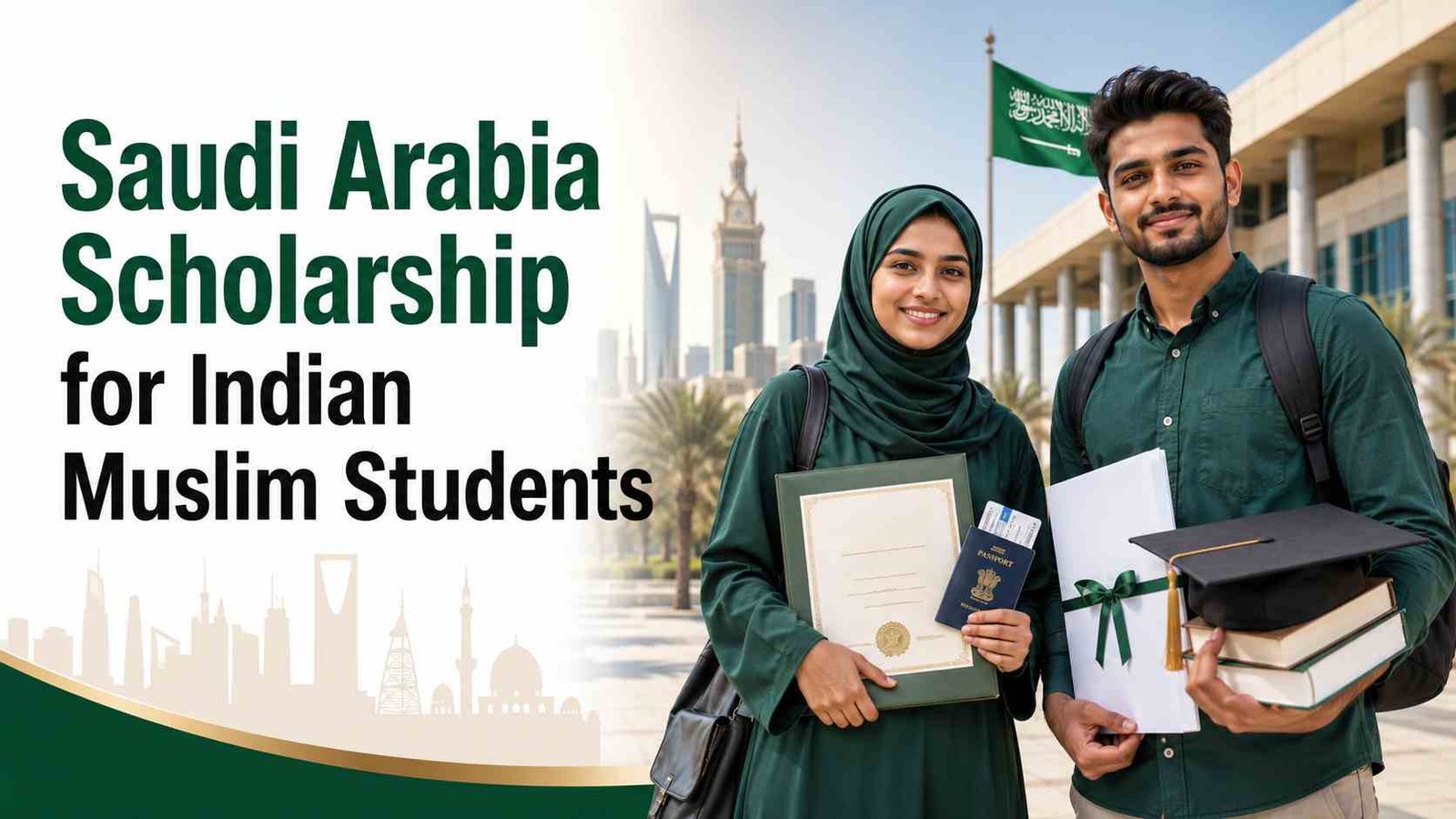
A Saudi Arabia scholarship for Indian Muslim students can come from the Saudi government, a Saudi public university, or the Islamic Development Bank.
Most Saudi university scholarships are open to eligible international students. These scholarships do not normally require applicants to be Muslim. The Islamic Development Bank Scholarship Program for Muslim Communities specifically accepts eligible Indian Muslim students.
However, the IsDB programme usually funds undergraduate study at a recognized university in India. It does not automatically provide admission or funding to study in Saudi Arabia.
Current status: The unified 2026 international application cycle on the Study in Saudi platform closed on May 31, 2026. Students targeting 2027 admission should prepare their passports, academic records, test scores, translations, attestations, medical reports, and recommendations before the next calendar is published.
Saudi Scholarships for Indian Students at a Glance
Scholarship or university
Study level
Funding
Muslim-only?
Application route
Current position
Saudi government external scholarships
Diploma, bachelor’s, master’s and PhD
Full or partial funding depends on the programme
No
Study in Saudi
2026 unified deadline passed
KAUST Fellowship
MS, MS/PhD and PhD
USD 20,000–30,000 annual stipend plus tuition, housing and insurance
No
KAUST admission portal
Fall 2026 closed
KFUPM Scholarship
Bachelor’s, selected MS and PhD programmes
Tuition, stipend, housing, healthcare and other benefits
No
KFUPM or Study in Saudi route
Programme-specific
King Saud University Scholarship
Mainly undergraduate and selected postgraduate routes
Benefits depend on scholarship category
No
Study in Saudi
2026 central cycle passed
KSU Graduate Initiative
Selected PhD programmes
USD 14,400 annually plus tuition, housing and healthcare
No
Initiative portal and Study in Saudi
Previous phase closed
King Abdulaziz University Scholarship
Undergraduate and postgraduate
University-specific international scholarship benefits
No
Study in Saudi or university portal
Programme-specific
Islamic University of Madinah Scholarship
Bachelor’s and postgraduate programmes
Full scholarship listings can include tuition, stipend, housing, insurance and tickets
Programme-dependent
Study in Saudi
2026 undergraduate period closed
Princess Nourah University Scholarship
Undergraduate and Arabic diploma for women
Tuition, stipend, housing, healthcare and travel benefits
No
Study in Saudi
2026 central cycle passed
IsDB Muslim Communities Scholarship
Undergraduate or first degree
Tuition, local stipend, books and medical support
Yes
IsDB scholarship system
Verify the next official call
The Saudi Ministry of Education scholarship framework divides public-university opportunities into full scholarships, partial scholarships, and paid study places. External scholarships are intended for non-Saudi applicants living outside Saudi Arabia.
Is There a Saudi Scholarship Only for Indian Muslim Students?
There is no single Saudi government scholarship formally reserved for Indian Muslim students across all Saudi universities.
Saudi public universities normally evaluate international applicants through nationality, academic qualifications, age, admission requirements, medical fitness, document authentication, and programme availability. Religion is not listed as a universal eligibility condition in the Saudi Ministry of Education’s general scholarship rules.
The Embassy of India in Riyadh confirms that Indian students can apply to participating Saudi government universities. Applicants must follow the conditions and application process of the relevant institution.
Which scholarship specifically accepts Indian Muslims?
India appears on the programme’s official list of eligible Muslim communities. The programme targets academically capable students who cannot continue their education without financial assistance.
Does the IsDB scholarship fund study in Saudi Arabia?
Usually, no.
The current IsDB SPMC booklet states that recipients normally study at recognized government universities in their own countries. An Indian recipient would therefore generally pursue an eligible degree in India rather than relocate to Saudi Arabia.
This distinction prevents a common application mistake:
Saudi government or university scholarship: funds education in Saudi Arabia.
IsDB Muslim Communities Scholarship: is administered by a Saudi-based development bank but normally funds education in the applicant’s home country.
Best Saudi Arabia Scholarships for Indian Muslim Students
1. Saudi Government External Scholarships
A Saudi external scholarship is a place awarded to a non-Saudi student who resides outside the Kingdom.
International applicants can search for full, partial, and self-funded programmes through the official Study in Saudi platform. The portal includes universities, academic programmes, scholarship types, study languages, admission conditions, and educational-visa information.
What can a full Saudi scholarship cover?
Benefits depend on the university and programme.
The Saudi Ministry of Education states that an external scholarship recipient may receive:
Free education
Healthcare
An arrival allowance
University accommodation
Student services
Annual travel tickets
A partial scholarship can provide fewer benefits. It may cover only the academic place, or the academic place and accommodation.
The Study in Saudi platform describes a full scholarship as funding that covers tuition, housing, and living support. Applicants must still read the individual programme page because the exact stipend and benefits are not standardized across every university.
What study levels are available?
Saudi public universities can offer scholarships for:
Arabic-language diplomas
Bachelor’s degrees
Higher diplomas
Master’s degrees
PhD programmes
The available level depends on the university and application cycle.
Can Indian students study medicine on a full scholarship?
Students should not assume that medical programmes are included.
The Ministry of Education’s general public-university scholarship page excludes health and medical specialties from its standard international scholarship route. Individual institutions can advertise separate fee-based health programmes for international students. King Saud University, for example, lists self-sponsored health-science programmes with separate conditions.
2. KAUST Fellowship
The KAUST Fellowship is one of the most comprehensive Saudi scholarships for Indian graduate students.
King Abdullah University of Science and Technology offers research-focused MS, MS/PhD, and PhD degrees. KAUST does not offer regular undergraduate degrees.
How much does the KAUST Fellowship provide?
The fellowship provides:
Full tuition and bench fees worth up to USD 35,000 per year
USD 20,000 in annual living support for MS students
USD 25,000–30,000 in annual living support for PhD students
Base university accommodation
Health insurance
Visa and relocation assistance
Initial travel and return-home support
KAUST estimates the fellowship’s total annual value at approximately USD 70,000–80,000, depending on the recipient’s circumstances.
Do Indian students need a separate scholarship application?
No separate KAUST Fellowship application is normally required.
Most admitted graduate students automatically receive the fellowship. Students with an external sponsorship or partnership arrangement can be subject to different funding terms.
What GPA is required?
KAUST permits applications from students with a minimum GPA of 3.0 on a 4.0 scale.
Admission remains highly competitive. KAUST states that approximately 90% of admitted applicants have a GPA above 3.3, while approximately 75% have a GPA above 3.5.
Is the KAUST 2026 application open?
No.
International applications for fall 2026 closed on May 7, 2026. The official page had not yet published a separate fall 2027 calendar at the time of this article’s verification. Students should monitor the KAUST admission timeline rather than relying on an estimated date.
KFUPM is particularly relevant to students interested in engineering, computing, mathematics, petroleum studies, materials, business, and applied sciences.
Undergraduate scholarship benefits
KFUPM states that international undergraduate students living outside Saudi Arabia receive a tuition waiver and a full scholarship.
Benefits may include:
Free on-campus housing
A monthly stipend
Free course textbooks
University medical services
KFUPM teaches its courses in English.
Graduate scholarship benefits
KFUPM offers comprehensive scholarships for all PhD programmes and selected MS programmes that do not have a corresponding doctoral track.
Graduate benefits can include:
Tuition-free study
A category-based stipend
Furnished accommodation
International air tickets
Medical and dental care
Subsidized meals
Textbooks
Research-assistant opportunities
Conditional conference funding
KFUPM does not publish one universal stipend amount for every scholarship category. Applicants should not copy an unofficial monthly estimate from third-party websites.
KSU’s current undergraduate external-scholarship conditions include:
A recognized high-school certificate
A minimum SAT score of 1010
An age between 17 and 25
A certificate issued within the previous five years
Properly attested supporting documents
Medical fitness
No existing Saudi scholarship
No previous bachelor’s degree
Possible interview or written examination
Available scholarship programmes include selected areas of engineering, computing, sciences, architecture, agriculture, and business. Some programmes accept both male and female students, while others have gender-specific availability.
The initiative has offered selected programmes in:
Computer science
Engineering
Basic and applied sciences
Health and medical sciences
The stated package includes:
Full tuition
USD 14,400 in annual living support
On-campus housing
University healthcare
Relocation support
Funding for three years
Applicants need an accredited master’s degree, recommendations, a CV, a statement of purpose, and accepted English-language evidence. The previous application phase is closed, and the official page should be checked for a new announcement.
KAU directs international students to its scholarship and admission resources. The exact benefits, programme availability, deadline, and selection requirements can differ by level and department. Applicants should verify each opportunity through the official KAU page or the Study in Saudi programme listing.
KAU is a possible option for applicants interested in:
Engineering
Computing
Natural sciences
Business
Humanities
Marine sciences
Environmental fields
Postgraduate research
Students should avoid assuming that every KAU admission place includes full funding. The programme page must explicitly state whether the place is fully funded, partially funded, or self-sponsored.
The university provides undergraduate and postgraduate admission routes for international students. Its academic areas include:
Quran and Islamic studies
Hadith
Sharia
Dawah
Arabic language
Islamic economics
Engineering
Computing
Science
The availability of programmes and gender categories must be checked on each current programme page. Many listed undergraduate Islamic and engineering programmes are designated for male applicants.
What does the full scholarship cover?
Current Study in Saudi listings for Islamic University programmes identify the following full-scholarship benefits:
Tuition waiver
Monthly stipend
Accommodation
Medical insurance
Travel tickets
The benefit amount is not presented as one universal USD figure on the programme pages.
What were the 2026 admission dates?
The university accepted applications for its 1448 AH undergraduate scholarship cycle from April 19 to May 21, 2026.
The published conditions included:
Age between 17 and 25
A high-school certificate no more than five years old
Good conduct
Police clearance
Medical fitness
A recommendation
No existing Saudi scholarship
Interview or test requirements where applicable
Applicants to the Quran faculty must also demonstrate complete memorization of the Quran and pass the required assessment.
7. Princess Nourah University Scholarship for Women
This route is particularly relevant to Indian Muslim women seeking undergraduate or Arabic-language study.
Eligibility requirements
An external applicant generally must:
Be between 17 and 25
Hold a recognized high-school certificate
Have graduated within the previous five years
Be medically fit
Have no previous PNU academic record
Have no previous Saudi educational scholarship
Submit authenticated academic documents
Submit a police clearance or certificate of good conduct
PNU can impose additional programme-level academic and language requirements.
Language and grade requirements
PNU’s published requirements are competitive.
For several engineering, science, computing, and business routes, the page lists a high-school result of 98 out of 100 and a SAT score of 1330 or an ACT score of 29. It also lists IELTS or TOEFL requirements for relevant English-taught programmes.
Applicants from non-Arabic-speaking countries can be required to pass the B2 level of the Hamza Arabic Academic Test. Applicants who do not satisfy the Arabic requirement may be considered for the Arabic diploma without a guaranteed progression to a bachelor’s degree.
PNU scholarship benefits
The external scholarship can include:
Healthcare
Accommodation
A monthly stipend
An arrival preparation allowance
A graduation book-shipping allowance
Discounted meals
An annual books allowance
Reimbursement for the initial journey
An annual return ticket
Educational-visa fees under the stated academic-year policy
Applications are submitted through Study in Saudi according to the platform’s annual calendar.
The programme began in 1983 with students from India, Sri Lanka, and Kenya. Its objective is to educate academically meritorious and financially needy young Muslims who can later contribute to their communities.
Is India eligible?
Yes.
India is explicitly included in the official list of eligible Muslim communities in IsDB non-member countries.
Who can apply?
An applicant must generally:
Belong to an eligible Muslim community
Need financial assistance
Be no older than 24
Have completed approximately 12 years of education
Have good grades in major science subjects
Secure admission in an eligible field
Demonstrate the required language proficiency
Be medically fit
Be willing to support community development
Admission to a university does not guarantee selection for the IsDB scholarship.
Which subjects are supported?
The official programme focuses on:
Medicine
Engineering
Agriculture
Dentistry
Pharmacy
Veterinary science
Nursing
Nutrition
Computer science
Forestry
Fisheries
Applicants must check whether the planned course and institution comply with the current IsDB rules.
What does the IsDB scholarship cover?
The programme can provide:
Tuition paid directly to the university
A monthly stipend based on the cost of living
An annual books and clothing allowance
Medical-treatment costs
Return economy tickets and an installation allowance for recipients exceptionally selected to study abroad
The programme does not normally cover visa costs, family expenses, computers, extra travel, conferences, external language training, or residence-permit charges.
Is the IsDB scholarship repayable?
Yes.
The IsDB booklet describes the support as an interest-free loan, or Qard Hasan, to the individual student. The student repays the support in manageable instalments after graduation and employment.
Repayment is made to a local IsDB Education Trust rather than directly to IsDB. The recycled funds support future students from the same community.
Is the IsDB 2026–27 application open?
The official IsDB website carries a “Scholarship Programs 2026–2027” heading. However, the accompanying page still states that the 2024–25 application period is closed and does not display a dependable new closing date.
Applicants should not rely on unofficial websites claiming a confirmed deadline. Monitor the official IsDB scholarship page for a new application notice.
Which Scholarship Fits Your Profile?
Applicant profile
Strongest options
Indian Muslim student after Class 12
Study in Saudi external scholarship, KFUPM, KSU, Islamic University or IsDB SPMC
Student seeking Islamic studies
Islamic University of Madinah and other Study in Saudi Islamic programmes
Student seeking Arabic-language study
Islamic University, PNU Arabic Institute or another Saudi public university
Engineering undergraduate
KFUPM, KSU, Islamic University engineering, KAU
Master’s applicant in science or engineering
KAUST, KFUPM, KAU
Research-focused PhD applicant
KAUST, KFUPM or KSU Initiative
Indian Muslim woman
PNU, KAUST, KSU, KAU and other programmes marked for female applicants
Student wanting to study specifically in Saudi Arabia
Saudi university scholarships rather than the standard IsDB SPMC route
Applicant seeking the clearest published USD package
KAUST Fellowship
General Eligibility Requirements
Age limits
The Saudi Ministry of Education lists the following general age ranges for non-Saudi scholarship applicants:
17–25 for undergraduate and Arabic-institute study
Up to 30 for master’s study
Up to 35 for PhD study
A university can publish additional requirements. Applicants must follow the programme-specific page when it differs from the general framework.
Academic performance
There is no single GPA requirement for every Saudi scholarship.
Examples include:
KAUST permits a minimum 3.0 GPA but admits many students with higher results.
KSU undergraduate external scholarships require at least SAT 1010.
PNU publishes high school, standardized-test, and language thresholds for selected programmes.
IsDB evaluates academic merit and financial need.
Students should use the exact requirements of their chosen programme rather than a general scholarship-listing website.
English and Arabic proficiency
Language requirements depend on the teaching language.
English-taught programmes may accept IELTS, TOEFL, STEP, or an approved equivalent. Arabic-taught programmes can require evidence of Arabic proficiency or the Hamza Arabic test.
An applicant should not assume that every Saudi scholarship is available without IELTS. Some programmes accept another test or grant a narrow exemption based on prior education.
Medical fitness and conduct
Saudi scholarship applications commonly require a medical report.
Universities can also require:
A police clearance certificate
A certificate of good conduct
Recommendations
Confirmation that the student was not dismissed from a Saudi institution
Confirmation that the student does not hold another Saudi scholarship
These conditions appear in the Ministry framework and university-specific requirements.
Documents Required from Indian Applicants
Document
Purpose
Valid Indian passport
Confirms identity and nationality
Passport photograph
Supports the digital application and visa record
Class 10 certificate
Confirms education history and date of birth
Class 12 certificate
Establishes undergraduate eligibility
Bachelor’s degree
Establishes master’s eligibility
Master’s degree
Establishes PhD eligibility
Complete transcripts
Shows grades and subjects
IELTS, TOEFL, STEP or Arabic result
Establishes language readiness
SAT or ACT
Required by certain undergraduate programmes
Statement of purpose
Explains programme and career alignment
Recommendation letters
Provides academic or character evidence
Research proposal
Supports PhD and research applications
Police clearance certificate
Confirms criminal-record status
Medical report
Confirms medical fitness
Official translations
Makes non-Arabic or non-English documents acceptable
Attestation or authentication
Verifies that certificates are genuine
Admission letter
Supports scholarship and visa processing
Applicants should ensure that names, dates, passport details, and degree titles are identical across every document.
PNU, for example, requires authenticated high-school documents, a valid passport, police clearance, and a recent medical report. Its medical report must be issued no more than three months before submission.
The portal displays full scholarships, partial scholarships, and paid programmes.
Step 4: Read each programme page
Check:
Applicant nationality
Gender availability
Age
Required qualification
Minimum GPA
Standardized tests
Language
Documents
Funding type
Duration
Scholarship benefits
Do not select a programme only because the university appears in a scholarship list.
Step 5: Upload the required documents
Use clear PDF or image files.
Upload certified translations and authenticated certificates where required.
Step 6: Submit before the central deadline
The 2026 unified schedule opened preference submission on May 20 and closed applications on May 31.
Students should wait for the official 2027 calendar before assuming that the dates will be identical.
Step 7: Monitor the application status
The institution reviews the application and records its decision through the portal.
An “Under Process” status means that the institution is still reviewing the application. It does not represent admission or a scholarship award.
Step 8: Complete the educational-visa process
An admitted student must follow the instructions issued by the university and the Study in Saudi platform.
The official visa conditions include a valid passport, admission from a licensed Saudi institution, medical evidence, and proof of funding or a financial guarantee.
2027 Scholarship Preparation Timeline
Period
Recommended action
July–August 2026
Compare universities and shortlist programmes
August–October 2026
Take IELTS, TOEFL, SAT or other required tests
September–December 2026
Obtain transcripts, recommendations and translations
November 2026–January 2027
Prepare graduate applications and research proposals
January–March 2027
Arrange police clearance, medical documents and attestations
April–May 2027
Monitor Study in Saudi and submit when the official cycle opens
After submission
Track the portal and answer university requests
After admission
Complete visa, housing and travel procedures
The dates above are a preparation framework. They are not official 2027 deadlines.
How Are Applicants Selected?
Saudi universities select students according to the conditions of the degree and scholarship.
Common selection factors include:
Academic performance
Standardized-test results
Language proficiency
Programme fit
Research experience
Publications
Recommendations
Statement of purpose
Interview performance
Available scholarship places
The IsDB SPMC adds financial need and commitment to community development.
Common reasons for rejection
Applications can fail when the student:
Applies to an unavailable study level
Exceeds the programme’s age limit
Uploads an expired passport
Submits unattested certificates
Provides incomplete translations
Omits the police clearance
Uses an old medical report
Misses a required test
Selects an unavailable gender category
Assumes admission automatically includes funding
Confuses the IsDB programme with study in Saudi Arabia
Confirm the scholarship on the university’s official .edu.sa website.
Check whether the place is full, partial, or self-funded.
Verify that Indian citizens are eligible.
Check whether religion is an actual requirement.
Confirm the study level and gender category.
Read the current programme conditions.
Verify the deadline on the official portal.
Avoid agents promising guaranteed admission.
Do not pay money to an unofficial scholarship representative.
A legitimate Saudi scholarship does not become more credible because it is promoted on social media or through a messaging group.
Frequently Asked Questions
1. Is there a Saudi scholarship only for Indian Muslim students?
Saudi public universities do not generally offer one universal scholarship exclusively for Indian Muslims. Eligible Indian citizens can apply as international students. The IsDB Muslim Communities Scholarship specifically accepts Indian Muslim applicants, but the programme normally funds undergraduate study at a recognized institution in India.
2. Can Indian students receive Saudi government scholarships?
Yes. Indian students can apply for external scholarships at participating Saudi universities. Applicants must satisfy the chosen university’s age, academic, language, document, and programme requirements. The Embassy of India in Riyadh advises students to apply through the relevant Saudi university and official admission system.
3. Must an applicant be Muslim to receive a Saudi university scholarship?
No. Most Saudi government and university scholarships classify applicants as non-Saudi or international students. They do not impose one universal Muslim-only condition. A particular Islamic programme may have specialized requirements. IsDB SPMC is different because it explicitly targets eligible Muslim communities in non-member countries.
4. Is India eligible for the IsDB Muslim Communities Scholarship?
Yes. India appears in the IsDB programme’s official list of eligible Muslim communities in non-member countries. Indian applicants must also demonstrate financial need, academic merit, eligible senior-secondary education, suitable language proficiency, medical fitness, and a commitment to community service.
5. Does the IsDB Scholarship fund study in Saudi Arabia?
The standard IsDB Muslim Communities Scholarship normally supports study at a recognized government university in the student’s own country. An Indian recipient would usually study in India. Students seeking education in Saudi Arabia should focus on Study in Saudi programmes and direct Saudi university scholarships.
6. Is the IsDB Scholarship a grant or a loan?
The programme describes its funding as an interest-free loan to the student and a grant to the community. After graduation and employment, the recipient repays the support in manageable instalments to a local IsDB Education Trust. The trust uses the repayments to support future students.
7. Which Saudi university offers the strongest fully funded scholarship?
KAUST provides the clearest published graduate package. It covers tuition, accommodation, insurance, relocation and an annual stipend of USD 20,000 for MS students or USD 25,000–30,000 for PhD students. KFUPM also provides comprehensive scholarships, but its stipend depends on the scholarship category.
8. Can Indian students apply to the Islamic University of Madinah?
Yes. Eligible Indian students can apply as international applicants when the relevant programme and cycle are open. Applicants must check the degree’s language, age, gender, academic and document requirements. Some current undergraduate Islamic, Arabic and engineering listings are designated for male international students.
9. Can Indian students receive a Saudi scholarship after Class 12?
Yes. Indian students who have completed Class 12 can apply for eligible undergraduate external scholarships. Common requirements include an age between 17 and 25, a recent high-school certificate, medical fitness, police clearance and authenticated documents. Certain universities also require SAT, ACT or language scores.
10. Does KAUST offer a fully funded scholarship to Indian students?
Yes. Indian applicants admitted to an eligible KAUST MS, MS/PhD or PhD programme normally receive the KAUST Fellowship. The fellowship covers tuition, housing, insurance, relocation and living support. KAUST does not offer a regular bachelor’s scholarship because it is a graduate research university.
11. Are Saudi scholarships available to Indian Muslim women?
Yes. Indian women can apply to eligible coeducational universities and women-specific institutions. Princess Nourah University offers external scholarships to non-Saudi female students. KAUST, KSU and other institutions also list programmes for women, but availability and admission conditions differ by department.
12. Is IELTS mandatory for Saudi scholarships?
IELTS is not mandatory for every Saudi scholarship. English-taught programmes may accept IELTS, TOEFL, STEP or another approved test. Some applicants qualify for limited exemptions based on previous education. Arabic-taught programmes can require Arabic proficiency or a Hamza test result instead.
13. What is the age limit for Saudi scholarships?
The general Ministry framework sets an age range of 17–25 for undergraduate and Arabic-institute applicants. The usual maximum is 30 for master’s applicants and 35 for PhD applicants. Universities and special programmes can impose different limits, so the individual programme page controls eligibility.
14. Do Saudi scholarships cover accommodation and flights?
Many full external scholarships include accommodation and travel support. The exact benefit depends on the university. KAUST, KFUPM, Islamic University programme listings and PNU describe housing or travel benefits. Partial scholarships may provide fewer benefits, so applicants must verify the coverage before accepting admission.
15. When will Saudi scholarships open for 2027?
The central Study in Saudi platform had not published a confirmed 2027 calendar when this article was verified. The 2026 unified deadline was May 31. Applicants should prepare documents early and monitor the official platform, university admission pages and scholarship announcements for the next cycle.
Conclusion
Indian Muslim students have three distinct funding pathways connected with Saudi Arabia.
The first pathway is a Saudi government or public-university scholarship. These awards fund study in Saudi Arabia and generally accept eligible international students regardless of religion.
The second pathway covers specialized Islamic, Arabic, science, engineering, and research scholarships at institutions such as the Islamic University of Madinah, KAUST, KFUPM, KSU, KAU, and Princess Nourah University.
The third pathway is the IsDB Scholarship Program for Muslim Communities. This programme specifically includes Indian Muslims but normally supports undergraduate education in India.
Applicants should decide where they want to study before selecting a scholarship. Students who want to live and study in Saudi Arabia should prioritize the Study in Saudi platform and official university portals.





 Scholarships2 months ago
 By Country3 months ago
 By Country3 months ago
 Scholarships3 months ago
 Scholarships2 months ago