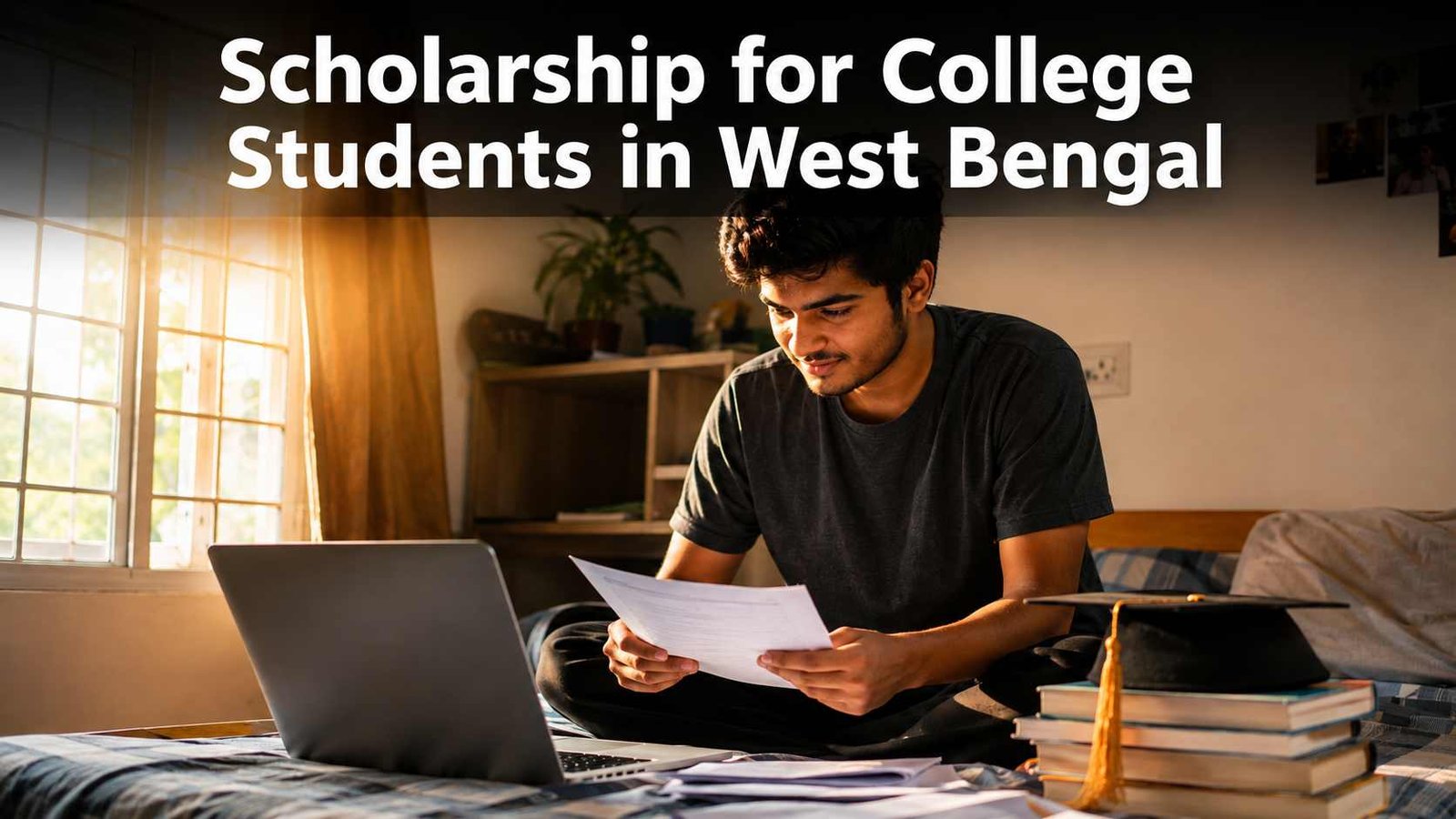
West Bengal runs eight major scholarship programmes for college students. Each programme targets a different profile: general merit, SC/ST/OBC category, minority community, girls, or science talent. No single scheme fits every student. This guide identifies which scheme matches your profile, compares all eight side by side, and walks through the application process end to end.
What Counts as a “College Scholarship” in West Bengal
A college scholarship in West Bengal is a financial-aid award for students enrolled in Class 11 through PhD at a recognized institution within the state, or in some cases anywhere in India for West Bengal-domiciled students. Two government tiers fund these awards: the West Bengal state government and the Government of India. Private foundations add a third tier. State schemes flow through department-specific portals. Central schemes flow through the National Scholarship Portal (NSP). Private schemes use their own foundation websites.
Every scholarship in this space shares five core attributes: eligibility criteria, award amount, application deadline, required documents, and a disbursal method. West Bengal disburses almost all government scholarship money through Direct Benefit Transfer (DBT) into an Aadhaar-seeded bank account. Understanding this shared structure makes it easier to compare unrelated schemes on equal terms.
Who Should Apply — and Who Should Not
Eligibility in West Bengal splits along five lines: academic category, family income, minority status, gender, and academic stream. Matching your actual profile to the correct scheme before applying saves time and avoids automatic rejection.
Apply if you fall into one of these groups:
General-category students with family income under ₹2.5 lakh and 60%+ marks → SVMCM
SC, ST, or OBC students with family income under ₹1–2.5 lakh (varies by category) → OASIS
Muslim, Christian, Sikh, Buddhist, Jain, or Parsi students with income under ₹2 lakh → Aikyashree
Unmarried girls who completed the Kanyashree K2 grant and are now in postgraduate study → Kanyashree K3
Students who scored 80%+ in Class 12 from any board, pursuing UG anywhere in India → Central Sector Scheme (CSSS/NSP)
Science-stream students (physics, chemistry, biology, math) with strong Class 12 results → JBNSTS
Meritorious WB or Jharkhand students (85%+ WBCHSE, 90%+ ISC/CBSE) with income under ₹8 lakh → G.P. Birla Scholarship
Students from very low-income households (below ₹60,000/year) with 65%+ marks → CMRF/Nabanna Scholarship
Do not apply, or expect rejection, if:
You are already receiving another central or state scholarship for the same academic year — nearly every West Bengal scheme carries a no-dual-benefit clause.
Your family income certificate exceeds the scheme’s stated ceiling, even by a small margin.
You hold a caste, minority, or income certificate issued by an unauthorized authority (private employer letters and self-declarations do not count).
You are domiciled outside West Bengal and applying to a state-specific scheme like SVMCM or Aikyashree, which require both West Bengal domicile and, in most cases, study within the state.
You are a married applicant applying for Kanyashree, which strictly requires unmarried status.
Full Comparison Table — All Major Schemes at a Glance
Scheme
Administered By
Level Covered
Annual Amount (₹)
Income Ceiling
Minimum Marks
Category
Portal
SVMCM
WB Higher Education Dept
Class 11 – PhD
12,000 – 60,000
2,50,000
60%+
General
svmcm.wbhed.gov.in
OASIS (Post-Matric)
Backward Classes Welfare / Tribal Development Dept
UG, PG, Diploma
5,500 – 16,500+
1,00,000 (SC/ST) / 2,50,000 (OBC)
50%+
SC / ST / OBC
oasis.gov.in
Aikyashree (Post-Matric)
WB Minorities Development & Finance Corporation
Class 11 – PhD
5,500 – 16,500
2,00,000
50%+
Minority community
wbmdfc.org
Kanyashree K3
Dept of Women & Child Development
PG / Professional
Up to 60,000
1,20,000
Merit-continuation from K2
Unmarried girls
wbkanyashree.gov.in
Central Sector Scheme (CSSS)
Ministry of Education, Govt of India
UG (all-India)
10,000 – 20,000 typical (up to 1,00,000 for top brackets)
4,50,000
80%+ in Class 12
General, merit-based
scholarships.gov.in
JBNSTS
Jagadis Bose National Science Talent Search Trust
UG Science / Medical / Engineering
Approx. 60,000 (stipend + book grant)
No fixed income cap
Talent-test based
Science stream
jbnsts.ac.in
G.P. Birla Scholarship
G.P. Birla Educational Foundation
UG (WB & Jharkhand)
Up to 50,000–60,000 + 7,000 book grant
8,00,000
85% (WBCHSE) / 90% (ISC/CBSE)
Merit-cum-means
gpbirlaedufoundation.com
CMRF / Nabanna Scholarship
Chief Minister’s Relief Fund
UG
Variable, one-time
60,000
65%+
Very-low-income households
wb.gov.in
Figures are current as of publication and revised across cycles. Confirm live amounts and deadlines on the official portal before submitting.
SVMCM is West Bengal’s flagship general-category scholarship. The West Bengal Higher Education Department administers it. SVMCM covers students from Class 11 through PhD, including undergraduate, postgraduate, technical, and professional courses. Eligible students must be permanent residents of West Bengal with an annual family income below ₹2,50,000 and a minimum of 60% marks in the last qualifying examination. The scholarship rate ranges from ₹1,000 to ₹5,000 per month depending on course level — UG Arts/Commerce students receive the lower end, while UG Engineering and Medical students receive the upper end. Payment reaches students via DBT into an Aadhaar-seeded bank account. Renewal is mandatory every year and requires maintaining the minimum marks threshold.
OASIS Portal (Post-Matric Scholarship for SC/ST/OBC)
OASIS is the unified portal for SC, ST, and OBC students across school, college, and university levels. The Backward Classes Welfare Department and Tribal Development Department jointly operate it. Post-Matric OASIS covers UG, PG, and Diploma students. The income ceiling differs by category: ₹1 lakh for SC/ST students and ₹2.5 lakh for OBC students. Award amount depends on course group, hosteller-versus-day-scholar status, and compulsory fees, typically ranging from ₹5,500 to ₹16,500 per year. ST applicants must first generate a National Scholarship Portal One-Time Registration (OTR) number before applying on the OASIS portal.
Aikyashree (Minority Community Scholarship)
Aikyashree serves Muslim, Christian, Sikh, Buddhist, Jain, and Parsi students. The West Bengal Minorities Development and Finance Corporation (WBMDFC) manages the scheme. Coverage spans Class 1 through PhD, though the Post-Matric component is what applies to college students. Eligible applicants need West Bengal domicile, minority-community membership, at least 50% marks in the previous qualifying exam, and family income below ₹2,00,000. The award ranges from ₹5,500 to ₹16,500 per year based on stream and hosteller status. Aikyashree and SVMCM cannot be claimed together — students must select whichever scheme offers a higher amount for their profile.
Kanyashree Prakalpa — K3 Component
Kanyashree Prakalpa is a three-tier scheme for unmarried girls, run by the Department of Women & Child Development and Social Welfare. K1 pays a small annual stipend during school years. K2 pays a one-time ₹25,000 grant at age 18. K3, the component relevant to college students, funds postgraduate and professional studies for students who already received K2. Family income must not exceed ₹1.2 lakh per year, though this limit is waived for orphans, disabled girls, and those in Child Care Institutions. K3 has no fixed marks bar since it continues from an already-verified K2 beneficiary.
Central Sector Scheme of Scholarship for College and University Students (CSSS / NSP)
CSSS is a Government of India scheme, not state-specific, but it reserves seats for West Bengal board toppers and accepts West Bengal-domiciled applicants studying anywhere in India. The Ministry of Education implements it through the National Scholarship Portal. Applicants must have passed Class 12 with at least 80% marks and be enrolled full-time in an undergraduate programme. Annual family income must not exceed ₹4.5 lakh. Roughly 82,000 scholarships are awarded nationally each year, with half reserved for female students. Award amount scales with course duration and level, commonly ₹10,000–₹20,000 per year for standard undergraduate courses.
Jagadis Bose National Science Talent Search Scholarship (JBNSTS)
JBNSTS, established in 1958, supports science-stream undergraduates through a Junior and Senior Talent Search structure. It is open to Indian nationals domiciled in West Bengal and several northeastern and eastern states. Applicants must have passed Class 10 or 12 in the qualifying academic year and pursue basic science, BS-MS, medicine, or engineering. Diploma and BSc Pass students are excluded. Senior scholars receive a monthly stipend plus an annual book grant, with select basic-science scholars eligible for additional research support.
G.P. Birla Educational Foundation Scholarship
The G.P. Birla Scholarship is a private, merit-cum-means award for West Bengal and Jharkhand students entering undergraduate science courses. Applicants need 85% marks in WBCHSE (or 90% in ISC/CBSE) in Class 12, plus a family income under the foundation’s published ceiling. The award covers tuition and hostel fees up to ₹50,000–60,000 per year, renewable for up to four years based on continued academic performance, plus a one-time ₹7,000 book grant in the first year. Unlike government schemes, receiving a G.P. Birla Scholarship does not automatically disqualify a student from also holding a government scholarship — applicants should confirm current combination rules directly with the foundation.
Chief Minister’s Relief Fund / Nabanna Scholarship
This scheme targets the most financially constrained households — family income must stay under ₹60,000 per year. Applicants need at least 65% marks in their last board examination. The award is a one-time grant rather than a recurring monthly stipend, intended to cover an immediate financial gap rather than fund an entire course.
Step-by-Step Application Guide
Confirm your matching scheme. Use the comparison table above to identify the one scheme your income, category, and marks profile satisfies — applying to a mismatched scheme wastes time and risks flags for duplicate submission.
Complete One-Time Registration (OTR) on the National Scholarship Portal if your scheme requires it (mandatory for OASIS, CSSS, and some Aikyashree categories). Download the OTR mobile app for face-authentication if prompted.
Fill in academic and personal details exactly as they appear on your marksheet and Aadhaar card — mismatches between documents are the single largest cause of rejection.
Upload required documents (see checklist below) in the specified format and file-size limit.
Submit for institute verification. Your college’s scholarship cell or Institute Nodal Officer (INO) must verify the application before it moves to the department level.
Track application status on the respective portal using your application ID and date of birth or registered mobile number.
Confirm Aadhaar-bank seeding at your bank branch if payment does not arrive after approval — this is the most common post-approval hold-up.
Required Documents Explained
Aadhaar card — primary identity proof and the anchor for DBT payment; must exactly match your bank account name.
Income certificate — issued by a Tahsildar, Revenue Inspector, BDO, or SDO, valid for one year; self-declarations and private-employer letters are rejected.
Domicile certificate — proves permanent West Bengal residency, required for nearly all state schemes.
Caste/community certificate — SC/ST/OBC certificate for OASIS, minority-community certificate for Aikyashree; must state the category explicitly and be issued within West Bengal.
Previous qualifying-exam marksheet — the scanned document your portal entry must numerically match.
Bank passbook or account details — must be in the student’s own name and Aadhaar-seeded for DBT to succeed.
Institution admission/fee receipt — confirms current enrollment and, for some schemes, the fee amount being reimbursed.
Passport-size photograph — recent, per the portal’s format specification.
Selection Process Explanation
Government scholarships in West Bengal follow a three-stage verification funnel rather than a competitive interview. First, the applicant submits the online form with supporting documents. Second, the college or institute’s scholarship cell checks the application against submitted marksheets, fee receipts, and enrollment records — this is the “institute verification” stage most portals show as a status update. Third, the relevant state department (Higher Education, Backward Classes Welfare, WBMDFC, or Women & Child Development) or, for central schemes, the state education board, does a final scrutiny before releasing funds via DBT. Merit-based private schemes like G.P. Birla and JBNSTS add a fourth layer: a shortlisting or interview round based on the strength of the academic record and, for JBNSTS, a talent-search test.
Common Mistakes Applicants Make
Aadhaar-bank mismatch. Name or account number differs slightly between Aadhaar and the bank passbook, which stalls or blocks DBT payment.
Non-Aadhaar-seeded bank account. Even a correct account fails if Aadhaar is not linked through NPCI mapping.
Wrong-authority income certificate. Certificates from a private employer or self-declaration on plain paper are not accepted; only a Tahsildar, Revenue Inspector, BDO, or SDO can issue a valid one.
Income marginally over the ceiling. Submitting an income certificate that shows a figure at or above the scheme’s cap causes automatic rejection, even by a small margin.
Applying to overlapping schemes simultaneously. Most portals flag or reject duplicate applications when a student holds another central or state scholarship for the same year.
Marks mismatch. The percentage entered on the form does not match the uploaded marksheet, triggering manual rejection.
Expired income certificate. Certificates are valid for one year; a certificate issued for a prior cycle will not clear verification for the current one.
Missed institute verification window. The application stays “Pending” indefinitely if the college scholarship cell does not verify it in time — students should follow up directly with their institution rather than assume automatic processing.
Previous Years’ Trends
Scholarship rules and dates shift year to year, and tracking that pattern helps set expectations for the current cycle. SVMCM has moved through several system versions (most recently V4.2), each adjusting the monthly rate structure and, in some years, raising rates significantly over the prior cycle. Aikyashree’s application window has drifted across recent years, generally opening between January and March, though exact dates change annually — some cycles have seen deadline extensions into May. OASIS Post-Matric and Pre-Matric applications for the 2026-27 cycle opened earlier than in some previous years, reflecting an effort to close the application-to-disbursal gap. The Central Sector Scheme has held a relatively stable structure but has periodically extended its deadline mid-cycle. Minority and SC/ST/OBC portals have also undergone domain and platform changes in recent years (for example, Aikyashree’s portal migrating between wbmdfc.org and wbmdfcscholarship.in), which is worth checking for each fresh application rather than assuming last year’s bookmark still applies.
FAQs
Which scholarship is best for general-category West Bengal students? SVMCM is the primary option for general-category students, covering Class 11 through PhD with awards up to ₹60,000 per year. It requires 60%+ marks and family income below ₹2.5 lakh. Students who miss its income ceiling but scored 80%+ in Class 12 should check the Central Sector Scheme instead.
Can I apply to two West Bengal scholarships at the same time? No. Nearly every government scheme — SVMCM, OASIS, Aikyashree, and CSSS — carries a no-dual-benefit clause. Applying to more than one for the same academic year risks rejection of both. Choose the scheme offering the higher amount for your profile.
What is the income limit for SVMCM? The annual family income must not exceed ₹2,50,000. This must be verified through an income certificate issued by a Tahsildar, Revenue Inspector, BDO, or SDO — self-declarations and employer letters are not accepted.
How do I check my OASIS application status? Log in to the official OASIS portal with your application ID and registered mobile number or date of birth. The portal shows real-time status: Pending, Verified, Approved, or Disbursed, along with the specific reason if the application is marked defective.
Why do West Bengal scholarship applications get rejected? The most common reasons are Aadhaar-bank name mismatches, income certificates issued above the ceiling or by an unauthorized authority, marks discrepancies against the uploaded marksheet, and applying to overlapping schemes in the same year. Reviewing every document against your Aadhaar before submission prevents most of these.
Is Aikyashree only for Muslim students? No. Aikyashree covers all recognized minority communities in India — Muslim, Christian, Sikh, Buddhist, Jain, and Parsi — not Muslim students exclusively. Eligibility depends on community membership, West Bengal domicile, and family income below ₹2 lakh.
What documents are needed for SVMCM renewal? Renewal requires the current year’s marksheet showing you met the minimum marks requirement, an updated income certificate if the previous one has expired, and confirmation that your Aadhaar-bank seeding remains active. Renewal typically opens in October–November each year.
Can a West Bengal-domiciled student studying outside the state apply for these scholarships? It depends on the scheme. SVMCM and Aikyashree generally require both West Bengal domicile and study within the state. The Central Sector Scheme, by contrast, is a Government of India scheme open to West Bengal-domiciled students studying anywhere in India.
What’s the practical difference between OASIS and SVMCM? OASIS serves SC, ST, and OBC students specifically, with category-based income ceilings and administration by the Backward Classes Welfare and Tribal Development Departments. SVMCM is open to general-category students with a single ₹2.5 lakh income ceiling, administered by the Higher Education Department.
How much does Kanyashree K3 pay? K3 provides financial support of up to ₹60,000 per year for postgraduate and professional study, available only to unmarried girls who already received the K2 grant at age 18 and continue meeting the ₹1.2 lakh family income limit.
Conclusion
West Bengal’s scholarship system covers nearly every student profile — general merit, SC/ST/OBC, minority, girl-child, and science-talent — but no single scheme covers everyone, and holding more than one simultaneously is not allowed. Start by matching your income, category, and marks against the comparison table, then follow the document checklist closely before you submit; Aadhaar-bank mismatches and wrong-authority income certificates cause more rejections than low marks ever do. For a deeper walkthrough of any single scheme’s renewal process or status-check troubleshooting, see our dedicated SVMCM and OASIS guides





 By Country2 months ago
 Scholarships2 months ago
 By Country3 months ago
 Scholarships1 month ago
 Scholarships2 months ago