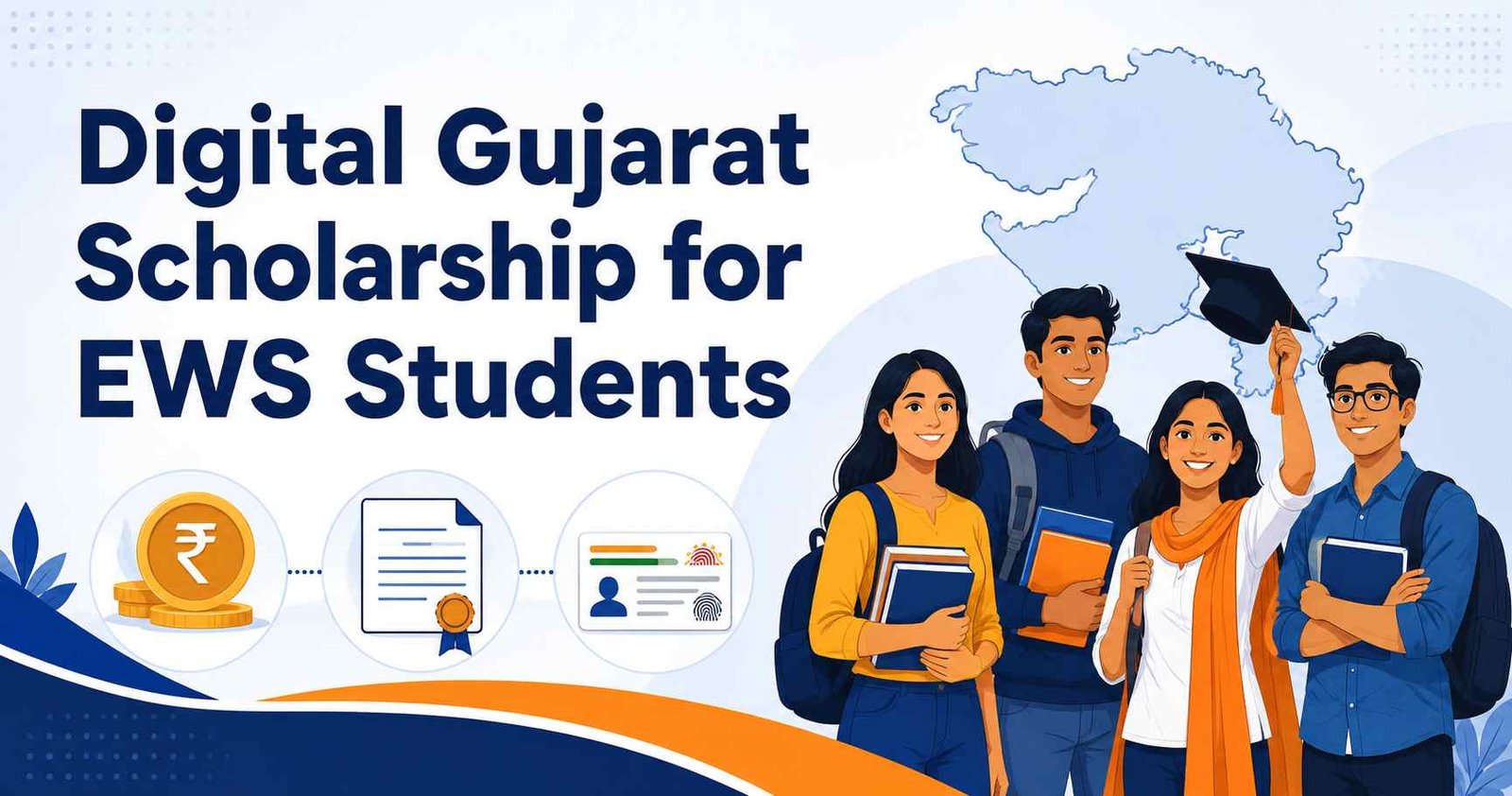
The Digital Gujarat Scholarship is the Government of Gujarat’s single online platform for state-funded financial aid, hosting more than 33 schemes for students from Class 1 through PhD. Among these, the EBC/EWS Scholarship supports students from the Economically Weaker Section — a category distinct from SC, ST, OBC, and SEBC. This guide covers exactly who qualifies, who doesn’t, which documents are required, and how the application moves from submission to payment for the 2026-27 academic year.
What Is the Digital Gujarat Scholarship for EWS Students?
The Digital Gujarat Portal, accessible at digitalgujarat.gov.in, centralizes scholarship delivery for students across categories: SC, ST, OBC, SEBC, EWS, NTDNT, Minority, and General. Within this system, the EWS-specific track (often listed as the EBC/EWS Scholarship) provides tuition support and, depending on the level of study, a maintenance allowance to students who fall under the Economically Weaker Section but do not qualify for SC, ST, OBC, or SEBC reservation.
The scheme is administered by Gujarat’s Developing Castes Welfare Department, and payments are made through Direct Benefit Transfer (DBT) directly into the student’s Aadhaar-linked bank account.
EWS Certificate vs. EWS Scholarship: Know the Difference
This is the single most confused point across public information on this topic, and getting it wrong is the fastest way to have your application rejected.
EWS Certificate (Income & Assets Certificate)
EBC/EWS Scholarship (Digital Gujarat)
Purpose
Grants 10% reservation in education and government jobs under the 103rd Constitutional Amendment
Provides direct financial aid (tuition/maintenance) for education
Issuing authority
Mamlatdar
N/A — it’s a benefit, not a document
Income ceiling
Family income up to INR 8,00,000 per year
Family income limit is scheme-specific and considerably lower — commonly cited between INR 1,20,000 and INR 2,00,000 depending on the exact scheme and year
What you need it for
Reservation in college admissions and government recruitment
Applying for scholarship money on the Digital Gujarat portal
Relationship
You generally need this certificate as a supporting document when applying for the scholarship
The scholarship application is a separate step, filed on the portal
Because the income ceilings differ so sharply, holding a valid EWS Certificate does not automatically mean you qualify for the EWS Scholarship — always check the scholarship’s own income limit before applying.
Who Should Apply
Students from the Economically Weaker Section (General category, not SC/ST/OBC/SEBC) with a valid EWS certificate
Gujarat domicile holders enrolled in a government-recognized institution
Students whose family annual income falls within the specific scheme’s limit (verify the current-year figure before applying — see caveat below)
Students currently studying anywhere from Std 1 through postgraduate/PhD level, applying under the level-appropriate scheme
Students who do not already hold an active SC/ST/OBC/SEBC scholarship for the same academic year
Who Should NOT Apply (and What to Do Instead)
SC, ST, OBC, or SEBC category students — apply under your own category’s Post-Matric or Pre-Matric scheme instead; applying under EWS by mistake causes automatic rejection during verification.
Students whose family income exceeds the scheme’s ceiling — even a small overstatement on the income certificate is a documented rejection trigger; don’t apply until your Mamlatdar-certified income falls within limit.
Students outside Gujarat domicile — the portal is restricted to permanent Gujarat residents studying at Gujarat-recognized institutions.
Students enrolled at unrecognized or private ungranted institutions — check your institution’s recognition status before applying, since this is a common and avoidable rejection reason.
Students already receiving another central or state scholarship covering the same fees for the same year — duplicate benefit claims are typically flagged during district-level verification; check with your institution’s scholarship coordinator first.
Eligibility Criteria at a Glance
Factor
Requirement
Domicile
Permanent resident of Gujarat with a valid domicile certificate
Within the scheme-specific ceiling (verify current figure on the portal — reported figures range from roughly INR 1,20,000 to INR 2,00,000 depending on scheme/year)
Institution
Government-recognized school, college, or university
Study level
Std 1 through PhD (scheme varies by level)
Bank account
Own account, Aadhaar-seeded via NPCI, for DBT payment
Certificate
Valid EWS/Income & Assets Certificate issued by Mamlatdar
Scholarship Amount and Coverage
Amounts vary by scheme and study level, and public sources report different figures for different years — treat the numbers below as a general range and confirm the exact figure for your scheme on the portal before budgeting around it.
Coverage Component
Typical Range
Tuition fee support (government/aided institutions)
Partial to full fee concession, scheme-dependent
Maintenance/monthly allowance
Commonly cited between INR 200 and INR 750 per month for post-matric schemes with a similar structure
Annual scheme-wide range across the whole Digital Gujarat portal
INR 940 to INR 2,00,000 per year, depending on scheme and level
EWS-specific annual figure (Std 9–12, per some sources)
Up to roughly INR 20,000 per year
Payment is made only after institution and district verification are complete, and only to an Aadhaar-seeded bank account in the student’s own name.
EWS Certificate: How to Get It Before You Apply
Apply at digitalgujarat.gov.in under certificate services, or at your local Mamlatdar office.
Submit income and asset proof for the family (property, income sources, no SC/ST/OBC/SEBC reservation claim).
Processing typically takes 7–14 working days.
Apply at least 30 days before your scholarship or admission deadline to leave room for corrections.
Documents Required for the EWS Scholarship Application
Aadhaar card, seeded with your own NPCI-linked bank account
EWS/Income & Assets Certificate issued by the Mamlatdar
Gujarat domicile certificate
Previous academic year’s marksheet
Bank passbook copy (student’s own account)
Current fee receipt from your institution
Recent passport-size photograph
Admission or enrollment proof for the current academic year
One Time Registration (OTR), where the specific scheme requires it — check your scheme’s guideline before assuming this applies to you
All files are typically uploaded as PDF or JPG, with a per-file size limit (commonly 200 KB) — scan clearly, since blurry uploads are a frequent rejection cause.
Step-by-Step Application Guide
Register on digitalgujarat.gov.in using your mobile number or email, and verify via OTP.
Complete your citizen profile with personal details.
From the dashboard, select “Request a New Service” → “Scholarship Services.”
Choose the correct EWS/EBC scheme for your study level and the current financial year (2026-27).
Fill in personal, academic, and bank account details carefully — names, dates, and numbers must match your documents exactly.
Upload all required documents in the specified format and size.
Save as Draft and review every field on the preview screen before final submission.
Accept the declaration and submit the application.
Note down your application reference number — screenshot it for future tracking.
Where your scheme requires it, submit a physical copy to your institution’s scholarship coordinator.
Track your application under Scholarship Services → Status on your dashboard.
Selection and Verification Process Explained
Institution verification — your college or school’s scholarship coordinator reviews and verifies your submitted application and documents.
District-level verification — the District Social Welfare Officer (or equivalent authority) cross-checks income, caste/category, and domicile certificates.
State department approval — the Developing Castes Welfare Department gives final approval.
DBT disbursal — approved funds are transferred to your Aadhaar-seeded bank account.
The full cycle, from submission to payment, commonly takes around three to six months, so applying early in the window materially improves your chances of on-time disbursal.
Common Mistakes That Get EWS Applications Rejected
Mistake
How to Avoid It
Name/date-of-birth mismatch across Aadhaar, marksheet, and application
Cross-check every field against your documents before submitting
Blurry or unreadable document scans
Re-scan at higher resolution; keep files within the size limit
Family income overstated beyond the scheme’s ceiling
Get an updated Mamlatdar income certificate before applying
Missing domicile certificate
Apply for it well ahead of the scholarship deadline
Applying under the wrong category scheme
Confirm you’re using the EWS/EBC scheme, not an SC/ST/OBC scheme
Bank account not Aadhaar-seeded, or a parent’s account used
Use your own account and confirm NPCI seeding before applying
Waiting until the last date
Apply in the first few weeks of the window to avoid portal slowdowns
Application stuck at “Under Verification” for weeks
Visit your institution’s scholarship coordinator in person with your reference number
Institution not on the government-recognized list
Confirm recognition status with your college before applying
How to Check Your Application Status
Visit digitalgujarat.gov.in and log in with your mobile number/email, password, and captcha.
Click “Scholarship” on your dashboard.
Your current status — pending, under verification, approved, or rejected — appears in the service request table.
If rejected, the portal typically shows a reason; correct it and reapply within the allowed window if the scheme permits.
Renewal Process for Existing Beneficiaries
Most Digital Gujarat scholarships, including EWS-track schemes, are renewed annually rather than being one-time awards.
Log in to your existing account.
Select Renewal Application instead of a fresh application.
Update your academic year and details.
Upload your latest marksheet.
Submit — renewal applications typically require fewer documents than a first-time application.
Previous Years’ Trends: What the Pattern Tells You About 2026-27
Looking across recent cycles, a consistent pattern emerges: application windows open in June or July, carry an official closing date in the following two to three months, and are frequently extended or reopened for students who missed the original deadline. For the 2026-27 cycle, the EWS/OBC/SEBC post-matric window opened on 6 July 2026 and is scheduled to close on 30 September 2026. In the prior cycle, categories that closed around March 2026 saw short reopened windows shortly after for students who had missed the original date, and separate reopened windows have appeared for backlog applications from academic years as far back as 2022-23.
The practical takeaway: deadlines shift, but late applicants who miss a window are not always permanently locked out — reopenings do happen, though they are not guaranteed and should never be relied on as a plan. Apply within the original window whenever possible.
Our Research Notes: Where Most Guides Get This Wrong
While researching this topic, three recurring problems showed up across publicly available guides:
The EWS Certificate and the EWS Scholarship are routinely treated as one thing. Several otherwise detailed guides quote the certificate’s INR 8,00,000 reservation-eligibility ceiling as if it were the scholarship’s income limit, which it is not — the scholarship’s ceiling is considerably lower.
Reported income limits and award amounts are inconsistent across sources, likely because different schemes (EBC vs. EWS vs. combined EBC/EWS tracks) get folded together under one label, and because circulars are updated yearly. Always verify the exact current-year figure on the official portal before assuming a number from any guide, including this one.
“Who should not apply” is almost never addressed, even though miscategorized applications are a common and entirely avoidable source of rejection.
Frequently Asked Questions
What is the Digital Gujarat scholarship for EWS students? It’s a Gujarat state government financial aid scheme, delivered through the Digital Gujarat portal, for students from the Economically Weaker Section who don’t qualify for SC, ST, OBC, or SEBC reservation. It covers tuition support and, for some levels, a monthly maintenance allowance, paid via Direct Benefit Transfer.
What is the income limit for the EWS scholarship in Gujarat? Public sources report different figures, generally between INR 1,20,000 and INR 2,00,000 per year depending on the exact scheme and academic year. Always confirm the current figure on the official portal before applying, since it differs from the separate EWS Certificate’s INR 8,00,000 reservation ceiling.
Is the EWS Certificate the same as the EWS scholarship? No. The certificate grants 10% reservation in admissions and government jobs and has a higher income ceiling. The scholarship is a separate financial-aid application with its own, lower income limit. You typically need the certificate as a supporting document for the scholarship, but holding it doesn’t guarantee scholarship eligibility.
Who is not eligible for the Digital Gujarat EWS scholarship? SC, ST, OBC, or SEBC category students (who should use their own category’s scheme), students whose family income exceeds the scholarship’s ceiling, students outside Gujarat domicile, and students at institutions not recognized by the government.
What documents are required for the EWS scholarship application? Aadhaar (bank-seeded), Mamlatdar-issued EWS/Income certificate, domicile certificate, previous marksheet, bank passbook, current fee receipt, a recent photo, and admission proof. Some central-linked schemes additionally require One Time Registration (OTR).
How much money does the EWS scholarship provide? It varies by scheme and study level. Across the whole Digital Gujarat portal, scholarship amounts range from about INR 940 to INR 2,00,000 per year; EWS-specific figures for some post-matric levels have been reported around INR 20,000 per year. Confirm the exact figure for your scheme before relying on it.
What is the last date to apply for 2026-27? For the EWS/OBC/SEBC post-matric track, the 2026-27 window opened 6 July 2026 and is scheduled to close 30 September 2026. Pre-matric schemes generally follow an earlier window. Always check the portal directly, since deadlines can be extended.
Why do EWS scholarship applications get rejected? Common reasons include mismatched details across documents, blurry uploads, income above the scheme limit, a missing domicile certificate, applying under the wrong category, and a bank account that isn’t Aadhaar-seeded in the student’s own name.
How long does it take to receive the scholarship after applying? The full process — institution verification, district verification, state approval, and DBT payment — commonly takes around three to six months from submission. Applying early in the window reduces delays.
Can I reapply if my application is rejected? Yes, in most cases. Check the rejection reason on your dashboard, correct the issue, and resubmit within the scheme’s active window, if reapplication is still open for that cycle.
Do I need to renew the scholarship every year? Yes. Most Digital Gujarat scholarships, including EWS-track schemes, require an annual renewal application with your latest marksheet, though renewals typically ask for fewer documents than a first-time application.
Can General category students without an EWS certificate apply? Not under the EWS scheme specifically — the EWS certificate is what establishes eligibility for this category. General category students without one may instead be eligible for merit-based schemes like MYSY, which has its own separate income and marks criteria.
Conclusion
The Digital Gujarat EWS Scholarship gives Economically Weaker Section students a real path to funded education, but it sits inside a portal of 30-plus overlapping schemes where a single miscategorized document or a confused income figure can cost you the award. The two moves that matter most: confirm you’re applying under the correct scheme (not your EWS certificate’s reservation ceiling), and apply in the first few weeks of the window rather than the last few days.





 By Country2 months ago
 Scholarships2 months ago
 By Country3 months ago
 Scholarships1 month ago
 Scholarships2 months ago