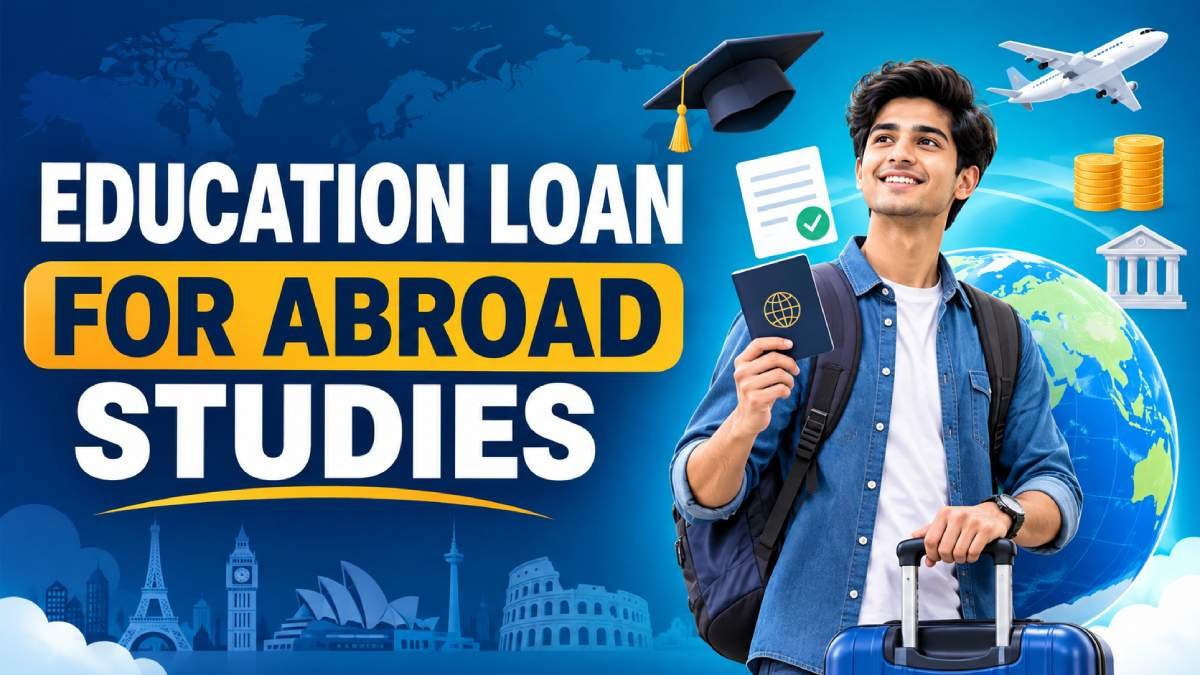
An education loan for abroad studies is a loan from a bank, an NBFC or an international lender that finances tuition and living costs for a degree at a foreign university. Indian public sector banks structure these loans around the Indian Banks’ Association (IBA) Model Education Loan Scheme. NBFCs and international lenders offer alternatives with different rules.
This guide explains who should apply, how lenders select borrowers, which documents you need, what the loan really costs and what disbursement trends show. Every figure comes from official or published lender data, and the guide flags where sources disagree.
Quick facts:
Model scheme cap for study abroad: INR 20 lakh (IBA Model Education Loan Scheme)
Collateral-free limit under the model scheme: up to INR 7.5 lakh
Margin on loans above INR 4 lakh for study abroad: 15%
Typical interest range across banks and NBFCs: roughly 8.3% to 15% per year
Repayment period: up to 15 years after the moratorium
Tax benefit: interest deduction under Section 80E for up to 8 assessment years
What Is an Education Loan for Abroad Studies?
An education loan for abroad studies is a loan that pays for a recognised full-time course at a foreign institution. The lender disburses the money in instalments, usually straight to the university, and you repay after a moratorium.
There are two main types:
Secured loans require collateral such as property, fixed deposits, government bonds or insurance policies. The collateral lowers the lender’s risk, so rates are usually lower.
Unsecured (collateral-free) loans require no pledged asset. Lenders judge the student’s profile, the university and the co-applicant’s income instead. Rates are usually higher.
What the loan usually covers: tuition, exam and lab fees, hostel or accommodation, travel, insurance, books, equipment and living costs, within the lender’s cost estimate.
What it may not cover: the margin money you must bring yourself, costs missing from your university’s fee or cost-of-attendance document, and expenses beyond the sanctioned limit.
Who Should Apply and Who Should Not Apply
Should you take an education loan to study abroad? Take one when you hold an admission offer, the course has a clear earning path and the monthly EMI fits a realistic post-study income. Avoid one when the debt would outweigh that income or a cheaper funding route exists.
Apply if…
Think twice if…
You hold an admission offer from a recognised university and course
You have no admission offer yet
You have a written cost estimate from the university
You are guessing the total cost
A parent or guardian with stable income and a clean credit history can be co-applicant
The co-applicant has a weak credit score or irregular income
You have first applied for scholarships, assistantships or fee waivers
You are borrowing 100% of the cost without checking scholarships
You can show how the course leads to an income that covers the EMI
The course is expensive and its job outcomes are uncertain
You can fund the margin money (15% above INR 4 lakh at banks following the IBA scheme)
You cannot arrange the margin or living costs
Who should not apply for a bank loan: students whose course or university falls outside the lender’s approved list, and students whose family cannot offer collateral above the collateral-free limit. Those students should compare NBFCs or international lenders instead.
Types of Lenders: Banks, NBFCs and International Lenders
Which lender suits you? Public sector banks suit students who can offer collateral and want the lowest rate. NBFCs suit students who need speed or collateral-free funding. International lenders suit students without a co-applicant.
Lender type
Examples
Typical limit
Collateral
Indicative rate
Typical speed
Public sector banks
SBI, Bank of Baroda, Canara Bank, PNB, Bank of Maharashtra, Indian Bank
Up to INR 1.5 crore for most programmes at SBI
Required above INR 7.5 lakh; SBI waives it up to INR 50 lakh for select international institutions
From about 8.4%
4 to 8 weeks
Private banks
ICICI Bank, HDFC Bank, Axis Bank
Varies by scheme
Often required above a collateral-free cap
Roughly 10% and above for secured loans
Faster than public banks
NBFCs
Avanse, Credila, Auxilo, Propelld
INR 40-75 lakh
Often unsecured within the limit
Roughly 10.5% to 15%
7 to 15 days
International lenders
MPOWER Financing, Prodigy Finance
Varies by programme
None; no cosigner at selected lenders
Generally higher
Varies
The Vidya Lakshmi portal lets you apply to several public banks through one form. See the application steps below.
Loan Amount, Interest Rate, Margin Money and Fees
How much can you borrow?
The IBA Model Education Loan Scheme sets a maximum of INR 20 lakh for studies abroad, as stated in a Lok Sabha reply on the Model Education Loan Scheme. Banks can sanction more under their own schemes. SBI Global Ed-Vantage lends up to INR 1.5 crore for most programmes, and some comparison sites report higher limits for top-ranked universities. Confirm the limit for your university with the branch.
What interest rate will you pay?
Education loan rates are floating and linked to an external benchmark such as the repo rate plus a lender spread. They change when the benchmark changes.
Lender category
Indicative rate (per year)
Note
Public sector banks, secured
About 8.4% to 10%+
Lowest tier; collateral above INR 7.5 lakh
Public sector banks, collateral-free up to INR 7.5 lakh
About 8.6% to 11%
Depends on the bank and scheme
Private banks
Roughly 10% and above
Varies by profile
NBFCs
Roughly 10.5% to 15%
Higher for collateral-free loans
Girl students at many public banks
0.50% concession
Offered by SBI and several others
Important: published rates for the same scheme differ across comparison sites, and SBI’s own rate page has shown different figures at different dates. Treat these ranges as indicative and ask the lender for a written quote.
What is margin money?
Margin money is the share of the cost that the family funds from its own resources. Under the IBA scheme, the margin is nil up to INR 4 lakh and 15% above that for studies abroad (5% for studies in India). The IBA Model Educational Loan Scheme circular records this margin structure. Scholarships and assistantships count toward the margin, and the family brings it in pro rata as disbursements happen.
Example: on a INR 20 lakh requirement, the bank funds INR 17 lakh and the family funds INR 3 lakh. Business Standard reports that margins across lenders can range from 10% to 25%, so ask each lender.
What fees apply?
SBI’s comparison-site listing shows a processing fee of 0.50% (minimum INR 10,000) plus GST. Under the IBA scheme, banks may charge a processing fee for loans abroad and refund it once the student starts the course. The scheme carries no prepayment penalty at banks following it. NBFCs and private banks may differ.
What does the loan really cost?
A small rate difference compounds over a long tenure. The tables below show our own calculation on a reducing-balance EMI from day one. They exclude moratorium interest and fees.
Loan
Rate
EMI per month (INR)
Total interest (INR)
INR 10 lakh, 10 years
9%
12,668
5.20 lakh
INR 10 lakh, 10 years
10%
13,215
5.86 lakh
INR 10 lakh, 10 years
11%
13,775
6.53 lakh
INR 10 lakh, 10 years
12%
14,347
7.22 lakh
INR 60 lakh, 15 years
9%
60,856
49.54 lakh
INR 60 lakh, 15 years
10%
64,476
56.06 lakh
A 1% rate difference on INR 60 lakh over 15 years changes total interest by about INR 6.5 lakh.
Moratorium interest: most banks charge interest during the course and the grace period. SBI charges simple interest in this phase. If a lender disbursed INR 30 lakh at once at 10% simple interest, 2.5 years of course plus grace period would add INR 7.5 lakh. Disbursement in instalments lowers the real figure. Paying interest during the moratorium keeps the principal from growing.
Selection Process Explained
How do lenders choose borrowers? Lenders assess five factors: the university and course, the student’s academic record, the co-applicant’s income and credit history, the value and legal status of collateral, and the total cost against the margin.
University and course. The lender checks that the institution and the course are recognised and on its approved list. A higher-ranked university improves approval chances, rate and collateral terms.
Academic record. The lender reviews mark sheets and entrance or language test scores. IBA scheme loans target meritorious students.
Co-applicant profile. The lender verifies the parent’s or guardian’s income, bank statements and credit score. One lender cites a minimum co-applicant CIBIL score of 600 for its collateral-free scheme.
Collateral. For loans above the collateral-free limit, the bank values the property or deposit and runs a legal check.
Cost and margin. The lender compares your cost estimate with the loan requested and confirms you can fund the margin.
The bank may interview the student and meet the co-applicant before it issues a sanction letter.
Step-by-Step Application Guide
How do you apply for an education loan for abroad studies? You compare lenders, check eligibility, gather documents, apply online or in person, complete verification and receive a sanction letter. Disbursement follows.
Estimate the total cost. Use your university’s cost-of-attendance figures for tuition, living costs, travel and insurance.
Compare lenders. Check public banks, NBFCs and international lenders on rate, margin, collateral, moratorium and fees.
Check eligibility. Confirm your course, university, age, nationality and co-applicant profile fit the lender’s rules.
Collect documents. Prepare student, co-applicant, admission and collateral papers (see the next section).
Apply. Apply directly to the bank or NBFC. Or register on the Vidya Lakshmi portal, fill the Common Education Loan Application Form (CELAF) once and apply to up to three banks at the same time.
Track the application. Banks update the status on your Vidya Lakshmi dashboard, and the loan itself is disbursed by the bank outside the portal.
Complete verification. Expect document checks, a possible interview and collateral valuation.
Accept the sanction. Read the sanction letter for rate, margin, moratorium, fees and disbursement terms.
Use the sanction letter for your visa. Many applicants use it as proof of funds.
Receive disbursement. The lender pays tuition to the university in instalments and releases living costs as per its policy.
Required Documents Explained
Which documents do lenders ask for? Lenders ask for identity proof, academic records, admission and fee details, income proof of the co-applicant and collateral papers. Requirements vary by lender, loan type and country.
Category
Documents
Why lenders ask
Student identity
Aadhaar, PAN, passport, two passport-size photographs
Verifies identity and nationality
Academic
Mark sheets and transcripts; entrance and language test scores
Shows merit and course readiness
Admission and cost
Admission or offer letter; fee structure or cost estimate
Confirms the course and the amount needed
Co-applicant
Identity and address proof, PAN, income proof (salary slips, ITR or Form 16), bank statements
Confirms repayment capacity
Collateral (if any)
Property papers, fixed deposit receipts, bonds or insurance policy
Secures the loan above the collateral-free limit
After sanction
Loan agreement, fee receipts, visa or immigration documents
Needed for disbursement and tracking
Tips: keep names and figures consistent across documents, because incomplete or inconsistent paperwork is a common reason for delay or rejection. NBFCs may not need property documents. Some lenders accept alternative income documents when a co-applicant files no ITR.
Loan Timeline: Admission, Sanction, Visa and Disbursement
When should you apply? Apply as soon as you hold an admission offer, and plan so that the sanction arrives before your visa appointment. Public banks can take 4 to 8 weeks, and Vidya Lakshmi applications for abroad studies can take about 30 days because the amount exceeds INR 7.5 lakh. NBFCs often finish in 7 to 15 days.
Stage
What happens
Planning tip
1. Admission offer
You receive the offer and fee details
Start lender comparison the same week
2. Application
You submit documents to the lender or Vidya Lakshmi
Apply to up to three banks together
3. Verification and sanction
The lender verifies, values collateral and issues a sanction letter
Allow the slowest realistic time for your lender type
4. Visa
You show proof of funds, often the sanction letter
Keep copies ready for the appointment
5. Disbursement
The lender pays the university in instalments
Keep margin money ready for each tranche
6. Moratorium and repayment
Course period plus grace, then EMIs
Pay interest during study if you can
Common Mistakes Applicants Make
Comparing advertised starting rates. Advertised rates apply to ideal profiles. Compare written offers.
Applying to only one lender. Vidya Lakshmi lets you apply to up to three banks with one form.
Ignoring margin money. A 15% margin above INR 4 lakh can mean lakhs of rupees in your own funds.
Underestimating the total cost. Missing living costs, insurance and moratorium interest causes funding gaps.
Submitting incomplete or inconsistent documents. Missing papers are a leading cause of delays and rejections.
Overlooking the co-applicant’s credit profile. A weak score hurts approval and the rate.
Choosing a course or university outside the lender’s approved list. Check recognition before applying.
Applying late. Late applications clash with visa and fee deadlines.
Previous Years’ Trends
What do past years show? Study-abroad lending grew strongly for a decade, dipped during the pandemic and slowed in 2025 when visa rules tightened in key destinations.
Period
Trend
Source
2012-13 to 2021-22
Public sector bank loans for study abroad rose from about INR 1.18 thousand crore to INR 7.58 thousand crore, more than six-fold, with growth every year except pandemic-hit 2020-21
Government reply in Lok Sabha, 13 February 2023, analysed by Factly
2018-19 to 2021-22
Loans disbursed for medical degrees abroad: INR 237.13 crore, 298.97 crore, 243.64 crore and 289.82 crore
Ministry of Finance data reported by India CSR
April to June 2025
Education loan disbursals in Gujarat fell 12% year on year as students deferred plans amid visa hurdles
News report republished by GradRight
June 2025
Remittances for overseas study fell to a five-year low of USD 138.8 million
Times of India report cited by GradRight
2025 into 2026
US international enrolments declined sharply amid visa appointment backlogs; 2026 brought signs of a reset
GradRight analysis, January 2026
What this means for applicants: demand follows visa policy. When rules tighten, students defer, so lenders and universities adjust. Build visa and loan timelines with extra buffer.
Education Loan Without Collateral or Co-Applicant
Can you get an education loan abroad without collateral? Yes. Banks following the IBA scheme waive collateral up to INR 7.5 lakh. SBI has raised its collateral-free limit to INR 50 lakh for select international institutions. NBFCs lend collateral-free up to roughly INR 40-75 lakh.
Can you get one without a co-applicant? Most Indian banks require a co-applicant. International lenders such as MPOWER Financing and Prodigy Finance approve students on academic profile and expected earnings, not family income. Prodigy Finance focuses on master’s programmes in business, STEM, public policy and health sciences. These loans usually carry higher interest rates and cover selected universities and programmes only.
International students in the USA or Canada are generally not eligible for US federal loans. Private lenders are the main route, and most of them require a cosigner. Some lenders waive that requirement.
Alternatives and Combining Funding Sources
Should you borrow the full amount? Combine sources to lower the debt. Scholarships and assistantships reduce the loan and also count toward the margin money. Interest subsidy schemes exist for certain categories. For example, SBI lists the Dr. Ambedkar interest subsidy scheme for overseas studies, and eligibility depends on category and income.
Explore our guides on scholarships for Indian students abroad, fully funded scholarships in Canada for Indian students and scholarships in Australia for Indian students before you finalise a loan amount.
Tax benefit: the Section 80E deduction on education loan interest covers interest only, has no upper limit and applies for up to eight assessment years or until the interest is repaid. Parents who repay the loan can claim it if they are taxpayers. Confirm the current rules and your tax regime with a chartered accountant.
Our Research Notes
Rates conflict across sources. SBI’s Global Ed-Vantage rate appears as 8.4% to 10% on some pages and as 10.65% to 11.15% on others. SBI’s own page showed different benchmark figures at different dates. Always verify on the lender’s official page.
The collateral-free limit depends on your university. SBI’s INR 50 lakh waiver applies to select international institutions. Ask which tier your university belongs to.
Margin money is the most overlooked cost. The IBA scheme sets 15% above INR 4 lakh for abroad, and Business Standard reports 10% to 25% across lenders.
Speed differs sharply. NBFCs can sanction in 7 to 15 days, while public banks take 4 to 8 weeks. Choose the lender that matches your visa deadline.
A small rate gap is a large cash gap. A 1% difference on INR 60 lakh over 15 years costs about INR 6.5 lakh.
Disbursement data tracks visa policy. The 2025 dip in Gujarat and in remittances followed visa and enrolment restrictions in major destinations.
FAQs: Education Loan for Abroad Studies
1. What is the maximum education loan for abroad studies in India?
Limits depend on the lender and scheme. The IBA Model Education Loan Scheme caps loans at INR 20 lakh for studies abroad. Many banks lend more under their own schemes, such as SBI Global Ed-Vantage, which goes up to INR 1.5 crore for most programmes. NBFCs typically lend INR 40-75 lakh. Always confirm the current limit with the lender.
2. Can I get an education loan for abroad studies without collateral?
Yes, within limits. Public banks following the IBA scheme do not ask for collateral up to INR 7.5 lakh, and a parent joins as co-borrower. SBI offers collateral-free loans up to INR 50 lakh for select international institutions. NBFCs and international lenders such as MPOWER Financing and Prodigy Finance also lend without collateral, usually at higher interest rates.
3. Can I study abroad with a 100% education loan?
Rarely. Under the IBA scheme, loans above INR 4 lakh for studies abroad carry a 15% margin, so the family funds that share. Business Standard reports margins of 10-25% across lenders. A scholarship or assistantship counts toward the margin. Some collateral-backed or NBFC loans cover a larger share, so ask each lender for its margin.
4. Who can be a co-applicant?
Parents or guardians are the standard co-applicants, and lenders check their income and credit history. A co-applicant with a weak credit score reduces approval chances. Some lenders accept other relatives who show stable income. International lenders such as MPOWER Financing approve students without any co-applicant, based on academic profile and expected earnings.
5. How long does approval take?
It depends on the lender and on whether collateral is involved. NBFC loans often clear in about 7-15 days. Public bank loans commonly take 4-8 weeks, and Vidya Lakshmi applications for abroad studies can take around 30 days because the amount exceeds INR 7.5 lakh. Apply as soon as you hold an admission offer.
6. Should I apply before or after the visa?
Apply after you receive the admission offer and before your visa appointment. Many visa processes ask for proof of funds, and a sanction letter from a regulated bank is often accepted for that purpose. The lender then disburses in instalments directly to the university. Waiting for the visa before applying creates avoidable delay.
7. What happens if my visa is rejected after the loan is sanctioned?
Disbursement normally follows confirmed admission and a fee demand, so a sanctioned but undisbursed loan can usually be cancelled or deferred. Policies differ between lenders, and processing fees may or may not be refunded. Read the sanction letter and ask your lender in writing about cancellation terms before your visa appointment.
8. Which bank gives the lowest interest rate for abroad education loans?
Public sector banks such as SBI, Bank of India and Canara Bank generally offer the lowest rates, with comparison sites quoting starting rates of roughly 8.4% to 8.7% in 2026. Your actual rate depends on profile, collateral and course. NBFC rates run higher. Compare firm written offers rather than advertised starting rates.
9. What does an education loan for abroad studies cover?
It covers tuition, exam and lab fees, hostel or accommodation, travel, insurance, books, equipment and living costs, subject to the lender’s cost estimate. Lenders usually pay tuition directly to the university in instalments. Costs that your university’s fee or cost-of-attendance document does not show may not be financed, so budget carefully.
10. Is there a tax benefit on an education loan?
Yes. Section 80E of the Income-tax Act allows a deduction for interest paid on a higher education loan, with no upper limit. The benefit runs for up to eight assessment years or until the interest is repaid, whichever is earlier. Only interest qualifies, not principal. Confirm eligibility with a chartered accountant, because it depends on your tax regime.
11. What is a moratorium period?
A moratorium is the period when you do not pay EMIs, usually the course duration plus six to twelve months. Interest still accrues during this time, and SBI charges simple interest in this period. Paying that interest while studying reduces the total cost, and some lenders give a small rate concession for doing so.
12. Should I apply for scholarships before an education loan?
Apply for scholarships first. They reduce how much you must borrow, and a scholarship or assistantship also counts toward the margin money that banks require. Use the loan to cover the remaining gap. Many students combine a partial scholarship with a smaller loan, which lowers both the EMI and the total interest paid.
13. Can international students outside India get a study abroad loan?
Yes. Private lenders serve international students in the USA and Canada. Most require a cosigner who is a citizen or resident there, but MPOWER Financing offers no-cosigner loans based on academic performance and future earning potential. International students are generally not eligible for US federal student loans, so private loans are the main route.
Conclusion
An education loan for abroad studies works best when you borrow only the gap that scholarships and savings leave. Compare written offers on rate, margin, collateral and speed. Prepare complete documents, line up the sanction letter before your visa appointment and plan for moratorium interest.





 Scholarships4 months ago

 Scholarships3 months ago
 By Country4 months ago
 Scholarships4 months ago
 By Country4 months ago

 Scholarships3 months ago

 Scholarships4 months ago

 Scholarships3 months ago