
Scholarships
Government Scholarship for 10th Class Students 2026: Eligibility, Amount and How to Apply

Published
7 days agoon
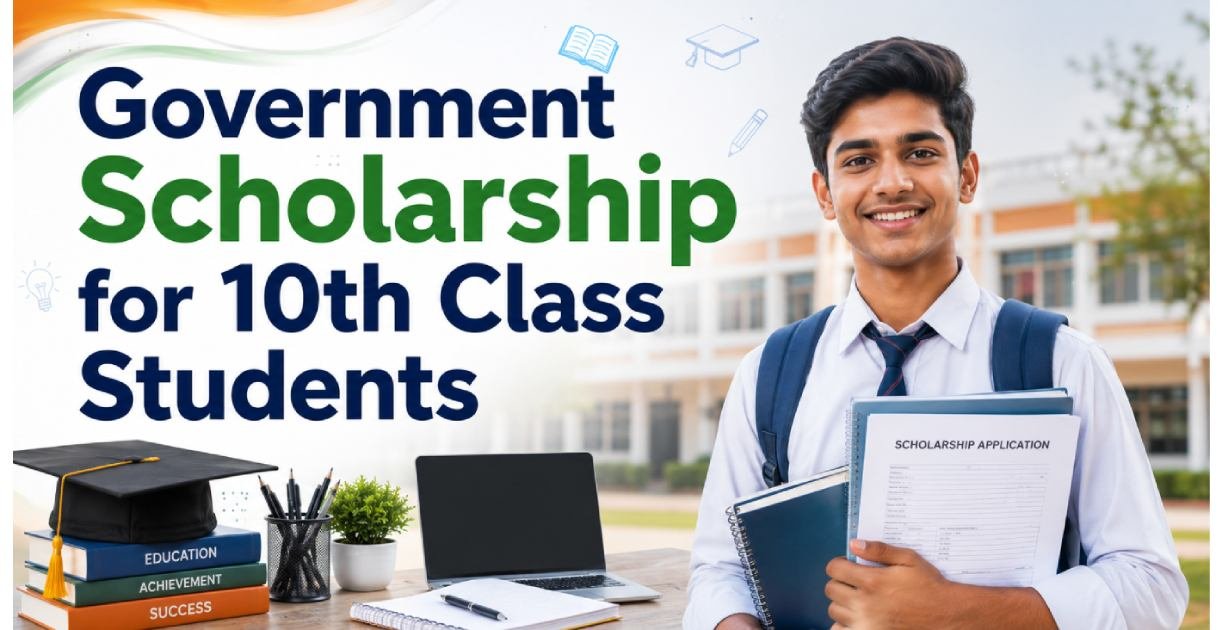
Government scholarships are available for students studying in Class 10 in India, but the correct program depends on the student’s current class, family income, social category, disability status, parent occupation, school type and whether the application is fresh or renewal. A student currently in Class 10 should first check direct pre matric schemes and renewal awards. A student who has already passed Class 10 should move to post matric scholarship options.
For central schemes, the most useful starting point is the National Scholarship Portal. The portal is open for academic year 2026 to 2027 and requires One Time Registration for scholarship applications. The fastest way to use this guide is to identify your student stage first, then match your eligibility before preparing documents.
Government Scholarships for Class 10 Students at a Glance
The table below gives the quickest answer to the primary query. It separates scholarships that directly cover Class 10 from awards that normally continue into Class 10 through renewal.
| Scholarship | Class 10 Route | Best For | Approximate Support in USD | Main Route |
|---|---|---|---|---|
| National Means Cum Merit Scholarship Scheme | Renewal in Class 10 | Meritorious students from lower income households in eligible government, aided and local body schools | About USD 127 per year | NSP renewal |
| Pre Matric Scholarship for Students with Disabilities | Direct Class 10 eligibility | Students with benchmark disability of at least 40 percent and qualifying family income | About USD 95 to USD 155 from stated annual components, depending on residence and allowance | NSP |
| Pre Matric Scholarships Scheme for SCs and Others | Direct Class 10 eligibility | Eligible Scheduled Caste students and children in specified occupation categories | About USD 37 to USD 85 per year, depending on component and residence | NSP plus state implementation |
| PM YASASVI Pre Matric Scholarship | Direct Classes 9 and 10 coverage | Eligible OBC, EBC and DNT students | About USD 42 per year under the published academic allowance | State implementation route |
| PM YASASVI Top Class Education in Schools | Usually continuation in Class 10 after selection at Class 9 | Meritorious OBC, EBC and DNT students in identified top class schools | Up to about USD 794 per year for Class 9 and 10 | NSP renewal for current listed cycle |
| Education Assistance for Wards of Specified Workers | Direct Class 10 eligibility | Children of eligible Beedi, Cine, IOMC and LSDM workers | About USD 21 per year for Class 10 | NSP |
| State Government Scholarships | Varies by state | Students meeting state domicile, income, category or merit criteria | Varies by state | State portal or NSP |
USD figures are approximate conversions for comparison. Official Indian government notifications publish scholarship values in Indian rupees. Always use the current official scheme document when making an application decision.
First Check: Are You Studying in Class 10 or Have You Already Passed Class 10?
This is the first decision because the phrase government scholarship for 10th class students can describe three different student situations. Each situation leads to a different scholarship path.
| Your Situation | What to Check First | Why |
|---|---|---|
| You are currently studying in Class 10 | Direct pre matric scholarships plus renewal awards | These programs can cover the current academic year. |
| You received a scholarship in Class 9 | Renewal rules before searching for a new award | Some major programs continue into Class 10 only through renewal. |
| You have passed the Class 10 board examination | Post matric scholarships and Class 11 funding | Your education stage has changed, so pre matric eligibility may end. |
If You Are Currently Studying in Class 10
Check whether you fit a direct Class 10 welfare scholarship first. Disability, Scheduled Caste, OBC, EBC, DNT and specified worker family schemes can be relevant. If you already won NMMSS or another entry level award, check renewal before submitting a new application elsewhere.
If You Have Already Passed Class 10
Move your search toward post matric scholarships. A student who has completed Class 10 and entered Class 11, a diploma, vocational study or another recognized post matric course may qualify for schemes that are not available while the student is still in secondary school.
If You Received a Scholarship in Class 9
Read the renewal conditions before doing anything else. NMMSS is the clearest example. Fresh selection occurs before the student enters Class 9, while qualifying awardees can continue the scholarship in Class 10 and later classes through renewal.
Which Government Scholarship Should You Check First?
Use the following eligibility router before opening application forms. The goal is to reduce wasted applications and direct each student to the scheme that matches the strongest eligibility attribute.
If you already hold NMMSS, check NMMSS renewal first.
If you have benchmark disability of at least 40 percent, check the disability pre matric scholarship.
If you belong to a Scheduled Caste and meet the income rule, check the Scheduled Caste pre matric scholarship.
If you belong to OBC, EBC or DNT categories, check PM YASASVI pre matric and Top Class School eligibility.
If your parent or guardian belongs to an eligible Beedi, Cine, IOMC or LSDM worker category, check the Ministry of Labour education assistance scheme.
If none of these central categories match, check your state government scholarship portal for domicile based school scholarships.
Who Should Apply for a Government Scholarship in Class 10?
A Class 10 student should apply when the student meets the mandatory rules of a specific scheme and can provide the required evidence before the deadline. Government scholarships are eligibility based programs, so the correct match matters more than the number of forms submitted.
Students from lower income households who meet a scheme income ceiling.
Eligible Scheduled Caste students studying full time in Class 9 or Class 10.
Eligible OBC, EBC and DNT students covered by PM YASASVI components.
Students with benchmark disability of at least 40 percent who meet the disability scholarship rules.
Current scholarship recipients who are eligible to renew an award in Class 10.
Children of workers covered by the Ministry of Labour education assistance scheme.
Students who meet a state scholarship program’s domicile, school, category, merit or income rules.
Students who can keep Aadhaar, OTR, bank, school and supporting documents consistent across the application.
Who Should Not Apply for a Particular Scholarship?
Do not apply simply because the scholarship name contains school, matric or Class 10. A student should skip a program when a mandatory rule clearly excludes the student. Applying to an ineligible program wastes time and can create confusion during verification.
Do not submit a fresh Class 10 NMMSS application if your route should be renewal and you were not selected earlier.
Do not apply to a category specific scholarship if you cannot prove the required category.
Do not use a disability scholarship if you do not meet the benchmark disability requirement.
Do not use an income limited scheme when family income exceeds the official ceiling.
Do not apply through an unofficial website or an agent who claims guaranteed approval.
Do not select the wrong school, state, academic year or fresh versus renewal option.
Do not assume that passing Class 10 keeps you eligible for every pre matric scholarship. Post matric rules may now apply.
Not Eligible Is Different From Not Selected
Not eligible means a mandatory rule is not met. Not selected means the student met basic eligibility but did not receive the award because of merit ranking, limited slots, verification, available funding or another selection rule. Students should understand this difference before interpreting an unsuccessful application.
Government Scholarship Eligibility for Class 10 Students
Eligibility is scheme specific. However, most Class 10 government scholarships can be checked through a common set of attributes before the student starts an application.
| Eligibility Attribute | What to Verify |
|---|---|
| Current class | Confirm whether the scheme covers Class 10 directly or only through renewal. |
| Nationality | Check whether Indian nationality is required. |
| Domicile | State implemented schemes often depend on the student’s domicile. |
| Family income | Use the current official income ceiling for the exact scheme. |
| School type | Some programs exclude private schools or restrict eligibility to identified schools. |
| Academic record | Check marks, promotion and renewal performance requirements. |
| Social category | SC, OBC, EBC and DNT schemes require the relevant category evidence. |
| Disability | Disability schemes require benchmark disability and valid disability documentation. |
| Parent occupation | Worker linked scholarships require proof of the qualifying occupation. |
| Fresh or renewal status | The application mode must match the student’s previous scholarship status. |
Best Central Government Scholarships for 10th Class Students
The following central schemes represent the most relevant government scholarship routes for the query. Each program has a different purpose, so compare eligibility before comparing amounts.
National Means Cum Merit Scholarship Scheme
The National Means Cum Merit Scholarship Scheme supports meritorious students from economically weaker sections so they can continue secondary education. According to the Ministry of Education, one lakh fresh scholarships are awarded to selected students entering Class 9 each year, with continuation in Classes 10, 11 and 12 for qualifying recipients.
The scholarship provides about USD 127 per year. The parental income ceiling is approximately USD 3,707 per year after conversion. Fresh selection is based on a state or Union Territory examination conducted while the student is in Class 8. This normally includes a Mental Ability Test and a Scholastic Aptitude Test.
A student already in Class 10 should therefore ask a simple question: Was I selected for NMMSS earlier? If yes, check renewal. If no, do not treat Class 10 as the fresh entry stage for this scheme.
For continuation, academic performance matters. The scheme guidelines include minimum marks requirements for progression and continued eligibility. Students must also remain in an eligible government, government aided or local body school and satisfy the other conditions of the scheme.
Pre Matric Scholarship for Students with Disabilities
The Department of Empowerment of Persons with Disabilities lists the pre matric scholarship for students studying in Class 9 or Class 10. The applicant must be an Indian national with benchmark disability of at least 40 percent and must meet the current family income rule.
The published support includes monthly maintenance assistance, a book grant and a disability allowance. Using the current conversion, the stated annual components are approximately USD 95 to USD 116 for a day scholar and approximately USD 133 to USD 155 for a hosteller, depending on the applicable disability allowance.
The official page also identifies UDID and Aadhaar as important documents and states that scholarship support is transferred through DBT and PFMS. A student should verify current rules before applying because disability documentation must match the application information.
Pre Matric Scholarships Scheme for SCs and Others
The Department of Social Justice and Empowerment states that the Scheduled Caste component covers full time students in Classes 9 and 10. The student must belong to a Scheduled Caste and the parent or guardian income must not exceed the published ceiling, which is approximately USD 2,648 per year after conversion.
The published annual academic allowance is approximately USD 37 for a day scholar and approximately USD 74 for a hosteller under the Scheduled Caste component. A separate component supports children of parents or guardians in specified cleaning and hazardous occupation categories. That component does not use the same family income ceiling.
This program is implemented through State Governments and Union Territory administrations. Students must therefore check the application path for their domicile instead of assuming that every state follows an identical workflow.
PM YASASVI Pre Matric Scholarship
The Department of Social Justice and Empowerment describes PM YASASVI as an umbrella scholarship framework for OBC, EBC and DNT students. Its components include pre matric, post matric, Top Class School Education and Top Class College Education.
The published pre matric rate for Classes 9 and 10 is approximately USD 42 per year. Published scheme material also uses a parent or guardian income ceiling equivalent to about USD 2,648 annually and specifies full time study in government schools for the pre matric component. Implementation details can vary by state.
PM YASASVI Top Class Education in Schools
This component supports meritorious OBC, EBC and DNT students in identified top class schools. The published ceiling for Classes 9 and 10 is up to approximately USD 794 per year for eligible school and hostel charges. The scholarship can continue from Class 9 to Class 10 subject to satisfactory performance and renewal requirements.
The current 2026 to 2027 listing on the National Scholarship Portal shows the Top Class School scheme open for renewal applications through September 30, 2026. This means a Class 10 student should not assume that the current portal window is a fresh Class 10 entry opportunity.
Financial Assistance for Education to Wards of Specified Workers
The Ministry of Labour and Employment provides education assistance for eligible children of Beedi, Cine, IOMC and LSDM workers. The published annual support for Class 9 and Class 10 is approximately USD 21.
The scheme has a specialized eligibility purpose. Students should verify the parent or guardian worker category before preparing the application. For the 2026 to 2027 NSP cycle, the pre matric application window is listed through September 30, 2026.
How Much Government Scholarship Can a Class 10 Student Get?
There is no single Class 10 scholarship amount. Government programs use different funding models. A smaller annual allowance may target broad welfare support, while a top class education award may cover much larger school or hostel charges.
| Program | Funding Model | Approximate Current Value in USD |
|---|---|---|
| NMMSS | Fixed annual scholarship | USD 127 per year |
| Disability Pre Matric Scholarship | Monthly maintenance plus book and disability allowances | About USD 95 to USD 155 from stated annual components |
| SC Pre Matric Scholarship | Consolidated academic allowance | About USD 37 day scholar or USD 74 hosteller |
| SC and Other Occupation Component | Consolidated academic allowance | About USD 37 day scholar or USD 85 hosteller |
| PM YASASVI Pre Matric | Consolidated academic allowance | About USD 42 per year |
| PM YASASVI Top Class School | Eligible school and hostel charges up to a ceiling | Up to about USD 794 per year for Classes 9 and 10 |
| Specified Worker Education Assistance | Fixed annual scholarship | About USD 21 per year for Class 10 |
Do not select a scholarship only because the amount is higher. A student must satisfy the scheme purpose, category, income, school and application rules. A high value scholarship that does not match the student’s profile is not a realistic opportunity.
National Scholarship Portal for Class 10 Students
The National Scholarship Portal is the central platform for many Government of India scholarship schemes. For academic year 2026 to 2027, the portal has been open since June 1, 2026. Students should use the portal to check active schemes, eligibility, current dates and application status.
What Is One Time Registration?
One Time Registration, usually called OTR, is the permanent NSP registration identifier used for scholarship applications. The current NSP page states that OTR is mandatory and is a unique 14 digit number issued using Aadhaar or Aadhaar Enrolment ID information. The identifier is intended to remain valid throughout the student’s academic career.
Do You Need Aadhaar for NSP?
NSP uses Aadhaar or Aadhaar Enrolment ID information when generating OTR. Students should make sure their identity information is consistent across Aadhaar, school records and scholarship documents. Incorrect names, dates of birth or other identity details can create verification problems.
Can You Apply for More Than One Scholarship?
NSP currently states that from academic year 2026 to 2027, students may apply for one merit based scholarship scheme and one or more eligible welfare based scholarship schemes, subject to the rules of each scheme. This does not mean every combination can be paid together. Always check scheme specific restrictions before accepting multiple awards.
Documents Required for Government Scholarships During Class 10
Document requirements vary by scheme. Prepare the core documents first, then add category specific evidence. The student should use the same spelling, date of birth, school details and identity information across every record.
| Document | Why It Is Needed | Who Commonly Needs It | Common Error |
|---|---|---|---|
| Aadhaar or Aadhaar enrolment information | Identity and OTR related verification | NSP applicants | Name or birth date does not match school records |
| OTR | NSP application access | Students applying through NSP | Using the wrong OTR or failing to complete registration |
| School enrollment evidence | Confirms current class and institution | Most applicants | Wrong school or class selected |
| Previous marksheet | Academic eligibility or renewal evidence | Merit and renewal applicants | Uploading an unreadable copy |
| Income certificate | Confirms household income eligibility | Income limited schemes | Expired or incorrect income document |
| Caste or category certificate | Confirms SC, OBC, EBC or DNT eligibility where applicable | Category based applicants | Certificate does not meet state or scheme rules |
| Domicile certificate | Confirms state eligibility where required | State implemented schemes | Applying under the wrong domicile |
| Bank account details | Supports scholarship payment | Most paid scholarship recipients | Incorrect account information or seeding issue |
| UDID or disability certificate | Confirms benchmark disability | Disability scholarship applicants | Invalid or inconsistent disability details |
| Parent occupation certificate | Confirms worker linked eligibility | Specified occupation schemes | Submitting unsupported occupation information |
| Previous scholarship details | Confirms renewal history | Renewal applicants | Choosing fresh application instead of renewal |
Step by Step Application Guide for Government Scholarship for 10th Class Students
The safest application process starts with eligibility and ends with payment tracking. Do not begin by uploading documents. First confirm that the program actually fits the student’s current class and application status.
1. Identify whether you are currently in Class 10, entering Class 10, or have already passed Class 10.
2. Check whether the scholarship accepts a fresh application in Class 10 or only a renewal.
3. Confirm the scholarship category, income ceiling, school type and domicile rules from the official government source.
4. Check the current application opening date and closing date for the correct academic year.
5. Prepare Aadhaar or Aadhaar enrolment information where NSP registration applies.
6. Generate or confirm your One Time Registration on NSP when the scheme uses NSP.
7. Check the student bank account and Aadhaar seeding requirements for the selected scheme.
8. Collect the income, category, disability, school, marks and parent occupation documents that apply to your case.
9. Log in to the official government scholarship portal. Do not use an unofficial mirror or agent website.
10. Select the correct scholarship scheme and the correct fresh or renewal application type.
11. Enter identity, school, class, bank and eligibility information exactly as shown on official records.
12. Upload readable documents in the required format and size.
13. Review every field before final submission, especially name, date of birth, class, school, income and bank details.
14. Submit before the student deadline. Do not assume the institute verification deadline is also the student deadline.
15. Save the application reference and confirmation information.
16. Monitor school or institute verification and respond if the application is marked defective.
17. Track district, state or ministry verification where the scheme uses those stages.
18. Track final sanction and scholarship payment through the official portal and PFMS where applicable.
How Are Government Scholarship Students Selected?
There is no single selection process for every Class 10 scholarship. Some programs use a competitive examination. Others use eligibility, category, income, merit, available slots and document verification. The student should understand the program’s selection logic before estimating the chance of receiving funding.
NMMSS Selection
NMMSS fresh selection is conducted by States and Union Territories through an examination at the Class 8 stage. The examination includes a Mental Ability Test and a Scholastic Aptitude Test. Students who meet the selection and scheme rules enter Class 9 as fresh awardees. Class 10 is normally a renewal stage.
Welfare Scholarship Selection
Welfare scholarships commonly rely on eligibility and verification. The student submits the application, the school or institute verifies the information, and higher authorities may perform additional verification. Limited slots or available funds can also affect the final result even when a student appears eligible.
PM YASASVI Top Class School Selection
Recent government material states that students are selected through a merit list prepared on the National Scholarship Portal and that the number of scholarships depends on available slots. A Class 10 recipient normally needs to satisfy renewal and performance requirements after selection at the relevant entry stage.
Typical Scholarship Selection Funnel
A useful way to understand the process is: application submission, eligibility check, document verification, school or institute verification, government verification, merit or slot decision where applicable, sanction, and Direct Benefit Transfer. A delay at any verification stage can delay the final payment.
How to Check Your Scholarship Application Status and Payment
After submission, the student should monitor the same official system used for the application. Do not rely only on messages from third parties. Status checking matters because a defective or unverified application may require action before the verification window closes.
Check the application status after logging in with your NSP OTR where the scheme uses NSP.
Look for institute or school verification status.
Respond to defective application notices within the allowed correction period.
Check higher level verification where the scheme uses district, state or ministry nodal officers.
After sanction, track payment through the official payment system where available.
Check whether the bank account is active and correctly linked or seeded when the scheme requires it.
The Public Financial Management System is used for payment tracking for many government scholarship disbursements. NSP also provides a Track Your Payment route to PFMS.
Common Mistakes Class 10 Scholarship Applicants Make
Most avoidable problems happen before selection. A student can lose a valid opportunity by choosing the wrong application type, missing a verification step or submitting inconsistent information.
1. Confusing a Class 10 renewal scholarship with a fresh Class 10 scholarship.
2. Trying to enter NMMSS fresh in Class 10 without having been selected at the proper earlier stage.
3. Selecting the wrong social category or scholarship component.
4. Using an income document that does not meet the current scheme or state requirement.
5. Entering Aadhaar information that conflicts with school records.
6. Using incorrect bank account information or ignoring an Aadhaar seeding requirement.
7. Skipping One Time Registration before an NSP application.
8. Selecting the wrong school, district, state or academic year.
9. Uploading blurred or incomplete documents.
10. Ignoring a defective application notice.
11. Submitting on the last day and leaving no time to fix technical or document problems.
12. Using a private website instead of the official government portal.
13. Assuming every government scholarship for Class 10 is available nationwide.
14. Assuming an application is complete before school or institute verification.
15. Assuming basic eligibility automatically guarantees scholarship payment.
What Happens After You Submit the Application?
Submission is not the final step. Scholarship applications commonly move through verification before sanction. The exact chain depends on the scheme, but students should expect one or more checks of identity, school enrollment, academic information, category, income and bank information.
The school or institute reviews the application where institute verification applies.
A district, state, ministry or other nodal authority may perform the next verification.
The application can be approved, rejected, marked defective or kept pending for clarification.
The responsible authority applies merit, slot or funding rules where the scheme requires them.
Approved scholarship amounts are sanctioned and sent through the prescribed payment system.
The student should keep records until payment is received and the academic year is complete.
How Do You Renew a Government Scholarship in Class 10?
Renewal means continuing a scholarship awarded in an earlier class or academic year. A renewal student should not automatically submit a fresh application. The exact requirements differ by program, but promotion, marks, continued eligibility, school status and timely renewal submission commonly matter.
For NMMSS, the scholarship can continue from Class 9 into Class 10 and then through Class 12 when the student meets the prescribed conditions. Government guidelines include minimum academic performance rules for continuation. The recipient must also remain in an eligible school and continue regular study.
For PM YASASVI Top Class Education in Schools, the scholarship can continue from Class 9 to Class 10 subject to satisfactory performance and annual renewal. The current 2026 to 2027 NSP listing is specifically a renewal window for this school component.
Government Scholarships After Passing Class 10
After passing Class 10, the student enters a different scholarship stage. The next search should focus on post matric programs, Class 11 scholarships, diploma scholarships and state specific higher secondary financial assistance. Do not continue using a pre matric list after your education level has changed.
Post Matric Scholarship for SC Students
Eligible Scheduled Caste students who move into recognized post matric study can check the relevant post matric scholarship rules implemented through government authorities. Course group, income, institution and state implementation rules affect the amount and application process.
PM YASASVI Post Matric Scholarship
OBC, EBC and DNT students who move beyond Class 10 should check the post matric component of PM YASASVI. The applicable course, income, domicile and institution rules should be verified through the responsible government department or state implementation portal.
State Government Scholarships After Class 10
States may offer separate scholarships for Class 11, Class 12, diploma, technical, vocational or other post matric study. A student should search using the state name, domicile, category and current course. This is more precise than searching only for scholarship after 10th.
Central Government Scholarship vs State Government Scholarship
| Attribute | Central Government Scheme | State Government Scheme |
|---|---|---|
| Funder | Union ministry or department | State government or state department |
| Coverage | National program with scheme specific eligibility | Usually linked to state domicile and state rules |
| Application | Often NSP, but not always | State portal, NSP or department process |
| Income rule | Defined by central scheme | Defined by state scheme or implementation rules |
| Amount | Scheme specific | State specific |
| Deadline | Central portal cycle or ministry schedule | State calendar |
| Best use | Check major national programs first | Check after matching state domicile and local eligibility |
Students should check both levels. A central program may fit the student’s category, while a state program may offer an additional or more locally relevant route. However, rules on holding more than one scholarship must be checked before accepting overlapping benefits.
Current Government Scholarship Application Dates for 2026 to 2027
The following dates are current portal dates verified for academic year 2026 to 2027. They are not permanent annual deadlines. Students should check the official portal again before submitting because governments can extend or revise timelines.
| Scheme | Current Student Application Deadline | Current Context |
|---|---|---|
| National Means Cum Merit Scholarship | September 30, 2026 | Fresh and renewal applications are listed on NSP for the current cycle. |
| Pre Matric Scholarship for Students with Disabilities | September 30, 2026 | Current NSP welfare scholarship window. |
| Education Assistance for Wards of Specified Workers, Pre Matric | September 30, 2026 | Current NSP pre matric window. |
| PM YASASVI Top Class Education in Schools | September 30, 2026 | Current NSP listing is for renewal. |
| State implemented pre matric programs | Varies | Check the current state or Union Territory process. |
The current dates above come from the scheme listings on the National Scholarship Portal. The portal also shows separate verification deadlines after the student application deadline, so applicants should not confuse the two.
Previous Years Trends in Government Scholarships for Class 10 Students
Previous cycles show that scholarship administration is becoming more digital, identity based and verification driven. The largest change for students is that application preparation now starts before the actual scholarship form because OTR, Aadhaar consistency, bank information and portal verification can determine whether an otherwise eligible application moves forward.
OTR Became a Core NSP Requirement
NSP introduced One Time Registration for scholarship applications from academic year 2024 to 2025 onward. The current portal continues to make OTR mandatory. This means old guides that begin directly with a scholarship form can now miss an essential registration step.
NMMSS Continues to Separate Fresh and Renewal Stages
NMMSS continues to award one lakh fresh scholarships to selected Class 9 entrants each year and continue eligible recipients through later classes. This stable structure explains why Class 10 searchers must check renewal status rather than assuming a fresh Class 10 entry route.
Verification Has Become More Visible to Students
Current NSP listings publish student, defective application, institute and higher level verification timelines. This gives students more transparency but also creates more deadlines to monitor. A submitted application can still fail if later verification is not completed.
DBT and Aadhaar Linked Payment Remain Important
Government scholarship programs increasingly rely on Direct Benefit Transfer and Aadhaar related account verification. Students should treat bank readiness as part of the application process rather than waiting until after selection to check payment details.
Opportunity Research Notes: What Class 10 Students Usually Miss
The following observations come from comparing program rules, application routes and current government portal behavior. These points provide the practical information that a simple scholarship list usually misses.
A scholarship that covers Class 10 does not always accept fresh applications in Class 10.
The student’s academic stage should be identified before the scholarship name is chosen.
A Class 10 pass student belongs to a post matric search journey even if the board result was recent.
NMMSS is often misrepresented as a fresh Class 10 scholarship even though the normal fresh selection stage occurs earlier.
A welfare scholarship can be easier to match by category and income than by scholarship amount.
Current NSP status matters because an old scholarship article can remain indexed after the official application window changes.
OTR is now a core application entity and should be prepared before deadline day.
Verification deadlines are separate from student application deadlines.
Bank and Aadhaar consistency can affect payment after selection.
State government opportunities should be checked after central eligibility because some state schemes are more specific to domicile and local education pathways.
A higher scholarship amount does not mean a better opportunity if the eligibility match is weak.
Students should understand renewal requirements before accepting an award because continued funding can depend on performance and school status.
Frequently Asked Questions
Which government scholarship is available for 10th class students?
Relevant options include NMMSS renewal, the Pre Matric Scholarship for Students with Disabilities, the Pre Matric Scholarships Scheme for SCs and Others, PM YASASVI components, education assistance for children of specified workers, and state government schemes. The correct choice depends on class stage, category, income, school and previous scholarship status.
Can a Class 10 student apply for NMMSS?
A Class 10 student normally receives NMMSS through renewal rather than fresh selection. Fresh NMMSS selection occurs through a state or Union Territory examination before entry into Class 9. Students who were selected earlier can continue into Class 10 when they satisfy academic, school and renewal requirements.
How much government scholarship can a Class 10 student get?
The amount depends on the scheme. NMMSS is about USD 127 per year. PM YASASVI Top Class School support can reach about USD 794 per year for Classes 9 and 10. Other welfare schemes provide smaller annual allowances, monthly maintenance support, book grants or disability allowances.
How can I apply for a government scholarship in Class 10?
First identify whether the scholarship accepts a fresh Class 10 application or requires renewal. Then verify eligibility on the official government source, prepare Aadhaar and OTR where NSP is used, collect documents, submit the correct application, monitor school or institute verification, correct defects, and track final sanction and payment.
What is the National Scholarship Portal?
The National Scholarship Portal is the Government of India platform used for many scholarship schemes. Students can register, check scheme eligibility, submit fresh or renewal applications, monitor status and access payment tracking routes. The current portal requires One Time Registration before students apply for NSP scholarship schemes.
What is OTR for NSP?
OTR means One Time Registration. NSP describes it as a unique 14 digit number generated using Aadhaar or Aadhaar Enrolment ID information. OTR is mandatory for NSP scholarship applications and is intended to remain associated with the student throughout the academic career, reducing repeated identity registration across scholarship years.
Is Aadhaar required for an NSP scholarship?
NSP uses Aadhaar or Aadhaar Enrolment ID information for One Time Registration. Students should make sure names, dates of birth and other identity details match their school and scholarship documents. Some schemes also require Aadhaar related bank seeding for Direct Benefit Transfer, so payment readiness should be checked early.
What documents are required for a Class 10 government scholarship?
Common documents include Aadhaar information, OTR, school enrollment evidence, previous marksheets, an income certificate, domicile evidence, bank details and category documents where relevant. Disability applicants may need UDID or disability certification. Worker linked schemes may require parent occupation evidence. Exact requirements always depend on the specific scheme.
Can SC students get a government scholarship in Class 10?
Yes. The central Pre Matric Scholarships Scheme for SCs and Others includes a Scheduled Caste component for full time students in Classes 9 and 10 who meet the current income condition. The scheme is implemented through States and Union Territories, so students should verify the current application route for their domicile.
Is there a government scholarship for OBC students in Class 10?
Yes. PM YASASVI includes a pre matric component for eligible OBC, EBC and DNT students in Classes 9 and 10. The Top Class School component can also support Class 10 as a continuation stage for eligible selected students in identified schools. Income, school and implementation rules must be checked.
Can students with disabilities get a scholarship in Class 10?
Yes. The central Pre Matric Scholarship for Students with Disabilities directly covers students in Classes 9 and 10. The student must have benchmark disability of at least 40 percent and meet the current family income rule. Support can include maintenance assistance, a book grant and a disability allowance.
Can private school students receive government scholarships in Class 10?
It depends on the scheme. NMMSS excludes private schools and focuses on eligible government, government aided and local body schools. Other programs can have different school rules. PM YASASVI Top Class School can include eligible shortlisted public, aided or private schools. Always verify the school requirement for the exact program.
Do I need an income certificate for a Class 10 scholarship?
Many need based and category based scholarships require proof of family income, but not every scheme uses the same ceiling or certificate rules. Some occupation based components may not have the same income limit. Check the current scheme guideline and state implementation instructions before requesting or uploading an income document.
Can I apply for two government scholarships at the same time?
NSP currently allows students in academic year 2026 to 2027 to apply for one merit based scheme and one or more eligible welfare based schemes, subject to scheme rules. Application permission does not automatically mean multiple benefits can be received together. Students must check overlapping award restrictions before accepting funding.
How do I check my government scholarship application status?
For NSP schemes, log in using your OTR and check the application status. Monitor school or institute verification, defective application notices and higher level verification. After sanction, use the official payment tracking route where available. Do not assume that submission means approval, because verification continues after the form is filed.
How is government scholarship money paid?
Many central scholarship programs use Direct Benefit Transfer to send funds to the verified bank account of the recipient. PFMS supports payment processing and tracking for many schemes. Students should confirm that the account details are correct and that any required Aadhaar seeding is completed before expecting the scholarship payment.
Why was my NSP scholarship application rejected?
Common reasons include ineligibility, incorrect category selection, inconsistent Aadhaar or school data, invalid income or caste documents, wrong fresh or renewal status, an ineligible institution, missed verification, duplicate information or failure to correct a defective application. The status and scheme rules should be reviewed before submitting a grievance.
What is the difference between fresh and renewal applications?
A fresh application is the first application for a scholarship at its approved entry stage. A renewal application continues an award from an earlier year or class. This difference is crucial for Class 10 students because NMMSS and some Top Class School awards normally reach Class 10 through renewal rather than fresh entry.
What scholarships can I apply for after passing Class 10?
After Class 10, students should move toward post matric scholarships, Class 11 funding, diploma support and state specific higher secondary schemes. SC students can check post matric scholarship routes, while eligible OBC, EBC and DNT students can check PM YASASVI post matric options. State domicile programs can add further opportunities.
Final Class 10 Scholarship Application Checklist
Confirm whether you are currently in Class 10 or have already passed Class 10.
Confirm whether the program accepts fresh applications or renewal in your class.
Verify category, income, school, domicile and academic requirements.
Use the official government portal and current academic year.
Complete OTR before NSP application where required.
Check Aadhaar and bank information before submission.
Prepare readable and valid documents.
Submit before the student deadline.
Monitor school or institute verification.
Correct defective applications promptly.
Track sanction and payment through official systems.
Review renewal requirements before the next academic year.
Conclusion
The best government scholarship for a 10th class student is the program that matches the student’s exact academic stage and eligibility profile. Current Class 10 students should first separate direct pre matric opportunities from renewal awards. Students who have already passed Class 10 should move immediately to post matric funding options.
Start with the National Scholarship Portal for central scheme status, then check the relevant government department and state scholarship authority. Prepare OTR, identity, income, category, school and bank information before the deadline. The next semantic step is to compare scholarships after Class 10 or read a dedicated National Scholarship Portal application guide.

You may like

Check Student Scholarship Status Online: SSP Karnataka Application and Payment Status

Government Scholarship for College Students 2022 in India: Eligibility, Amount, and Application Guide

Digital Gujarat Scholarship for OBC Students 2026 to 27: Eligibility, Amount, Last Date and Application Guide

Turkey Burslari Scholarship 2026: Eligibility, Benefits, Deadline, Interview, and Results

SBI Asha Scholarship 2026-27: Eligibility, Amount, Last Date and Apply Online

Scholarship for J&K Students: Eligibility, Amount, Deadlines, and How to Apply
Trending
-
 Scholarships2 months ago
Turkey Burslari Scholarship 2026: Eligibility, Benefits, Deadline, Interview, and Results
-
 Scholarships1 month ago
SBI Asha Scholarship 2026-27: Eligibility, Amount, Last Date and Apply Online
-
 Scholarships2 months ago
Scholarship for J&K Students: Eligibility, Amount, Deadlines, and How to Apply
-
 By Country2 months ago
Korean Government Scholarship for Indian Students: GKS Eligibility, Benefits, Deadlines and Application
-

 Scholarships1 month ago
Scholarships for PG Students in Kerala 2026: Eligibility, Amounts, Deadlines and Application Links
-
 By Country2 months ago
Scholarship for MBBS Students in India
-

 Scholarships1 month ago
West Bengal Student Scholarship 2026-27: Eligibility, Amounts, Last Dates and Apply Online
-
 Scholarships2 months ago
Abdul Kalam Scholarship for Class 10 Students: Verified Programs, Eligibility and Application Guide