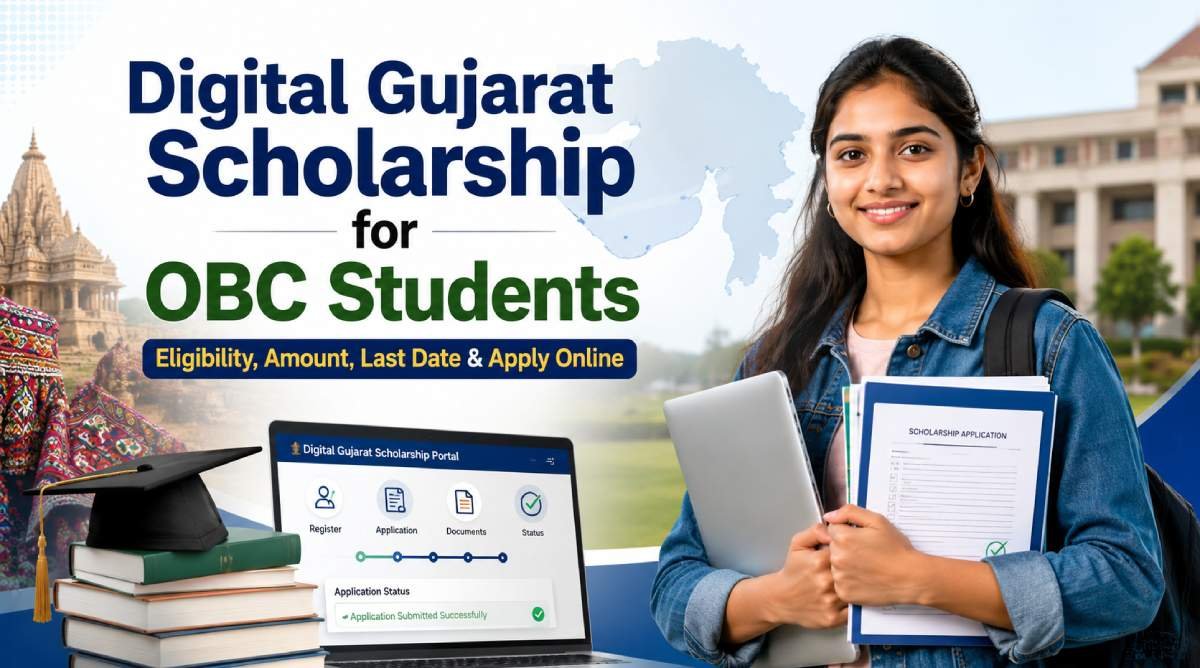
OBC and SEBC students in Gujarat who are studying after Class 10 should first identify the correct Digital Gujarat scholarship service before applying. The main current central post matric framework for eligible OBC, EBC and DNT students is PM YASASVI. For the 2026 to 27 Gujarat cycle, the currently reported application window is 6 July 2026 through 30 September 2026. The central family income ceiling is approximately USD 2,646 per year, and the yearly benefit can reach approximately USD 212 depending on the course group. Confirm the live application status on the Digital Gujarat official portal before final submission.
Item
Current information
Academic year
2026 to 27
Main search intent
Post matric financial assistance for OBC and related developing caste students
Primary current central scheme
PM YASASVI Post Matric Scholarship for OBC, EBC and DNT Students
Application window
6 July 2026 through 30 September 2026
Family income ceiling
Approximately USD 2,646 per year under the central PM YASASVI post matric framework
Yearly benefit
Approximately USD 53 to USD 212 depending on course group
Application mode
Online through the applicable Gujarat scholarship service
Fresh and renewal
Both journeys apply, but renewal students should follow the current portal instructions shown in their account
Official authority
Director, Developing Castes Welfare, Government of Gujarat, with the central PM YASASVI framework from the Ministry of Social Justice and Empowerment
Check First: Is This the Right Scholarship for You?
The phrase Digital Gujarat Scholarship for OBC Students describes a search need, not one single scholarship name. Digital Gujarat is the service portal. OBC and SEBC students can see different education assistance schemes depending on caste classification, study level, course, institution and income. The Director, Developing Castes Welfare education scheme directory lists several Gujarat education assistance schemes for developing caste students.
For a student studying after Class 10, the most important central entity to check is the PM YASASVI scholarship framework. PM YASASVI includes post matric financial assistance for eligible OBC, EBC and DNT students. Gujarat can also operate state specific SEBC and developing caste assistance, so the exact service selected on Digital Gujarat matters.
OBC and SEBC Are Related Terms, but the Portal Category Must Match Your Certificate
Students often search OBC scholarship while Gujarat government pages frequently use SEBC or developing caste terminology. Do not choose a service only because the title looks similar. Match the category shown on your valid certificate with the category accepted by the specific Digital Gujarat service.
Who Should Apply?
You should apply when your category, study level, admission, income and documents match the conditions of the scholarship service shown in your Digital Gujarat account. The following checklist is designed for a quick decision before you spend time filling the form.
You belong to an eligible OBC, SEBC, EBC or DNT category for the selected scheme.
You are studying at a post matric or post secondary level that the selected service covers.
Your family income is within the limit of the selected scholarship.
You have taken admission through an eligible and recognized process.
Your institution can verify your admission and academic information.
Your identity, category, income, academic and bank documents are available and readable.
Your bank account information is correct and can receive government benefit payments.
You can complete the application before the current deadline and respond to any verification query.
Who Should Not Apply Under the PM YASASVI Post Matric Route?
Do not submit a PM YASASVI post matric application only because you identify as OBC. The scheme has specific conditions. A student should use another route or first confirm eligibility when any of the following conditions applies.
Your category is not accepted under the selected scheme.
Your annual family income is above the applicable ceiling.
You are still at a study level covered by a pre matric scheme instead of a post matric scheme.
Your admission route is excluded by the applicable rules.
You cannot produce valid category or income evidence when the scheme requires it.
You selected an old Gujarat scheme page and assumed that its historical amount or condition automatically applies to the 2026 to 27 application.
You are already receiving another educational scholarship that cannot be combined with the selected benefit.
Your application details do not match the records held by your institution, Aadhaar data or bank account.
Eligibility Self Check
Question
What you should confirm
Category
Your valid certificate matches the category accepted by the service you select.
Study level
Your current class, diploma, degree or postgraduate program is covered by the scholarship.
Income
Your total family income is within the scheme limit.
Admission
Your admission is recognized and eligible under the scheme rules.
Institution
Your school, college or training institution can verify your current enrollment.
Documents
Your certificates are current, readable and consistent with the form.
Payment
Your bank details are correct and ready for government benefit transfer.
What Is the Income Limit?
The current central PM YASASVI post matric framework uses a family income ceiling equivalent to approximately USD 2,646 per year. This article uses the 4 September 2026 reference conversion rate. The official scheme is defined in Indian currency, so the USD value is approximate. Always use the amount and certificate requirement shown by the current government application service. The official PM YASASVI guidelines also explain that the state government sets the detailed selection and implementation procedure.
How Much Can an OBC Student Receive?
The post matric PM YASASVI benefit depends on the course group. The central framework combines an academic allowance with a tuition component for Groups 1 to 3. Group 4 receives the academic allowance. The following figures are approximate USD equivalents based on the 4 September 2026 reference exchange rate.
Course group
Typical study type
Academic allowance
Tuition component
Approximate yearly total
Group 1
Degree and postgraduate professional courses
USD 106
USD 106
USD 212
Group 2
Other professional degree, diploma and certificate courses
USD 85
USD 53
USD 138
Group 3
Graduate and postgraduate courses not included in Groups 1 or 2
USD 64
USD 21
USD 85
Group 4
Post matric non degree courses after Class 10
USD 53
No separate tuition component in the central table
USD 53
Your exact payable amount can depend on how Gujarat maps your course to the applicable group and on the current service rules. Do not estimate your entitlement from another student studying a different course.
Which Digital Gujarat Scholarship Should You Select?
Select the scheme only after matching your category and course. The wrong service is one of the easiest ways to create a returned or rejected application.
Your situation
What to check first
You are in Class 9 or 10
Check the applicable pre matric route rather than the post matric route.
You are in Class 11, Class 12, ITI or another eligible post Class 10 course
Check the post matric service that matches your category and course.
You are in a diploma or professional certificate course
Check the post matric course group and any Gujarat specific assistance shown in your account.
You are in a university degree or postgraduate course
Check PM YASASVI post matric eligibility and any state SEBC assistance relevant to your course.
You study at a notified top institution and meet separate merit conditions
Check whether PM YASASVI Top Class College Education is a better fit.
You received the same scholarship last academic year
Open the renewal application shown in the portal before starting a new fresh application.
Documents Required for Digital Gujarat OBC Scholarship
Prepare documents before opening the form. Each document proves a different eligibility fact. A complete file also reduces the risk of an institute query after submission.
Aadhaar Card
Aadhaar supports identity verification. Check the spelling of your name, date of birth and other identity details before applying. If your scholarship record and Aadhaar record differ, resolve the inconsistency instead of repeatedly submitting different spellings.
OBC or SEBC Category Certificate
The category certificate proves that you belong to the beneficiary group accepted by the selected service. Use the current and legally valid certificate required by the Gujarat service. Do not upload a relative’s certificate or a certificate that does not identify the applicant.
Income Certificate
The income certificate supports the annual family income condition. Use the certificate period and issuing authority required by the current application. A certificate that is too old, incomplete or inconsistent with the form can trigger verification problems.
Non Creamy Layer Certificate
Some Gujarat OBC or SEBC services may ask for a Non Creamy Layer certificate. Do not assume that it is either always required or never required. Follow the document list of the specific service selected in the 2026 to 27 portal.
Previous Academic Marksheet
The previous marksheet confirms your last completed academic stage and helps the institution verify progression. Upload a clear copy with the student name, examination, year and result visible.
Current Admission Proof or Bonafide Certificate
This proves that you are currently enrolled in the institution and course entered in the application. The course name, academic year and institution details should match the online form.
Fee Receipt
The fee receipt supports the current admission and fee information. Use the current academic year receipt if the service asks for it.
Student Bank Passbook
The bank document confirms the account holder name, bank name, branch and account details. Use an active account that can receive government benefit payments. Recheck every digit before final submission.
Hostel Certificate
Hostel related proof is needed only when the selected service or benefit depends on hostel status. Day scholars should not claim hosteller status without valid evidence.
Other Conditional Documents
The portal can ask for additional proof depending on course, gap in study, guardian status, institution type or scheme. Treat the live document checklist as the final requirement for your application.
Document Check Before Upload
The applicant name is consistent across Aadhaar, bank, category and academic records.
The income certificate is valid for the required period.
The category certificate belongs to the applicant and matches the selected scheme.
The marksheet and admission proof are readable.
The fee receipt belongs to the current academic year when required.
The bank account is active and the entered account number is correct.
Every scan is complete and not cropped.
Any conditional document shown by the portal has been added.
How to Apply for Digital Gujarat Scholarship for OBC Students
Apply only through the official government service. Start from the Digital Gujarat portal and follow the scholarship service visible for your profile and academic year.
Step 1: Confirm your category and scheme
Check your caste category, study level, course and income before entering data. This prevents you from completing the wrong application.
Step 2: Prepare all documents
Create clear digital copies and compare the applicant name, course details, certificate information and bank data.
Step 3: Sign in or complete registration
Use your existing Digital Gujarat account if you already have one. New users should follow the current registration process shown on the official portal.
Step 4: Complete your profile
Enter identity, address, category and contact information accurately. Do not use a nickname when your official documents use another name.
Step 5: Open scholarship services
Go to the scholarship or education assistance service area and select the 2026 to 27 academic cycle where applicable.
Step 6: Choose the correct OBC or SEBC service
Read the scheme name and eligibility details before selecting it. Do not select a service simply because another student in your college selected it.
Step 7: Enter academic information
Add the current institution, course, year or semester, admission details and previous academic information exactly as supported by your documents.
Step 8: Enter family income and category information
Use the values supported by the current certificates. Do not round or alter figures to fit an eligibility limit.
Step 9: Enter bank information
Use the student account information required by the scheme. Recheck the account number and bank details carefully.
Step 10: Upload documents
Upload clear files in the format and size accepted by the portal. Open each uploaded file to confirm that the correct document is attached.
Step 11: Review before final submission
Compare the form with Aadhaar, category certificate, income certificate, marksheet, admission proof and bank record.
Step 12: Submit the application
Complete the final submission step only after review. Save the application number and a copy of the submitted form.
Step 13: Complete institution requirements
If your college asks for a printout or supporting documents for verification, submit them within the institution deadline.
Step 14: Track verification
Check whether the institute and department have verified, returned or queried the application. Respond quickly when a correction is permitted.
Do You Need NSP OTR?
The National Scholarship Portal student guidance states that One Time Registration is mandatory for scholarships on NSP for academic year 2026 to 27. However, a Digital Gujarat applicant should not assume that every Gujarat service requires the same OTR step. Follow the current instruction shown by the specific government service and circular you are using.
How the Selection and Verification Process Works
The standard PM YASASVI post matric process is not a simple first come approval. The applicant must satisfy the scheme rules, and the state follows its verification and selection procedure within available funds and applicable priorities.
Stage
What happens
What the student should do
Application screening
The submitted details and documents are checked for basic completeness and eligibility.
Keep all uploaded documents available and monitor the portal.
Institute verification
The institution confirms that you are a genuine student in the course and academic year stated.
Make sure your college records match the application.
Government scrutiny
The competent authority reviews category, income, course and other conditions.
Respond to any permitted correction or query without delay.
Selection or sanction
Eligible applications are considered under the applicable state procedure and available allocation.
Do not treat submission as final approval.
Payment
Sanctioned benefits are sent through the government payment process to the eligible account.
Keep the account active and verify payment details if the status is sanctioned but money is not received.
The standard PM YASASVI post matric scholarship should not be confused with the separate PM YASASVI Top Class schemes. Post matric selection is based on eligibility and the state procedure, with merit and means relevant where funds require prioritization. Top Class schemes can use separate institution, slot and merit conditions.
Common Mistakes That Can Delay or Reject an Application
Mistake
Why it matters
Better action
Choosing the wrong scheme
A valid OBC certificate does not make every developing caste service applicable.
Match category, study level and course before selecting the service.
Using old eligibility information
Older Gujarat scheme pages can show legacy amounts or conditions.
Use current portal instructions and current government circulars for 2026 to 27.
Name mismatch
Different spelling across Aadhaar, bank and college records creates verification problems.
Use the same official identity details everywhere.
Invalid income proof
An outdated or incorrect certificate can fail the income check.
Use the certificate period and authority required by the live service.
Wrong course group
The benefit level can depend on course classification.
Enter the exact recognized course and let the applicable service rules determine the group.
Unclear uploads
Unreadable or cropped files cannot prove eligibility.
Open every uploaded file before submission.
Incorrect bank details
Payment can fail even after sanction.
Verify account holder name and every account detail.
Submitting too early without review
Final submission can limit editing.
Complete a field by field review first.
Ignoring institute verification
The application can remain pending after student submission.
Follow your institution process and monitor status.
Waiting for an extension
A previous year reopening does not guarantee a new extension.
Apply within the published window.
Ten Point Pre Submission Audit
I selected the scholarship that matches my category.
My course and current study year are correct.
My annual family income matches the certificate.
My name is consistent across all major records.
My category certificate is valid for the selected service.
My admission and fee documents belong to the current academic year where required.
My bank account information is correct.
Every uploaded document is readable and complete.
I saved the application details before final submission.
I know how my institution will complete verification.
How to Check Your Application Status
After submission, the next user need is status. Sign in to the same government portal used for the application and open the scholarship application record. Status wording can vary by service, but the following meanings are useful.
Status type
What it usually means
Your next action
Submitted
The student has completed online submission.
Check whether institution verification is still required.
Pending at institute
The college or school has not completed its verification stage.
Contact the scholarship or student section of the institution if the delay is unusual.
Returned or defective
The verifier found information that needs correction or clarification.
Read the reason, correct only what the portal permits and resubmit within the allowed time.
Verified
A verification stage has been completed.
Continue monitoring until sanction or final decision.
Rejected
The application did not satisfy a requirement or was not corrected as required.
Read the rejection reason before contacting the relevant authority.
Sanctioned
The competent authority has approved the benefit.
Monitor the bank account and payment status.
When Will the Scholarship Amount Be Credited?
Submission does not create an immediate payment date. The application normally moves through institute verification, government scrutiny and sanction before payment. A student should therefore track both the application status and the bank account instead of assuming that all applicants receive funds on the same day.
If the status shows sanction but the amount is not visible, confirm that the bank account is active, the account details are correct and any government payment requirements have been satisfied. Do not share OTP, PIN or password details with anyone claiming to release the scholarship.
How to Renew the Digital Gujarat OBC Scholarship
Renewal is for a student who already received or held the applicable scholarship and continues to meet the current conditions. Do not create a duplicate fresh application when the portal already provides a renewal path for the same scheme.
1. Sign in to your existing Digital Gujarat account.
2. Open the scholarship service and check whether a renewal application is available.
3. Review the carried forward personal and category information.
4. Update the current course year, semester, marks, admission and fee information where required.
5. Upload any new or renewed certificate requested for the current academic year.
6. Review bank information and update it only when the government service allows and the new details are correct.
7. Submit the renewal within the current application window.
8. Complete institution verification requirements and track the renewed application.
Previous Years Trends and What They Mean for 2026 to 27
Previous Digital Gujarat scholarship cycles show a recurring pattern: applications are tied to the academic admission cycle, students often receive a limited submission window, and some cycles can receive a later reopening or extension for remaining applicants. This pattern is useful for planning, but it should never be treated as a promise of extra time.
Trend observed
What it means for applicants
Application windows usually follow the new academic cycle
Prepare documents soon after admission instead of waiting for the final month.
Fresh and renewal students can face the same closing period
Returning students should not assume renewal stays open longer.
Reopening has occurred in some previous cycles
A reopening is an exception, not a right.
Institute verification continues after student submission
Submitting early gives more time to fix a returned application.
Scheme names and implementation details can change over time
Use the current academic year service and circular instead of copying a previous year guide.
Current 2026 to 27 window ends on 30 September 2026
Apply before that date unless an official government update changes the schedule.
Research Notes: Important Details Other Guides Often Mix Together
Digital Gujarat is the portal, not one scholarship
A page that treats Digital Gujarat Scholarship as a single universal award can give the wrong income limit, amount or document list. The exact service name matters.
OBC search language and Gujarat SEBC language need context
Students may search OBC while official Gujarat welfare pages use SEBC and developing caste terminology. Eligibility must follow the certificate and the selected service, not a loose synonym.
Older Gujarat scheme pages can still rank in search
Legacy scheme pages remain useful for understanding the state scholarship ecosystem, but an old benefit figure should not be presented as the current PM YASASVI amount.
Post Matric and Top Class are different PM YASASVI components
The regular post matric route and Top Class College Education have different selection logic. Students should not combine their rules.
USD figures are editorial conversions
The scholarship is officially administered using Indian currency. The USD figures in this page are approximate conversions for consistency with the site currency policy.
OTR is mandatory on NSP, but portal context matters
NSP requires OTR for scholarship applications on NSP. A Digital Gujarat student should follow the specific Gujarat service instruction instead of importing an NSP step into every state scheme automatically.
A deadline extension should never be assumed
Past reopenings create search demand, but the safest action is to submit within the published current window.
Other Scholarships OBC Students in Gujarat Should Check
If you are not eligible for the standard post matric route, or if your institution and academic profile qualify you for another scheme, check these adjacent opportunities before giving up on financial aid.
PM YASASVI Top Class College Education for eligible students admitted to notified institutions under its separate conditions.
Other educational assistance for SEBC and developing caste students listed by the Government of Gujarat.
MYSY and other Gujarat higher education assistance where the student meets the separate eligibility conditions.
National Scholarship Portal opportunities that match the student category, institution and course.
What is the Digital Gujarat Scholarship for OBC students?
Digital Gujarat is the Gujarat government service portal used for multiple welfare and education schemes. OBC and SEBC students can access different scholarship services according to category, course and income. For eligible post matric OBC, EBC and DNT students, PM YASASVI is an important central scholarship framework implemented through the state process.
What is the last date for the Digital Gujarat OBC Scholarship in 2026 to 27?
The currently reported application window for the 2026 to 27 post matric cycle runs from 6 July 2026 through 30 September 2026. Students should submit before 30 September rather than wait for a possible extension. Always confirm the live closing date on the official Digital Gujarat portal before final submission.
Who is eligible for the OBC post matric scholarship in Gujarat?
Eligibility depends on the selected service. Under the central PM YASASVI post matric framework, eligible students belong to the covered OBC, EBC or DNT group, study at a post matric level, meet the family income condition, hold valid documents and satisfy admission and state implementation requirements.
What is the family income limit for PM YASASVI post matric scholarship?
The central PM YASASVI post matric framework uses a family income ceiling equal to approximately USD 2,646 per year at the 4 September 2026 reference exchange rate. Because the official scheme is administered in Indian currency, students should follow the exact amount and certificate instructions shown by the current government service.
How much can an OBC student receive under PM YASASVI post matric scholarship?
The central course group structure provides an approximate yearly total from USD 53 to USD 212 using the 4 September 2026 reference exchange rate. Group 1 has the highest listed total. The final amount depends on the course group and the applicable state implementation rules for the student.
Is OBC the same as SEBC on Digital Gujarat?
OBC and SEBC are closely related classification terms, but students should not treat them as automatically identical in every form. Gujarat government welfare pages commonly use SEBC and developing caste terminology. Select a scholarship only when your valid category certificate matches the beneficiary category required by that specific Digital Gujarat service.
Which documents are required for Digital Gujarat OBC scholarship?
Common documents include Aadhaar, a valid OBC or SEBC category certificate, income certificate, previous academic marksheet, current admission or bonafide proof, fee receipt and student bank details. Some applicants may also need a Non Creamy Layer certificate, hostel proof or another conditional document shown by the selected service.
Is a Non Creamy Layer certificate compulsory for every OBC scholarship application?
No single answer applies to every Digital Gujarat OBC or SEBC service. Some services can require a Non Creamy Layer certificate while others rely on different category and income evidence. Read the current document checklist for the exact scholarship you select and upload the certificate only when the applicable government service requires it.
How do I apply for the Digital Gujarat OBC scholarship online?
Sign in to Digital Gujarat, complete your profile, open scholarship services, choose the current academic year and select the scheme matching your category and course. Enter academic, income and bank details, upload the required documents, review every field, submit the form and then monitor institute and government verification.
Is NSP OTR required for Digital Gujarat scholarship?
NSP states that One Time Registration is mandatory for scholarship applications made on the National Scholarship Portal. Digital Gujarat is a state portal, so students should follow the instructions of the exact Gujarat scholarship service being used. Do not assume an NSP requirement applies automatically unless the current Gujarat service or circular asks for it.
Can engineering, diploma, ITI and postgraduate students apply?
Many post Class 10 courses can fall within the post matric scholarship framework, including professional degrees, diplomas, certificates and other graduate or postgraduate study. Eligibility still depends on category, income, admission route, institution and course classification. Check the selected Digital Gujarat service instead of assuming every course receives the same amount.
How do I renew my Digital Gujarat OBC scholarship?
Use the same Digital Gujarat account and check whether the current academic year shows a renewal application for your existing scheme. Review carried forward information, update current academic and document details, submit within the application window and complete institution verification. Avoid creating a duplicate fresh application when a valid renewal route already exists.
How can I check my Digital Gujarat scholarship status?
Sign in to the portal used for your application and open the submitted scholarship record. Check whether it is submitted, pending at institute, returned, verified, rejected or sanctioned. If the application is returned, read the reason first. If it is pending at institute, contact the institution scholarship section when the delay becomes unusual.
Why can a Digital Gujarat scholarship application be returned or rejected?
Common reasons include choosing the wrong scheme, category mismatch, income above the limit, invalid certificate, unreadable document, name mismatch, incorrect bank data, ineligible admission, missing institutional verification or failure to correct a returned form. The rejection or return message should guide the next action rather than guesswork.
Can I edit the application after final submission?
Editing depends on the workflow and current portal controls. Some fields may become locked after final submission, while a returned application can allow specific corrections. Review the full form before submitting and save a copy. If a critical error remains, use the official portal guidance or contact the relevant institution or government help channel.
When will the scholarship amount be credited?
There is no single payment date for every applicant. The application must pass institute verification, government scrutiny and sanction before payment. After sanction, bank or payment validation can still affect timing. Monitor both the portal status and the student bank account, and never share OTP, PIN or password information with anyone.
Can an OBC student receive another scholarship at the same time?
The answer depends on the rules of both schemes. Some educational scholarships cannot be held together, while current NSP guidance allows one merit based scholarship and one or more welfare based scholarships when the specific scheme rules permit it. Read the conditions of each benefit before accepting overlapping funding.
What should I do if my college has not verified the application?
First confirm that the application was finally submitted and that no document is pending from your side. Then contact the college scholarship, student or nodal section with your application number. Early submission is useful because institute verification can reveal issues that still need correction before the government completes the final decision.
Conclusion
A student searching for the Digital Gujarat Scholarship for OBC Students should first identify the correct scholarship service, then verify category, income, course and documents before applying. For eligible post matric OBC, EBC and DNT students, PM YASASVI is the main current central framework to understand. The 2026 to 27 Gujarat application window currently runs through 30 September 2026, so eligible students should apply early enough to resolve verification issues.
The next useful step is to read a dedicated PM YASASVI Scholarship 2026 to 27 guide or a Digital Gujarat Scholarship Status guide. Those pages can support the user after eligibility and submission without repeating the entire application journey on this page.





 By Country2 months ago
 Scholarships1 month ago
 By Country2 months ago
 Scholarships1 month ago
 Scholarships2 months ago