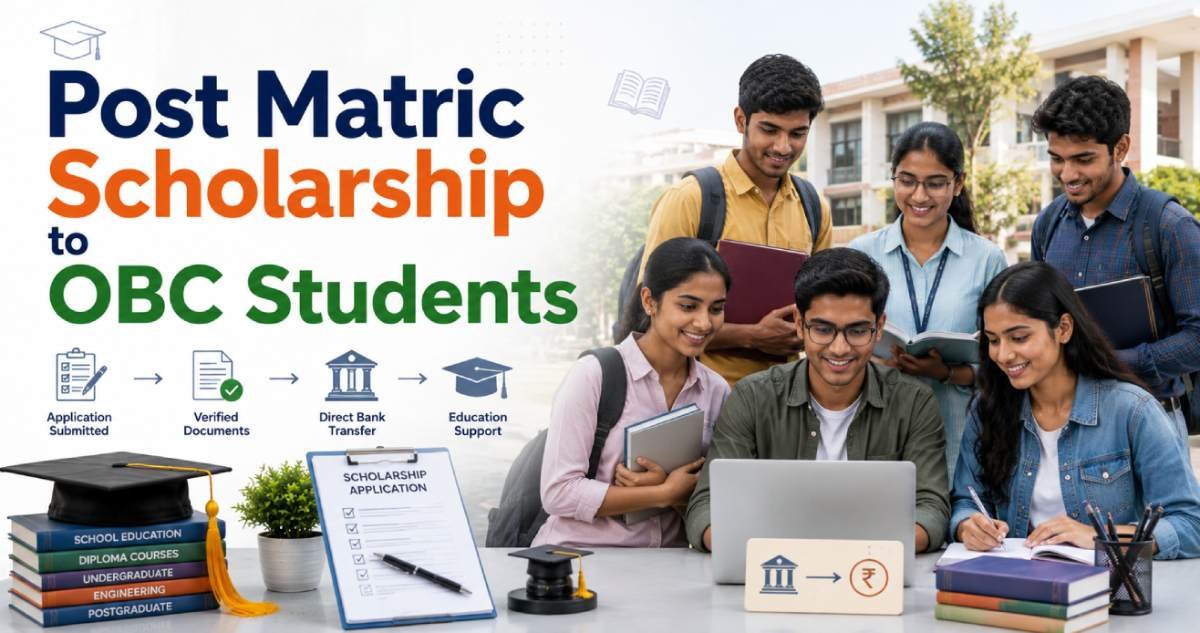
The PM YASASVI Post Matric Scholarship provides financial assistance to eligible OBC, EBC and DNT students studying after Class 10 in India. The published family income ceiling is INR 250,000 per year, which is approximately USD 2,648 at the conversion used for this article. The annual support depends on the course group and is approximately USD 53 to USD 212 under the current published rate structure. The application route is not identical across India because States and Union Territories implement the scheme.
Fast answer: confirm that your study is after Class 10, verify your community and income eligibility, identify your course group, find the correct State application portal, prepare documents, submit before the State deadline, and monitor institute and government verification.
PM YASASVI Post Matric Scholarship for OBC, EBC and DNT Students
Study stage
Post matriculation or post secondary education after Class 10
Eligible groups
OBC, EBC and DNT students subject to applicable rules
Family income ceiling
Approximately USD 2,648 per year
Annual support
Approximately USD 53 to USD 212 according to course group
Implementation
State Governments and Union Territory Administrations
Application route
State portal, NSP or another State directed route
Fresh and renewal
Both can apply according to State process and continuing eligibility
Selection
Administrative eligibility and verification process
Payment
Government disbursement through the applicable State and DBT system
What Does Post Matric Scholarship Mean?
Post matric means education pursued after the Class 10 stage. It does not mean only college, and it does not mean only education after Class 12.
An eligible OBC student can therefore enter the post matric scholarship journey at several education levels, depending on the State implementation and recognized course.
Class 11 and Class 12 study after completion of Class 10.
Diploma and certificate study at the post Class 10 stage.
Undergraduate study such as BA, BSc, BCom and other recognized degrees.
Professional degree study such as engineering, medicine, management and technology.
Postgraduate study such as MA, MSc, MCom and professional postgraduate programs.
Research study and other eligible advanced programs where included in the course classification.
The official Government education page describes the program as support for students at the post matriculation and post secondary stage. See the Government PM YASASVI education guidance.
Post Matric Scholarship Versus PM YASASVI Top Class College
These are separate scholarship components. A student should identify the correct scheme before comparing amounts or submitting an application.
Attribute
Post Matric Scholarship
Top Class College
Purpose
Broad financial assistance after Class 10
Higher value support for students at notified institutions
Institution model
State and Union Territory implementation rules
Specified Top Class institutions
Funding model
Course group academic allowance plus tuition component
Tuition and other approved higher education costs
Selection
State or Union Territory procedure
Merit and institution slot based process
Application
State portal, NSP or State directed route
National Scholarship Portal
Same scholarship
No
No
Do not use Top Class College benefit figures when estimating an ordinary Post Matric Scholarship. The funding structures are materially different.
Apply when your community, income, study level, institution and State implementation all match the current rules.
OBC students who have completed Class 10 and continue in eligible education.
Eligible EBC and DNT students covered by the same Post Matric component.
Students whose parents or guardians have annual income within the published ceiling.
Class 11 and Class 12 students in an eligible post matric course.
Diploma and certificate students in recognized programs.
Undergraduate students in general degree programs.
Students in engineering, medicine, management, technology and other eligible professional courses.
Postgraduate students in eligible academic or professional programs.
Existing recipients who continue to satisfy renewal conditions.
Who Should Not Apply?
Do not apply if you have not reached the post Class 10 education stage.
Do not apply under the OBC route if your community status does not meet the applicable scheme definition.
Do not apply if annual family income is above a mandatory State or scheme ceiling.
Do not apply for an unrecognized or excluded course.
Do not use the Post Matric form when you actually intend to apply for Top Class College Education.
Do not use another State portal merely because a guide on the internet shows that application process.
Do not upload an invalid or unrelated community certificate.
Do not ignore scholarship overlap restrictions where the State or scheme applies them.
Do not submit identity, bank or academic information that conflicts with official records.
Not Eligible Versus Not Verified
Not eligible means you fail a mandatory rule such as community, income, course or institution eligibility. Not verified means the application may be eligible but the institution or government authority has not completed the administrative check. A verification delay should be followed up. A true eligibility failure usually requires a different scholarship route.
OBC Post Matric Scholarship Eligibility
Use this checklist before opening the application form.
Confirm that you belong to an eligible OBC, EBC or DNT category under the applicable rules.
Confirm that your education is at the post Class 10 stage.
Confirm that your course is recognized and eligible.
Confirm that the institution is recognized for the scholarship process.
Check the annual family income ceiling.
Check the State or domicile conditions.
Identify whether you are submitting a fresh application or renewal.
Check whether another scholarship or fee assistance creates a conflict.
Confirm that your Aadhaar and identity information match your academic records.
Confirm that your bank account can receive the required government payment.
Check the current State application deadline.
Check the institution verification deadline if it is published separately.
What Is the OBC Post Matric Scholarship Income Limit?
The current central scheme mandate states that income from all sources should not exceed INR 250,000 per year. That amount is approximately USD 2,648 at the exchange rate used on September 3, 2026.
The income certificate must normally come from the authority accepted by your State. Do not assume that a salary slip, self declaration or old certificate will be accepted when the portal asks for a formal income certificate.
Do not automatically treat EBC and EWS as the same eligibility category. PM YASASVI uses EBC as one of its beneficiary categories. EWS is used in a separate reservation and certification context. Your State may define the required certificate and category evidence differently.
Use the category named in the scholarship form and the current State instructions. Do not upload an EWS certificate simply because the application mentions EBC unless the official State guidance explicitly accepts it.
Which Course Group Are You In?
Your course group determines the published annual scholarship amount. This is the fastest way to estimate the benefit accurately.
Group 1
Group 1 covers degree and postgraduate professional programs. The official classification includes medicine, engineering, technology, planning, architecture, design, fashion technology, agriculture, veterinary and allied sciences, management, business finance, administration and computer science or applications.
It also includes specified postgraduate professional diplomas, professional qualifications, law programs and eligible research programs connected with Group 1, Group 2 and Group 3 courses.
Group 2
Group 2 covers other professional programs leading to a degree, diploma or certificate. Examples include pharmacy, nursing, paramedical study, mass communication, hotel management, tourism, hospitality, financial services, selected vocational streams, ITI programs and polytechnic study where the prescribed entrance level applies.
Group 3
Group 3 covers graduate and postgraduate study not included in the professional Group 1 or Group 2 categories. Common examples include BA, BSc, BCom, MA, MSc and MCom.
Group 4
Group 4 covers other post matriculation, post Class 10, non degree courses that are not included in the first three groups.
The annual amount depends on the course group. The following USD figures are approximate conversions for editorial consistency.
Course Group
Academic Allowance
Tuition Component
Approximate Annual Total
Group 1
About USD 106
About USD 106
About USD 212
Group 2
About USD 85
About USD 53
About USD 138
Group 3
About USD 64
About USD 21
About USD 85
Group 4
About USD 53
No separate published tuition component in the current table
About USD 53
The official scheme publishes its amounts in INR. The USD values above are approximate conversions as of September 3, 2026. Exchange rates change and do not change the official INR entitlement.
A higher course fee does not automatically increase the ordinary Post Matric amount. Do not confuse these fixed course group rates with the higher support available under PM YASASVI Top Class College Education.
Which Portal Should You Use?
There is no single application portal that every OBC Post Matric student in India should use. The Central Government supports the scheme, while State Governments and Union Territory Administrations carry out selection, verification and disbursement.
Identify the State or Union Territory that handles your scholarship eligibility.
Visit the official Backward Classes, Social Welfare or scholarship portal for that State.
Check whether the State directs OBC Post Matric applicants to NSP.
Check whether the State uses its own scholarship portal.
Check whether an NSP OTR is required even when the State uses a separate portal.
Check your college scholarship notice because institute verification may use a separate deadline.
Apply only through the official route published for the current academic year.
National Scholarship Portal for OBC Students
The National Scholarship Portal is used for many central and State scholarship workflows. However, availability of one PM YASASVI component on NSP does not prove that every State routes ordinary OBC Post Matric applications through the same NSP form.
What is OTR?
OTR means One Time Registration. NSP uses it as a persistent student identifier connected with Aadhaar or the permitted identity route. Some State portals can require NSP OTR even when the final scholarship form is submitted through the State system.
Your State may use its own portal for the ordinary Post Matric scheme.
The current application cycle may not yet be open.
Your student profile may not match the scheme shown by the portal.
The State may require a separate registration or mapping process.
You may be looking at Top Class College instead of the Post Matric component.
State Scholarship Portal Examples
State implementation is easiest to understand through current examples.
West Bengal OASIS
West Bengal is accepting 2026 to 2027 online applications for Post Matric OBC scholarships through its official OASIS system. The portal also provides a user manual for generating NSP OTR and submitting the scholarship application through OASIS.
Maharashtra directs Post Matric scholarship applications for academic years 2025 to 2026 and 2026 to 2027 through MahaDBT 2.0 from June 1, 2026. The portal lists Post Matric Scholarship to OBC Students under the OBC welfare department.
Maharashtra students should follow the current instructions on the official MahaDBT portal.
These examples show why a student should identify the State route before following a generic application tutorial.
What Is the Freeship Card?
A Freeship Card is an administrative mechanism described in Government PM YASASVI guidance that can allow an eligible student to study without prepayment of covered fees, subject to State implementation.
The Freeship Card is not the same thing as final scholarship payment. One step supports access to the institution. The later scholarship process verifies eligibility and disburses the approved assistance.
Because States implement the scheme, do not assume that every State uses an identical Freeship Card workflow, name or application timetable.
Required Documents for OBC Post Matric Scholarship
The exact document list varies by State, but the following records are commonly required.
Document
Why It Is Needed
Common Error
Aadhaar
Identity and portal verification
Name, date of birth or number mismatch
NSP OTR where required
Links student identity in NSP workflows
Using another person’s OTR
OBC or applicable community certificate
Proves beneficiary category
Wrong category or unaccepted authority
Income certificate
Proves annual family income
Expired certificate or wrong financial year
Domicile or residence proof
Establishes State eligibility
Applying through the wrong State
Previous year marksheet
Academic history and renewal
Uploading an older result
Admission letter
Confirms course and institution
Course name does not match portal
Bonafide certificate
Confirms current enrollment
Old academic session
Fee receipt
Supports fee information
Incomplete or unreadable receipt
Bank account details
Government payment
Incorrect account or bank mapping
Photograph where required
Student identity
Wrong size or unreadable image
Disability certificate where applicable
Additional eligibility where relevant
Invalid or incomplete disability record
Step by Step OBC Post Matric Scholarship Application Guide
Use this sequence so you do not complete the wrong form or miss verification.
Confirm that your education is after Class 10.
Confirm your OBC, EBC or DNT eligibility under the applicable rules.
Check annual family income.
Identify your course group.
Identify the State or Union Territory that administers your application.
Find the current official State application portal.
Check the current student application deadline.
Create NSP OTR if your State or portal requires it.
Confirm Aadhaar details and identity information.
Obtain a valid income certificate from the accepted authority.
Prepare the correct OBC or community certificate.
Prepare your latest academic records.
Enter institution and course details exactly as registered.
Enter bank information carefully.
Upload clear and readable documents.
Review every field before final submission.
Submit the application before the deadline.
Save the application number and acknowledgement.
Confirm that your institution has received the application for verification.
Respond to a defective application notice within the allowed period.
Monitor State or district verification.
Track sanction and payment after approval.
How Does Selection Work?
OBC Post Matric Scholarship is mainly an administrative eligibility program rather than an essay competition. The State or Union Territory lays down the detailed student selection procedure.
Typical selection and verification funnel
The student submits the application.
Identity and portal data are checked.
Community status is checked.
Family income evidence is checked.
Course and institution eligibility are checked.
The institution verifies enrollment and application details.
The State or Union Territory authority completes eligibility verification.
The scholarship is sanctioned if all applicable conditions are satisfied.
The approved amount enters the government payment process.
Status labels vary by portal, but the student should think about the application as a sequence.
Status
Meaning
Student Action
Submitted
The application reached the portal
Save acknowledgement
Defective
An error or missing item needs correction
Correct it before the deadline
Institute verification pending
College has not completed verification
Contact scholarship or nodal office
Institute verified
College has confirmed student data
Wait for the next authority
State or district verification pending
Government review is not complete
Monitor official portal
Sanctioned
Scholarship is approved
Check payment stage
Payment processed
Amount entered the payment system
Confirm bank status
Credited
Scholarship reached the account
Keep payment record
Why Is My Application Stuck at Institute Verification?
Institute verification can remain pending because the college has not completed its scholarship batch, student admission information does not match the portal, a certificate is unclear, a course is not mapped correctly or the institution is waiting for corrected data.
Contact the college scholarship office or nodal officer before contacting unrelated government departments. The institution normally sees the verification issue earlier in the process.
When Will the Scholarship Money Be Credited?
There is no single national payment date for every OBC Post Matric student. States verify and disburse scholarships according to their implementation schedule.
Application submission is not approval.
Institute verification is not final sanction.
Government sanction is not always immediate bank credit.
Bank account and Aadhaar mapping issues can delay DBT.
State budget release and verification batches can affect timing.
Use the official portal status instead of social media payment predictions.
The central metadata describes disbursement as continuing through the financial year. This is another reason to avoid publishing one universal payment date.
OBC Post Matric Scholarship Renewal
Renewal is the continuation application for a student who already received or held the scholarship in the previous academic period. Renewal rules can differ by State.
Remain enrolled in an eligible course and institution.
Submit the latest academic result or promotion information.
Update family income evidence where required.
Keep community and domicile records valid.
Confirm bank information remains correct.
Update Aadhaar or OTR details if the portal requires action.
Submit the renewal form before the State deadline.
Complete institution verification again where required.
What if I fail or repeat a year?
Do not assume that one academic failure automatically ends every Post Matric benefit. Promotion, repeat year and renewal rules can be State specific. Read the current implementation instructions and ask the institution scholarship office how the portal treats your academic status.
Can You Receive Another Scholarship at the Same Time?
There is no safe universal answer for every State scholarship combination. Another government scholarship, private scholarship, college grant, tuition reimbursement or fee waiver can interact differently with Post Matric assistance.
Check whether the second award pays the same tuition or fee component.
Check whether the State portal asks you to declare another scholarship.
Check whether the second provider prohibits government aid.
Disclose existing assistance when the form requests it.
Do not collect duplicate reimbursement for the same expense if the rules prohibit it.
Common Mistakes OBC Post Matric Applicants Make
Thinking post matric means only education after Class 12.
Confusing ordinary Post Matric Scholarship with PM YASASVI Top Class College.
Using another State’s application instructions.
Ignoring the State specific deadline.
Selecting the wrong course group.
Estimating the scholarship with Top Class College amounts.
Beneficiary totals can differ by reporting period because States submit and reconcile scholarship data over time. Compare like periods before interpreting a rise or fall.
Opportunity Research Notes: What OBC Students Often Miss
Research Insight
Why It Matters
Post matric begins after Class 10
A student does not need to wait until college before checking eligibility.
Course group comes before amount
The published benefit depends on whether the course falls into Group 1, 2, 3 or 4.
Post Matric and Top Class College are different
Using the wrong scheme amount creates unrealistic funding expectations.
State route comes before application steps
The correct portal can differ across India.
NSP is infrastructure, not always the only route
A State portal can still require NSP OTR or integrate with national systems.
EBC and EWS should not be casually interchanged
The certificate and category must match the scholarship and State rules.
Freeship access and final payment are different
A fee access mechanism does not mean the scholarship has already been credited.
Verification and sanction are separate
An institute verified application can still require State review.
Sanction and bank credit are separate
DBT and bank mapping can create another processing stage.
Renewal should be protected early
Existing recipients should not wait until the closing date to discover a document or portal problem.
Official State instructions outrank old articles
Deadlines, portals and implementation details can change from one academic year to another.
Frequently Asked Questions About Post Matric Scholarship to OBC Students
What is Post Matric Scholarship for OBC students?
The Post Matric Scholarship is a PM YASASVI component that provides financial assistance to eligible OBC, EBC and DNT students studying after Class 10. State Governments and Union Territory Administrations implement the program. Support is linked to course group, family income, recognized education and the current State application process.
Who is eligible for OBC Post Matric Scholarship?
An applicant generally needs to belong to an eligible OBC, EBC or DNT category, study at the post Class 10 stage, attend a recognized institution and satisfy the annual family income ceiling. State domicile, documents, course recognition and fresh or renewal conditions must also match the current implementation rules.
What does post matric mean?
Post matric means education after the Class 10 stage. It can include Class 11, Class 12, diploma, certificate, undergraduate, professional, postgraduate and eligible research study. Students should not interpret post matric as meaning only college or only education after Class 12.
Can Class 11 students apply for OBC Post Matric Scholarship?
Yes, Class 11 is a post matric stage because the student has completed Class 10. Eligibility still depends on the student’s community, family income, State rules, institution and course recognition. The applicant should check the current State scholarship portal because the application process is not identical across India.
Can Class 12 students apply for OBC Post Matric Scholarship?
Yes. Eligible Class 12 students can fall within the post matric education stage. The student must satisfy the applicable OBC, EBC or DNT rules, income ceiling and State implementation requirements. Renewal students should also verify whether their previous scholarship record has been correctly carried into the current academic year.
Can college students apply for OBC Post Matric Scholarship?
Yes. The program can cover eligible undergraduate, postgraduate and professional college study. The scholarship amount depends on the course group. Students should first identify whether their course belongs to Group 1, Group 2 or Group 3, then check the correct State application route and institution eligibility.
Can BTech students get OBC Post Matric Scholarship?
Yes, an eligible BTech student can fall under Group 1 because engineering is listed among degree level professional courses. Group 1 currently has a published annual total equivalent to about USD 212. The student must still meet community, income, State, institution and application requirements.
Can diploma students apply?
Yes, eligible diploma students can qualify when their course falls within the recognized post matric classification. Many professional diplomas fall within Group 2, while other non degree post Class 10 courses can fall within Group 4. Use the official course grouping and State portal rather than guessing the scholarship amount.
Can postgraduate students apply?
Yes. Postgraduate study can qualify under the scheme. Professional postgraduate study can fall within Group 1 or Group 2, while general postgraduate study such as MA, MSc or MCom commonly falls within Group 3. Eligibility still depends on the applicant’s category, income, State and recognized institution.
What is the income limit for OBC Post Matric Scholarship?
The current central scheme mandate uses a parental or guardian income ceiling of INR 250,000 per year from all sources, approximately USD 2,648 at the conversion used for this article. Students should obtain the income certificate format accepted by their State and confirm whether a current year certificate is required.
How much scholarship do OBC students receive?
The published annual amount depends on course group. Group 1 totals about USD 212, Group 2 about USD 138, Group 3 about USD 85 and Group 4 about USD 53 using the current conversion. Official entitlements remain denominated in INR, so USD values are approximate editorial conversions.
Which course group does BTech belong to?
Engineering is listed within Group 1 of the published Post Matric course classification. Group 1 covers degree and postgraduate professional programs such as engineering, medicine, technology, architecture, agriculture, management and computer science. Students should still check their exact course title in the State application system before submission.
How do I apply for PM YASASVI Post Matric Scholarship?
First confirm eligibility and course group. Then identify the official portal used by your State or Union Territory. Create NSP OTR if required, prepare Aadhaar, community, income, academic and bank documents, submit the form, save the application number and monitor institution and government verification until sanction and payment.
Is OBC Post Matric Scholarship available on NSP?
It can be connected with NSP in some implementations, but students should not assume every State uses the same NSP workflow. States can use their own scholarship portals or integrate national identity tools into a State system. Check the current official State welfare department or scholarship portal before applying.
Why is the scholarship not showing on NSP?
The scholarship may not appear because your State uses another portal, the current cycle is not open, your profile does not match the scheme, or you are looking for the wrong PM YASASVI component. Verify the State application route first and confirm whether NSP OTR is required separately.
What is OTR?
OTR means One Time Registration on the National Scholarship Portal. It acts as a persistent student identity for scholarship workflows that use NSP. Some State systems can request an NSP OTR even when the scholarship form itself is submitted through a State portal, so follow the current State instructions.
What documents are required?
Common documents include Aadhaar, NSP OTR where required, OBC or other eligible community certificate, income certificate, domicile or residence proof, latest marksheet, admission or bonafide record, fee receipt and bank information. States can request additional documents, so the portal checklist should be treated as final.
Is an income certificate mandatory?
An income certificate is normally essential because the scheme uses an annual family income ceiling. The certificate must come from the authority accepted by the implementing State. Do not rely on an old income certificate, salary slip or informal declaration when the application requires an official current certificate.
Which OBC certificate is required?
The accepted OBC or community certificate depends on the scholarship and State implementation. Use the category certificate requested by the official application portal and issued by the competent authority. Do not assume that a certificate used for a different admission or reservation purpose will automatically satisfy the scholarship.
What is a Freeship Card?
A Freeship Card is a mechanism described in Government PM YASASVI guidance that can allow an eligible student to study without prepayment of covered fees, subject to State implementation. It should not be confused with final scholarship payment. The State controls the practical process and timing.
How do I renew the scholarship?
Renew through the portal specified by your State. Update current enrollment, academic result, income evidence where required, identity and bank information. Complete institution verification again if the workflow requires it. Renewal deadlines can differ from fresh application dates, so existing recipients should check the portal early.
How do I check scholarship status?
Log in to the official portal used for your application. Check submission, defective application, institute verification, State verification, sanction and payment stages. If verification is pending at the institution, contact the college scholarship office. If payment is sanctioned but not credited, check bank and DBT information.
Why is my application stuck at institute verification?
The college may not have completed its verification batch, or your admission, course, certificate or identity details may need correction. Contact the institution scholarship office or nodal officer first. A student should not wait until the government verification deadline if the application remains pending at the college.
When will the scholarship amount be credited?
There is no single national credit date. States verify and disburse Post Matric scholarships according to their schedules. Payment follows successful eligibility and verification. Bank mapping, Aadhaar issues, State processing and payment batches can affect timing. Use the official status tracker rather than unofficial payment date predictions.
Can I receive two scholarships?
Possibly, but the answer depends on the rules of both awards. Another government scholarship, private grant, college scholarship or fee waiver may restrict duplicate assistance. Declare existing funding whenever requested and check whether both programs reimburse the same expense before accepting more than one scholarship.
Is EWS the same as EBC for this scholarship?
Do not assume they are identical. PM YASASVI names EBC as an eligible category, while EWS is used in a separate reservation and certification context. The required category evidence can vary by State. Submit only the certificate accepted in the current scholarship instructions.
Is PM YASASVI Post Matric the same as Top Class College Scholarship?
No. Both sit under the broader PM YASASVI framework, but they are separate programs. Post Matric Scholarship uses course group based assistance and State implementation. Top Class College Education supports eligible students at notified institutions through a different funding and selection structure.
Final OBC Post Matric Scholarship Checklist
Confirm that your study is after Class 10.
Confirm OBC, EBC or DNT eligibility.
Check the family income ceiling.
Identify your course group.
Find the correct State application portal.
Create OTR if required.
Prepare current certificates.
Submit before the State deadline.
Confirm institute verification.
Track sanction and payment.
Protect renewal eligibility for the next academic year.
Conclusion
The Post Matric Scholarship to OBC students is most useful when the student follows the correct decision path. First confirm that the course is after Class 10. Then verify community and income eligibility. Next identify the course group and expected benefit. Finally, use the application route published by the implementing State or Union Territory.




 By Country2 months ago
 Scholarships1 month ago
 By Country2 months ago
 Scholarships1 month ago
 Scholarships2 months ago