
Scholarships
Scholarship for Backward Class Students 2026-27

Published
1 month agoon
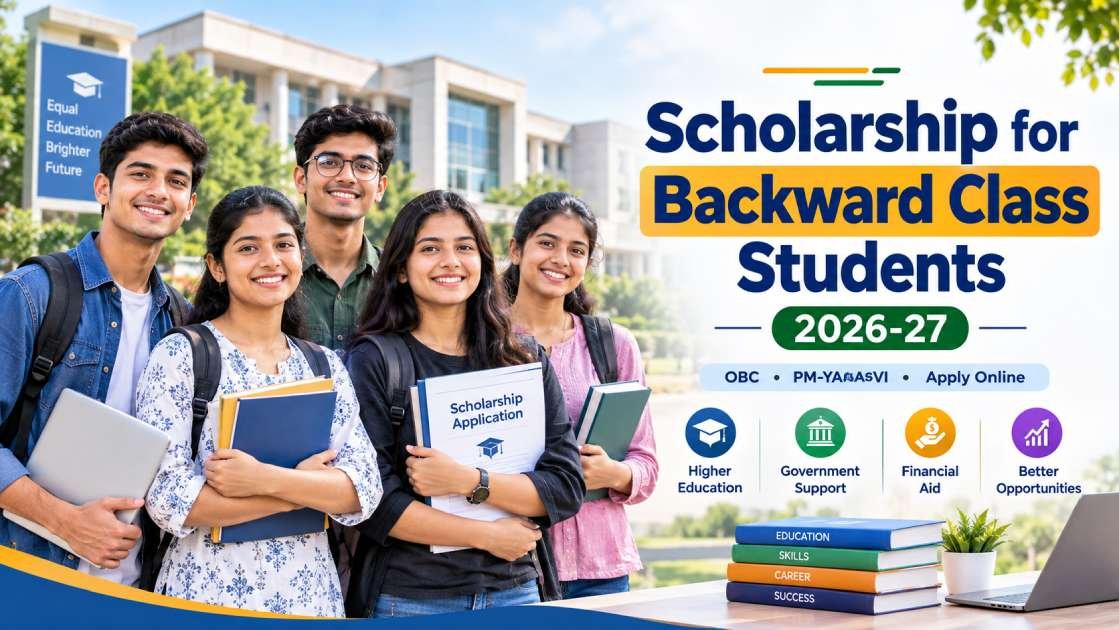
A scholarship for backward class students provides financial assistance to eligible students from Other Backward Classes and related notified categories in India.
The main Central Government framework is PM-YASASVI.
PM-YASASVI supports eligible OBC, EBC and DNT students through Pre-Matric, Post-Matric, Top Class School Education and Top Class College Education schemes.
Students can receive support for school education, college fees, academic expenses, living costs, books and other approved educational expenses.
Eligibility depends on the specific scholarship.
A student may need to meet conditions related to category, annual family income, domicile, academic level, institution, course and previous academic performance.
Scholarship for Backward Class Students 2026-27: Quick Overview
The following table summarizes the main scholarship routes for backward class students.
| Scholarship | Eligible Students | Study Level | Main Benefit | Income Limit | 2026-27 Status |
|---|---|---|---|---|---|
| PM-YASASVI Pre-Matric Scholarship | OBC, EBC, DNT | Classes IX-X | Approx. USD 42 annual academic allowance | Approx. USD 2,597/year | Implemented through States/UTs |
| PM-YASASVI Post-Matric Scholarship | OBC, EBC, DNT | Post-Matric and higher education | Approx. USD 52-208 academic allowance depending on course group, plus eligible assistance | Approx. USD 2,597/year under current PM-YASASVI framework | State/UT implementation |
| PM-YASASVI Top Class Education in Schools | OBC, EBC, DNT | Classes IX-XII | Up to approx. USD 779-1,298 per year | Approx. USD 2,597/year | Renewal applications listed for 2026-27 |
| PM-YASASVI Top Class Education in Colleges | OBC, EBC, DNT | Higher education after Class XII | Tuition, living support, books and computer assistance | Approx. USD 2,597/year | Open until October 31, 2026 |
| State BC/OBC Scholarships | Depends on state | School to postgraduate | Fee reimbursement, maintenance allowance or scholarship | State-specific | Varies by state |
USD values are approximate conversions.
Actual scholarship rules are defined in Indian currency by the Government of India.
Students should therefore treat USD figures as reference values rather than fixed payment amounts.
What Is a Scholarship for Backward Class Students?
A backward class scholarship is educational financial assistance for students belonging to an eligible socially or educationally backward community.
The term does not refer to one scholarship.
It can describe several Central and State Government schemes.
The Government of India primarily uses classifications such as:
- Other Backward Classes or OBC
- Economically Backward Classes or EBC
- Denotified, Nomadic and Semi-Nomadic Tribes or DNT
State governments can use additional classifications.
Examples include:
- BC
- MBC
- DNC
- State-specific backward classes
Students should identify their exact legal category before applying.
Is BC the Same as OBC?
Not always.
OBC is a widely used classification under Central and State Government systems.
BC is a broader term that some states use for backward communities.
A community recognized as backward by one state may not have exactly the same status under another state’s scholarship rules.
The Central OBC list and state backward-class lists can also differ.
This distinction matters because scholarship eligibility depends on the scheme’s official category requirements.
OBC vs EBC vs EWS
OBC, EBC and EWS should not be treated as interchangeable terms.
OBC
OBC means Other Backward Classes.
OBC classification primarily relates to recognized social and educational backwardness under applicable government lists.
EBC
EBC means Economically Backward Classes in the context of relevant scholarship programs.
The exact definition depends on the scheme.
EWS
EWS means Economically Weaker Sections.
EWS is a separate reservation and eligibility category.
An EWS certificate does not automatically make a student eligible for an OBC scholarship.
Always use the category required by the specific scheme.
PM-YASASVI Scholarship for Backward Class Students
PM-YASASVI stands for Prime Minister Young Achievers Scholarship Award Scheme for Vibrant India.
The scheme is administered by the Department of Social Justice and Empowerment under the Ministry of Social Justice and Empowerment.
PM-YASASVI functions as an umbrella program for educational support targeted at eligible OBC, EBC and DNT students.
Students can review the current Central Government framework through the official PM-YASASVI scheme information.
The major educational components include:
- Pre-Matric Scholarship
- Post-Matric Scholarship
- Top Class Education in Schools
- Top Class Education in Colleges
Each component targets a different stage of education.
PM-YASASVI Pre-Matric Scholarship
The Pre-Matric Scholarship supports eligible students studying in Classes IX and X.
It is designed to reduce financial barriers before students complete secondary education.
Who is eligible?
The main eligibility conditions include:
- The applicant must be an Indian national.
- The applicant must belong to an eligible OBC, EBC or DNT category.
- The applicant must hold a valid category certificate.
- The student must study full time in Class IX or X.
- The student must study in a Government school under the current scheme conditions.
- Annual parental or guardian income must not exceed approximately USD 2,597.
- The student cannot simultaneously hold another educational scholarship for the same Classes IX-X study.
Scholarship amount
Eligible students can receive an academic allowance equivalent to approximately USD 42 per year.
Payment is made through Direct Benefit Transfer.
The amount may be transferred to the eligible student or parent according to applicable payment rules.
Who should consider this scholarship?
The scholarship is relevant to OBC, EBC and DNT students currently studying in Classes IX or X in eligible Government schools.
Students attending a school that does not meet the scheme conditions should check state-specific scholarship alternatives.
PM-YASASVI Post-Matric Scholarship
The Post-Matric Scholarship supports eligible OBC, EBC and DNT students after the matriculation stage.
The scheme covers education at the post-secondary and higher-education levels.
Eligible courses can include:
- Classes XI and XII
- Diploma courses
- Undergraduate programs
- Postgraduate programs
- Professional courses
- Technical courses
- Research programs
The detailed implementation process is handled through State Governments and Union Territory administrations.
Post-Matric Scholarship amount
Government reporting for the current PM-YASASVI framework describes academic allowances that vary according to course category.
The allowance is approximately USD 52 to USD 208, depending on the applicable course group.
Other eligible educational expenses can also be covered according to scheme and state rules.
Students should not assume that every course receives the highest amount.
Family income
The current PM-YASASVI Post-Matric framework uses an annual family-income threshold equivalent to approximately USD 2,597.
State implementation conditions still matter.
Students should verify the current rules applicable in their domicile state.
PM-YASASVI Top Class Education in Schools
Top Class Education in Schools provides higher-value assistance to academically strong OBC, EBC and DNT students studying in selected schools.
The program covers education from Class IX to Class XII.
Scholarship amount
The scheme can provide support up to approximately:
- USD 779 per year for Classes IX and X
- USD 1,298 per year for Classes XI and XII
The assistance is intended to cover eligible school tuition and hostel-related costs within scheme ceilings.
Income requirement
Parental or guardian annual income should generally not exceed approximately USD 2,597.
School requirement
A student must attend an eligible school covered under the scheme.
Being an OBC student alone does not make every Class IX-XII student automatically eligible.
2026-27 application status
The National Scholarship Portal currently lists renewal applications for the Top Class School scheme through October 31, 2026.
Students should check whether a fresh application route is available for their category and institution before assuming they can submit a new application.
PM-YASASVI Top Class College Education
The Top Class College Education scheme is one of the strongest scholarship opportunities for eligible backward class students pursuing higher education.
The scheme supports OBC, EBC and DNT students who secure admission to notified institutions.
Eligible institutions can include selected:
- IITs
- IIMs
- IIITs
- AIIMS institutions
- NITs
- National Law Universities
- NIFT institutions
- NID institutions
- Central Government institutions
- Other approved institutions meeting prescribed quality criteria
The Government publishes the notified institution and scholarship-slot list for each relevant academic year.
What does the Top Class College Scholarship cover?
Eligible students can receive several forms of support.
Tuition fees
The scholarship covers eligible tuition fees and non-refundable institutional charges.
For qualifying private-sector institutions, the annual tuition ceiling is equivalent to approximately USD 2,077.
Commercial Pilot Training and eligible Type Rating programs at qualifying private flying institutions can receive tuition support up to approximately USD 3,864 per year.
Living expenses
Eligible students can receive approximately USD 31 per month for living expenses.
Books and stationery
The scheme provides approximately USD 52 per year for books and stationery.
Computer or laptop
A student can receive one-time computer or laptop assistance of up to approximately USD 467 during the course.
Eligible students should confirm the current benefit rules through the Government PM-YASASVI Top Class College eligibility and benefits page.
Who Is Eligible for the Top Class College Scholarship?
An applicant must satisfy several conditions.
The applicant should:
- Belong to an eligible OBC, EBC or DNT category.
- Have annual family income up to approximately USD 2,597.
- Secure admission to a full-time prescribed course.
- Study at an institution notified under the scheme.
- Meet the institution’s normal admission criteria.
- Fall within the number of scholarship slots allocated to the institution.
Eligibility does not automatically guarantee an award.
Available institutional slots can limit the number of recipients.
Special Rules for Top Class College Students
Several less obvious rules can affect selection.
Two-sibling rule
The scheme does not provide benefits to more than two siblings from the same family.
Applicants can be required to submit an affidavit confirming compliance.
Reservation for eligible girl students
Thirty percent of institutional slots are reserved for eligible girl students according to inter-se merit.
Eligible girls already selected through the overall merit list are treated separately from this reserved allocation.
Unused girl-student slots can be transferred according to scheme rules.
Academic progression
The scholarship can continue until course completion if the student maintains satisfactory academic progress.
Students must apply for renewal.
A student who fails to progress to the next semester or class can lose the scholarship.
Scholarship for Backward Class Students Last Date 2026-27
There is no single deadline for every backward class scholarship.
Different schemes and states use different schedules.
For the PM-YASASVI Top Class College Education scheme, the National Scholarship Portal currently lists:
| Stage | 2026-27 Date |
|---|---|
| Scheme opened | June 1, 2026 |
| Student application deadline | October 31, 2026 |
| Defective application verification | November 15, 2026 |
| Institute verification | November 15, 2026 |
| DNO/SNO/MNO verification | November 30, 2026 |
Students should use the National Scholarship Portal to confirm current application status before submitting an application.
Important: Do not use the Top Class College deadline as the deadline for every OBC or backward class scholarship. Pre-Matric, Post-Matric and state schemes can follow different calendars.
State Scholarships for Backward Class Students
State governments implement additional scholarships and fee-support programs for backward class students.
The terminology and eligibility criteria can differ significantly.
Tamil Nadu
Tamil Nadu commonly uses classifications such as:
- Backward Classes
- Most Backward Classes
- Denotified Communities
Students should therefore search according to their Tamil Nadu community classification rather than relying only on the term OBC.
Karnataka
Karnataka operates backward-class educational welfare programs and state scholarship processes.
Students may encounter schemes involving post-matric assistance, fee support, hostel support and Vidyasiri-related benefits.
West Bengal
West Bengal provides OBC scholarship application services through the state’s OASIS ecosystem.
Eligible students should follow the current state process instead of assuming that every application is submitted directly through NSP.
Uttar Pradesh
Eligible OBC students can access state scholarship and fee-reimbursement programs.
The application schedule and verification process are set by the state.
Maharashtra
Maharashtra implements educational support for eligible backward-class categories through state welfare systems.
Students should check the exact department and category applicable to their community.
Who Should Apply for a Backward Class Scholarship?
You should apply when your profile matches the mandatory scheme criteria.
A strong applicant normally meets all of the following relevant conditions:
- Your category is officially recognized.
- You have a valid caste or community certificate.
- You satisfy the family-income ceiling.
- Your domicile matches the scheme.
- Your current academic level is eligible.
- Your course is covered.
- Your school or college is recognized.
- Your institution is notified where required.
- You meet academic or merit conditions.
- Your application can be submitted before the deadline.
- You can provide the required documents.
Students should prioritize scholarships where every hard eligibility condition is satisfied.
Who Should Not Apply?
Do not apply only because the scholarship title mentions OBC or backward classes.
You should not submit an application if you clearly fail a mandatory condition.
Common reasons not to apply include:
- Your community is not included in the required category.
- Your annual family income exceeds a fixed limit.
- You do not meet the domicile requirement.
- Your course is not eligible.
- Your institution is not recognized.
- Your institution is not included in a required Top Class list.
- You do not possess the required category certificate.
- You already receive an incompatible scholarship.
- You exceed a sibling restriction.
- You failed the academic progression rule for renewal.
- The current application window has closed.
A technically ineligible application normally cannot be rescued by strong grades or a personal statement.
Eligibility Criteria for Backward Class Scholarships
Eligibility criteria vary by scheme.
Students should check every attribute separately.
Category
The scholarship may require:
- OBC
- EBC
- DNT
- BC
- MBC
- DNC
- Another state-recognized category
A certificate must normally support the claimed category.
Family income
Income limits vary.
Several major PM-YASASVI components use an annual family-income ceiling equivalent to approximately USD 2,597.
A state scholarship can use a different limit.
Domicile
State scholarships usually require the student to belong to the relevant state or Union Territory.
Study location and domicile are not always the same thing.
Academic level
Schemes target different stages.
Examples include:
- Class IX
- Class X
- Classes XI-XII
- Diploma
- Undergraduate
- Postgraduate
- Professional degree
- Doctoral study
Institution
The school or college may need to be:
- Government-run
- Government-recognized
- Accredited
- Specifically notified
- Included in the current scholarship list
Merit
Some scholarships primarily test eligibility.
Others have limited slots and use merit.
Top Class schemes can use academic or admission performance when eligible applicants exceed available slots.
Documents Required for Backward Class Scholarship
Documentation proves that the applicant meets the scholarship conditions.
| Document | Purpose | Common Problem |
|---|---|---|
| Aadhaar | Identity verification | Name or date-of-birth mismatch |
| Caste/community certificate | Category eligibility | Wrong category or invalid certificate |
| Income certificate | Family-income verification | Outdated certificate |
| Domicile certificate | State eligibility | Wrong domicile |
| Marksheets | Academic performance | Missing latest result |
| Admission proof | Enrollment verification | Wrong academic year |
| Fee details or receipt | Financial claim | Fee mismatch |
| Bank details | DBT payment | Incorrect account information |
| Passport-size photograph | Applicant identification | Wrong file format |
| Entrance rank proof | Merit verification | Rank document missing |
| Disability certificate | Additional eligibility where applicable | Invalid or incomplete certificate |
Is a caste certificate compulsory?
A valid category certificate is generally required when scholarship eligibility depends on an applicant belonging to OBC, EBC, DNT or another recognized backward category.
The exact certificate format depends on the scheme and authority.
Is a Non-Creamy-Layer certificate required?
Do not assume one universal rule.
A Non-Creamy-Layer certificate may be required in some OBC processes.
Other schemes primarily specify a caste certificate and family-income limit.
Follow the document checklist for the exact scholarship you are applying for.
Does the income certificate need to be current?
Applicants should use an income certificate that satisfies the validity period specified for the current application cycle.
An older certificate can cause verification problems.
Why must Aadhaar and bank details match?
Scholarship payments increasingly use electronic verification and Direct Benefit Transfer.
Incorrect personal details can delay verification or payment.
Check the spelling of:
- Applicant name
- Date of birth
- Aadhaar details
- Bank-account holder name
before final submission.
How to Apply for Scholarship for Backward Class Students
The exact application process depends on whether the scholarship uses NSP or a state portal.
The following workflow applies to many Central scholarship applications.
Step 1: Identify your exact category
Determine whether you belong to:
- OBC
- EBC
- DNT
- BC
- MBC
- DNC
- Another eligible category
Do this before selecting a scheme.
Step 2: Identify the correct scholarship
Match the scholarship to your academic level.
A Class IX student should not apply for a college scholarship.
A college student should not apply for Pre-Matric assistance.
Step 3: Check family income
Compare your household income with the scheme limit.
Do not rely on the threshold from another scholarship.
Step 4: Check your institution
Confirm whether your school, college or university qualifies.
Top Class scholarships can require the institution to appear on an approved list.
Step 5: Complete NSP registration where required
Students applying through NSP should complete the current registration and identity-verification process.
Provide accurate personal details.
Step 6: Select the correct scholarship
Choose the exact scheme from the applicant dashboard.
Read its conditions before continuing.
Step 7: Enter academic information
Provide:
- Current course
- Class or year
- Institution
- Previous marks
- Admission information
- Fee information
Check these details against official records.
Step 8: Enter category and income details
Use information that matches your certificates.
Do not estimate or alter financial information.
Step 9: Add bank details
Enter the correct account information for scholarship payment.
Verify every digit.
Step 10: Upload documents
Upload readable copies in the required format.
Poor scans can delay verification.
Step 11: Review the complete application
Check:
- Name
- Aadhaar
- Category
- Income
- Course
- Institution
- Bank information
- Uploaded documents
Correct errors before final submission.
Step 12: Submit and save the application ID
Keep the application ID and acknowledgement.
You will need them for tracking.
How the Selection Process Works
Submitting a scholarship application does not mean the scholarship has been approved.
A typical application passes through several stages.
Stage 1: Application submission
The student completes and submits the application.
Stage 2: Eligibility screening
The system or authority checks whether the student meets basic scheme criteria.
Stage 3: Institute verification
The school, college or university verifies details such as:
- Enrollment
- Course
- Academic year
- Fees
- Student status
Stage 4: Government verification
The relevant district, state, ministry or nodal authority performs additional checks.
Stage 5: Merit or slot allocation
Some scholarships have limited numbers of awards.
Eligible applicants can therefore be ranked.
Top Class College applications can be restricted by institution-specific scholarship slots.
Stage 6: Tie-breaking
Where candidates have equal merit for a final available Top Class College slot, lower family income can receive preference.
Stage 7: Sanction
The responsible authority approves eligible selected applications.
Stage 8: Payment
Approved assistance is transferred according to scheme rules.
Student allowances can be transferred directly to beneficiaries.
Eligible institutional fees can be paid according to the applicable DBT process.
How to Check Backward Class Scholarship Status
Applicants should monitor the status after submission.
Common status stages include:
- Submitted
- Pending at institute
- Verified by institute
- Defective application
- Pending with nodal officer
- Verified
- Sanctioned
- Payment processed
- Rejected
What does defective application mean?
A defective application normally means a problem requires correction.
Examples include:
- Missing document
- Incorrect certificate
- Mismatched information
- Incomplete academic details
Correct the application within the permitted verification window.
What does pending at institute mean?
The educational institution has not completed verification.
Contact the institution’s scholarship or nodal office if the status remains unchanged close to the verification deadline.
What does sanctioned mean?
Sanction generally means the scholarship has been approved for payment.
Payment may still take additional processing time.
Fresh vs Renewal Scholarship Application
Students should understand whether they are making a fresh application or renewing an existing scholarship.
| Attribute | Fresh Application | Renewal Application |
|---|---|---|
| Applicant | First-time applicant | Existing scholarship recipient |
| Main purpose | Obtain new award | Continue current award |
| Academic records | Admission/current qualification | Previous-year progression |
| Documents | Full eligibility documentation | Updated documents as required |
| Selection | New eligibility/merit evaluation | Continued eligibility |
| Academic condition | Entry criteria | Promotion/progression often required |
A previous scholarship award does not always renew automatically.
Students may need to submit a renewal application every academic year.
Common Mistakes Backward Class Scholarship Applicants Make
1. Selecting the wrong category
OBC, EBC and EWS are not the same.
Choosing the wrong category can invalidate an application.
2. Using state eligibility for a Central scheme
A community’s state status does not automatically prove eligibility under every Central program.
Check the exact scheme.
3. Using an outdated income certificate
A document from an older financial year may not satisfy current requirements.
4. Entering Aadhaar details incorrectly
Identity mismatches can create verification problems.
5. Entering incorrect bank information
A wrong account number or account-holder mismatch can delay payment.
6. Applying for the wrong academic year
Always select the current cycle.
7. Uploading unreadable documents
Certificates should be clear and complete.
8. Ignoring institute verification
Submission is only one stage.
Your institution can still need to verify the application.
9. Missing the correction deadline
A defective application may be rejected if it is not corrected within the allowed period.
10. Assuming every OBC student gets the scholarship
Eligibility and selection are different.
Some programs have limited slots.
11. Holding an incompatible scholarship
Some schemes prevent students from receiving another educational scholarship for the same study period.
12. Forgetting renewal
Students receiving multi-year support can lose benefits if they fail to complete annual renewal requirements.
Why Backward Class Scholarship Applications Get Rejected
Invalid category certificate
The certificate may not prove eligibility for the selected scheme.
Income exceeds the limit
A student whose household income exceeds a mandatory ceiling is not eligible under that rule.
Wrong institution
The institution may not qualify.
Top Class programs can require a notified institution.
Verification not completed
An application can fail when required verification remains incomplete.
Document mismatch
Different spellings, dates or other personal information across documents can create verification issues.
Duplicate benefits
Applicants cannot assume that every scholarship can be combined with another award.
Academic progression failure
Renewal can depend on promotion to the next year, class or semester.
Limited slots
An eligible applicant can still miss a Top Class award if the institution has fewer scholarship slots than eligible candidates.
How Backward Class Scholarship Payment Works
Government scholarship payments increasingly use Direct Benefit Transfer.
DBT transfers approved benefits directly according to scheme rules.
Student payments
Living allowance, books or other student benefits can be transferred directly to the beneficiary.
Institutional payments
Certain tuition fees and non-refundable charges can be transferred directly to the eligible institution.
Why can payment be delayed?
Possible reasons include:
- Application verification still pending
- Bank-account mismatch
- Aadhaar-related verification problem
- Incorrect beneficiary details
- Sanction processing
- State-level processing delays
- Funding-cycle timing
A submitted application is not proof that payment has been approved.
Previous Years’ Trends in Backward Class Scholarships
Recent Government data shows that backward-class education funding operates at substantial scale.
Pre-Matric participation
Government reporting for 2025-26 provisionally recorded approximately 25.22 lakh students under the Pre-Matric component.
The final figure can change because States and Union Territories continue data compilation.
Post-Matric participation
The Post-Matric component provisionally covered approximately 31.29 lakh beneficiaries in 2025-26.
Post-Matric assistance remains one of the largest PM-YASASVI educational components.
Top Class programs are expanding
Government reporting in 2026 stated that more than 45,000 students had received support under Top Class Education in Schools.
Nearly 38,000 students had been covered through the college-level Top Class program.
Government spending increased
Official Government reporting published in April 2026 indicated year-on-year expenditure growth across major OBC, EBC and DNT education programs.
The reported increase was particularly strong for Top Class Education in Schools and Top Class Education in Colleges.
What do these trends mean for applicants?
Growth in funding does not remove eligibility requirements.
High-value programs can still have limited scholarship slots.
Applicants should therefore treat eligibility, documents and timely verification as critical factors.
Research Notes and Verification Findings
Our review of current Government scholarship information produced several important findings.
Finding 1: There is no single “backward class scholarship”
The search term describes several programs.
Students need to identify the exact scheme that matches their category and academic stage.
Finding 2: OBC is not automatically the same as every state BC category
State classifications can differ from Central terminology.
Always verify your category against the relevant authority.
Finding 3: The highest-value scholarships have narrower eligibility
Top Class College support can cover substantial tuition and education costs.
The scheme also restricts eligibility by income, institution and allocated scholarship slots.
Finding 4: Eligibility does not guarantee selection
A student can meet every minimum requirement but still compete for limited slots.
Finding 5: State implementation matters
Post-Matric and other scholarship processes can depend heavily on State Government rules.
Finding 6: Deadlines are scheme-specific
October 31, 2026 is relevant to the current Top Class College application listing.
It should not be copied as the universal deadline for every backward class scholarship.
Finding 7: Institute verification is critical
Students often focus only on submission.
Applications can remain incomplete in practice until institutional and government verification stages are finished.
Finding 8: Scholarship status should be monitored after submission
Students should continue checking the portal until verification and payment stages are resolved.
How to Verify a Backward Class Scholarship Before Applying
Use this verification process before sharing personal information.
- Identify the Government department responsible for the scholarship.
- Confirm the academic year.
- Check the official category requirement.
- Check the family-income limit.
- Verify your academic level.
- Confirm that your institution qualifies.
- Check whether the application is fresh or renewal.
- Verify the deadline.
- Confirm the official application portal.
- Review the document requirements.
Avoid portals that promise guaranteed scholarship approval.
A legitimate government scholarship does not guarantee selection merely because an applicant pays a third party.
Backward Class Scholarship Application Checklist
Before submitting, confirm the following:
- My category is eligible.
- My caste/community certificate is valid.
- My family income meets the limit.
- My income certificate is current.
- My domicile meets the requirement.
- My current academic level is eligible.
- My course is eligible.
- My institution qualifies.
- My Aadhaar information is correct.
- My bank information is correct.
- My marksheets are complete.
- My admission proof is ready.
- My fee details are accurate.
- My uploaded documents are readable.
- I checked the current deadline.
- I submitted the correct scheme.
- I saved my application ID.
- I checked institute verification.
- I monitored the final scholarship status.
Frequently Asked Questions About Scholarship for Backward Class Students
What scholarships are available for backward class students?
Backward class students can access PM-YASASVI Pre-Matric, Post-Matric, Top Class School and Top Class College scholarships when they meet the applicable conditions. State governments also operate separate OBC, BC, MBC and related financial-aid programs. Eligibility depends on category, income, domicile, academic level and institution.
Who is eligible for an OBC scholarship?
Eligibility depends on the specific scholarship. An applicant normally needs a valid OBC or other qualifying category certificate, eligible family income, correct domicile, enrollment in an approved academic program and any required academic performance. Some schemes also restrict eligible schools, colleges, courses or available scholarship slots.
What is PM-YASASVI?
PM-YASASVI is the Government of India’s Young Achievers Scholarship Award Scheme for Vibrant India for OBCs and Others. The umbrella framework supports eligible OBC, EBC and DNT students through Pre-Matric, Post-Matric, Top Class School and Top Class College educational-support components.
What is the income limit for an OBC scholarship?
There is no single income limit for every OBC scholarship. Several current PM-YASASVI components use an annual family-income ceiling equivalent to approximately USD 2,597. State scholarships can use different income thresholds. Applicants should always check the limit for the exact scholarship and academic year.
How much scholarship can backward class students receive?
The amount varies substantially. Pre-Matric assistance can be relatively small, while Top Class programs can cover major tuition costs and additional educational expenses. Top Class College support can include tuition, monthly living assistance, annual book support and one-time computer or laptop assistance.
What is the last date for OBC scholarship 2026-27?
There is no universal OBC scholarship deadline. The PM-YASASVI Top Class College scheme currently lists October 31, 2026 as the student application deadline on NSP. Verification continues afterward. Pre-Matric, Post-Matric and state scholarships can follow different deadlines, so applicants must verify their specific scheme.
How can I apply for a backward class scholarship online?
First identify your category, academic level and correct scheme. Check income and institution eligibility. Complete registration on NSP or the relevant state portal. Enter personal and academic details, upload certificates, add bank information, review the application and submit it before the official deadline.
Which documents are required for an OBC scholarship?
Common documents include Aadhaar, a caste or community certificate, income certificate, domicile certificate, marksheets, admission proof, fee details, bank-account information and a photograph. Top Class or merit-based scholarships can also require entrance-rank proof. Exact requirements vary by scheme and state.
Is a caste certificate compulsory for an OBC scholarship?
A category certificate is normally essential when OBC or another backward-class identity determines eligibility. The certificate must be issued by the competent authority accepted under the scheme. Applicants should verify whether the program requires a general caste certificate, a specific format or additional category documentation.
Is a Non-Creamy-Layer certificate required for an OBC scholarship?
Not every scholarship publishes the same document rule. Some OBC processes can require Non-Creamy-Layer evidence, while other scholarship guidelines focus on a valid caste certificate and separate family-income certificate. Applicants should follow the current document checklist for their specific scholarship instead of assuming one universal requirement.
Can college students apply for an OBC scholarship?
Yes. Eligible OBC, EBC and DNT students can access post-matric and higher-education support. PM-YASASVI Top Class College Education specifically supports eligible students studying beyond Class XII in notified institutions. Post-Matric programs can also cover undergraduate, postgraduate, professional and other recognized post-secondary courses.
Can I receive two scholarships at the same time?
It depends on the rules of both scholarships. Several government schemes restrict recipients from simultaneously holding another scholarship or stipend for the same educational purpose. Students who receive multiple offers should check the conditions before accepting both. Failure to disclose duplicate benefits can affect eligibility or payment.
How do I renew an OBC scholarship?
Log in through the relevant scholarship portal during the renewal window. Update academic, income, bank and institutional information where required. Upload current documents and submit the renewal application. Continued funding can depend on promotion to the next class or semester and successful institutional verification.
How can I check my OBC scholarship status?
Use the scholarship portal through which the application was submitted. Check whether the application is submitted, defective, pending at institute, verified, sanctioned, rejected or processed for payment. Applicants should monitor both application and payment stages because successful submission does not mean funds have been sanctioned.
Why is my OBC scholarship application pending?
An application can remain pending because institute verification, nodal-officer verification, document correction or government processing has not finished. Check the displayed status first. If the application remains pending close to a verification deadline, contact the institution’s scholarship office or the authority identified by the portal.
Why was my backward class scholarship rejected?
Common rejection reasons include an invalid category certificate, income above the scheme limit, wrong domicile, ineligible institution, incomplete verification, incorrect documents, duplicate scholarship benefits, failed academic progression or lack of available slots. The exact reason should be checked in the scholarship portal or official rejection record.
When will the OBC scholarship amount be credited?
There is no universal payment date. Payment begins only after required verification and sanction stages are completed. DBT processing can also depend on correct Aadhaar, bank and beneficiary details. Students should track the scholarship portal rather than relying on unofficial social-media posts claiming a fixed nationwide payment date.
What is the difference between OBC, BC, EBC and EWS?
OBC refers to Other Backward Classes. BC is a broader term used differently by states. EBC refers to economically backward groups under relevant schemes. EWS is a separate Economically Weaker Sections category. These terms are not interchangeable, so applicants must use the classification specified by the scholarship.

You may like

Fully Funded Scholarships in UK for Indian Students (2027-28 Intake)

Scholarships Without IELTS for Indian Students (2027 Intake): Verified List, Eligibility and How to Apply

Fully Funded Scholarships in Canada for Indian Students (2027–28 Intake)
Trending
-
 Scholarships4 months ago
Turkey Burslari Scholarship 2026: Eligibility, Benefits, Deadline, Interview, and Results
-

 Scholarships3 months ago
SBI Asha Scholarship 2026-27: Eligibility, Amount, Last Date and Apply Online
-
 By Country4 months ago
Scholarship for MBBS Students in India
-
 Scholarships4 months ago
Scholarship for J&K Students: Eligibility, Amount, Deadlines, and How to Apply
-
 By Country4 months ago
Korean Government Scholarship for Indian Students: GKS Eligibility, Benefits, Deadlines and Application
-
 Scholarships3 months ago
Scholarships for PG Students in Kerala 2026: Eligibility, Amounts, Deadlines and Application Links
-
 Scholarships4 months ago
Abdul Kalam Scholarship for Class 10 Students: Verified Programs, Eligibility and Application Guide
-

 Scholarships3 months ago
West Bengal Student Scholarship 2026-27: Eligibility, Amounts, Last Dates and Apply Online