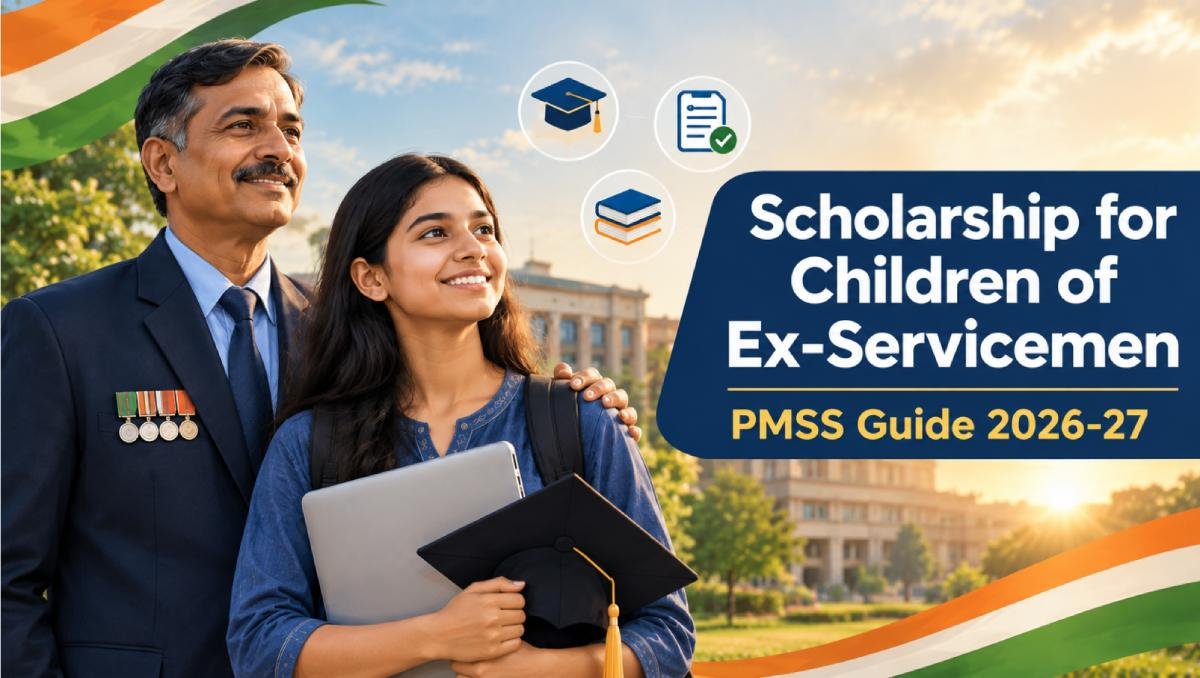
The Prime Minister’s Scholarship Scheme (PMSS) is the main scholarship for children of ex-servicemen. The Kendriya Sainik Board (KSB) under the Ministry of Defence runs it, and it selects 5,500 students a year, split equally between boys and girls. Boys receive INR 30,000 per year and girls receive INR 36,000 per year. That equals roughly USD 316 and USD 379 per year at about 95 INR per USD. Applicants need 60% in the qualifying exam and must be first-year students. KSB’s notice for 2026-27 lists 31 December 2026 as the last date for fresh applications. Information Brochure 2024 25 +3
What scholarships exist for children of ex-servicemen?
Children of ex-servicemen can access four types of support. PMSS is the largest. The others differ by who the parent served with and where the application is filed.
Scheme
Run by
For whom
Amount
Where to apply
PMSS (ex-servicemen)
KSB, Ministry of Defence
Wards and widows of ex-servicemen and ex-Coast Guard personnel
INR 2,500 / 3,000 per month (about USD 26 / 32)
KSB portal
AFFDF Education Grant
KSB
Up to two children of ex-servicemen, Class I to graduation
Reported at INR 2,000 per month (about USD 21) from 1 November 2025, up from INR 1,000
KSB portal
PMSS for CAPF, Assam Rifles, State/UT Police, Railways
Home Ministry / Railways
Wards of CAPF, Assam Rifles, martyred state police and RPF/RPSF personnel
The most common mistake starts here. PMSS for ex-servicemen is not an NSP scheme. Ex-servicemen wards apply on the KSB website, while CAPF, police and railway wards apply on NSP. shiksha
PMSS for ex-servicemen’s children: key facts
PMSS is a merit-based scholarship that supports professional degrees. The scheme began in 2006 and is funded from the National Defence Fund. The monthly rates rose to INR 2,500 for boys and INR 3,000 for girls from FY 2019-20. deswdesw
Attribute
Detail
Awards per year
5,500 (2,750 boys + 2,750 girls)
Boys
INR 2,500/month = INR 30,000/year (about USD 316)
Girls
INR 3,000/month = INR 36,000/year (about USD 379)
Duration
Two to five years, matching the course length
Payment
First payment after the merit list, then yearly after renewal
What does PMSS add up to over a full course? Most competitor pages stop at the yearly figure. The totals below use about 95 INR per USD, so they will move with the exchange rate.
Course length
Boys total
Girls total
2 years
INR 60,000 (about USD 632)
INR 72,000 (about USD 758)
3 years
INR 90,000 (about USD 947)
INR 108,000 (about USD 1,137)
4 years (BE/B.Tech)
INR 120,000 (about USD 1,263)
INR 144,000 (about USD 1,516)
5 years
INR 150,000 (about USD 1,579)
INR 180,000 (about USD 1,895)
Which courses are covered?
PMSS covers first professional degrees approved by a central regulator. Examples include BE/B.Tech, MBBS, BDS, B.Ed, BBA, BCA, B.Pharma and integrated law courses recognised by bodies such as AICTE, the National Medical Commission and UGC. hp
Master’s degrees: Only MBA and MCA are covered. ksb
Officers’ children qualify only in some cases. Categories 1 to 5 apply irrespective of rank and cover personnel killed in action, disabled in action, died in service, disabled in service, or holders of gallantry awards. The general category 6 covers personnel below officer rank only. A retired officer whose service does not fall in categories 1 to 5 cannot claim PMSS for a child. hphp
Step-by-step application guide
You apply once, online, and three offices verify the form. Start as soon as admission is confirmed.
Confirm eligibility. Check the 60% rule, the course list and the two-ward limit.
Check the institution. Confirm that the course is recognised and the university is not on UGC’s fake list.
Collect signatures. Get Annexure-1 signed by the Zila Sainik Board, Annexure-2 by the college and Annexure-3 by the bank.
Fill the form and upload documents. Enter the ex-serviceman’s service details, then upload every scanned document.
Submit and track. Zila Sainik Boards check uploaded documents against originals within five working days, then Rajya Sainik Boards check them again before KSB processes the application. hp
Fix observations quickly. If a board finds a defect, it contacts the student by phone or email, and the student must correct it. hp
Check the merit list. KSB uploads the list on its website, and your Rajya Sainik Board informs you of your serial number. hp
Timing note: In the 2024-25 cycle, zilas had to forward applications by 15 December and Rajya boards by 31 December. The 2026-27 internal dates may differ, so apply early. The reported last date for fresh applications is 31 December 2026. Confirm it on the KSB portal. hpesminfoclub
Required documents explained
KSB requires scanned originals of every document. Missing any required scan leads to rejection. hp
Document
Who issues or signs it
What to check
Annexure-1 (ex-servicemen certificate)
Zila Sainik Board or Coast Guard HQ
Lists all children as per the discharge book
Annexure-2 (bonafide certificate)
Principal, Registrar, Dean, Director or equivalent
Signature and designation are clear
Annexure-3 (Aadhaar–bank link certificate)
The student’s bank
Aadhaar is linked to the account
Matriculation certificate
School board
Confirms date of birth
Qualifying-exam marksheets
University or board
All semesters for graduation or diploma
Bank passbook, first page
Bank
Printed, not handwritten, with name, account number and IFSC; SBI or PNB preferred
Aadhaar card
UIDAI
Name matches the bank account
PPO or ESM identity card
Services
Needed for category 6
Category proof (categories 1 to 5)
Army Part II Order, Navy Gen form or Air Force POR, plus the PPO; gallantry cases need the award certificate and Gazette notification
Do not attach the discharge book; only the signed Annexure-1 is required. ksb
If a ward was born after the parent’s retirement, the ex-serviceman uploads an affidavit or self-certificate. hp
Common mistakes applicants make
Most rejections come from paperwork, not from low marks. The mistakes below are ranked by how often the official rules single them out.
Miscounting the 60%. KSB counts all subjects, including optional ones, not the best subjects. hp
Uploading CGPA without a conversion. When the marksheet shows only CGPA, the university’s percentage conversion formula must go with it. hp
Applying in the wrong year. Second-year and lateral-entry students are not eligible.
Unsigned or incomplete annexures. Incomplete or wrongly filled applications are rejected. hp
Mismatched details. The date of birth on the 10th-class certificate can differ from the discharge book by up to 366 days; a larger gap becomes a problem. hp
Bank errors. The account must be KYC-compliant, active and Aadhaar-linked, and the IFSC must be typed without special characters.
Choosing an ineligible course or institution. Check the course list and UGC’s fake-university notices before admission.
Waiting for the last date. The brochure advises applying as soon as admission is taken, because late observations do not delay the merit list. hp
Selection process explained
KSB selects by ex-serviceman category first and marks second. Shortlisting depends on the category of the ex-serviceman and the percentage in the qualifying exam across all subjects. hp
Priority
Category
1
Killed in action
2
Disabled in action and boarded out, disability attributable to service
3
Died in service from attributable causes
4
Disabled in service, disability attributable to service
5
Gallantry award holders
6
General category, personnel below officer rank only
When marks are equal, KSB prefers orphans, then wards of widows, then wards of junior ranks, then longer courses, then ex-servicemen with longer service, then the older student. A Board of Officers at KSB finalises the list. Because seats split equally, boys and girls effectively compete within their own group. hphp
Payment, acknowledgement and renewal
PMSS is renewable, but renewal is strict. The first payment follows selection in the merit list. Later payments need an online payment-cum-renewal form, a fresh bonafide certificate, marksheets and a bank passbook page, submitted within one year of completing the academic year. hphp
Each year needs at least 50% marks and a first-attempt pass in every subject. hp
A failure or re-appearance closes the scholarship permanently. hp
After each payment, the student must record the date and amount on the portal, or KSB can cancel the scholarship and recover the money. hp
Moving to another college for the same course in the same academic year is permitted, but KSB must be told in writing. hp
False statements lead to refund of every rupee paid and possible criminal proceedings. hp
Previous years’ trends
Official data shows a consistently high selection rate. The table below uses the Department of Ex-Servicemen Welfare’s published figures. The last two columns are my calculations.
Academic year
Fresh applications
Found eligible
Merit list (selected)
Selected ÷ applied
Ineligible share
2015-16
6,063
5,823
5,500
90.7%
4.0%
2016-17
5,683
5,348
5,242
92.2%
5.9%
2017-18
5,957
5,600
5,452
91.5%
6.0%
2018-19
5,449
5,028
5,028
92.3%
7.7%
2019-20
5,923
5,611
5,500
92.9%
5.3%
2020-21
5,885
5,552
5,489
93.3%
5.7%
These figures come from the Department of Ex-Servicemen Welfare PMSS page, which also records renewal cases rising to 10,464 and annual disbursement growing from about INR 28.6 crore to INR 53.2 crore across the period. At about 95 INR per USD, that is roughly USD 3.0 million rising to USD 5.6 million. desw
Our research notes
These patterns come from the official data and the 2024-25 brochure.
Eligibility, not competition, was the filter. Between 91% and 93% of fresh applicants were selected in every year shown. Between 4% and 8% were found ineligible, so most of the loss happened before ranking.
The merit list was below 5,500 in four of six years. Only 2015-16 and 2019-20 reached 5,500. The equal boys-and-girls split likely explains part of this, because a shortfall in one group cannot be filled by the other.
In 2018-19, every eligible applicant was selected. The eligible pool and the merit list were both 5,028.
The renewal base is now twice the intake. Renewal cases reached 10,464 in 2020-21 against 5,489 new selections, which makes continuing eligibility the bigger test over a degree.
Deadlines differ by route and by year. The 2024-25 brochure used 30 November, while the 2026-27 notice is reported as 31 December. NSP-based routes use their own dates, so never copy a date from a CAPF or police-ward page.
One failed subject ends the scholarship permanently. This rule carries the largest financial penalty and appears least often in competitor guides.
Other options if PMSS does not fit
PMSS does not cover every child, so check these routes.
Education Grant from the Armed Forces Flag Day Fund: It supports up to two children per ex-serviceman from Class I to graduation, and widows pursuing a postgraduate degree outside professional courses. Applicants must not be drawing an education allowance or similar benefit from a state or employer. Rank and pension conditions apply, so ask your Zila Sainik Board. esmcorneresmcorner
NSP-based PMSS routes: Use these if the parent served in the CAPF, Assam Rifles, State or UT Police, or the RPF/RPSF.
State sainik welfare grants: Ask your Rajya or Zila Sainik Board which education grants your state offers.
FAQs
1. Who is eligible for the PM scholarship for ex-servicemen’s children?
Dependent wards and widows of ex-servicemen and ex-Coast Guard personnel qualify if they joined the first year of a recognised professional degree course and scored at least 60% in the qualifying exam. Wards of civilians and paramilitary personnel are excluded. Only two wards per ex-serviceman family can apply, and each student can use the scheme for one course. hp
2. How much does PMSS pay?
Boys receive INR 2,500 per month (INR 30,000 per year, about USD 316). Girls receive INR 3,000 per month (INR 36,000 per year, about USD 379). KSB pays the amount annually and continues it for the full course duration, usually two to five years, provided the student meets the yearly renewal conditions. hp
3. What is the last date for PMSS 2026-27?
KSB’s notice for 2026-27 lists 31 December 2026 as the last date for fresh applications. Earlier cycles used earlier cut-offs, such as 30 November in the 2024-25 brochure. Apply as soon as admission is confirmed, because Zila Sainik Boards need time to verify documents, and confirm the date on the KSB portal. esminfoclubhp
4. Can children of ex-service officers apply?
Children of ex-service officers qualify only in priority categories 1 to 5, which cover personnel killed in action, disabled in action, died in service, disabled in service with attributable disability, or holding gallantry awards. Category 6, the general category, is limited to personnel below officer rank (PBOR). Other officers’ wards are not eligible. hp
5. Can a second-year student apply?
No. Fresh PMSS applications are accepted only from students who took admission in the first year of the course in the current academic year. Students in the second or later years cannot apply, and lateral-entry students are also excluded. A student who has already used PMSS for one course cannot claim it again for another. ksb
6. Is MBA or MCA covered by PMSS?
Yes. MBA and MCA are the only postgraduate courses covered by PMSS. Other master’s degrees such as MA, MSc and MCom are excluded. Eligible first professional degrees include BE/B.Tech, MBBS, BDS, B.Ed, BBA, BCA, B.Pharma and integrated law, provided a recognised regulator such as AICTE, NMC or UGC approves the course. ksbhp
7. Is PMSS for ex-servicemen applied for on the National Scholarship Portal?
No. Wards of ex-servicemen apply through the Kendriya Sainik Board’s own online portal. The National Scholarship Portal handles separate PMSS routes for wards of Central Armed Police Forces, Assam Rifles, State and UT Police and Railway Protection Force personnel. Applying on the wrong portal wastes time, so confirm which route matches the parent’s service. shiksha
8. How many children per family can get PMSS?
Only two wards of an ex-serviceman or ex-Coast Guard member can receive PMSS. The application must list every child according to the discharge book. If a ward was born after retirement, the ex-serviceman uploads an affidavit or self-certificate. Each student can claim PMSS for one course only. hp
9. What happens if I fail a subject after getting PMSS?
The scholarship closes permanently. Renewal requires at least 50% marks in each semester or academic year and clearing every subject in the first attempt. A failure or re-appearance in any subject ends the scholarship for the rest of the course, and KSB does not entertain correspondence on closed cases. Plan your study load accordingly. ksb
10. Can I receive PMSS together with another scholarship?
Possibly, but the combined amount cannot exceed what PMSS alone offers. If a student already receives a scholarship or concession from another source that is larger than the PMSS amount, the Zila Sainik Board will not recommend the application. Declare every other benefit honestly, because KSB can recover amounts paid on false or incomplete statements. hp
11. How do I check the merit list or application status?
KSB uploads the merit list on its website, and the Rajya Sainik Board tells students in its state their selection serial number. Applicants can also monitor application progress by logging in to the KSB portal. For help, contact the KSB helpline or the PMSS team through the contact details published on the portal. ksb
12. What is the minimum percentage required?
Applicants need at least 60% in the minimum educational qualification (MEQ), calculated over all subjects, including optional ones, not the best subjects. If a marksheet shows both marks and CGPA, KSB uses the marks. If it shows only CGPA, upload the university’s official percentage conversion formula with the marksheet. hp
Conclusion
PMSS is the central scholarship for children of ex-servicemen, and it rewards early, accurate applications. It pays boys about USD 316 and girls about USD 379 per year. Officials select 5,500 students annually, and the historical data shows that the main hurdle is eligibility and paperwork, not a long queue. Check the officer-rank rule, calculate the 60% over all subjects, and keep every renewal condition in view, because one failed subject ends the award.




 Scholarships4 months ago

 Scholarships3 months ago
 By Country4 months ago
 Scholarships4 months ago
 By Country4 months ago
 Scholarships3 months ago
 Scholarships4 months ago

 Scholarships3 months ago