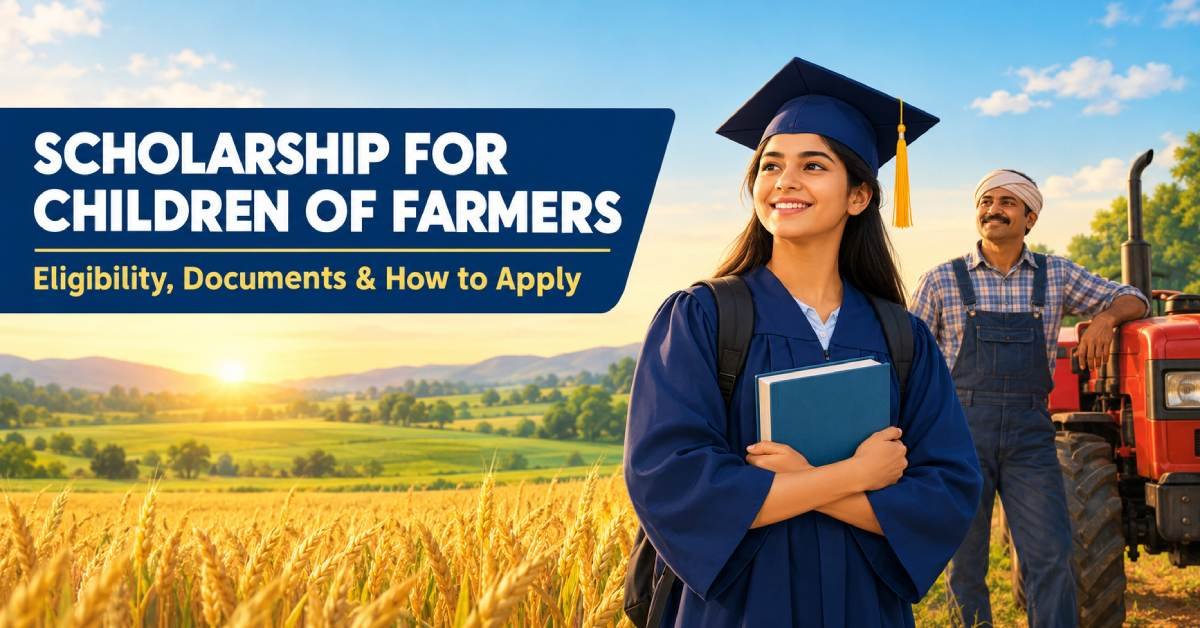
A scholarship for children of farmers is a financial award that a funder gives to a student whose parent or guardian farms, belongs to a farm organization, or holds a registered farmer status. Farm Bureau federations, Farmers Union chapters, agricultural cooperatives, Farm Credit lenders, and some state governments fund these awards. Each funder sets its own rules for membership, study field, and residency.
Key facts
Typical US award sizes range from USD 1,000 to USD 3,500, and the largest listed in this guide reaches USD 3,000 to USD 3,500 per student.
Most US deadlines in the 2026 cycle fell between late January and mid-April.
Karnataka, India, pays INR 2,500 to INR 11,000 per year to children of registered farmers.
Not every farm-branded award is for farmers’ children. Several are for the children of cooperative or lender employees.
This guide explains who qualifies, which documents funders request, how selection works, and how requirements changed between 2020 and 2026.
What Is a Scholarship for Children of Farmers?
A scholarship for children of farmers rewards students from farm families with money for tuition, fees, or living costs. Funders use the parent’s farm connection as the main eligibility gate. The student’s grades, leadership, and financial need then decide who wins.
The five main types
Type
Eligibility gate
Example funders
Membership-based
Parent or guardian belongs to the organization
Farm Bureau federations, Farmers Union
Cooperative or employer-linked
Parent is a member-owner, customer, or employee
Foremost Farms, Central Valley Ag, Pipestone
Government scheme
Parent is a registered farmer
Karnataka Agriculture Department
Agriculture-major award
Student studies an agriculture-related field
Agriculture Future of America (AFA)
Youth-organization award
Student belongs to a youth agriculture organization
National FFA Organization
The National FFA Organization alone offers more than 120 scholarships with over USD 2.7 million in funds, according to Bold.org’s FFA scholarship guide. FFA awards require FFA membership, not a farming parent.
Scholarships for Children of Farmers in 2026: Examples Compared
The table below compares real programs from the 2026 cycle. Most deadlines have passed, so use the table to plan for 2027.
Scholarship
Funder
Amount
Who qualifies
Latest deadline
Country
Leadership in Agriculture Scholarship
Kentucky Farm Bureau Federation
Up to USD 3,000
Seniors who are children of active members; any major; GPA 3.5+ or ACT 23+
Jan 29, 2026
US (Kentucky)
YFR High School Scholarship
Oklahoma Farm Bureau
Nine awards of USD 1,000
Graduating seniors from Farm Bureau families; full-time agriculture program in Oklahoma
Mar 15, 2026
US (Oklahoma)
Agricultural Education Scholarship
Foremost Farms Foundation, run by Scholarship America
USD 3,500 per student
Children of member farmers who sell milk, and members
Winners announced Apr 14, 2026
US
Central Valley Ag Scholarship
Central Valley Ag cooperative
20 awards of USD 1,000
Children of member-owners and employees; agriculture-related fields
Mar 1, 2026
US
Helping Farmers Scholarship
Pipestone
Five awards of USD 1,000
Children of Pipestone customers; preference for agriculture degrees
Apr 1 (2025 cycle)
US
William J. Collins Scholarship
AgriBank with AFA
Two awards of USD 2,000
Children of Farm Credit employees in the AgriBank District
Mar 5, 2026
US
CM Raitha Vidya Nidhi
Karnataka Agriculture Department
INR 2,500 to INR 11,000 per year
Children of registered farmers after Class 10; no income limit
Dec 31, 2026 (verify on the official portal)
India
The William J. Collins Scholarship shows why careful reading matters. It serves children of Farm Credit employees, not children of farmers.
Who Should Apply for a Farm Family Scholarship, and Who Should Not?
Students should apply when a parent or guardian meets the funder’s farm connection test and the student meets the study and residency rules. Students should skip programs where either condition fails. Four gates decide eligibility.
Gate
Question to check
Example rule
Parent status
Is the parent a member, customer, employee, or registered farmer?
Oklahoma accepts a parent or guardian’s Farm Bureau membership only
Student status
Are you a graduating senior or a current college student?
AFA’s Collins award accepts both
Study plan
Must you major in agriculture?
Oklahoma requires it; Kentucky does not
Geography
Do you live or study in the funder’s state or district?
Kentucky requires in-state college enrollment
Strong fit
Students whose parent holds an active membership in the funding organization.
Students planning an agriculture, animal science, or agribusiness degree.
Students with a documented record of leadership or community work.
Students who can attach transcripts and test scores that meet stated thresholds.
Students in Karnataka whose parent’s land record appears in the state database.
Poor fit
Students whose only link is a grandparent’s, sibling’s, or other relative’s membership. Oklahoma Farm Bureau excludes these memberships.
Children of paid Farm Bureau employees applying to Farm Bureau member awards. Oklahoma excludes them.
Students who plan to study outside the funder’s state when the award requires in-state enrollment.
Students below a stated threshold, such as Kentucky’s GPA 3.5 or ACT 23 requirement.
Past recipients applying to programs that bar repeat winners.
How Do You Apply for a Scholarship for Children of Farmers?
You apply by confirming your eligibility, collecting documents, completing the application, and submitting it before the funder’s deadline. Most US programs open in autumn or winter and close by April. Follow these eight steps.
Confirm the parent’s status. Ask the parent whether the family holds a current membership, customer account, or registered farmer record. Request proof early, because some memberships need renewal.
Build a shortlist. List programs by funder type: membership, cooperative, government, agriculture-major, and youth-organization awards. Record each deadline in a calendar.
Check the study and residency rules. Match your intended major, state, and enrollment level to each program.
Gather documents. Collect transcripts, test scores, a resume, and membership proof. The next section explains each item.
Write the essay. Answer the exact prompt. Oklahoma Farm Bureau, for example, asks how the award will help you reach your educational goals. Read our scholarship essay guide for structure and examples.
Request references early. Ask a teacher, counselor, or community leader at least four weeks before the deadline. Share your resume and the award description with each reference writer.
Submit before the deadline. Follow the funder’s route exactly: online portal, email, or postmark. Oklahoma accepts email or mail with a postmark by the deadline.
Confirm receipt and keep copies. Save confirmation emails and a copy of every file.
For Karnataka’s scheme, confirm that the parent’s land ownership is registered in the FRUITS database, because the scheme verifies land ownership automatically. Then follow the state’s official application process.
Which Documents Do Farm Scholarships Require?
Farm scholarships require documents that prove who you are, how you perform, and how you connect to farming. Each document answers a specific question for the selection committee.
Document
What it proves
Practical tip
Official transcript
Academic performance
Request a sealed or electronic copy early
Resume of activities and honors
Leadership and involvement
List agriculture, FFA, 4-H, and community work first
Essay
Goals, motivation, and fit
Oklahoma sets a 500-word limit, double-spaced, Times New Roman 12-point
Reference or character letter
Third-party judgment of your character
Choose someone who knows your work, not only your grades
ACT or SAT scores
Meets score thresholds
Kentucky lists ACT 23 as an alternative to GPA 3.5
Karnataka’s scheme verifies land ownership through the FRUITS database
A 2020 Texas Farm Bureau checklist asked applicants to upload the Expected Family Contribution page of the FAFSA report. The federal FAFSA now reports a Student Aid Index in that role, so confirm which figure a current program requests.
What Common Mistakes Do Applicants Make?
Applicants most often lose awards through eligibility errors, not weak writing. Avoid these mistakes.
Applying to employee-child awards as a farmer’s child. The AFA Collins award serves Farm Credit employees’ children.
Using the wrong relative’s membership. Oklahoma accepts a parent or legal guardian’s membership, not a grandparent’s or sibling’s.
Letting membership lapse. Oklahoma requires membership in good standing for the duration of the scholarship.
Ignoring the study-field rule. Oklahoma requires a full-time agriculture program at an accredited Oklahoma institution.
Missing the postmark or email deadline. Funders count late applications as incomplete.
Breaking formatting rules. An essay above the word limit or in the wrong font signals carelessness.
Reapplying where past winners are barred. Central Valley Ag and Rocky Mountain Farmers Union both exclude previous recipients.
Submitting a generic essay. Tie your farm experience to a concrete academic goal. Our guide to recommendation letters helps you brief reference writers the same way.
How Does the Selection Process Work?
Funders select winners by scoring applicants against published criteria, then notifying winners and paying the award to the college or the student. The criteria differ by funder.
Program
Selection criteria
Payment route
AFA Collins Scholarship
Career goals and vision, leadership and community involvement, financial need
Awarded through AFA; recipients invited to the AFA Leaders Conference, November 12 to 15, 2026
Foremost Farms awards
Academic success and community involvement
Run by Scholarship America, which selects winners independently
Kentucky Farm Bureau
GPA or ACT threshold, essay, merit, and financial need
Paid to the in-state college
Rocky Mountain Farmers Union
Farmers Union and community activities carry 40 percent of the score
Per program rules
Farm Credit East FFA award
Scoring rubric for Supervised Agricultural Experience projects
USD 500 awards twice a year
Central Valley Ag
Eligibility and application review
Funds sent directly to colleges for the fall semester
Karnataka CM Raitha Vidya Nidhi
Automatic land-ownership verification; eligible children receive benefits
Direct Benefit Transfer to the student
The National Farmers Union scholarship program adds a distinctive requirement. Applicants must hold Farmers Union membership and submit letters from a Farmers Union leader and from a teacher or professor.
What Do Previous Years’ Trends Show (2020 to 2026)?
The Oklahoma Farm Bureau YFR High School Scholarship offers the clearest multi-year record, because the organization publishes a new application packet every year.
Cycle
Awards
Deadline
Essays
Reference letters
2020
Nine awards of USD 1,000
April 2, 2020
Three, 500 words each
Two
2023
Nine awards of USD 1,000
February 24, 2023
One, 500 words
One
2025
Nine awards of USD 1,000
March 15, 2025
One, 500 words
One
2026
Nine awards of USD 1,000
March 15, 2026
One, 500 words
One
Three trends stand out.
Application burden fell. Oklahoma cut its essays from three to one and its reference letters from two to one between 2020 and 2023.
Award values held or rose. Oklahoma kept nine awards of USD 1,000. Foremost Farms raised its scholarship to USD 3,500 and awarded USD 49,000 to fourteen students in 2026.
Deadlines clustered in winter and spring. Kentucky’s window ran from November 28, 2025 to January 29, 2026. Central Valley Ag closed on March 1, and AFA’s Collins award closed on March 5.
What this means for the 2027 cycle: Programs repeat their calendars, so prepare documents between October and December 2026. Verify each date on the funder’s official page when applications open.
Opportunity Research Notes
These observations come from the programs reviewed for this guide. They do not cover every farm scholarship.
The parent’s status matters more than family income. Five of the six US programs in the comparison table gate eligibility by membership, customer status, or employment, not by income. Karnataka’s scheme has no income bar.
Most programs expect an agriculture connection in the study plan. Only Kentucky’s Leadership in Agriculture Scholarship explicitly accepts any major. Foremost Farms recipients still listed business among their intended programs, so related fields can succeed.
Employee-child awards share search results with farmer-child awards. The Collins award, Central Valley Ag’s employee track, and Foremost Farms’ employee track all serve employees’ children. Farm families should filter by parent status first.
Documents repeat across programs. Transcripts, a resume, an essay, and a reference letter appear in most US packets. Build one master packet, then adapt the essay for each prompt.
Requirements shift, so cycle-specific checks matter. Oklahoma’s lighter 2023 to 2026 packet shows that funders simplify applications over time. The 2020 Texas FAFSA page request also shows how federal terminology changes.
Match your enrollment level. AFA accepts graduating seniors and current college students, while Oklahoma’s YFR award targets graduating seniors only.
Frequently Asked Questions
Are there scholarships for children of farmers?
Yes. Farm Bureau federations, Farmers Union, agricultural cooperatives, and Farm Credit lenders fund awards for farm families, and some governments run schemes for registered farmers. Amounts vary widely: Oklahoma Farm Bureau’s high school awards are USD 1,000 each, while Foremost Farms awarded USD 3,500 per student in 2026. Each program sets its own membership and study rules.
Do I have to study agriculture to qualify?
Not always, but often. Kentucky Farm Bureau’s Leadership in Agriculture Scholarship accepts any major, while Oklahoma Farm Bureau’s YFR award requires a full-time agriculture program. AFA and cooperative awards usually favor agriculture-related fields. Read each program’s study-field rule before applying, because it decides eligibility.
Does my parent need Farm Bureau or Farmers Union membership?
Often yes. Oklahoma Farm Bureau requires a Farm Bureau family, and a parent or legal guardian’s membership qualifies, but a grandparent’s or sibling’s does not. National Farmers Union awards require Farmers Union membership. Membership must stay in good standing throughout the award period, so confirm renewal dates before submitting.
Can I apply if my family leases farmland?
It depends on the program. Kentucky Farm Bureau asks that parents be actively engaged in production agriculture. The wording describes farming activity rather than land title. Karnataka’s scheme verifies registered land ownership through a state database. Ask the funder whether leased land counts.
How much money can I receive?
Amounts range from small local awards to larger national ones. A 2024 Oklahoma county award offered USD 250, Kentucky’s award reaches USD 3,000, and Foremost Farms paid USD 3,500 per student in 2026. Karnataka’s scheme pays INR 2,500 to INR 11,000 per year. Many awards are one-time payments, so apply to several programs.
When are the deadlines?
Most US programs reviewed closed between late January and mid-April. Kentucky closed on January 29, Central Valley Ag on March 1, AFA’s Collins award on March 5, and Oklahoma on March 15 in 2026. Karnataka’s listing shows December 31, 2026. Programs repeat similar windows, so start preparing in autumn.
Do farm scholarships require an essay?
Many do. Oklahoma Farm Bureau asks for one essay of up to 500 words, and Kentucky’s award lists an essay as required. Government schemes such as Karnataka’s rely on registration checks instead of essays. Confirm the prompt, word limit, and formatting rules in the current application packet before you begin writing.
Is financial need required?
Not always. Kentucky considers need alongside merit, and AFA’s Collins award weighs financial need with career goals and leadership. Oklahoma’s listed requirements do not mention need, and Karnataka’s scheme has no income limit. Check whether the application asks for FAFSA pages or income details before you decide to apply.
Can college students apply, or only high school seniors?
Both groups can qualify, depending on the program. Oklahoma’s YFR award targets graduating seniors, while the AFA Collins scholarship accepts graduating seniors and current college students. Karnataka’s scheme covers Class 11 through PhD, diploma, and ITI courses. Match your enrollment level to each program’s stated applicant pool.
Are there scholarships for children of farmers outside the US?
Yes, though options are fewer and more government-led. Karnataka, India, runs the CM Raitha Vidya Nidhi scheme for children of registered farmers after Class 10. Some countries also fund young farmers directly, which differs from awards for farmers’ children. Search your national agriculture ministry and farmer cooperatives for equivalent schemes.
Can I apply for more than one farm scholarship?
Usually yes. Oklahoma Farm Bureau’s form asks applicants to list other scholarships received, which suggests that multiple awards are acceptable. Build a master packet with your transcript, resume, and essay, then adapt it for each program. Always read each funder’s rules on combining awards.
Can past recipients reapply?
Often not. Central Valley Ag states that past recipients may not reapply, and Rocky Mountain Farmers Union bars previous recipients from applying for additional awards. AFA’s Collins award targets students who have not previously received it. Treat most farm scholarships as one-time awards and plan a different program for each year of study.
Conclusion
A scholarship for children of farmers rewards students whose families connect to agriculture through membership, employment, customer status, or registered farming. Eligibility depends on four gates: the parent’s status, the student’s level, the study plan, and geography. Students who prepare a master packet in autumn and verify each funder’s current rules gain the strongest position for the 2027 cycle.




 Scholarships4 months ago

 Scholarships3 months ago
 By Country4 months ago
 Scholarships4 months ago
 By Country4 months ago

 Scholarships3 months ago
 Scholarships4 months ago

 Scholarships3 months ago