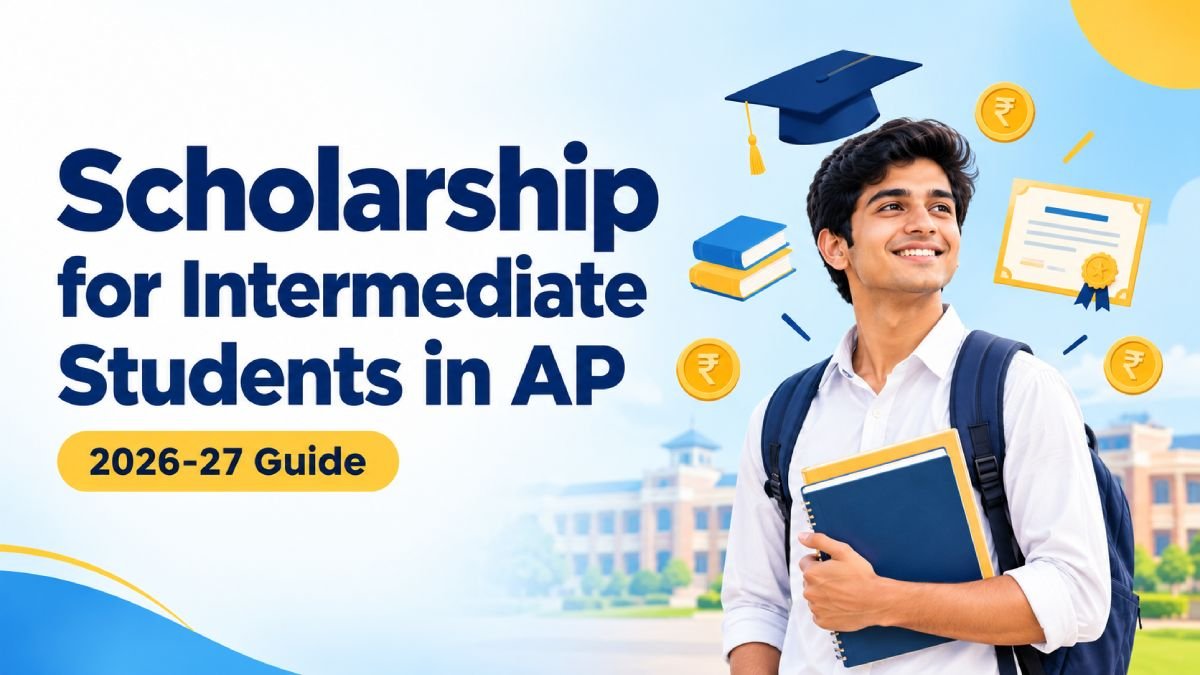
Scholarship for intermediate students in AP means financial aid for Andhra Pradesh students enrolled in Class 11 or Class 12 (Intermediate). Three routes exist: the state Post Matric Scholarship, the private Vidyadhan Intermediate 1st Year scholarship, and the central CSSS scheme after Class 12. This guide explains eligibility, documents, steps, selection, mistakes and deadlines for each. Last updated: October 21, 2026.
Quick answer: Yes. AP Inter students can apply for the state Post Matric Scholarship through Jnanabhumi if they belong to an eligible category and meet the income limit. High scorers can apply for Vidyadhan after Class 10. Top Class 12 scorers can apply for CSSS on the National Scholarship Portal.
Note on amounts: Official amounts are in Indian rupees (INR). USD figures use roughly INR 96 per USD, which was the market rate around 10 October 2026. The rate moves, so treat USD values as approximate. One lakh equals 100,000. banklive
Which scholarships can AP intermediate students apply for?
AP intermediate students can apply for three scholarship routes, and each has its own funder, income limit and window.
Scheme
Funder
Annual benefit
Income limit
Who it targets
Status (Oct 2026)
AP Post Matric Scholarship (RTF and MTF)
Andhra Pradesh Government, via Jnanabhumi
RTF: full fee paid to the college. MTF: INR 10,000 (ITI), 15,000 (polytechnic), 20,000 (degree and above); no Inter amount published in sources reviewed
INR 12,000 (about USD 125) for UG years 1–3; INR 20,000 (about USD 208) for PG
INR 4.5 lakh (about USD 4,690)
Top 20 percentile in Class 12
Deadline listed 31 Oct 2026
AP Post Matric Scholarship (RTF and MTF)
The AP Post Matric Scholarship is a state scheme that helps eligible students continue studying after Class 10. Students apply through the Jnanabhumi portal. The scheme has two parts. RTF reimburses tuition, special, other and exam fees in full, and the money goes to the institution on the student’s behalf. MTF pays a yearly maintenance amount to the mother’s bank account, or to the natural guardian if the mother is absent.
The state names eligible categories as SC, ST, BC, EBC (other than Kapu), Kapu, Minority and differently abled. The scheme now carries the Post Matric RTF and MTF names under a November 2024 government order.
Vidyadhan Intermediate 1st Year (Andhra Pradesh)
Vidyadhan is a private scholarship for students entering Class 11. It is run by the Sarojini Damodaran Foundation. The foundation awards INR 10,000 per year to selected students. Applicants must hold Andhra Pradesh domicile, pass Class 10 in the cycle year with at least 90% or 9 CGPA (75% or 7.5 CGPA for students with disabilities), and have family income below INR 2,00,000.
Central Sector Scheme of Scholarship (CSSS)
CSSS is a central merit scheme for college and university students. Applications go through the National Scholarship Portal. The scheme requires a Class 12 score in the top 20 percentile, family income under INR 4.5 lakh and regular college admission. Inter students meet CSSS in their final year, because the scheme starts after Class 12.
Who should apply and who should not apply
Who should apply
Apply for Jnanabhumi if you belong to an eligible category, hold AP domicile, and your family income is at or below INR 2.5 lakh (about USD 2,600).
Apply for Vidyadhan if you passed Class 10 in the cycle year with at least 90% or 9 CGPA and your family earns below INR 2 lakh.
Plan for CSSS if you expect a top-20-percentile Class 12 result and a regular college seat.
Who should not apply
Families above the income cap. The state cap is INR 2.5 lakh, and no family member may be an income tax payer.
Families with government jobs or pensions. Government employees and pensioners are excluded, but sanitary workers remain eligible regardless of income.
Families above the asset limits. The limits are 10 acres of wetland, 25 acres of dry land, no personal four-wheeler (taxis, tractors and autos excepted), and no more than 1,500 square feet of urban built-up property.
Students below 75% attendance. Attendance of 75% is mandatory for the state scholarship.
Students who already hold another scholarship and want CSSS. CSSS does not allow another scholarship at the same time.
Current Inter students waiting for Vidyadhan. The 2026 cycle closed on 20 June 2026.
Quick self-check
Question
If yes
If no
Is your family income at or below INR 2.5 lakh?
State aid is possible
Skip Jnanabhumi
Do you belong to a listed state category?
State aid is possible
Check Vidyadhan and CSSS
Did you score 90% or 9 CGPA in Class 10 this year?
Vidyadhan fits (next cycle)
Skip Vidyadhan
Will you rank in the top 20 percentile in Class 12?
Prepare for CSSS
Skip CSSS
Required documents explained
Each scheme asks for slightly different papers, and a missing or mismatched document is the most common cause of delay.
Document
Why it is needed
Scheme
Aadhaar card
Identity and biometric authentication
All
Aadhaar-linked mobile number
Receives OTP and confirmation SMS
Jnanabhumi
Aadhaar-linked bank account
Receives the payment
All
Residence certificate
Proves AP domicile
Jnanabhumi, Vidyadhan
Income certificate
Proves the income cap; Vidyadhan does not accept a ration card as proof
All
Caste validity certificate
Proves category
Jnanabhumi
Last marksheet
Proves marks and qualification
All
Bonafide or admission certificate
Proves enrollment
Jnanabhumi, CSSS
Passport photograph
Application file
All
The state scholarship checklist lists Aadhaar, an Aadhaar-linked mobile number and bank account, residence, income and caste certificates, the last marksheet, a bonafide certificate, a passport photo and a ration card where applicable. Vidyadhan needs a photo, a Class 10 marksheet and an income certificate from a competent authority, and does not accept a ration card.
Step-by-step application guide
How to apply for the AP Post Matric Scholarship
Complete OTR. Students must finish the NSP One-Time Registration before applying, with a deadline of October 31, 2026.
Collect the form. Download the Jnanabhumi Scholarship Application Form (JSAF) or collect it from the college.
Fill and sign. Enter all details and submit the signed form to the college principal.
Principal verifies and uploads. The principal checks the details and uploads the application, and the student receives an SMS confirmation.
Confirm with biometrics. The student verifies the application and gives biometric authentication, and can access the form at a MeeSeva centre using the Aadhaar number and application ID.
Track status. Log in to the Jnanabhumi student portal, open Print Application Status and enter the Aadhaar or application ID.
Colleges may follow a slightly different internal workflow, so confirm the current process with your college scholarship officer.
How to apply for Vidyadhan
Open the Vidyadhan application page and click Apply.
Register with an email address or mobile number and confirm the email.
Log in and create a new application from your Vidyadhan account.
Fill in the details and upload the photo, Class 10 marksheet and income certificate.
Submit before the deadline, because incomplete applications are not considered. The 2026 deadline was 20 June 2026.
How to apply for CSSS
Complete OTR on the National Scholarship Portal to obtain an OTR ID.
Check that your board marks fall in the top 20 percentile for your stream.
Log in and select the Central Sector Scheme of Scholarship under central schemes.
Enter course, institute and income details, then upload the income certificate and Class 12 marksheet.
Submit the form. The college and state nodal authority verify the application before the money is transferred to the student’s account.
How the selection process works
Selection differs by scheme, and none of the three is first-come, first-served.
Jnanabhumi: Selection is rule-based verification. Institutional, district and state officers verify the application before final approval. The portal uses a Kutumba ID to verify residency, caste and income.
Vidyadhan: The foundation shortlists applicants on academic merit and application details. Shortlisted candidates then take a short online test or interview.
CSSS: Selection is by percentile cut-off. NSP publishes board-wise percentile cut-off lists, and students must fall within the top 20 percentile of their board and stream.
Common mistakes applicants make
Mistake
Why it hurts
How to avoid it
Missing OTR
The NSP form cannot start
Complete OTR before the October 31 deadline
Aadhaar and bank mismatch
Payment fails at transfer
Link Aadhaar to the bank account before applying
Wrong or old income certificate
Fails the income check
Get a fresh certificate from a competent authority
Ration card as Vidyadhan income proof
The foundation does not accept it
Upload an income certificate
Attendance below 75%
Blocks release of the state scholarship
Track attendance from the first month
Holding two overlapping scholarships
CSSS rejects the claim
Choose one route with the college officer
Skipping renewal
The scholarship lapses
Renew each year
Waiting for the last day
Servers slow and verification runs late
Submit at least a week early
Previous years’ trends
Public records let us document the following patterns. A full year-by-year amount comparison for Inter-level aid is not published in one place.
Year
What changed or happened
What it means
2024
The AP government renamed Jagananna Vasathi Deevena as Post Matric Scholarship MTF in June 2024, and the Vidya Deevena scheme became Post Matric RTF.
Older pages use outdated scheme names
Pre-2024
An older Social Welfare Department page lists a lower income ceiling of INR 2.00 lakh.
Today’s cap is INR 2.5 lakh; check which page you read
2026
AP SSC results were declared on April 30, 2026. The Vidyadhan deadline fell on 20 June 2026.
Vidyadhan opened about seven weeks after results
2026
The CSSS portal opened on 1 June 2026. The deadline is listed as 31 October.
CSSS runs from June to October
2026–27
The state post-matric window is expected to open in November 2026.
These findings come from comparing the sources behind this guide.
Date stacking is the real risk. The NSP OTR and CSSS deadlines (both listed for 31 October 2026) fall weeks before the expected Jnanabhumi window. A student in the Inter-to-degree transition can miss the first while waiting for the second.
Inter coverage needs confirmation. An older Social Welfare Department page says the post-matric scheme covers Intermediate. The current RTF and MTF description lists maintenance amounts only for ITI, polytechnic and degree-and-above courses. No Inter-specific MTF figure appears in the sources reviewed, so ask your college scholarship officer whether your course is covered.
Income ceilings differ by scheme. The state cap (INR 2.5 lakh, about USD 2,600) sits above Vidyadhan’s (INR 2 lakh, about USD 2,080) but below CSSS’s (INR 4.5 lakh, about USD 4,690). A family can qualify for one and miss another.
CSSS and state aid do not stack. CSSS bars other central or state scholarships and fee reimbursement. A student weighing Jnanabhumi RTF against CSSS must pick one before the degree year.
Most guides disagree on dates. Aggregator sites list tentative windows. Treat every date as provisional until the portal or your college confirms it.
Renewal and payment
The state scholarship renews each year. The college principal enters the current admission date and the previous year’s hall ticket or roll number, the student receives an SMS, and then gives biometric authentication. Renewal also needs 75% attendance in the previous year and clearing the previous annual exams.
FAQs
1. Is there a scholarship for intermediate students in AP? Yes. Intermediate students in Andhra Pradesh can look at three routes: the state Post Matric Scholarship through Jnanabhumi, the private Vidyadhan Intermediate 1st Year scholarship, and, after Class 12, the central CSSS. Each scheme has separate eligibility, so check income, category and marks before applying.
2. Who is eligible for the AP Post Matric Scholarship? A student must be an Andhra Pradesh domicile from the SC, ST, BC, EBC, Kapu, Minority or differently abled category. Family income must stay at or below INR 2.5 lakh (about USD 2,600), attendance must reach 75%, and no family member may pay income tax or hold a government job (sanitary workers excepted).
3. Can general-category (OC) students get an AP Inter scholarship? The Post Matric Scholarship lists specific categories, so general-category students usually do not qualify under it. Vidyadhan and CSSS do not use caste categories. They rely on marks and family income, so general-category students can apply to those, along with any community-specific schemes listed on AP portals.
4. What is the income limit for AP scholarships? Income limits differ by scheme. The AP Post Matric Scholarship allows up to INR 2.5 lakh (about USD 2,600) a year. Vidyadhan requires income below INR 2 lakh (about USD 2,080). CSSS allows up to INR 4.5 lakh (about USD 4,690). Always use a current income certificate from a competent authority.
5. When will AP Post Matric applications open? Careers360 expects applications to open in November 2026 and close in December 2026, but both dates are tentative. Final dates were not confirmed in the sources reviewed. Check the Jnanabhumi portal and your college notice board, because colleges also set internal submission deadlines before the portal closes.
6. Can I apply for Vidyadhan now? The 2026 Vidyadhan Intermediate 1st Year cycle closed on 20 June 2026. The program targets students who passed Class 10 in the same year, so current Inter students cannot apply now. Watch the Vidyadhan portal after AP SSC results next year, because the 2026 deadline fell about seven weeks after results.
7. Can I hold Vidyadhan and a state scholarship together? The sources reviewed state no rule that blocks Vidyadhan alongside state aid, so confirm with the Sarojini Damodaran Foundation and your college before applying to both. CSSS is stricter: the scheme does not allow another central or state scholarship or fee reimbursement at the same time.
8. Who receives the scholarship money? RTF goes to the college account as a fee reimbursement on the student’s behalf. MTF goes to the mother’s bank account, or to the natural guardian if the mother is unavailable. CSSS pays through the student’s individual bank account, which should be linked with Aadhaar for uninterrupted payment.
9. Why do scholarship applications get rejected? Common causes include attendance below 75%, mismatched Aadhaar and bank details, an expired or wrong-category certificate, income above the limit and overlapping scholarships. Verification passes through college, district and state officers, so an error at any level stops payment. Fix every detail before submitting.
10. What documents do I need? Core documents are Aadhaar, an Aadhaar-linked mobile number and bank account, residence certificate, income certificate, caste certificate, last marksheet, college bonafide or admission certificate and a passport photograph. Vidyadhan also requires the Class 10 marksheet and does not accept a ration card as income proof.
11. Do I need to renew the scholarship every year? Yes, for the state scholarship. Renewal requires the college principal to enter the current admission date and the previous year’s hall ticket or roll number. The student then receives an SMS confirmation and completes biometric authentication at the college. Attendance of 75% in the previous year is also required.
12. Can I apply for CSSS while still in Inter? No. CSSS needs a Class 12 board result in the top 20 percentile and admission to a regular degree course. Inter students should complete NSP One-Time Registration early and keep the Class 12 marksheet, income certificate and college bonafide ready for the cycle that follows their results.
Conclusion
Scholarship for intermediate students in AP is not one scheme but a sequence. Jnanabhumi covers category-based state aid, Vidyadhan rewards high Class 10 scorers, and CSSS rewards top Class 12 scorers. Check income limits first, gather documents early and confirm Inter-level coverage with your college. Next, read our guide to scholarships for AP degree students to plan the step after Inter.




 Scholarships4 months ago

 Scholarships3 months ago
 By Country4 months ago
 Scholarships4 months ago
 By Country4 months ago

 Scholarships3 months ago
 Scholarships4 months ago

 Scholarships3 months ago