
Scholarships
Scholarship for MS in USA for Indian Students 2026-27: Best Fully Funded Options

Published
1 week agoon
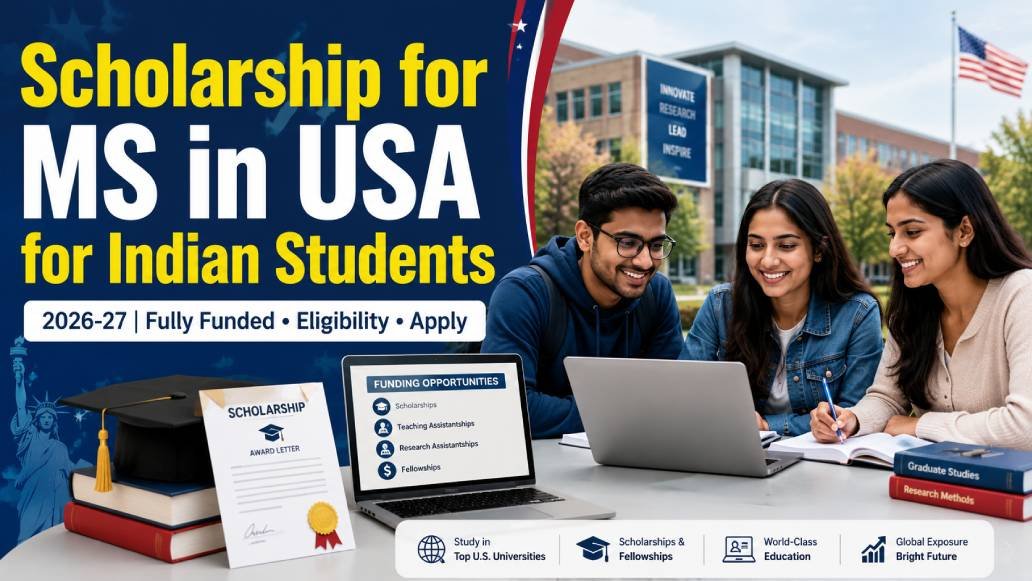
A scholarship for MS in USA for Indian students can reduce tuition fees, living expenses, health insurance, travel costs, or the total cost of a U.S. master’s degree.
Indian students should not limit their search to programs officially called “scholarships.”
Funding for a master’s degree in the United States can include scholarships, fellowships, Research Assistantships (RA), Teaching Assistantships (TA), Graduate Assistantships (GA), tuition waivers, university merit awards, and Indian loan-scholarships.
The funding type matters because each option covers different costs.
A fully funded fellowship can cover tuition and living expenses.
A tuition waiver may cover only tuition.
An assistantship can combine employment, a stipend, and tuition remission.
A loan-scholarship must eventually be repaid.
According to the EducationUSA graduate funding guide, international graduate students should begin financial planning early because scholarships may cover only part of tuition and living expenses. EducationUSA also recommends researching university fellowships and teaching or research assistantships before submitting applications.
Quick answer: Indian students seeking MS funding in the USA should compare external scholarships such as Knight-Hennessy, AAUW International Fellowships, Fulbright-Nehru where eligible, Inlaks, K.C. Mahindra, J N Tata, and Narotam Sekhsaria with university-specific merit awards, RA positions, TA positions, and tuition waivers.
For Fall 2027 applicants, funding research should start during university shortlisting rather than after receiving admission.
Scholarship for MS in USA for Indian Students: Quick Comparison
| Scholarship or funding route | Best for | Maximum/typical support | Current status |
|---|---|---|---|
| Knight-Hennessy Scholars | Stanford MS applicants | Tuition + living stipend + travel | Open |
| AAUW International Fellowship | Eligible women pursuing first STEM master’s | USD 20,000 | Open |
| Fulbright-Nehru Master’s Fellowship | Experienced Indians in specified fields | Tuition + living + travel + health support | Latest Master’s cycle closed |
| Inlaks Scholarship | High-achieving Indians in eligible fields | Up to USD 120,000 | 2026 cycle closed |
| K.C. Mahindra PG Scholarship | Strong Indian PG applicants | Interest-free loan scholarship | 2026 cycle closed |
| J N Tata Endowment | Indian postgraduate students abroad | Up to about USD 20,956 | 2026 cycle closed |
| Narotam Sekhsaria PG Scholarship | High-merit Indian applicants | Variable interest-free repayable assistance | 2026 cycle closed |
| Research Assistantship | Research-oriented MS students | Stipend + possible tuition waiver | University-specific |
| Teaching Assistantship | Students with teaching/communication strength | Stipend + possible tuition waiver | University-specific |
| University merit scholarship | Strong applicants | Partial to substantial tuition reduction | University-specific |
A student should compare the net cost after funding, rather than selecting a scholarship only because it has the highest advertised value.
What Does a Fully Funded MS in USA Actually Mean?
A fully funded MS normally means the student’s major educational expenses are covered through scholarships, fellowships, assistantships, or a combination of funding sources.
The exact definition varies by university.
Fully Funded Scholarship
A fully funded scholarship normally covers most or all major expenses.
Coverage can include:
- Tuition.
- Mandatory university fees.
- Living stipend.
- Housing.
- Books.
- Health insurance.
- Travel.
A fully funded scholarship does not necessarily cover every personal expense.
Full Tuition Scholarship
A full tuition scholarship pays the eligible tuition amount.
The student may still need to fund:
- Housing.
- Food.
- Health insurance.
- University fees.
- Transportation.
- Personal expenses.
Full tuition and fully funded are therefore not interchangeable terms.
Partial Scholarship
A partial scholarship reduces the cost of study without paying the entire bill.
For example, a university can award USD 10,000 toward a program whose total annual cost exceeds USD 60,000.
The student must still finance the remaining amount.
Fellowship
A fellowship is financial support awarded for graduate study, research, professional development, or academic achievement.
A fellowship may include tuition and a stipend.
Knight-Hennessy is an example of a comprehensive graduate fellowship.
Research Assistantship
A Research Assistantship provides funding in exchange for research work.
The MS student may work under a professor, laboratory, research center, or funded project.
RA compensation can include:
- Monthly stipend.
- Tuition waiver.
- Tuition remission.
- Health-insurance benefits.
Benefits depend on the university and appointment.
Teaching Assistantship
A Teaching Assistantship provides funding in exchange for teaching-related duties.
Typical responsibilities include:
- Conducting lab sessions.
- Leading discussion sections.
- Grading.
- Office hours.
- Supporting undergraduate courses.
A TA appointment can provide a stipend and tuition benefits.
Loan Scholarship
A loan scholarship provides education funding that must later be repaid.
K.C. Mahindra, J N Tata Endowment, and Narotam Sekhsaria use repayable funding models.
Students should never treat a loan scholarship as free money.
Best Scholarships for MS in USA for Indian Students in 2026-27
The following opportunities have strong relevance for Indian master’s applicants.
Knight-Hennessy Scholars at Stanford University
Knight-Hennessy Scholars (KHS) is one of the strongest full-funding options for an Indian student admitted to an eligible Stanford University graduate program.
There is no citizenship restriction.
Indian citizens can apply.
Knight-Hennessy considers applicants across Stanford graduate disciplines, including eligible MS programs.
The program evaluates independence of thought, purposeful leadership, and civic mindset rather than using one simple minimum test score.
Students can review the official Knight-Hennessy admission information.
What Does Knight-Hennessy Cover?
Knight-Hennessy provides funding for up to three years of eligible Stanford graduate study.
The funding includes:
- Fellowship funding for tuition and associated fees.
- Stipend for living expenses.
- Academic expenses.
- Books and supplies.
- Local transportation.
- Reasonable personal expenses.
- Annual travel stipend.
- One-time relocation support for newly enrolling scholars.
The official Knight-Hennessy funding page confirms these funding components.
Knight-Hennessy Deadline for 2027
The application for the 2027 Knight-Hennessy cohort is currently open.
The deadline is:
October 6, 2026 at 1:00 p.m. Pacific Time.
Applicants must also submit a separate application to their Stanford graduate program.
The Stanford program application must be submitted by the earlier applicable KHS program deadline or December 1, 2026 where that rule applies.
Who Should Apply?
Knight-Hennessy is worth considering if you:
- Are applying to Stanford.
- Have strong academic evidence.
- Demonstrate leadership.
- Can show intellectual independence.
- Have meaningful community or civic engagement.
- Can explain a credible long-term impact goal.
For the 2027 cohort, normal degree-year eligibility requires applicants to have earned or expect to earn the qualifying bachelor’s degree in 2020 or later, subject to the program’s stated exceptions.
AAUW International Fellowship for Women in STEM
The AAUW International Fellowship is a major opportunity for eligible Indian women pursuing their first master’s degree in a STEM field.
Applicants must be non-U.S. citizens and cannot hold U.S. permanent resident status.
The current program requires full-time study at an eligible institution.
It also requires a minimum cumulative GPA of 3.5 on a 4.0 scale for the applicant’s highest earned degree.
Students can review the official AAUW International Fellowships page.
AAUW Master’s Fellowship Amount
The current master’s fellowship provides:
USD 20,000
The fellowship stipend is paid to the fellow in two installments.
Which MS Fields Qualify?
The current AAUW program covers STEM master’s programs.
Examples include:
- Computer Science.
- Artificial Intelligence.
- Data Science.
- Machine Learning.
- Cybersecurity.
- Information Technology.
- Software Engineering.
- Computer Engineering.
- Electrical Engineering.
- Mechanical Engineering.
- Civil Engineering.
- Materials Engineering.
- Bioengineering.
- Mathematics.
- Statistics.
- Environmental Science.
- Biomedical Science.
This makes AAUW particularly relevant to Indian women searching for MS in Computer Science scholarships in USA.
AAUW 2027-28 Deadline
The current application cycle:
- Opened: August 17, 2026.
- Closes: September 17, 2026 at 5:00 p.m. Eastern Time.
- Award notification: March 2027.
Who Should Not Apply?
The Master’s Fellowship is not appropriate if:
- You do not identify as a woman.
- You are a U.S. citizen or permanent resident.
- Your program is not an eligible STEM program.
- Your GPA does not meet the current minimum.
- You already hold a master’s degree.
- You intend to study part time.
Fulbright-Nehru Master’s Fellowship
The Fulbright-Nehru Master’s Fellowship is one of the best-known U.S. funding programs for Indian citizens.
However, it is not a universal MS scholarship.
USIEF targets experienced Indian professionals pursuing specific fields.
The latest dedicated Master’s competition available through USIEF is for academic year 2026-27.
Students should check the official Fulbright-Nehru Master’s Fellowship page before planning an application.
What Does Fulbright-Nehru Cover?
The fellowship can provide:
- Tuition and fees.
- Living and related costs.
- Round-trip economy airfare.
- Accident and sickness coverage.
- J-1 visa support.
USIEF notes that the funding may not necessarily cover every cost and that a fellow may need additional resources.
Fulbright-Nehru Eligibility
The latest Master’s rules require the applicant to:
- Have at least 55% marks.
- Hold the equivalent of a U.S. bachelor’s degree.
- Have at least three years of relevant full-time paid professional experience by the application deadline.
- Demonstrate leadership.
- Demonstrate community-service experience.
- Meet the remaining USIEF requirements.
A candidate with a bachelor’s degree shorter than four years must meet the additional degree-equivalency conditions specified by USIEF.
Which Fields Are Eligible?
The latest Fulbright-Nehru Master’s competition accepts:
- Economics.
- Environmental Science/Studies.
- Higher Education Administration.
- International Legal Studies.
- Journalism and Mass Communication.
- Public Health.
- Sustainable Development/Sustainability.
- Urban and Regional Planning.
Is Fulbright Available for MS in Computer Science?
No, not under the latest Fulbright-Nehru Master’s field list.
Computer Science is not one of the listed fields.
A typical B.Tech graduate applying directly for MS in Computer Science should therefore not build a funding plan around this specific fellowship.
Is Fulbright-Nehru Open for Fall 2027?
Students should be careful with old deadlines.
The current dedicated Master’s page still describes the 2026-27 competition, whose application deadline was May 14, 2025.
Students seeking a later Master’s cohort should wait for USIEF to publish a new dedicated Master’s competition rather than assuming the old deadline or eligibility cycle applies.
Inlaks Scholarship
The Inlaks Scholarship supports talented Indian graduates pursuing postgraduate education at leading institutions in the United States, United Kingdom, and Europe.
The maximum scholarship value is:
USD 120,000
The award can cover:
- Tuition.
- Living expenses.
- One-way travel.
- Visa costs.
- Health allowance.
The 2026 Inlaks Scholarship competition is closed.
Students can monitor the official Inlaks Scholarship page for the next cycle.
Do You Need a U.S. University Admit?
Yes.
Inlaks requires the applicant to have evidence of admission to the selected university and course when applying.
A conditional or unconditional offer may be accepted subject to the Foundation’s conditions.
Academic Requirements
The current criteria require approximately:
- 65% or equivalent for Social Sciences, Humanities, Law, Fine Arts, Architecture, and related disciplines.
- 70% or equivalent for Mathematics, Sciences, Environment, and related subjects.
Is Inlaks Available for MS in Computer Science?
No under the standard current scholarship rules.
Inlaks explicitly excludes:
- Computer Science.
- Engineering, except for its specified Imperial College London exception.
- Business and Finance.
- Management.
- Medicine and Dentistry.
- Several other listed subjects.
For a student pursuing MS CS in the United States, Inlaks should therefore not appear on the primary scholarship shortlist.
K.C. Mahindra Scholarship for Postgraduate Studies
The K.C. Mahindra Scholarship for Postgraduate Studies provides an interest-free loan scholarship to qualifying Indian students.
The overseas scholarship has supported Indian students attending universities including Stanford, Harvard, Carnegie Mellon, Columbia, MIT, Georgia Tech, and other institutions.
The 2026 application cycle is closed.
The deadline was April 30, 2026 at 6:00 p.m.
Students can monitor the K.C. Mahindra scholarship page for the next cycle.
K.C. Mahindra Scholarship Amount
The main scholarship page currently describes:
- Up to approximately USD 10,478 for the top K.C. Mahindra Fellows.
- Up to approximately USD 5,239 for other standard awardees.
These are approximate USD conversions of the program’s India-denominated limits.
The award is an interest-free loan scholarship, not a non-repayable grant.
Eligibility
Applicants must generally:
- Be Indian citizens.
- Hold a First-Class degree or equivalent diploma.
- Enter an eligible postgraduate program.
- Meet the program commencement-period rules.
- Complete final-year degree requirements within the required timeline if applying before graduation.
How Competitive Is K.C. Mahindra?
Competition is substantial.
In 2024, KCMET reported 2,354 applications, with 90 candidates reaching interviews and receiving awards.
In 2025, the Trust reported 2,404 applications, with 95 candidates interviewed and awarded scholarships.
A First-Class degree therefore establishes eligibility but does not automatically create a competitive scholarship profile.
J N Tata Endowment Loan Scholarship
The J N Tata Endowment provides loan scholarships to Indian students undertaking higher studies overseas.
The maximum current loan scholarship is approximately:
USD 20,956
The official Endowment terms state that not every selected student receives the maximum amount.
Students can monitor the J N Tata Endowment when the next application cycle opens.
Is the J N Tata Scholarship Free Money?
No.
The loan scholarship currently carries 2% simple interest per year.
The trustees can provide an interest exemption or rebate at their discretion.
Repayment is scheduled through installments from the third through seventh year from the date of disbursement under the current terms.
2026 Application Cycle
Applications for the 2026 Loan Scholarship were open from January 5 to March 15, 2026.
The cycle is therefore closed.
Students should prepare early for the next annual cycle.
Narotam Sekhsaria Foundation PG Scholarship
The Narotam Sekhsaria Foundation Postgraduate Scholarship Programme provides repayable, interest-free financial assistance to high-achieving Indian students.
The Foundation’s 2026 cycle is closed.
The deadline was March 23, 2026 at 5:00 p.m.
Students can monitor the next cycle through the Foundation’s postgraduate scholarship program.
Who Was Eligible in 2026?
The applicant needed to:
- Be an Indian national residing in India.
- Be below 30 years of age as of January 31, 2026.
- Graduate from an accredited Indian university.
- Plan postgraduate study at a highly ranked institution.
- Secure admission before final award.
Applicants awaiting university admission could still apply.
Students could not apply after the course had already started.
Repayment
The assistance is interest-free but repayable.
Repayment begins one year after course completion under the current program terms.
Which MS Scholarships Are Open Right Now?
Last verified: August 31, 2026
| Funding opportunity | Current status | Deadline |
|---|---|---|
| Knight-Hennessy Scholars 2027 | Open | October 6, 2026 |
| AAUW International Fellowship 2027-28 | Open | September 17, 2026 |
| Fulbright-Nehru Master’s | New later Master’s cycle not currently established on dedicated page | Monitor USIEF |
| Inlaks Scholarship 2026 | Closed | Next cycle awaited |
| K.C. Mahindra 2026 | Closed | Next cycle awaited |
| J N Tata Endowment 2026 | Closed | Next cycle awaited |
| Narotam Sekhsaria 2026 | Closed | Next cycle awaited |
| University RA/TA | Varies | Department-specific |
| University merit scholarships | Varies | Often tied to admission deadline |
The most important rule is simple:
Never reuse a scholarship deadline from a previous admission cycle without checking the official provider.
Best Scholarships by MS Field
Scholarship eligibility changes significantly by subject.
Scholarships for MS in Computer Science in USA
Indian MS CS applicants should prioritize:
- Knight-Hennessy for Stanford.
- AAUW International Fellowship for eligible women.
- University merit scholarships.
- Research Assistantships.
- Teaching Assistantships.
- Departmental fellowships.
- K.C. Mahindra when the next cycle opens.
- J N Tata Endowment when the next cycle opens.
- Narotam Sekhsaria when eligible.
Students should not automatically prioritize Fulbright-Nehru Master’s or Inlaks for MS CS.
The latest Fulbright-Nehru Master’s list does not include Computer Science.
Inlaks explicitly excludes Computer Science under its current standard scholarship rules.
Scholarships for MS in Data Science and AI
Eligible applicants can check:
- Knight-Hennessy at Stanford.
- AAUW for eligible women.
- University merit funding.
- RA positions in AI, machine learning, statistics, robotics, or computational research.
- K.C. Mahindra.
- J N Tata.
- Narotam Sekhsaria.
AAUW explicitly includes Artificial Intelligence, Data Science, Machine Learning, Computer Science, and related fields within its current STEM framework.
Scholarships for MS in Engineering
Engineering applicants should prioritize:
- Knight-Hennessy.
- AAUW for eligible women.
- University departmental fellowships.
- RA/TA.
- K.C. Mahindra.
- J N Tata.
- Narotam Sekhsaria.
Do not use Inlaks as a standard U.S. engineering scholarship because its current Engineering exception applies specifically to Engineering and Natural Sciences at Imperial College London.
Scholarships for MS in Public Health
Public Health students can investigate:
- Fulbright-Nehru Master’s.
- Knight-Hennessy where studying at Stanford.
- AAUW when the program meets current STEM criteria.
- Inlaks where all field conditions are satisfied.
- University funding.
- Indian loan-scholarships.
Public Health is explicitly included in the latest Fulbright-Nehru Master’s fields.
Scholarships for Environmental and Sustainability Programs
Applicants should check:
- Fulbright-Nehru Master’s.
- Knight-Hennessy.
- AAUW.
- Inlaks.
- University fellowships.
- Research assistantships.
- Indian overseas funding programs.
Environmental Science/Studies and Sustainability are explicitly included in the latest Fulbright-Nehru Master’s competition.
Can an Indian Student Get a 100% Scholarship for MS in USA?
Yes.
Indian students can receive full funding for an MS in the United States.
However, 100% funding is not the normal outcome for every master’s applicant.
EducationUSA states that most scholarships may cover only part of total tuition and living costs and that assistantships are particularly common at the doctoral level.
Full funding is more realistic through combinations such as:
- Full fellowship.
- Full tuition scholarship + stipend.
- RA + tuition waiver.
- TA + tuition waiver.
- University fellowship + external scholarship.
What Can Full Funding Cover?
A comprehensive package may include:
- 100% tuition.
- University fees.
- Living stipend.
- Housing.
- Health insurance.
- Books.
- Travel.
Coverage must be checked in writing.
Do not assume that “full scholarship” automatically covers health insurance or living expenses.
University Scholarship vs External Scholarship
| Attribute | University funding | External scholarship |
|---|---|---|
| Provider | U.S. university/department | Foundation, government or trust |
| Linked to university | Usually yes | Sometimes portable |
| Application timing | Often with admission | Provider-specific |
| Automatic consideration | Sometimes | Usually separate |
| Tuition waiver | Common possibility | Less common |
| Living stipend | Possible | Scheme-specific |
| Research duties | Possible | Usually no |
| Teaching duties | Possible | Usually no |
| Can be combined | University-specific | Provider-specific |
Students should search both categories.
Relying on external scholarships alone can leave substantial funding gaps.
How Research Assistantships Work for MS Students
A Research Assistantship (RA) is a paid academic appointment connected to research.
A professor, laboratory, or department normally funds the position through research money.
An RA can involve:
- Software development.
- Experiments.
- Data analysis.
- Simulation.
- Laboratory work.
- Literature review.
- Machine learning.
- Research publications.
- Engineering design.
Compensation can include a stipend and tuition benefits.
The exact package varies by university.
EducationUSA recommends checking whether graduate programs provide research assistantships in exchange for tuition waivers and/or stipends.
Are RA Positions Guaranteed?
No.
An MS admission offer does not automatically guarantee an RA.
Funding can depend on:
- Professor grants.
- Research fit.
- Department policies.
- Prior research.
- Programming or laboratory skills.
- Available projects.
- Semester timing.
Never enroll in an expensive program you cannot afford solely because someone suggested that an RA “should become available later.”
How Teaching Assistantships Work
A Teaching Assistantship (TA) is an academic employment position connected to teaching.
Responsibilities can include:
- Teaching labs.
- Grading assignments.
- Holding office hours.
- Conducting tutorials.
- Supporting instructors.
- Answering student questions.
A TA can provide a stipend and tuition remission.
International students may also face English-language proficiency or departmental teaching requirements.
Are TA Positions Guaranteed?
No.
TA availability depends on:
- Department teaching demand.
- Course enrollment.
- Applicant communication skills.
- English proficiency.
- Department budget.
- Previous teaching experience.
Students should read the university’s graduate-assistantship policy rather than assuming every MS student receives a TA.
Research MS vs Coursework MS: Which Is Easier to Fund?
A research-oriented MS can provide more natural pathways to RA funding.
A coursework or professional master’s program can have fewer research positions.
This is not a universal rule.
Research or Thesis-Based MS
A research MS normally includes:
- Thesis.
- Faculty supervision.
- Research credits.
- Laboratory or research-group participation.
This structure can create stronger alignment with faculty-funded research.
Coursework or Professional MS
A professional MS normally emphasizes:
- Courses.
- Industry skills.
- Projects.
- Professional development.
Some programs offer excellent scholarships.
Others are predominantly tuition-funded.
What Should You Check?
Before applying, examine:
- Is the MS thesis-based?
- Can MS students hold RA positions?
- Can first-semester students receive assistantships?
- Does an assistantship provide tuition remission?
- Does it waive nonresident tuition?
- Is health insurance included?
- What is the appointment duration?
- How many current MS students are funded?
A university’s ranking alone cannot answer these questions.
Who Should Apply for MS Scholarships in USA?
You should actively pursue scholarships if your profile matches the funding criteria and you can prepare a competitive application.
Strong candidates commonly demonstrate several of the following:
- Strong undergraduate academics.
- Relevant coursework.
- Research experience.
- Strong projects.
- Publications or conference work.
- Leadership.
- Community engagement.
- Professional experience.
- Clear career goals.
- Strong recommendation letters.
- A focused Statement of Purpose.
- Evidence of impact.
- Strong scholarship-program fit.
You should also apply when the scholarship is only partial if you have a realistic strategy for covering the remaining cost.
Who Should Not Apply?
Do not apply to a scholarship when you clearly fail a mandatory condition.
You should generally not apply when:
- Your subject is explicitly excluded.
- You exceed the age limit.
- You lack mandatory professional experience.
- You do not meet citizenship requirements.
- The scholarship requires an admission offer and you do not have one.
- You already started the overseas program and the scholarship excludes current students.
- You cannot satisfy the academic minimum.
- You cannot provide required documents.
- You intend to misrepresent your profile.
- You are treating repayable funding as a non-repayable grant.
Examples
A fresh B.Tech graduate with no full-time work experience should not apply to the latest Fulbright-Nehru Master’s Fellowship because three years of relevant paid professional experience is mandatory.
An MS Computer Science applicant should not apply for the standard Inlaks Scholarship because Computer Science is explicitly excluded.
What CGPA Is Required for an MS Scholarship in USA?
There is no universal scholarship CGPA requirement.
Each provider creates its own academic standard.
| Scholarship | Academic rule |
|---|---|
| Knight-Hennessy | No simple universal minimum published; holistic selection |
| AAUW | Minimum 3.5/4.0 GPA for highest degree |
| Fulbright-Nehru Master’s | Minimum 55% plus other requirements |
| Inlaks – Social Sciences/Humanities/etc. | Minimum 65% or equivalent |
| Inlaks – Mathematics/Sciences/Environment | Minimum 70% or equivalent |
| K.C. Mahindra | First-Class degree or equivalent |
| J N Tata | Academic eligibility applies under current Endowment rules |
Can You Get a Scholarship With an 8 CGPA?
Yes.
An 8/10 CGPA can satisfy the academic threshold for many opportunities.
However, an 8 CGPA does not guarantee funding.
Scholarship committees can also consider:
- Research.
- University quality.
- Class rank.
- Professional experience.
- Leadership.
- Essays.
- Recommendations.
- Interviews.
- Financial need.
- Program fit.
The correct question is not only “Is my CGPA eligible?”
The better question is:
“Is my total profile competitive for this scholarship?”
Do You Need Work Experience?
It depends on the scholarship.
| Funding source | Work-experience rule |
|---|---|
| Fulbright-Nehru Master’s | At least 3 years relevant full-time paid experience |
| Knight-Hennessy | No universal multi-year professional-experience requirement |
| AAUW | No equivalent mandatory 3-year rule |
| Inlaks | No universal professional-experience requirement |
| K.C. Mahindra | Strong overall profile; no equivalent Fulbright rule |
| J N Tata | Program-specific eligibility without a universal three-year rule |
| RA | Research skills can matter more than corporate experience |
| TA | Teaching/communication experience can strengthen candidacy |
Fresh graduates therefore still have several possible funding routes.
They should not build their strategy around scholarships that explicitly require professional experience.
Can Students With a 3-Year Indian Bachelor’s Degree Apply?
Sometimes.
U.S. universities create their own degree-equivalency rules.
Some accept qualifying three-year Indian bachelor’s degrees.
Others require additional education or credential evaluation.
Scholarship rules can also differ from university rules.
Fulbright-Nehru provides a useful example.
The latest Master’s fellowship requires either:
- A four-year bachelor’s degree, or
- A completed master’s degree, or
- An eligible full-time postgraduate diploma when the bachelor’s degree is shorter than four years.
Never assume that one university’s acceptance of a three-year bachelor’s degree means every scholarship will also accept it.
Is GRE Required for MS Scholarships in USA?
Not universally.
GRE requirements can come from:
- The university.
- The MS department.
- The scholarship.
- A later selection stage.
An applicant should therefore check admission requirements and funding requirements separately.
A university can make the GRE optional while a particular scholarship or department still uses test evidence.
Likewise, a scholarship can avoid a GRE requirement while the MS program itself requires the examination.
Do You Need TOEFL or IELTS?
Most Indian international applicants need to satisfy the English-language requirement of the U.S. university unless the institution grants an applicable exemption.
Accepted examinations can include:
- TOEFL.
- IELTS.
- Duolingo English Test at participating institutions.
- Other university-approved tests.
The score requirement is university-specific.
The scholarship may also impose additional language requirements.
Documents Required for MS Scholarships in USA
Applicants should prepare scholarship documents alongside university applications.
Passport
The passport verifies identity and citizenship.
Use a valid passport matching your application information.
Academic Transcripts
Official or unofficial transcripts show:
- Courses.
- Grades.
- GPA/CGPA.
- Degree progress.
- Academic rigor.
Do not alter transcript formatting.
Degree or Provisional Certificate
The certificate verifies completion of your bachelor’s degree.
Final-year students can sometimes apply using current records, subject to scholarship rules.
Statement of Purpose
The SOP explains:
- Academic background.
- MS objective.
- Relevant preparation.
- Research or professional interests.
- Career goals.
A scholarship SOP should not simply repeat a university SOP without adapting it to the funder’s selection criteria.
Scholarship Essays
Scholarship essays can focus on:
- Leadership.
- Community impact.
- Career vision.
- Research.
- Financial need.
- Social contribution.
- Personal experiences.
Letters of Recommendation
Strong recommendation letters provide third-party evidence of your ability.
Choose recommenders who can discuss specific achievements.
Avoid generic letters.
Resume or CV
The CV can include:
- Education.
- Research.
- Internships.
- Employment.
- Publications.
- Projects.
- Leadership.
- Awards.
- Volunteering.
- Technical skills.
GRE Score
Submit GRE scores where required or strategically useful.
TOEFL or IELTS
Submit the required English-language evidence.
U.S. University Offer Letter
Some external scholarships require confirmed admission.
Inlaks specifically requires evidence of admission when applying.
Work Experience Certificates
These are especially important for scholarships such as Fulbright-Nehru Master’s, which requires relevant paid professional experience.
Research Portfolio
Research-oriented applicants can prepare:
- Publications.
- Research papers.
- Thesis.
- GitHub portfolio.
- Technical projects.
- Posters.
- Conference presentations.
Financial Documents
Some funding or later visa-related processes can require:
- Bank statements.
- Sponsor records.
- Loan sanction documentation.
- Scholarship award letter.
MS Scholarship Document Checklist
| Document | Why it matters | Common mistake |
|---|---|---|
| Passport | Identity/citizenship | Expired document |
| Transcript | Academic assessment | Missing semester |
| Degree certificate | Qualification | Incorrect provisional document |
| SOP | Program fit | Generic essay |
| Scholarship essays | Selection fit | Reusing university SOP |
| LORs | Third-party evaluation | Generic recommender |
| CV | Complete profile | Missing research/results |
| GRE | Admission/scholarship where required | Assuming universal requirement |
| TOEFL/IELTS | English proficiency | Missing scholarship deadline |
| Admit letter | Required by some scholarships | Applying before qualifying admit |
| Work certificate | Professional experience | Role/dates unclear |
| Research evidence | RA/research funding | No proof of contribution |
| Financial records | Need/proof of funds | Insufficient documentation |
How to Apply for an MS Scholarship in USA Step by Step
A funding-first application strategy is more effective than searching for scholarships after admission.
Step 1: Choose Your MS Field
Define the actual degree.
Examples:
- MS Computer Science.
- MS Data Science.
- MS Artificial Intelligence.
- MS Electrical Engineering.
- MS Mechanical Engineering.
- MS Public Health.
- MS Environmental Science.
Scholarship eligibility can change by field.
Step 2: Calculate Your Maximum Affordable Cost
Determine how much you and your family can realistically contribute.
Include:
- Tuition.
- Fees.
- Housing.
- Food.
- Health insurance.
- Travel.
- Books.
- Personal expenses.
Do not shortlist universities using tuition alone.
Step 3: Build a Funding-First University Shortlist
For every university, check:
- Total cost of attendance.
- Merit scholarships.
- Department fellowships.
- RA availability.
- TA availability.
- Tuition-waiver rules.
- Health-insurance benefits.
- Location cost.
EducationUSA recommends starting graduate financial planning early and notes that scholarship deadlines can occur up to 18 months before enrollment.
Step 4: Identify External Scholarships
Create a separate list for:
- Knight-Hennessy.
- AAUW.
- Fulbright-Nehru.
- Inlaks.
- K.C. Mahindra.
- J N Tata.
- Narotam Sekhsaria.
- Field-specific opportunities.
Remove scholarships that exclude your field.
Step 5: Check Scholarship Timing
Determine whether the scholarship requires:
- Application before admission.
- Parallel application.
- Admission first.
- University nomination.
This prevents missed opportunities.
Step 6: Take Required Tests
Complete:
- GRE where required.
- TOEFL/IELTS where required.
Apply early enough for official scores to reach programs by their deadlines.
Step 7: Prepare SOP and Scholarship Essays
Write separate documents for different selection contexts.
A university asks:
Why should we admit you?
A scholarship committee may ask:
Why should we fund you?
Those are related but different questions.
Step 8: Request Strong Recommendations
Give recommenders:
- CV.
- Academic goals.
- Scholarship criteria.
- Submission deadline.
Ask early.
Step 9: Apply to Universities Early
Early submission can matter because some funding is allocated during initial admission review.
Do not assume scholarship consideration continues indefinitely after the main deadline.
Step 10: Submit Separate Scholarship Applications
Complete all external scholarship forms separately.
Check:
- Essays.
- Recommendation process.
- Admission requirements.
- Supporting documents.
Step 11: Investigate RA and TA Opportunities
Review the department website.
Contact faculty when appropriate.
Your email should show genuine research fit rather than simply asking:
“Do you have funding?”
Step 12: Compare Admission Offers by Net Cost
Create this calculation:
Total Cost of Attendance − Confirmed Scholarships − Confirmed Assistantship Benefits = Remaining Funding Gap
Compare the remaining gap across universities.
Step 13: Accept Confirmed Funding
Get written confirmation.
Save:
- Scholarship letter.
- Assistantship appointment.
- Tuition-waiver letter.
- Funding statement.
Step 14: Prepare Form I-20 Financial Documentation
Your university needs evidence of sufficient resources before issuing the initial Form I-20.
SEVIS records can include:
- Personal funds.
- University funds.
- Other funding sources.
- On-campus employment.
Total documented funding must meet or exceed required expenses before the initial I-20 can be issued.
Step 15: Proceed With the F-1 Visa Process
After obtaining the I-20, follow the applicable student-visa process.
Keep scholarship and funding records available.
Should You Apply for Scholarships Before or After University Admission?
It depends on the scholarship.
| Funding source | Best application timing |
|---|---|
| Knight-Hennessy | Parallel with Stanford graduate application |
| AAUW | Must satisfy current admission/enrollment requirements |
| Fulbright-Nehru | Separate Fulbright process |
| Inlaks | University admission required |
| K.C. Mahindra | Follow annual scholarship/admission timeline |
| J N Tata | Can operate alongside overseas admission process subject to current rules |
| Narotam Sekhsaria | Applicants awaiting university acceptance can apply |
| University merit scholarship | Often with admission application |
| RA/TA | Before, during, or after admission depending on department |
Knight-Hennessy is a good example of a parallel process.
Applicants submit a KHS application and a separate Stanford graduate application.
How Does the Scholarship Selection Process Work?
Different funders measure different attributes.
| Scholarship | Main selection model |
|---|---|
| Knight-Hennessy | Academic strength + independent thought + leadership + civic mindset |
| AAUW | Academic excellence + STEM plan + impact + financial plan |
| Fulbright-Nehru | Eligibility → expert review → interview → final nomination/placement |
| Inlaks | Application review → preliminary interview → final interview |
| K.C. Mahindra | Application → shortlist → interview → award |
| J N Tata | Application → evaluation/selection stages |
| Narotam Sekhsaria | Application → shortlist → documents → interview |
| RA | Research match + skills + professor funding |
| TA | Teaching need + communication + departmental eligibility |
AAUW, for example, evaluates academic achievement, feasibility of the applicant’s academic plan, commitment to women and girls, long-term impact, and the strength of the applicant’s financial plan.
Does Meeting Scholarship Eligibility Guarantee Selection?
No.
Eligibility determines whether an application can enter the competition.
Selection determines who receives funding.
A student can meet every minimum rule and still lose because of:
- Limited awards.
- Higher-ranked applicants.
- Stronger research.
- Better leadership record.
- Better essays.
- Stronger recommendations.
- Interview performance.
- Program fit.
K.C. Mahindra demonstrates the scale of this competition.
The Trust reported 2,354 applications in 2024 and 2,404 applications in 2025, while only a comparatively small group progressed to interviews and awards.
Applicants should therefore distinguish minimum eligibility from competitive strength.
Can You Get Funding After Receiving an MS Admit?
Yes.
Some funding becomes available after admission.
Possible sources include:
- Department scholarship.
- Faculty RA.
- TA appointment.
- Graduate Assistantship.
- Laboratory grant.
- Continuing-student scholarship.
- Second-year merit award.
However, future funding is uncertain until confirmed.
Do not accept an MS program you cannot afford solely because an assistantship might become available later.
Your financial plan should work using confirmed funding.
Treat future RA/TA opportunities as upside rather than guaranteed income.
Is FAFSA Available to Indian MS Students?
An ordinary Indian student studying in the United States on F-1 status generally cannot receive U.S. federal student aid through FAFSA.
Federal Student Aid states that students must be U.S. citizens or eligible noncitizens to receive federal student aid.
The U.S. government’s international-student guidance similarly states that most foreign citizens are not eligible for federal student aid.
Indian MS students should instead investigate:
- University scholarships.
- Fellowships.
- RA.
- TA.
- Graduate Assistantships.
- External scholarships.
- Indian funding programs.
- Education loans.
Can a Scholarship Be Used for Form I-20 Proof of Funds?
Yes.
A confirmed scholarship can contribute to the financial resources recorded for the I-20 process.
SEVIS includes funding fields for:
- Student personal funds.
- Funds from the school.
- Funds from another source.
- On-campus employment.
The student’s total verified funds must meet or exceed the required expenses before the initial I-20 can be issued.
A scholarship award can therefore reduce the amount that must be demonstrated from family savings, loans, or other sources.
Can You Combine a Scholarship With an Education Loan?
Yes, in many cases.
A common MS funding stack is:
Scholarship + family funds + education loan
Another structure can be:
Tuition waiver + assistantship stipend + small loan
Students should first subtract confirmed financial aid from total educational cost.
Then borrow only for the remaining gap.
For example:
| Cost component | Example |
|---|---|
| Total estimated cost | USD 70,000 |
| University scholarship | −USD 15,000 |
| External scholarship | −USD 10,000 |
| Family contribution | −USD 15,000 |
| Remaining funding gap | USD 30,000 |
The student would then evaluate borrowing based on USD 30,000 rather than the original USD 70,000 cost.
Common Mistakes Indian MS Scholarship Applicants Make
Avoiding common mistakes can improve both scholarship selection and financial planning.
1. Assuming Every Scholarship Covers MS Computer Science
Fulbright-Nehru and Inlaks show why field-level verification matters.
2. Treating Loan Scholarships as Grants
K.C. Mahindra, J N Tata, and Narotam Sekhsaria use repayable models.
3. Searching for Scholarships Only After Admission
Funding research should begin during university shortlisting.
EducationUSA recommends beginning U.S. graduate planning 12–18 months ahead and notes that scholarship deadlines can occur very early.
4. Applying Only to Expensive Universities With Weak MS Funding
A famous university can still be financially unsuitable.
5. Ignoring Department Funding Pages
University-wide financial aid pages may not list every RA, TA, or departmental fellowship.
6. Assuming RA or TA Is Guaranteed
An MS admission does not guarantee assistantship funding.
7. Missing Scholarship Deadlines
External deadlines can occur before university decisions.
8. Reusing One Generic SOP
Funding committees and admission committees evaluate different questions.
9. Choosing Weak Recommenders
A specific recommendation from someone who knows your work is usually more useful than a generic recommendation from a more famous person.
10. Ignoring Subject Restrictions
Read the scholarship’s eligible-field list.
11. Applying to Fulbright Without Required Work Experience
The latest Fulbright-Nehru Master’s Fellowship requires at least three years of relevant full-time paid professional experience.
12. Applying to Inlaks for an Excluded U.S. MS Field
Computer Science and standard Engineering applications are currently excluded.
13. Confusing Full Tuition With Fully Funded
Full tuition does not automatically pay rent, insurance, food, or travel.
14. Assuming FAFSA Will Fund an F-1 Student
Most foreign citizens do not qualify for U.S. federal student aid.
15. Ignoring Living Costs
EducationUSA notes that U.S. living costs vary substantially by location.
16. Planning Around Unconfirmed Future Funding
Never count an RA, TA, scholarship, or tuition waiver until it is formally confirmed.
Previous Years’ Trends for Indian Students Studying in USA
Current enrollment data shows both the scale of Indian demand and the need for careful funding planning.
India Is the Largest Source of International Students in the USA
India sent 363,019 students to the United States in academic year 2024-25.
That represented a 10% year-over-year increase and kept India as the leading country of origin for international students.
Indian Graduate Enrollment Had Already Reached Nearly 200,000
In 2023-24, U.S. institutions hosted 196,567 graduate students from India.
That represented a 19% increase from the previous year.
The scale confirms why Indian students are a major part of the U.S. graduate applicant pool.
International Graduate Enrollment Has Recently Softened
International graduate enrollment in the United States fell 3% to 488,481 students in 2024-25 after several years of growth.
New international graduate enrollment fell more sharply during the same period.
This does not mean graduate funding has disappeared.
It means applicants should avoid relying on assumptions based on previous admission cycles.
U.S. Universities Continue to Recruit Heavily From India
IIE’s Fall 2024 research found that 81% of institutions recruiting international graduate students prioritized India.
Indian applicants remain strategically important to U.S. graduate recruitment.
External Scholarships Remain Highly Competitive
K.C. Mahindra received more than 2,300 applications in 2024 and more than 2,400 in 2025.
The trend reinforces one important point:
Students should diversify funding rather than depending on one famous scholarship.
Our Research Notes: What Indian MS Applicants Should Know
Several funding facts are frequently missed in generic MS scholarship articles.
There Is No Universal “MS Scholarship”
A scholarship can be:
- University-specific.
- Country-specific.
- Gender-specific.
- Subject-specific.
- Merit-based.
- Need-based.
- Research-linked.
- Repayable.
The correct shortlist depends on the student’s exact profile.
Full Funding Is Program-Specific
Two universities with similar rankings can offer dramatically different funding structures.
One department may fund MS students through research grants.
Another may reserve most assistantships for PhD candidates.
MS CS Applicants Need a Different Scholarship List
Many popular “study abroad scholarship” lists recommend Fulbright and Inlaks to every applicant.
That approach is inaccurate for MS CS under current rules.
The latest Fulbright-Nehru Master’s program does not include Computer Science.
Inlaks specifically excludes Computer Science.
Research Funding and Merit Scholarships Are Different
A scholarship committee may evaluate academic merit and leadership.
A professor hiring an RA may care more about:
- Research fit.
- Programming.
- Laboratory experience.
- Publications.
- Technical skills.
Students should optimize for both when seeking research funding.
A High CGPA Alone Does Not Guarantee Funding
A 9.5 CGPA can still lose to a candidate with stronger research or leadership.
Scholarship selection is multi-dimensional.
Scholarship Deadlines Can Come Before Admission Decisions
EducationUSA notes that some funding deadlines can occur as early as 18 months before enrollment.
Funding research should therefore begin before applications are submitted.
Scholarship Funding Can Reduce Your I-20 Gap
Confirmed scholarship and university funding can be included in the financial-support picture used for I-20 issuance.
That makes scholarship strategy part of visa planning.
USD 20,000 Is Not Always Better Than an Assistantship
Suppose University A gives a USD 20,000 scholarship but still leaves USD 60,000 in total costs.
University B provides an assistantship that waives tuition and pays a stipend, leaving only USD 15,000 in uncovered expenses.
University B offers the stronger financial outcome despite having a less impressive “scholarship amount.”
Compare Net Cost, Not Headline Award
Always calculate:
Total Cost − Confirmed Funding = Net Cost
That number determines affordability.
Do Not Count Future RA/TA Funding Without a Written Offer
A professor’s encouraging email is not the same as a funding appointment.
A department saying assistantships “may be available” is not a guarantee.
Build the initial budget around confirmed funds.
Best Funding Strategy for Fall 2027
Indian students targeting Fall 2027 should use a layered approach.
First Layer: Fully Funded Opportunities
Apply for:
- Knight-Hennessy where Stanford fits.
- AAUW if eligible.
- Relevant future Fulbright competition.
- Major university fellowships.
Second Layer: University Merit Scholarships
Target universities that provide meaningful awards to international MS students.
Third Layer: RA and TA Funding
Prioritize programs where MS students are actually eligible.
Fourth Layer: Indian External Funding
Monitor:
- Inlaks.
- K.C. Mahindra.
- J N Tata.
- Narotam Sekhsaria.
- Field-specific Indian foundations.
Fifth Layer: Family Funds and Loans
Use loans for the remaining funding gap rather than automatically financing the entire sticker price.
MS Scholarships Worth Checking Right Now
Last verified: August 31, 2026
Knight-Hennessy Scholars
Status: Open
Deadline: October 6, 2026
Best for: Stanford graduate applicants
Funding: Tuition + stipend + travel
Use the official Knight-Hennessy application information.
AAUW International Fellowship
Status: Open
Deadline: September 17, 2026
Best for: Eligible international women entering their first STEM master’s degree
Master’s award: USD 20,000
Use the official AAUW International Fellowship page.
Fulbright-Nehru Master’s Fellowship
Status: Latest dedicated Master’s cycle completed
Next action: Monitor USIEF for a new dedicated Master’s competition.
Use the official USIEF Fulbright-Nehru Master’s page.
Inlaks Scholarship
Status: 2026 applications closed
Maximum: USD 120,000
Important: Computer Science excluded.
Use the official Inlaks Scholarship page.
K.C. Mahindra Scholarship
Status: 2026 applications closed
2026 deadline: April 30, 2026
Type: Interest-free loan scholarship
Use the official K.C. Mahindra scholarship page.
J N Tata Endowment
Status: 2026 cycle closed
Maximum loan scholarship: About USD 20,956
Interest: 2% simple interest under current terms
Narotam Sekhsaria Foundation
Status: 2026 cycle closed
2026 deadline: March 23, 2026
Type: Repayable interest-free financial assistance
Use the official Narotam Sekhsaria PG Scholarship information.
Official Resources for Indian MS Applicants
Use authoritative sources whenever eligibility or deadlines are involved.
For U.S. graduate funding strategy, use the EducationUSA graduate finance guide.
For Stanford full funding, use the Knight-Hennessy Scholars website.
For Indian women in STEM, use the AAUW International Fellowships page.
For Fulbright funding, use the United States-India Educational Foundation Master’s Fellowship page.
For Inlaks, use the Inlaks Scholarship official page.
For Mahindra funding, use the K.C. Mahindra Education Trust scholarship page.
For U.S. federal-aid eligibility, use the Federal Student Aid FAFSA guidance.
Frequently Asked Questions
Can an Indian student get a 100% scholarship for MS in USA?
Yes. Indian students can receive full funding through comprehensive fellowships, university scholarships, or assistantships that combine tuition remission with a stipend. Knight-Hennessy is one example. However, full funding is highly competitive, and EducationUSA notes that many graduate scholarships cover only part of total tuition and living expenses.
Which scholarship is best for MS in USA for Indian students?
The best scholarship depends on the field and applicant profile. Stanford applicants should check Knight-Hennessy. Eligible women pursuing STEM can check AAUW. Experienced professionals in specified fields can consider Fulbright-Nehru. Other Indian students should combine university merit funding, RA/TA opportunities, and Indian external scholarships.
How much CGPA is required for an MS scholarship in USA?
There is no universal CGPA requirement. AAUW currently requires at least 3.5/4.0. Fulbright-Nehru requires at least 55% plus professional experience. Inlaks uses different academic thresholds by field. Knight-Hennessy does not publish one simple minimum GPA that automatically determines eligibility or selection.
Can I get a scholarship for MS in USA with an 8 CGPA?
Yes. An 8/10 CGPA can satisfy the academic requirements of many scholarships and universities. Selection still depends on the complete profile. Research, projects, work experience, leadership, recommendations, essays, university quality, interviews, and subject fit can influence whether an eligible applicant actually receives funding.
Can Indian students get a fully funded MS in Computer Science in USA?
Yes, but full funding is competitive. MS CS applicants should prioritize university fellowships, research assistantships, teaching assistantships, tuition waivers, Knight-Hennessy at Stanford, and AAUW for eligible women. The latest Fulbright-Nehru Master’s and standard Inlaks Scholarship are not normal MS CS options under their current field rules.
Is Fulbright available for MS in Computer Science?
Not under the latest Fulbright-Nehru Master’s field list. The current list covers Economics, Environmental Science, Higher Education Administration, International Legal Studies, Journalism, Public Health, Sustainability, and Urban and Regional Planning. Computer Science is not listed.
Can I get an MS scholarship without GRE?
Yes. There is no universal rule that every MS scholarship requires the GRE. Requirements differ by university, department, and funder. Some programs are GRE-optional or GRE-free. Applicants must separately check the admission requirements of the MS program and the requirements of the scholarship or fellowship.
Do I need work experience for MS scholarships in USA?
Not always. Fulbright-Nehru Master’s requires at least three years of relevant full-time paid work experience. Knight-Hennessy and AAUW do not impose that same universal three-year rule. Research experience can be more important than corporate experience when applying for an RA or research-oriented MS program.
Can a fresh graduate get a scholarship for MS in USA?
Yes. Fresh graduates can compete for university merit awards, Knight-Hennessy where eligible, AAUW for eligible women, assistantships, and several Indian funding programs. However, scholarships that explicitly require professional experience, such as the latest Fulbright-Nehru Master’s Fellowship, are not appropriate for fresh graduates.
Can a student with a three-year Indian bachelor’s degree apply for MS funding?
Potentially. U.S. universities determine their own degree-equivalency rules. Scholarship requirements can also differ. Fulbright-Nehru, for example, imposes additional education requirements when the bachelor’s degree is shorter than four years. Students should verify both university admission eligibility and scholarship eligibility separately.
How do I get an RA or TA for MS in USA?
Start by identifying departments that allow master’s students to hold assistantships. Review faculty research, laboratory funding, TA policies, and tuition-remission rules. Build research or teaching evidence before applying. Contact relevant professors professionally when appropriate. An MS admit alone does not guarantee an RA or TA.
Are research and teaching assistantships guaranteed?
No. Assistantships depend on faculty grants, departmental budgets, teaching demand, student skills, research fit, and university policy. EducationUSA advises students to investigate assistantships but notes that such funding is especially common at the PhD level. Do not budget for an assistantship until the university confirms it.
Should I apply for scholarships before or after university admission?
It depends on the scholarship. Knight-Hennessy requires a parallel Stanford and scholarship process. Inlaks requires admission before applying. Narotam Sekhsaria allows applicants awaiting university acceptance. University scholarships may be automatic or require a separate application. Students should map each funding deadline before submitting university applications.
Can I apply for more than one MS scholarship?
Generally yes, unless a scholarship’s conditions prohibit multiple applications or simultaneous awards. Students can often apply to several external scholarships and university funding opportunities. If selected for more than one award, disclose the funding and check each provider’s stacking rules before accepting both benefits.
Can I combine an MS scholarship with an education loan?
Yes in many cases. A student can use a partial scholarship to reduce tuition and finance the remaining amount through savings or an education loan. Calculate the total cost after confirmed scholarships first. Borrowing only for the remaining gap can significantly reduce interest and repayment pressure after graduation.
Is FAFSA available to Indian students studying MS in USA?
Ordinary Indian F-1 students generally do not qualify for U.S. federal student aid. Federal Student Aid requires recipients to be U.S. citizens or eligible noncitizens. Indian students should focus on university scholarships, fellowships, assistantships, external scholarships, Indian funding programs, and education loans instead.
Can a scholarship be used as proof of funds for Form I-20?
Yes. Confirmed scholarships and university funding can contribute toward the financial resources documented for Form I-20 issuance. SEVIS allows universities to record school funding, other funding sources, personal funds, and eligible on-campus employment. The student’s documented resources must satisfy the required financial amount.
What documents are required for MS scholarships in USA?
Common documents include a passport, bachelor’s transcripts, degree certificate, CV, Statement of Purpose, scholarship essays, recommendation letters, TOEFL or IELTS scores, GRE where required, work-experience evidence, research records, and university admission letter where necessary. Financial documents may also be required for need-based funding or I-20 processing.
Which MS scholarships are open for Fall 2027?
As of August 31, 2026, Knight-Hennessy is open until October 6, 2026. AAUW International Fellowships are open until September 17, 2026. Other major Indian external programs such as Inlaks, K.C. Mahindra, J N Tata, and Narotam Sekhsaria have completed their 2026 application cycles.
Is a tuition waiver the same as a fully funded scholarship?
No. A tuition waiver removes some or all tuition charges. A fully funded package can additionally cover living expenses, health insurance, fees, books, and sometimes travel. Students should calculate the remaining annual cost after every confirmed benefit rather than relying on labels such as “full scholarship.”
Conclusion
A scholarship for MS in USA for Indian students should be treated as one part of a broader graduate-funding strategy.
Indian applicants can pursue external scholarships, university fellowships, Research Assistantships, Teaching Assistantships, tuition waivers, and Indian loan-scholarships.
The correct strategy starts before university applications.
Students should:
Choose the MS field → calculate affordable cost → shortlist funding-friendly universities → identify field-compatible scholarships → prepare strong applications → apply early → pursue RA/TA opportunities → compare confirmed funding → calculate net cost → prepare I-20 funding documents.
For Fall 2027, Knight-Hennessy Scholars and AAUW International Fellowships are two important opportunities currently open as of August 31, 2026.
MS Computer Science applicants should focus especially on university funding, RA/TA positions, Knight-Hennessy where applicable, AAUW for eligible women, and Indian external funding programs.
Students should not automatically include Fulbright-Nehru Master’s or Inlaks in an MS CS shortlist because their current field restrictions do not support that assumption.
The most important financial comparison is not:
“Which scholarship gives the most money?”
The better question is:
“Which university and funding combination leaves me with the lowest realistic net cost?”..

You may like

Check Student Scholarship Status Online: SSP Karnataka Application and Payment Status

Government Scholarship for College Students 2022 in India: Eligibility, Amount, and Application Guide

Digital Gujarat Scholarship for OBC Students 2026 to 27: Eligibility, Amount, Last Date and Application Guide

Turkey Burslari Scholarship 2026: Eligibility, Benefits, Deadline, Interview, and Results

SBI Asha Scholarship 2026-27: Eligibility, Amount, Last Date and Apply Online

Scholarship for J&K Students: Eligibility, Amount, Deadlines, and How to Apply
Trending
-
 Scholarships2 months ago
Turkey Burslari Scholarship 2026: Eligibility, Benefits, Deadline, Interview, and Results
-
 Scholarships1 month ago
SBI Asha Scholarship 2026-27: Eligibility, Amount, Last Date and Apply Online
-
 Scholarships2 months ago
Scholarship for J&K Students: Eligibility, Amount, Deadlines, and How to Apply
-
 By Country2 months ago
Korean Government Scholarship for Indian Students: GKS Eligibility, Benefits, Deadlines and Application
-
 Scholarships1 month ago
Scholarships for PG Students in Kerala 2026: Eligibility, Amounts, Deadlines and Application Links
-
 By Country2 months ago
Scholarship for MBBS Students in India
-

 Scholarships1 month ago
West Bengal Student Scholarship 2026-27: Eligibility, Amounts, Last Dates and Apply Online
-
 Scholarships2 months ago
Abdul Kalam Scholarship for Class 10 Students: Verified Programs, Eligibility and Application Guide