
Scholarships
Scholarship for Poor Students in India 2026-27: Best Government & Private Financial Aid

Published
1 week agoon
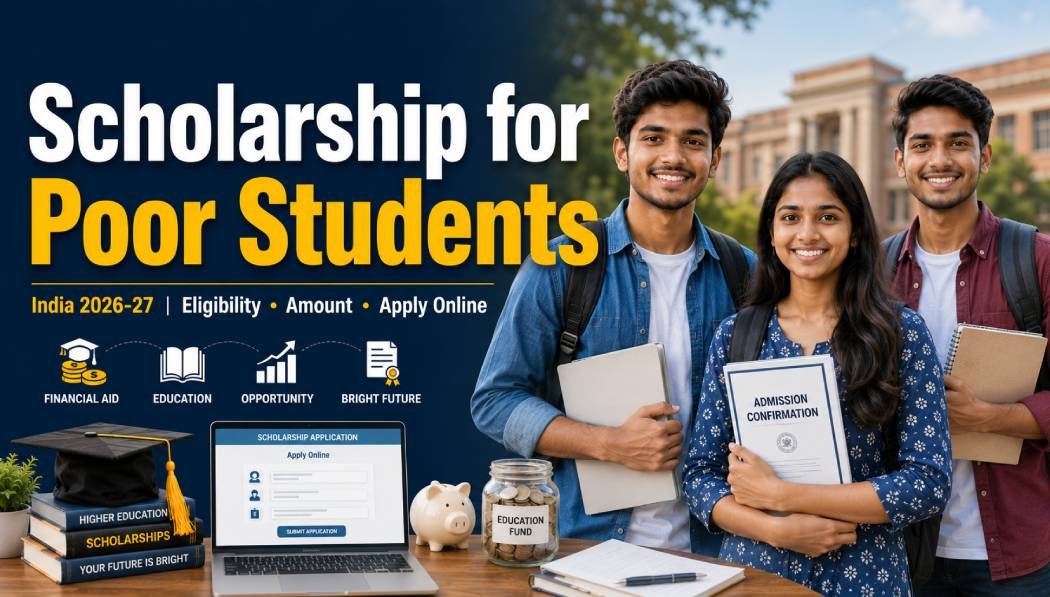
A scholarship for poor students provides financial assistance to students whose families cannot comfortably afford school, college, or university expenses.
Scholarship providers normally use terms such as economically weaker students, low-income students, financially disadvantaged students, need-based applicants, EWS students, or merit-cum-means applicants instead of using “poor student” as an official eligibility category.
Students from low-income families can find support from the Government of India, state governments, corporate foundations, nonprofit organizations, universities, and colleges.
Financial assistance may cover tuition fees, books, accommodation, living expenses, educational equipment, or a fixed annual scholarship.
The correct scholarship depends on the student’s family income, academic performance, education level, institution, category, and financial circumstances.
Quick answer: Low-income students in India should compare government scholarships such as the National Means-cum-Merit Scholarship Scheme and PM-USP CSSS with private programs such as SBI Platinum Jubilee Asha Scholarship, Reliance Foundation Scholarships, FAEA Scholarship, and university need-based financial aid.
Students searching for government scholarships should start with the National Scholarship Portal.
The National Scholarship Portal is open for academic year 2026-27. One-Time Registration is mandatory for applications on NSP. Students may also apply for one merit-based scholarship and one or more welfare-based scholarship schemes from 2026-27 when the individual schemes permit it.
Currency note: All financial values in this guide are displayed in USD as requested. Government and Indian scholarship providers normally publish awards in Indian currency. USD values below are approximate conversions based on the exchange rate available on August 31, 2026, when the rupee was trading around 95.44 per USD.
Scholarship for Poor Students in India: Quick Overview
Different education levels require different scholarship strategies.
| Student profile | Scholarship worth checking | Main selection basis | Approximate support |
|---|---|---|---|
| Class IX-XII student in an eligible government/aided school | NMMSS | Financial need + state selection test | USD 126 per year |
| High-performing student after Class XII | PM-USP CSSS | Class XII merit + income | USD 126-210 per year |
| Class IX-XII low-income student | SBI Asha | Merit + financial need | Up to USD 157 per year |
| UG student | SBI Asha | Merit + income + institution rules | Up to USD 786 per year |
| IIT student | SBI Asha | Merit + financial need | Up to USD 2,096 per year |
| IIM student | SBI Asha | Merit + financial need | Up to USD 5,239 per year |
| Medical student | SBI Asha | Merit + financial need | Up to USD 4,715 per year |
| Eligible overseas SC/ST student | SBI Asha | Merit + need + program rules | Up to USD 15,717 per year |
| First-year undergraduate student | Reliance Foundation UG Scholarship | Merit-cum-means + aptitude test | Up to USD 2,096 over degree |
| Socially/economically disadvantaged undergraduate | FAEA Scholarship | Financial/social disadvantage + academic profile | Support under FAEA norms |
| Student admitted to a university with need-based aid | Institutional financial aid | Family affordability assessment | Partial to 100% support at some institutions |
Students should compare the total benefit, not only the advertised maximum scholarship amount.
What Does “Scholarship for Poor Students” Actually Mean?
A scholarship for poor students generally means financial aid for students from households with limited ability to pay educational costs.
There is no universal government definition that applies to every scholarship.
A family’s eligibility can depend on income, assets, household size, education expenses, category, academic achievement, and the cost of the student’s course.
Need-Based Scholarship
A need-based scholarship primarily evaluates the student’s financial circumstances.
The provider may consider household income, assets, savings, dependents, education expenses, and other unavoidable costs.
Academic standards can still apply.
Merit-Based Scholarship
A merit-based scholarship primarily rewards achievement.
Selection may depend on marks, rank, examination results, sports, leadership, research, or another form of excellence.
Family income may not always be considered.
Merit-Cum-Means Scholarship
A merit-cum-means scholarship combines academic merit with financial need.
The student must normally satisfy both conditions.
The Reliance Foundation Undergraduate Scholarship and PM-USP CSSS are examples of programs with strong merit-and-means elements.
EWS Scholarship
EWS means Economically Weaker Section in specific legal and policy contexts.
An EWS certificate is relevant only when the scholarship or admission rule specifically requires it.
A student does not need an EWS certificate for every low-income scholarship.
BPL-Based Assistance
Some welfare schemes can use Below Poverty Line status as an eligibility or priority indicator.
BPL status and general financial need are not identical.
Fee Waiver
A fee waiver reduces the amount charged by an institution.
A fee waiver may cover part or all of tuition.
It does not automatically provide money for hostel, food, books, transport, or living costs.
Best Scholarships for Poor Students in India in 2026-27
The best scholarship depends on the student’s education level and financial profile.
The following programs have strong relevance for economically disadvantaged students.
National Means-cum-Merit Scholarship Scheme
The National Means-cum-Merit Scholarship Scheme (NMMSS) supports meritorious students from economically weaker families and aims to reduce dropout after Class VIII.
The Government of India awards 100,000 fresh scholarships every year to selected Class IX students.
Students can renew the scholarship through Classes X, XI, and XII when they satisfy the renewal requirements.
The scholarship is available for students studying in eligible State Government, government-aided, and local-body schools.
NMMSS Amount
The annual scholarship is approximately USD 126 per student.
NMMSS Income Limit
The parental income ceiling is approximately USD 3,667 per year from all sources.
NMMSS Academic Requirement
Students normally need at least 55% marks or an equivalent grade in Class VII to appear for the selection examination.
The minimum is relaxed by five percentage points for eligible SC/ST students.
NMMSS Selection
A student must clear the selection examination conducted by the relevant State or Union Territory.
The scholarship application then passes through verification.
NMMSS 2026-27 Deadline
The student application deadline for fresh and renewal applications is August 31, 2026.
Institute-level verification closes on September 15, 2026.
District-level verification closes on September 30, 2026.
Students can access the scheme through the National Scholarship Portal.
PM-USP Central Sector Scholarship for College and University Students
The PM-USP Central Sector Scheme of Scholarship for College and University Students, or CSSS, supports meritorious students from lower-income households who continue into regular higher education after Class XII.
The scholarship is administered by the Department of Higher Education.
PM-USP CSSS Eligibility
A student normally needs to:
- Be above the 80th percentile of successful candidates in the relevant Class XII examination stream.
- Pursue a regular course.
- Have annual family income up to approximately USD 4,715.
- Meet the current scholarship-duplication rules.
- Satisfy all NSP and institutional requirements.
Diploma students are not eligible under the current scheme rules.
Students who took a drop after Class XII are also excluded under the published eligibility criteria.
PM-USP Scholarship Amount
The scholarship rate is approximately:
- USD 126 per year during the first three years of eligible graduate study.
- USD 210 per year at postgraduate level.
- USD 210 per year in the fourth and fifth years of applicable integrated or professional programs.
B.Tech and B.E. students can receive the graduate-level amount during the first three years and approximately USD 210 in the fourth year.
PM-USP Renewal
A selected student can normally renew the scholarship annually subject to applicable requirements.
Current guidelines require satisfactory academic performance and adequate attendance.
The published FAQ specifies at least 50% marks and 75% attendance for renewal.
PM-USP 2026-27 Status
The National Scholarship Portal currently lists the 2026-27 renewal cycle as open.
Renewal applications currently close on September 30, 2026.
Students should check the National Scholarship Portal scholarship list for the latest fresh or renewal status before applying.
SBI Platinum Jubilee Asha Scholarship 2026-27
The SBI Platinum Jubilee Asha Scholarship is a large merit-cum-means scholarship initiative operated by SBI Foundation.
The 2026-27 program covers students from Class IX through higher education.
Different tracks cover school, undergraduate, postgraduate, medical, IIT, IIM, and selected overseas students.
Students can use the official SBI Asha Scholarship portal.
SBI Asha Scholarship Amount
Current maximum annual benefits include approximately:
| Track | Maximum support |
|---|---|
| Class IX-XII | USD 157 |
| Undergraduate | USD 786 |
| IIT | USD 2,096 |
| Postgraduate | USD 2,619 |
| Medical | USD 4,715 |
| IIM | USD 5,239 |
| Eligible overseas SC/ST students | USD 15,717 |
The official portal states that overall annual awards range from approximately USD 157 to USD 15,717, depending on the scholarship track.
SBI Asha Income Limit
The family-income threshold differs by track.
School applicants generally need family income up to approximately USD 3,143 per year.
Higher-education applicants generally use an income ceiling of approximately USD 6,287 per year.
SBI Asha Academic Requirement
The official portal lists a baseline academic requirement of 75% marks or 7.0 CGPA, with category-specific relaxations.
SBI Asha Deadline
The currently reported deadline for the 2026-27 cycle is September 4, 2026.
Students should confirm the live deadline on the official SBI Asha portal immediately before submission.
Reliance Foundation Undergraduate Scholarship 2026-27
The Reliance Foundation Undergraduate Scholarship supports first-year undergraduate students using a merit-cum-means selection model.
The program selects up to 5,000 undergraduate scholars each year.
Students can apply through the official Reliance Foundation Undergraduate Scholarship page.
Reliance Foundation UG Eligibility
Applicants must generally:
- Be resident Indian citizens.
- Have passed Class XII with at least 60%.
- Be enrolled in the first year of a regular full-time undergraduate degree during 2026-27.
- Have household income below approximately USD 15,717 per year.
- Complete the mandatory aptitude test.
Preference is given to students whose household income is below approximately USD 2,619 per year.
Reliance Foundation Scholarship Amount
Selected undergraduate scholars can receive up to approximately USD 2,096 over the duration of their degree.
Reliance Foundation Selection
The initial selection considers:
- Aptitude test score.
- Academic information.
- Personal information.
- Financial circumstances.
The final assessment follows a merit-cum-means approach.
2026-27 Status
Applications for the 2026-27 undergraduate scholarship are currently open according to the official program page.
FAEA Scholarship 2026-27
The Foundation for Academic Excellence and Access (FAEA) provides scholarships and bursaries to socially and economically disadvantaged students.
FAEA emphasizes educational opportunity for students whose choices might otherwise be restricted by financial and social disadvantage.
Students can review the program on the official FAEA website.
FAEA 2026-27 Status
Fresh applications for the 2026-27 cycle closed on July 7, 2026.
Students who missed the cycle should monitor the official FAEA website for the next scholarship announcement instead of submitting information through unofficial links.
University Need-Based Financial Aid
Institutional financial aid can be one of the strongest options for a student whose family cannot afford an expensive university.
Unlike many government scholarships, university need-based aid does not always use one fixed nationwide income ceiling.
The institution may calculate the gap between the family’s ability to pay and the actual cost of attendance.
For example, Plaksha University’s financial-aid program states that need-based support can range from 25% to 100% of tuition and living expenses.
Plaksha also considers family savings, assets, and essential expenses when evaluating financial need.
This illustrates an important principle:
A family’s income alone does not always show its true ability to pay for higher education.
Students should therefore check the financial-aid office of every university where they receive admission.
Which Scholarship Is Best for You?
The best scholarship depends on where you are in your education journey.
If You Are in Class VIII
Check whether you can appear for the state-level NMMSS selection examination.
NMMSS is specifically designed to support economically weaker students who might otherwise leave school after Class VIII.
If You Are in Classes IX-XII
Check:
- NMMSS if you were selected at the required stage.
- SBI Asha School Scholarship.
- State government scholarships.
- Category-based scholarships where applicable.
- School-specific fee concessions.
If You Have Completed Class XII
Check:
- PM-USP CSSS.
- Reliance Foundation Undergraduate Scholarship.
- SBI Asha UG Scholarship.
- FAEA when a fresh cycle opens.
- State scholarships.
- University need-based financial aid.
If You Are an Engineering Student
Check:
- Reliance Foundation UG Scholarship if you are a first-year student.
- SBI Asha UG or IIT track where relevant.
- PM-USP CSSS where eligible.
- AICTE scholarship schemes matching your category.
- University financial aid.
If You Are a Medical Student
Check:
- SBI Asha Medical Scholarship.
- NSP welfare schemes.
- State government scholarships.
- Institutional scholarships.
- Category-specific medical education assistance.
If You Are a General-Category Student
Do not assume that you cannot receive financial aid.
Many need-based and merit-cum-means scholarships are not restricted to SC, ST, or OBC students.
Reliance Foundation UG Scholarships, university financial aid, and several private scholarships can be open across categories subject to their individual rules.
Who Should Apply for Scholarships for Poor Students?
You should apply when your family has genuine difficulty financing your education and you satisfy the specific scholarship’s eligibility conditions.
You should strongly consider applying if:
- Your family income falls below the scholarship’s ceiling.
- Tuition or living costs create significant pressure on your household.
- Your family cannot fund your education without borrowing heavily.
- You meet the minimum marks requirement.
- You study in an eligible school, college, or university.
- You can provide valid income documents.
- You can complete the required test or interview.
- You meet the nationality or domicile requirement.
- You satisfy the program’s class, course, or year-of-study condition.
- You can meet renewal requirements after receiving the scholarship.
A low-income student should normally create a portfolio of eligible scholarship applications rather than relying on one program.
Who Should Not Apply?
Do not apply to a specific scholarship when you clearly fail a mandatory requirement.
You should generally not apply when:
- Your household income exceeds a strict income ceiling.
- You are in the wrong class or year of study.
- Your institution is not eligible.
- You are pursuing distance education when regular study is mandatory.
- The scheme accepts only first-year students and you are already in a later year.
- You do not meet mandatory academic requirements.
- You do not belong to a required category.
- You cannot provide genuine income or academic records.
- You already receive another benefit that the scholarship expressly prohibits.
- You plan to provide false information about family finances.
Do not manipulate income documents.
Scholarship providers can withdraw awards if information is inaccurate or misleading.
Reliance Foundation specifically states that scholarships can be withdrawn when supplied information is false, inaccurate, or misleading.
How Much Family Income Is Allowed for Poor Student Scholarships?
There is no universal income limit.
Each provider defines financial need differently.
| Scholarship | Approximate annual household income ceiling |
|---|---|
| NMMSS | USD 3,667 |
| PM-USP CSSS | USD 4,715 |
| SBI Asha School track | USD 3,143 |
| SBI Asha higher-education tracks | USD 6,287 |
| Reliance Foundation UG | Below USD 15,717 |
| Reliance Foundation preferred lower-income group | Below USD 2,619 |
| University need-based aid | Institution-specific |
The table reveals why students should not search for only one universal “poor family income limit.”
A student may fail the income test for one scheme and still qualify for another.
Does Income Alone Determine Financial Need?
No.
Some scholarships use a strict income ceiling.
Others conduct a broader affordability assessment.
A university or foundation can consider:
- Parents’ gross income.
- Other household income.
- Savings.
- Property.
- Investments.
- Business ownership.
- Number of dependents.
- Siblings in education.
- Medical expenses.
- Existing loans.
- Essential household expenses.
- Family financial emergencies.
- Course cost.
- Available financial-aid budget.
Plaksha University, for example, states that its assessment can consider income, savings, assets, and essential non-discretionary expenses.
This means two families with the same income can receive different aid decisions.
What If Family Income Is Above the Limit but We Still Cannot Afford College?
A strict government scholarship normally cannot ignore a fixed statutory income ceiling.
You should not misstate your income.
Instead, check scholarships that use broader financial-need assessments.
University financial aid can be particularly useful in this situation because some institutions consider assets, liabilities, household expenses, dependents, and actual educational costs.
You should also check:
- University fee waivers.
- Emergency student aid.
- Education grants.
- Merit scholarships.
- Category-based aid.
- Interest-subsidy programs.
- Education loans as a final funding layer.
Can General-Category Poor Students Get Scholarships?
Yes.
A low-income student does not need to belong to a reserved caste category to qualify for every scholarship.
Several programs use economic and academic criteria rather than caste alone.
Examples include:
- Reliance Foundation Undergraduate Scholarship.
- PM-USP CSSS.
- SBI Asha Scholarship tracks that are open beyond caste-specific categories.
- University need-based financial aid.
- Merit-cum-means scholarships from foundations and institutions.
Students should search using both income-based terms and category-based terms.
This increases topical coverage of available opportunities.
Is an EWS Certificate Required for Every Scholarship?
No.
An EWS certificate is required only when the particular scholarship or government rule asks for it.
Many scholarships accept an income certificate or other financial documents instead.
Private foundations can create their own verification requirements.
University financial-aid offices may request tax returns, salary documents, bank statements, asset details, or expense information.
Always read the document checklist for the specific scholarship.
Can a Poor Student Get a 100% Scholarship?
Yes.
A student can receive 100% financial support in some programs, but full funding is not automatic.
The meaning of “100% scholarship” also varies.
100% Tuition Scholarship
A 100% tuition scholarship pays the full tuition charge.
The student may still need money for:
- Hostel.
- Meals.
- Books.
- Transport.
- Laptop.
- Insurance.
- Personal expenses.
100% Financial Aid
A comprehensive financial-aid package can cover tuition and other educational costs.
The exact coverage depends on the institution.
Plaksha University currently states that its need-based assistance can range from 25% to 100% of tuition and living expenses.
Fully Funded Scholarship
A fully funded scholarship usually covers most major educational costs.
Students should read the benefit description carefully.
“Full tuition” and “fully funded” are not always the same.
What Expenses Can Scholarships Cover?
Scholarship benefits differ significantly.
| Expense | Government scholarship | Private scholarship | University need-based aid |
|---|---|---|---|
| Tuition fees | Sometimes | Often | Often |
| College fees | Sometimes | Sometimes | Often |
| Hostel | Scheme-specific | Scheme-specific | Can be covered |
| Meals | Less common | Sometimes | Can be covered |
| Books | Sometimes | Sometimes | Can be covered |
| Laptop | Selected schemes | Selected programs | Institution-specific |
| Transport | Less common | Scheme-specific | Institution-specific |
| Monthly stipend | Some schemes | Some programs | Sometimes |
| Living expenses | Selected schemes | Selected programs | Can be included |
Always calculate the student’s unfunded cost after scholarship.
A larger scholarship is not automatically the better financial option if the institution itself is much more expensive.
Documents Required for Scholarships for Poor Students
Documents prove identity, academic eligibility, admission, and financial need.
Exact requirements vary.
Income Certificate
An income certificate verifies household income.
Government scholarships often use it to enforce a fixed income ceiling.
Check:
- Correct applicant/family details.
- Current validity.
- Correct income period.
- Correct issuing authority.
Salary Certificate
Salaried parents may need:
- Salary slips.
- Employer certificate.
- Tax records.
- Form 16 or equivalent financial documentation.
The exact requirement depends on the provider.
Income Proof for Self-Employed Parents
Self-employed households may need:
- Tax returns.
- Business bank statements.
- Business registration information.
- Audited financial statements.
- Income declaration.
University financial-aid offices can request more detailed information than government scholarship portals.
Aadhaar
Aadhaar is important for many government scholarship identity and payment processes.
NSP uses Aadhaar or Aadhaar Enrollment ID in One-Time Registration.
Marksheets
Marksheets verify:
- Minimum marks.
- Class completion.
- Academic progression.
- Merit.
Use the correct academic year.
Admission Letter
An admission letter proves that the student has secured admission.
Some private and institutional scholarships cannot be assessed before admission.
Bonafide Certificate
A bonafide certificate confirms that the applicant is currently enrolled at the institution.
Fee Structure or Fee Receipt
The provider may request the actual cost of education.
This helps calculate assistance.
Bank Details
Government and private providers can transfer funds directly into the student’s bank account.
The bank-account name should match required identity records.
Category Certificate
SC, ST, OBC, EWS, disability, or other certificates are required only when the scholarship uses those categories.
Financial Asset Information
A need-based university can request:
- Savings.
- Investments.
- Property information.
- Business assets.
- Family bank statements.
Plaksha’s financial-aid guidance is one example of a more detailed family-financial assessment.
Scholarship Document Checklist
| Document | Why it is required | Common mistake |
|---|---|---|
| Aadhaar | Identity/OTR/verification | Name mismatch |
| Income certificate | Income eligibility | Old certificate |
| Marksheets | Academic eligibility | Wrong year uploaded |
| Admission letter | Enrollment proof | Provisional status unclear |
| Bonafide certificate | Current student status | Outdated certificate |
| Fee receipt | Education-cost proof | Missing semester details |
| Bank proof | Payment | Account not in required name |
| Tax records | Financial assessment | Missing earning member |
| Salary certificate | Parent income proof | Gross/net income confusion |
| Category certificate | Category eligibility | Wrong or expired document |
| Asset details | University need assessment | Incomplete disclosure |
| Disability certificate | PwD benefit | Invalid/current format missing |
How to Apply for a Scholarship for Poor Students Step by Step
A systematic application process reduces mistakes.
Step 1: Identify Your Education Level
Start with your current stage:
- Class VIII.
- Class IX-X.
- Class XI-XII.
- Diploma.
- Undergraduate.
- Postgraduate.
- Professional course.
Do not apply to scholarships designed for another study level.
Step 2: Calculate Household Income Correctly
Include the income sources required by the scholarship.
Do not confuse monthly income with annual income.
Do not use net salary when the scholarship requests gross household income.
Step 3: Identify Your Scholarship Type
Choose among:
- Government scholarship.
- Need-based scholarship.
- Merit-cum-means scholarship.
- Corporate scholarship.
- NGO/foundation scholarship.
- University financial aid.
Students should normally check more than one category.
Step 4: Create a Shortlist
Create a table containing:
- Scholarship name.
- Eligibility.
- Income limit.
- Marks requirement.
- Amount.
- Deadline.
- Portal.
- Documents.
- Selection process.
Remove clearly ineligible programs.
Step 5: Verify Every Scholarship on the Official Website
Do not apply based only on a social-media post.
Check the official provider page.
For government scholarships, use the National Scholarship Portal when the scheme is listed there.
Step 6: Prepare Documents
Scan documents clearly.
Use readable PDF or image files within the prescribed size.
Check names, dates, certificate numbers, and income values.
Step 7: Complete OTR for NSP
One-Time Registration is mandatory for scholarship applications on NSP.
OTR is a unique 14-digit number linked to Aadhaar or Aadhaar Enrollment ID and remains relevant across the student’s academic career.
Step 8: Complete the Application Form
Enter:
- Personal details.
- Academic records.
- Family income.
- Institution details.
- Bank information.
- Category information.
- Scholarship-specific details.
Do not copy information from another student’s application.
Step 9: Upload Supporting Documents
Use the exact documents requested.
Do not upload an unrelated certificate simply because the portal accepts the file.
Step 10: Complete the Required Test
Some scholarships include a competitive assessment.
NMMSS uses a state-level selection test.
Reliance Foundation UG requires an aptitude test.
Missing a mandatory test can end the application.
Step 11: Review Before Submission
Check every number.
Pay particular attention to:
- Family income.
- Marks.
- Admission year.
- Bank details.
- Aadhaar.
- OTR.
- Institution.
- Course.
- Scholarship category.
Step 12: Submit Before the Deadline
Do not wait for the final hour.
Technical problems can occur.
Some scholarships also require verification after student submission.
Step 13: Complete Institution Verification
NSP scholarships can require verification by the educational institution and other nodal authorities.
An application that remains unverified may not move to final selection.
Step 14: Track Your Application and Payment
Save:
- Application ID.
- OTR.
- Registered email.
- Registered phone number.
- Acknowledgment.
- Scholarship portal login.
Continue checking the status until the award is credited.
How to Apply Through the National Scholarship Portal
NSP is the Government of India’s major scholarship platform.
Create One-Time Registration
Visit the NSP student portal.
Generate OTR using the required identity process.
Check Scholarship Eligibility
Use the scheme listings and eligibility functionality available on NSP.
Do not choose a scholarship based only on its name.
Submit the Application
Complete the relevant fresh or renewal application.
Complete Institution Verification
The institution may verify the student’s enrollment and application.
Complete Higher-Level Verification
Some schemes include district, state, ministry, or other nodal verification.
Track Payment
NSP links students to scholarship-payment tracking through PFMS.
Government scholarships can use Direct Benefit Transfer into eligible bank accounts.
How Do Scholarship Providers Decide Who Is Financially Needy?
Providers use different assessment models.
A simple government scheme may compare declared family income against a fixed ceiling.
A private foundation may combine academic merit and income.
A university can conduct a much more detailed affordability analysis.
Family Income
This is usually the starting point.
Income can include earnings from:
- Salary.
- Business.
- Professional work.
- Agriculture.
- Rent.
- Investments.
- Other sources.
Number of Dependents
A household supporting several children or elderly relatives can have less disposable income.
Siblings in Education
Two families with the same annual income can have different education burdens when one family supports several students.
Family Assets
Property, investments, savings, and business ownership can affect institutional aid.
Essential Expenses
Medical costs, debt obligations, and unavoidable expenses can affect affordability assessments.
Tuition and Living Costs
Financial need is partly related to the cost of the institution.
A family might afford one college but not another.
Academic Performance
Need-based aid can still become competitive when funding is limited.
Plaksha states that when demand exceeds available financial-aid resources, other factors such as academic and extracurricular performance may also be considered.
How Does the Scholarship Selection Process Work?
Selection depends on the provider.
| Scholarship | Typical selection process |
|---|---|
| NMMSS | Eligibility → state selection test → NSP application → verification → award |
| PM-USP CSSS | Class XII merit → income eligibility → application → verification → selection |
| Reliance Foundation UG | Eligibility → application → aptitude test → merit-cum-means assessment → scholar selection |
| SBI Asha | Eligibility → academic/financial assessment → verification → selection |
| FAEA | Social/economic disadvantage → academic assessment → provider selection |
| University financial aid | Admission → financial-aid application → family-financial review → committee decision |
Does Meeting the Eligibility Criteria Guarantee a Scholarship?
No.
Eligibility allows a student to be considered.
Selection decides who actually receives funding.
A scholarship can receive far more eligible applications than it has awards.
Reliance Foundation demonstrates this clearly.
For the 2025-26 cycle, the foundation reported more than 125,000 applications and selected 5,100 undergraduate and postgraduate scholars.
That equals an approximate overall selection rate of 4.1%.
The selected cohort also showed strong academic and financial profiles.
Reliance Foundation reported that:
- 83% came from households in the lower-income preference group.
- 97% of selected undergraduate scholars scored above 90% in Class XII.
- 146 selected scholars were persons with disabilities.
The lesson is important.
Minimum eligibility is the entry requirement. It is not a guarantee of selection.
Fresh Scholarship vs Renewal
Fresh and renewal applications serve different purposes.
| Requirement | Fresh applicant | Renewal applicant |
|---|---|---|
| New scholarship selection | Yes | No |
| Previous scholarship record | Usually no | Yes |
| Current enrollment | Required | Required |
| Academic performance | Used for initial eligibility | Used for continuation |
| Income documents | Often required | Scheme-specific |
| Application submission | Required | Required |
| Renewal deadline | Not applicable | Critical |
| Automatic continuation | No | Usually no |
Students should never assume that a scholarship renews automatically.
PM-USP, NMMSS, and many other schemes require renewal action in subsequent years.
Can You Apply for More Than One Scholarship?
Yes, in many situations.
However, applying for multiple scholarships and receiving multiple scholarships are different questions.
Every scheme can impose its own duplication rule.
The National Scholarship Portal currently states that from academic year 2026-27, students may apply for one merit-based scholarship scheme and one or more welfare-based scholarship schemes, subject to the eligibility rules of the schemes concerned.
Always check:
- Whether simultaneous benefits are allowed.
- Whether fee reimbursement can be combined.
- Whether university aid is reduced after an external award.
- Whether one provider requires disclosure of another scholarship.
Never hide another scholarship if disclosure is required.
Common Mistakes Scholarship Applicants Make
Scholarship rejection is often preventable.
Searching Only for “Poor Student Scholarship”
The phrase is useful for discovery.
It is too broad for final selection.
Search specific concepts such as:
- Need-based scholarship.
- Merit-cum-means.
- EWS scholarship.
- University financial aid.
- Scholarship after Class XII.
- Scholarship for your degree.
Applying Without Reading Eligibility
Read the complete criteria before creating an account.
Confusing EWS With Financial Need
A student can be financially needy without qualifying under every EWS rule.
Using an Old Income Certificate
Check the required certificate period.
Entering Incorrect Household Income
Use the exact definition required by the scholarship.
Hiding Assets or Income
Private universities can investigate inconsistencies.
False information can lead to cancellation.
Missing a Mandatory Test
Reliance Foundation UG requires an aptitude test.
NMMSS requires a state selection examination.
Ignoring NSP OTR
OTR is mandatory for NSP applications.
Applying Through an Unofficial Website
Always identify the actual scholarship provider.
Paying for a “Guaranteed Scholarship”
Legitimate scholarship selection cannot normally be guaranteed by an agent.
Applying on the Final Day
You may discover a missing document too late.
Ignoring Institution Verification
Student submission may only be the first stage.
Assuming Eligibility Means Selection
Competitive scholarships can reject many eligible applicants.
Forgetting Renewal
A scholarship can stop if renewal conditions are not completed.
How to Identify a Fake Scholarship
Scholarship scams target students who urgently need financial support.
Treat these warning signs seriously:
- Guaranteed scholarship in exchange for payment.
- Request for banking PIN.
- Request for OTP.
- Request for account password.
- Unofficial imitation of a government portal.
- Application available only through an unknown social-media account.
- No published provider information.
- Immediate-payment pressure.
- Large “processing fee” without an official explanation.
- Unrealistic award promises.
- No eligibility criteria.
- Poorly copied government branding.
NSP itself warns students not to share sensitive personal information such as passwords, PINs, OTPs, and account details in inappropriate channels.
Reliance Foundation has also warned that it does not solicit money to offer its scholarships.
Previous Years’ Scholarship Trends
Scholarship programs are becoming larger, more digital, and more competitive.
NMMSS Remains a Large School Scholarship Program
NMMSS provides 100,000 fresh scholarships every year.
The scheme renews eligible awards through Classes X-XII.
In the 2025 application cycle, official data recorded tens of thousands of fresh applications and more than 170,000 renewal submissions by August 30, 2025.
The program remains a major national route for economically weaker school students.
Private Scholarships Are Highly Competitive
Reliance Foundation received more than 125,000 applications for its 2025-26 UG and PG scholarship cycle.
Only 5,100 scholars were selected.
The data suggests that applicants should strengthen both academic and application quality rather than relying only on income eligibility.
Corporate Scholarships Are Expanding Across Education Levels
SBI Asha now covers multiple student stages.
The official 2026-27 program includes school students, undergraduate students, postgraduate students, medical students, IIT students, IIM students, and an overseas-study track.
Digital Identity Is Becoming Central to Government Scholarships
NSP requires OTR.
Aadhaar is used in OTR generation.
NSP also provides Aadhaar-seeding and payment-tracking support.
Future applicants should treat identity and bank-data accuracy as core application requirements.
Our Research Notes: What Low-Income Students Should Know
The following findings can materially change a student’s scholarship strategy.
“Poor” Is Not One Official Eligibility Category
A search engine query can use “poor students.”
A scholarship provider usually needs measurable criteria.
Those criteria can include income, academic merit, BPL status, EWS status, caste category, disability, crisis conditions, or demonstrated financial need.
There Is No Universal Income Ceiling
NMMSS and PM-USP use different ceilings.
SBI Asha uses separate school and higher-education ceilings.
Reliance Foundation uses another threshold.
Universities can apply their own financial-aid models.
General-Category Students Can Qualify
Economic assistance is not limited to reserved categories.
Students should search category-neutral private and institutional programs.
EWS Is Not Mandatory Everywhere
EWS is one possible eligibility classification.
It is not a universal synonym for financial need.
A Higher Income Does Not Always Mean Higher Ability to Pay
Family size, medical expenses, assets, education costs, and debt can change actual affordability.
Institutional aid may capture those differences better than rigid income-ceiling programs.
100% Support Exists but Is Competitive
Some universities can provide full tuition or broader full financial aid.
Students should distinguish full tuition from complete cost-of-attendance funding.
Minimum Marks May Not Be Competitive Marks
A scholarship may advertise a 60% or 75% minimum.
Selected students can still have substantially higher marks when applicant volume is high.
Reliance’s 2025-26 results show this effect clearly.
Admission Can Come Before Financial-Aid Assessment
Some universities first evaluate admission and then invite admitted or shortlisted applicants to submit financial-aid information.
Plaksha uses this type of process.
Government and University Aid Use Different Models
Government scholarship:
Eligibility → portal → documents → verification → sanction → DBT
University financial aid:
Admission → financial disclosure → affordability assessment → committee decision → fee reduction/grant
Students should understand which model applies before preparing documents.
Compare Unmet Cost, Not Just Scholarship Amount
Suppose Scholarship A gives USD 500 toward a college where the student still owes USD 1,000.
Scholarship B gives USD 2,000 toward a university where the student still owes USD 8,000.
Scholarship B has the larger headline award.
Scholarship A leaves the student with the smaller funding gap.
The best scholarship is therefore the one that produces the most affordable net education cost.
Scholarships Worth Checking Right Now in 2026-27
Status can change quickly.
Last verified: August 31, 2026
| Scholarship | Status on/around August 31, 2026 | Action |
|---|---|---|
| NMMSS | Deadline August 31, 2026 | Apply immediately if eligible |
| SBI Platinum Jubilee Asha | Open; deadline September 4, 2026 | Apply before deadline |
| Reliance Foundation UG | Applications open | Check official portal and apply |
| FAEA 2026-27 | Fresh deadline passed July 7, 2026 | Monitor next cycle |
| PM-USP CSSS | 2026-27 renewal currently open | Renewal students should check NSP |
Scholarship deadlines can be extended, changed, or divided into fresh and renewal dates.
Always re-check the official portal immediately before applying.
Best Application Strategy for a Low-Income Student
A strong scholarship strategy uses several funding layers.
Start in this order:
- Check government scholarships.
- Check your state scholarship portal.
- Check category-specific scholarships.
- Check corporate foundation scholarships.
- Check nonprofit scholarships.
- Apply for university need-based financial aid.
- Check college fee concessions.
- Check emergency assistance.
- Compare education loans only after grant and scholarship options.
- Re-check renewal opportunities every academic year.
Create a spreadsheet containing:
- Scholarship.
- Deadline.
- Amount.
- Income limit.
- Marks requirement.
- Portal.
- Required documents.
- Test.
- Status.
- Result.
- Renewal date.
This prevents missed deadlines.
Official Scholarship Websites Students Should Use
For central government applications, use the National Scholarship Portal.
For government higher-education scholarship rules, use the Ministry of Education PM-USP guidance.
For the SBI program, use the official SBI Platinum Jubilee Asha Scholarship portal.
For Reliance, use the official Reliance Foundation Undergraduate Scholarships page.
For FAEA opportunities, use the official FAEA India scholarship website.
Students seeking institutional need-based support should use the financial-aid section of the university’s official website.
Frequently Asked Questions
Which scholarship is best for poor students in India?
The best scholarship depends on the student’s class, family income, marks, and institution. School students should check NMMSS and SBI Asha. Undergraduate students should consider PM-USP CSSS, Reliance Foundation, SBI Asha, FAEA, state programs, and university need-based financial aid where eligible.
How can a poor student get a scholarship in India?
A low-income student should calculate annual family income, identify scholarships matching the current education level, verify official eligibility, prepare income and academic documents, apply through the official portal, complete any mandatory exam or aptitude test, and follow the application through institution verification and final selection.
What is the income limit for scholarships for poor students?
There is no universal limit. NMMSS uses an annual parental-income ceiling of about USD 3,667. PM-USP CSSS uses about USD 4,715. SBI Asha applies different limits by education level. Reliance Foundation UG allows a higher ceiling but gives preference to lower-income households.
Can a general-category poor student get a scholarship?
Yes. Several need-based and merit-cum-means programs are available without restricting all awards to SC, ST, or OBC students. General-category students should check Reliance Foundation scholarships, PM-USP CSSS, SBI Asha, private foundation scholarships, university financial aid, and state-level economic assistance programs.
Is an EWS certificate compulsory for a need-based scholarship?
No. An EWS certificate is required only when a particular scholarship or government rule asks for it. Other providers may use an income certificate, tax return, salary proof, bank statements, or a detailed financial-aid form. Students should follow the document requirements of each individual scholarship.
Can a poor student get a 100% scholarship?
Yes. Some universities and scholarship providers can cover 100% of tuition or broader educational costs. Full funding is competitive and depends on the program. Students should check whether “100%” means tuition only or also includes hostel, meals, books, and living expenses.
Which scholarship is available after Class 10 for poor students?
Students after Class X should check state post-matric scholarships, category-based schemes, school-level assistance for Classes XI-XII, SBI Asha, and other government welfare programs. Students already selected under NMMSS can continue through Classes X-XII subject to the scheme’s renewal and academic requirements.
Which scholarships are available after Class 12 for low-income students?
Students after Class XII should check PM-USP CSSS, Reliance Foundation Undergraduate Scholarship, SBI Asha UG Scholarship, FAEA when applications are open, state government programs, institution-specific scholarships, and university need-based financial aid. Eligibility can depend on marks, income, regular enrollment, and course type.
What documents are required to prove financial need?
Common documents include an income certificate, salary slips, tax returns, employer certificates, bank statements, business-income records, admission proof, fee structure, Aadhaar, marksheets, and category certificates where relevant. Universities can also request asset information, savings records, sibling education expenses, and evidence of unavoidable household costs.
Can private-college students get scholarships for low-income families?
Yes. Private-college students can qualify for several corporate, foundation, government, and institution-specific programs. However, each scholarship sets its own institution and course rules. Students should verify whether their college is recognized or eligible before submitting an application and should also contact the college financial-aid office.
Can I apply for two scholarships at the same time?
Often yes, but individual schemes can restrict simultaneous benefits. From 2026-27, NSP states that students can apply for one merit-based scholarship and one or more welfare-based scholarships subject to eligibility. Students should still check whether the selected schemes permit receiving both awards at the same time.
Do scholarships cover hostel and living expenses?
Some scholarships cover only a fixed annual amount or tuition. Other programs can include hostel, books, maintenance, living expenses, or educational equipment. University need-based financial aid may provide broader support. Students should compare the covered expenses rather than assuming that every scholarship pays the complete cost of education.
Do I need admission before applying for financial aid?
It depends on the program. Some external scholarships allow applications during the admission period. Some institutional financial-aid programs require an admission offer or shortlist before financial assessment. Students should check the scholarship timeline early because waiting for admission can cause them to miss an external scholarship deadline.
What if my family income is above the scholarship limit but we still cannot afford college?
Do not provide false income information. A strict government scholarship normally cannot waive its income ceiling. Instead, search for university need-based aid and scholarships with higher thresholds. Some institutions evaluate savings, assets, dependents, medical costs, and other unavoidable expenses in addition to annual household income.
Why do eligible students sometimes not receive scholarships?
Eligibility only allows a student to compete. Scholarships may have limited awards, merit rankings, aptitude tests, institutional quotas, verification rules, or limited budgets. Reliance Foundation, for example, selected 5,100 scholars from more than 125,000 applications in its 2025-26 cycle, showing how competitive major programs can be.
How can I check whether a scholarship website is genuine?
Identify the actual funding organization first. Use official government, university, foundation, or corporate websites. Check domain ownership, eligibility rules, contact information, and application-fee policy. Never share an OTP, PIN, password, or banking credentials with anyone claiming they can guarantee scholarship approval.
Conclusion
A scholarship for poor students can help financially disadvantaged students continue their education without relying entirely on family income or education loans.
The first step is to identify the student’s real funding profile.
Students should determine their education level, annual household income, academic performance, category, institution, and actual financial gap.
School students should prioritize programs such as NMMSS and relevant school scholarships.
College students should compare PM-USP CSSS, Reliance Foundation Scholarships, SBI Asha, FAEA, state schemes, and institutional financial aid.
Students should also remember that financial need does not automatically guarantee a scholarship.
Strong applications require correct documents, timely submission, accurate income disclosure, completion of required tests, and successful verification.
The most effective strategy is to apply to multiple legitimate scholarships for which the student is genuinely eligible, while checking whether simultaneous benefits are allowed.

You may like

Check Student Scholarship Status Online: SSP Karnataka Application and Payment Status

Government Scholarship for College Students 2022 in India: Eligibility, Amount, and Application Guide

Digital Gujarat Scholarship for OBC Students 2026 to 27: Eligibility, Amount, Last Date and Application Guide

Turkey Burslari Scholarship 2026: Eligibility, Benefits, Deadline, Interview, and Results

SBI Asha Scholarship 2026-27: Eligibility, Amount, Last Date and Apply Online

Scholarship for J&K Students: Eligibility, Amount, Deadlines, and How to Apply
Trending
-
 Scholarships2 months ago
Turkey Burslari Scholarship 2026: Eligibility, Benefits, Deadline, Interview, and Results
-
 Scholarships1 month ago
SBI Asha Scholarship 2026-27: Eligibility, Amount, Last Date and Apply Online
-
 Scholarships2 months ago
Scholarship for J&K Students: Eligibility, Amount, Deadlines, and How to Apply
-
 By Country2 months ago
Korean Government Scholarship for Indian Students: GKS Eligibility, Benefits, Deadlines and Application
-

 Scholarships1 month ago
Scholarships for PG Students in Kerala 2026: Eligibility, Amounts, Deadlines and Application Links
-
 By Country2 months ago
Scholarship for MBBS Students in India
-

 Scholarships1 month ago
West Bengal Student Scholarship 2026-27: Eligibility, Amounts, Last Dates and Apply Online
-
 Scholarships2 months ago
Abdul Kalam Scholarship for Class 10 Students: Verified Programs, Eligibility and Application Guide