
Scholarships
Scholarship for SC Students in Karnataka 2026–27: SSP Eligibility, Amount, Last Date & Apply Online

Published
1 week agoon
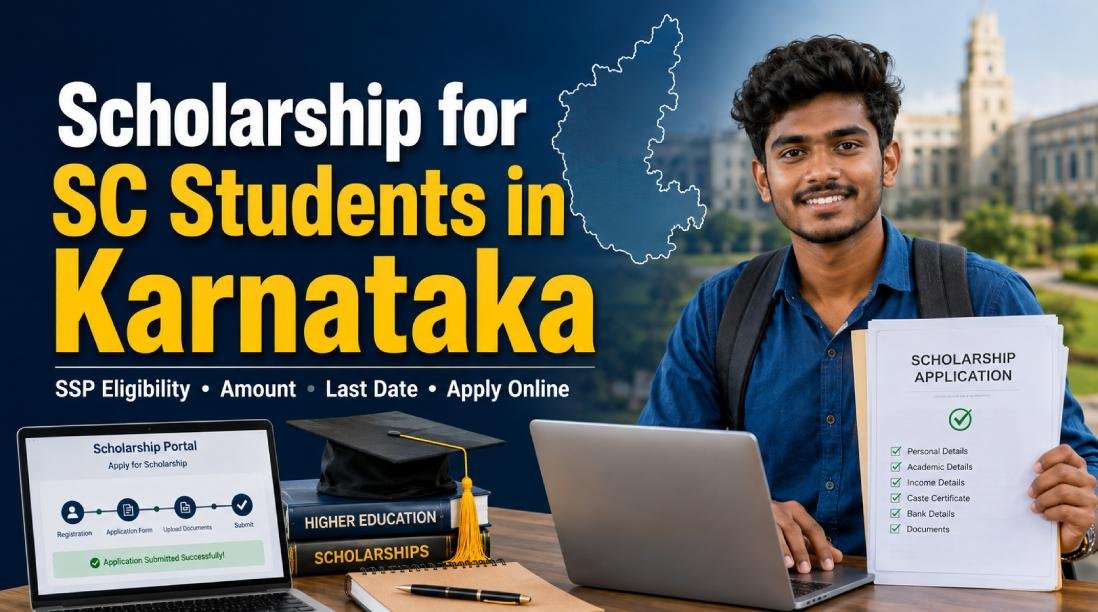
Scheduled Caste students in Karnataka can receive education financial assistance through multiple state and centrally sponsored scholarship schemes.
The main application platform is the Karnataka State Scholarship Portal, or SSP.
The scholarship available to an SC student depends on the student’s class, course, annual family income, institution, hostel status, and academic level.
The major options include the SC Post-Matric Scholarship, Pre-Matric Scholarship, fee reimbursement, Hosteller Maintenance Scheme, PhD Stipend, and SC Prize Money.
For the 2026–27 academic year, the official Karnataka State Scholarship Portal currently lists January 31, 2027 as the Social Welfare Department post-matric application deadline.
The Social Welfare Department pre-matric deadline is currently September 30, 2026.
SC students applying through SSP must also obtain an NSP One Time Registration, or OTR, number.
Quick answer: Most SC students studying after Class 10 should first check the SC Post-Matric Scholarship on SSP. Students with annual family income above INR 250,000 should not assume that all financial assistance ends. Karnataka separately lists a fee-reimbursement route for eligible SC students with income above INR 250,000 and below INR 1,000,000.
SC Scholarship Karnataka 2026–27: Quick Overview
| Attribute | Details |
|---|---|
| Scholarship category | Scheduled Caste student financial aid |
| State | Karnataka |
| Main application portal | Karnataka SSP |
| Main department | Social Welfare Department |
| Academic year | 2026–27 |
| Main post-matric scheme | SC Post Matric Scholarship — GoI |
| Main PMS income limit | Up to INR 250,000 |
| Approximate USD equivalent | About USD 2,620 |
| Higher-income reimbursement tier | Above INR 250,000 and below INR 1,000,000 |
| Approximate upper USD equivalent | About USD 10,480 |
| Post-matric deadline | January 31, 2027 |
| Pre-matric deadline | September 30, 2026 |
| NSP OTR required | Yes |
| Aadhaar required | Yes |
| Aadhaar-bank seeding | Required for DBT |
| Fresh application | Available |
| Renewal | Available for applicable schemes |
| Payment method | Direct Benefit Transfer |
| Prize Money | Separate academic incentive |
USD conversions are approximate and are included only for international comparison. Scholarship authorities calculate eligibility and payments in Indian rupees.
What Scholarships Are Available for SC Students in Karnataka?
There is no single universal programme officially called only the “SC Scholarship Karnataka.”
The keyword represents several financial-aid schemes.
The correct scholarship depends on the student’s education level and financial circumstances.
1. SC Post-Matric Scholarship
The SC Post-Matric Scholarship is the primary scholarship for many Scheduled Caste students studying after Class 10.
The scheme is supported by the Government of India and implemented in Karnataka through the state scholarship system.
Eligible students can receive support for:
- Compulsory non-refundable educational fees
- Academic allowance
- Professional courses
- General undergraduate courses
- Postgraduate courses
- Diploma programmes
- Other recognized post-matric education
The main parental or guardian income ceiling under the central Post-Matric Scholarship for SC Students is INR 250,000 per year.
Students can review the national framework through the Department of Social Justice and Empowerment Post-Matric Scholarship guidelines.
Applications in Karnataka are handled through the Karnataka State Scholarship Portal.
2. Pre-Matric Scholarship for SC Students
Pre-matric scholarships support eligible SC students before post-secondary education.
Karnataka currently separates different pre-matric student groups.
The current SSP framework includes support for:
- Eligible SC students in Classes 1–8
- Eligible SC students in Classes 9–10
- Children of parents engaged in specified occupations under a separate component
The income condition differs according to the scheme component.
Karnataka SSP currently lists an annual income ceiling below INR 600,000 for the relevant Classes 1–8 SC scheme.
The national Class 9–10 SC pre-matric framework generally uses a parental income ceiling of INR 250,000.
Students and parents should check the current scheme shown after entering the student’s details on SSP.
3. Fee Reimbursement for SC Students With Income Above INR 250,000
This is one of the most important Karnataka-specific distinctions.
Many scholarship articles state that an SC student becomes ineligible once family income exceeds INR 250,000.
That statement is incomplete.
The official SSP currently lists a Social Welfare Department scheme described as:
Fee Reimbursement Scheme — Income above INR 250,000 and below INR 1,000,000.
This means an eligible SC student whose family income is too high for the main Government of India Post-Matric Scholarship may still need to investigate Karnataka’s separate fee-reimbursement route.
The relevant income band is:
Above INR 250,000 but below INR 1,000,000 annually.
That is approximately USD 2,620 to USD 10,480 based on the current reference conversion.
Eligibility still depends on course, institution, admission conditions, department, and applicable government rules.
Important: An annual family income above INR 250,000 does not automatically mean an SC student has no fee-support option in Karnataka.
4. Hosteller Maintenance Scheme
SC students living in hostels may qualify for additional maintenance assistance.
Hosteller benefits help address costs connected with living away from home for education.
Hostel status must normally be established through the required institutional or accommodation records.
A student should not select “hosteller” merely because the student rents accommodation near the college.
The definition and evidence required by the applicable scheme should be checked on SSP.
5. PhD Stipend Scheme
Karnataka SSP also lists a PhD stipend route under the Social Welfare Department.
This scheme addresses a different student intent from the regular undergraduate or post-matric scholarship.
Doctoral students should therefore check both:
- applicable Post-Matric Scholarship eligibility; and
- separate research or PhD stipend support.
The available benefit, research conditions, duration, and department rules should be checked for the current academic year.
6. Management and NRI Tuition Fee Reimbursement
SSP currently lists a Management & NRI Tuition Fee Reimbursement scheme under the Social Welfare Department.
The existence of this scheme does not mean that every management-quota or NRI admission automatically qualifies.
Students must verify:
- course eligibility;
- admission category;
- income rules;
- institution eligibility;
- department rules; and
- applicable government orders.
7. SC Prize Money Karnataka
SC Prize Money is a separate academic incentive.
It should not be confused with the regular SSP Post-Matric Scholarship.
The Post-Matric Scholarship supports students while they are pursuing education.
Prize Money generally rewards eligible SC students after successfully completing specified educational qualifications.
Current Karnataka Social Welfare information lists incentives for levels including:
- SSLC
- PUC
- Degree
- Postgraduate study
- Engineering
- Medical education
Students can review the programme context through the Karnataka Social Welfare Department information published by the Kodagu district administration.
Which SC Scholarship Should You Apply For?
The student’s current education level provides the fastest starting point.
| Student profile | Scheme to check first |
|---|---|
| Class 1–8 | SC Pre-Matric Scholarship |
| Class 9–10 | SC Pre-Matric Scholarship |
| 1st or 2nd PUC | SC Post-Matric Scholarship |
| ITI student | SC Post-Matric / relevant departmental scheme |
| Polytechnic diploma | Post-Matric + applicable technical fee reimbursement |
| BA/BSc/BCom | SC Post-Matric Scholarship |
| BBA/BCA | SC Post-Matric Scholarship |
| Engineering/BTech | PMS + applicable technical fee reimbursement |
| MBBS/BDS/medical | PMS + applicable Medical Education scheme |
| MA/MSc/MCom | SC Post-Matric Scholarship |
| Professional PG | Post-Matric / departmental reimbursement |
| PhD | Post-Matric + PhD stipend where eligible |
| Hosteller | Main scholarship + applicable maintenance scheme |
| Student who completed eligible qualification | SC Prize Money |
Students should use the official SSP Karnataka portal as the primary source for scheme identification.
SC Scholarship Karnataka Income Limit Explained
Income is one of the strongest eligibility attributes.
However, Karnataka does not use one income ceiling for every SC scholarship.
Family Income Up to INR 250,000
The main Government of India Post-Matric Scholarship for SC students uses a parental or guardian income ceiling of INR 250,000 annually.
That is approximately USD 2,620.
A student under this income threshold should investigate the regular PMS-SC route first.
Income Above INR 250,000 but Below INR 1,000,000
Karnataka SSP separately lists a fee-reimbursement scheme for eligible students in this income range.
The upper threshold of INR 1,000,000 is approximately USD 10,480.
This tier matters because students may incorrectly stop searching for financial assistance when their income exceeds the central PMS limit.
Income Above INR 1,000,000
An SC student above this particular reimbursement threshold should investigate other scholarships independently.
Possible alternatives can depend on:
- academic merit;
- institution;
- professional course;
- disability;
- private scholarship;
- corporate scholarship;
- university aid; or
- another government programme.
Category status alone does not guarantee eligibility for every scheme.
How Much Scholarship Do SC Students Get in Karnataka?
There is no universal fixed amount.
The total benefit depends on the scholarship, course group, tuition structure, and whether the student is a hosteller or day scholar.
The national Post-Matric Scholarship framework divides courses into groups.
Post-Matric Academic Allowance
| Course group | Hosteller | Day scholar |
|---|---|---|
| Group I professional degree/PG | INR 13,500 ≈ USD 141 | INR 7,000 ≈ USD 73 |
| Group II other professional courses | INR 9,500 ≈ USD 100 | INR 6,500 ≈ USD 68 |
| Group III general graduate/PG courses | INR 6,000 ≈ USD 63 | INR 3,000 ≈ USD 31 |
| Group IV other post-Class-X courses | INR 4,000 ≈ USD 42 | INR 2,500 ≈ USD 26 |
The academic allowance should not be confused with eligible compulsory non-refundable fees.
The Post-Matric Scholarship framework can provide both applicable educational-fee support and the relevant academic allowance.
Does SSP Pay the Full College Fee?
Not every amount printed on a college fee sheet is automatically reimbursable.
Scholarship rules typically distinguish between eligible compulsory fees and other institutional charges.
Possible non-identical components include:
- tuition fee;
- examination fee;
- development charge;
- university fee;
- laboratory fee;
- hostel fee;
- mess fee;
- transport;
- refundable deposit;
- optional services.
Students should obtain an itemized fee statement from the institution.
Students should then compare that statement with the reimbursement rules of the applicable scheme.
Scholarship for SC Engineering Students in Karnataka
SC engineering students can access multiple financial-aid routes depending on income and admission details.
An engineering student should check:
- SC Post-Matric Scholarship
- Directorate of Technical Education fee reimbursement
- Higher-income SC reimbursement tier
- Hostel maintenance support
- Other professional-course benefits
Students should keep their counselling and admission information ready.
Relevant details can include:
- KCET admission information;
- counselling number;
- college registration;
- course;
- semester;
- fee receipt; and
- study certificate.
Engineering Students With Income Up to INR 250,000
These students should first investigate the main SC Post-Matric Scholarship.
Engineering Students Above INR 250,000 Income
Students with annual family income above INR 250,000 but below INR 1,000,000 should check the Karnataka fee-reimbursement scheme.
This is particularly important for engineering and other higher-fee professional courses.
Scholarship for SC Medical Students in Karnataka
SC medical students should not assume that every benefit is administered only through the Social Welfare Department.
Karnataka SSP currently identifies scholarship routes connected with the Department of Medical Education.
Eligible students studying programmes such as MBBS and other professional medical courses should check:
- SC Post-Matric Scholarship;
- Department of Medical Education scholarship/reimbursement;
- hostel or maintenance assistance where applicable; and
- Prize Money after successful completion where eligible.
Medical students should verify the exact reimbursable tuition because professional-course fees can differ substantially by institution and admission category.
Scholarship for SC PUC Students in Karnataka
PUC is post-Class-X education.
Eligible SC PUC students should therefore investigate the Post-Matric Scholarship rather than the Class 9–10 Pre-Matric Scholarship.
Students should keep:
- Aadhaar;
- NSP OTR;
- caste certificate;
- income certificate;
- RD numbers;
- current study details;
- previous marks information; and
- bank details
ready before completing the SSP application.
Scholarship for SC Diploma Students in Karnataka
Polytechnic and other recognized diploma students can fall within the post-matric scholarship ecosystem.
The exact benefit depends on the course classification and relevant department.
A diploma student should verify:
- whether the programme is recognized;
- applicable course group;
- family income;
- fee reimbursement eligibility;
- institution recognition;
- current year admission; and
- hostel status.
Scholarship for SC Degree Students in Karnataka
Students pursuing general bachelor’s programmes such as BA, BSc, and BCom can apply under the relevant post-matric framework if they satisfy the eligibility conditions.
General degree courses normally fall into a different academic-allowance group from professional programmes such as engineering or medicine.
This difference affects the annual maintenance amount.
Scholarship for SC Postgraduate Students
Eligible SC students pursuing MA, MSc, MCom, professional master’s degrees, and other recognized postgraduate programmes should check the post-matric scheme.
Professional postgraduate programmes may fall into a different course group from general postgraduate degrees.
The course grouping can change the academic allowance.
Who Should Apply for the Karnataka SC Scholarship?
A student should investigate the SC scholarship if the following conditions broadly match the student’s circumstances.
You should apply if:
- You belong to a Scheduled Caste recognized for the applicable scheme.
- You satisfy Karnataka domicile or residence conditions.
- You study in an eligible class, course, or institution.
- Your family income falls within the relevant scheme limit.
- You possess a valid caste certificate.
- You possess the required income certificate.
- Your RD information can be verified.
- You have obtained NSP OTR.
- Your Aadhaar details are correct.
- Your bank account can receive DBT.
- You have the required education registration number.
- You can complete institutional verification.
- You satisfy hostel requirements if claiming hosteller benefits.
- You meet renewal and academic progression requirements.
The final eligibility decision depends on the applicable scheme.
Who Should Not Apply?
Do not submit an SC scholarship application under a scheme when you clearly fail a mandatory eligibility condition.
You should not apply under a specific scheme if:
- You do not belong to the eligible SC category.
- Your caste documentation cannot establish the category.
- Your course is not covered.
- Your institution is not eligible.
- Your family income exceeds that scheme’s limit.
- Your admission category is excluded.
- You cannot satisfy mandatory document requirements.
- You are claiming an incompatible duplicate government benefit.
- You intentionally enter another person’s certificate or RD number.
- You select hosteller status without qualifying accommodation.
- You apply under the wrong government department.
- You use Prize Money as though it were a recurring annual scholarship.
Exception worth checking: Students above the INR 250,000 PMS income ceiling should not automatically stop. Karnataka currently lists a separate SC fee-reimbursement scheme for income above INR 250,000 and below INR 1,000,000.
Documents Required for SC Scholarship in Karnataka
Document requirements can vary by scheme.
The following records are commonly important.
| Document or data | Why it is required | Common mistake |
|---|---|---|
| Aadhaar | Identity verification | Name mismatch |
| NSP OTR | Scholarship identity | OTR not generated |
| SC caste certificate | Category verification | Incorrect certificate |
| Caste RD number | Online verification | Wrong number entered |
| Income certificate | Income eligibility | Wrong financial information |
| Income RD number | Digital validation | Typing error |
| SSLC registration number | Academic identification | Wrong year/board |
| SATS ID | School student identification | Incorrect SATS number |
| University/college registration | Current education | Registration mismatch |
| Counselling number | Professional admission verification | Old counselling number |
| Admission order | Seat verification | Missing document |
| Fee receipt | Fee claim | Unclear scan |
| Study/bonafide certificate | Enrollment | Previous-year document |
| Previous marks card | Academic progress | Missing semester |
| Hostel certificate | Hosteller status | Invalid hostel proof |
| Bank account details | DBT | Inactive account |
| Aadhaar-bank seeding | Payment | Aadhaar not mapped |
| Mobile number | OTP and communication | Old phone number |
What Is an RD Number?
RD numbers identify digitally issued revenue certificates in Karnataka.
An applicant may need the RD number associated with documents such as:
- caste certificate; and
- income certificate.
SSP can use the RD number to retrieve or validate certificate information.
Entering the wrong RD number can prevent successful verification even when the student physically holds the correct certificate.
Is NSP OTR Mandatory for Karnataka SC Scholarship?
Yes.
The current Karnataka SSP instructions state that NSP OTR is mandatory for Social Welfare Department scholarship applicants, including SC students.
OTR means One Time Registration.
It is associated with the National Scholarship Portal.
Students should generate the OTR before completing the relevant SSP workflow.
Use the official National Scholarship Portal for NSP registration and scholarship identity functions.
Why OTR Matters
OTR helps establish a persistent scholarship identity.
It can reduce duplication across scholarship systems.
Students should ensure that the information used for OTR matches:
- Aadhaar;
- name;
- date of birth;
- gender; and
- other identity details.
A mismatch can disrupt the SSP application.
Is Aadhaar-Bank Seeding Required for SSP?
Aadhaar-bank linkage is important for scholarship payment through Direct Benefit Transfer.
The current SSP instructs students to ensure that the appropriate bank account is Aadhaar seeded.
Students should verify that:
- the account is active;
- the account belongs to the eligible student where required;
- Aadhaar details match;
- the bank has completed Aadhaar mapping; and
- there are no dormant-account restrictions.
Students can review Aadhaar services through the official UIDAI website.
Students should not assume that simply writing an Aadhaar number on a bank form guarantees successful DBT mapping.
Step-by-Step Application Guide for SC Scholarship on SSP
The exact interface can change, but the application generally follows the sequence below.
Step 1: Open the Official SSP Portal
Visit the Karnataka State Scholarship Portal.
Avoid unofficial websites that request payment to submit a government scholarship application.
Step 2: Complete NSP OTR
SC applicants should obtain the required OTR through the National Scholarship Portal.
Complete this step before attempting final scholarship submission where SSP requires OTR.
Step 3: Create or Access Your SSP Account
New students should use the current account-creation process.
Renewal students should use their existing scholarship profile when instructed.
Step 4: Enter Aadhaar Details
Provide Aadhaar information accurately.
The name and demographic details should match official records.
Step 5: Verify Mobile Number
Enter an active mobile number.
Keep access to the number for OTPs and application updates.
Step 6: Enter Academic Identification
Provide relevant information such as:
- SSLC registration number;
- SATS ID;
- college registration number;
- university registration number; or
- other requested academic identifiers.
Step 7: Enter Caste Certificate Details
Provide the SC caste certificate information.
Enter the correct RD number.
Do not type an income certificate RD number into the caste field.
Step 8: Enter Income Certificate Details
Provide the current income certificate information.
SSP uses the income value to determine whether the applicant fits a particular scholarship or reimbursement tier.
Step 9: Add Current Course and Institution
Select the correct:
- institution;
- department;
- course;
- year;
- semester; and
- admission information.
Wrong course mapping can result in an incorrect scheme or rejection.
Step 10: Enter Counselling Information
Professional-course students may need counselling information.
Enter the number and admission year exactly as shown in the admission record.
Step 11: Select Hosteller or Day Scholar
Choose the correct residential status.
Do not select hosteller only because the allowance is higher.
Supporting hostel evidence may be verified.
Step 12: Upload or E-Attest Required Documents
Complete document submission according to the current SSP process.
Some records may require e-attestation rather than a simple upload.
Step 13: Check Aadhaar-Bank Seeding
Confirm that the account intended for DBT is correctly mapped.
Resolve banking issues before payment becomes due.
Step 14: Review Every Field
Check:
- spelling;
- Aadhaar;
- OTR;
- caste;
- income;
- RD numbers;
- course;
- college;
- admission;
- hostel status; and
- bank details.
Step 15: Submit the Application
Submit before the relevant department’s deadline.
Save:
- acknowledgement;
- application/reference number; and
- screenshots or PDF confirmation where available.
Step 16: Monitor Verification
Submission is not the final stage.
The college and government department may still need to verify the application.
Track the status until final sanction and payment.
What Is E-Attestation in SSP?
E-attestation is a digital document-verification process.
Uploading a document and getting it verified are not necessarily the same step.
Depending on the scheme and course, documents such as the following may require institutional verification:
- study certificate;
- fee receipt;
- marks card;
- hostel certificate; and
- other academic records.
The purpose of e-attestation is to confirm that the uploaded record is genuine and connected with the applicant.
A scholarship can remain pending when e-attestation is incomplete.
SC Scholarship Selection Process Explained
The main SSP scholarship is not usually a competitive scholarship where only the students with the highest marks receive funding.
The process is primarily based on eligibility and document verification.
A typical workflow is:
NSP OTR → SSP registration → scholarship application → document validation → e-attestation → institution verification → departmental verification → sanction → DBT payment
Stage 1: Applicant Verification
SSP verifies identity and profile information.
Stage 2: Certificate Verification
Category and income information is checked.
Stage 3: Academic Verification
The institution verifies enrollment and academic data.
Stage 4: Scheme Eligibility
The competent department determines whether the application satisfies the rules.
Stage 5: Sanction
An eligible verified application can be approved for payment.
Stage 6: DBT
The sanctioned benefit is transferred according to the applicable payment mechanism.
Marks can still matter when a specific incentive or limited-seat scheme explicitly uses merit.
Do SC Students Have to Pay College Fees Before SSP Reimbursement?
There is no universal answer for every Karnataka college.
Students often confuse three separate amounts:
- Admission/counselling payment
- College tuition and compulsory fees
- Scholarship-reimbursable amount
The way a college collects fees can depend on:
- admission authority;
- course;
- institution type;
- government fee order;
- scholarship sanction timing; and
- reimbursement mechanism.
KEA or Counselling Fee
This is connected with the admission process.
It should not automatically be treated as the complete annual cost.
College Tuition Fee
The institution may have an approved tuition structure.
The scholarship may reimburse eligible components according to government rules.
Non-Reimbursable Charges
Students may still encounter costs for items that are not covered.
These can include certain:
- hostel charges;
- mess charges;
- deposits;
- transport;
- optional services; and
- miscellaneous institutional expenses.
What Should You Do if a College Demands the Full Amount?
Request:
- an itemized fee statement;
- the applicable government fee order;
- written clarification from the scholarship/nodal officer;
- an explanation of which charges are reimbursable; and
- an explanation of how reimbursement will be adjusted after SSP sanction.
Do not rely only on verbal statements.
Hosteller vs Day Scholar: Which SC Student Gets More?
Hostellers generally receive a higher academic allowance under the national PMS-SC framework.
For example, Group I professional-course students currently have an academic allowance of:
- INR 13,500 for hostellers
- INR 7,000 for day scholars
This is approximately USD 141 versus USD 73.
The higher hosteller amount reflects additional living costs.
Students must still prove qualifying hostel status.
Karnataka SC Prize Money 2026–27
Prize Money is a separate incentive for eligible students who successfully complete specified qualifications.
It is not the same as the recurring Post-Matric Scholarship.
Current Karnataka Social Welfare information lists the following amounts.
| Qualification | Prize Money | Approx. USD |
|---|---|---|
| SSLC with 60%–74.99% | INR 7,000 | USD 73 |
| SSLC with 75% or above | INR 15,000 | USD 157 |
| PUC | INR 20,000 | USD 210 |
| Degree | INR 25,000 | USD 262 |
| Postgraduate | INR 30,000 | USD 314 |
| Engineering/Medical | INR 35,000 | USD 367 |
Exact eligibility and current application windows should be verified through the Karnataka Social Welfare system before applying.
SC Prize Money vs SSP Post-Matric Scholarship
| Attribute | SSP Post-Matric Scholarship | SC Prize Money |
|---|---|---|
| Main purpose | Support continued education | Reward academic completion |
| Application stage | While studying | After completing eligible qualification |
| Benefit type | Fees + allowance | Fixed incentive |
| Renewable | Generally yes | Not an annual renewal in the same sense |
| Income rule | Main PMS threshold applies | Separate programme conditions |
| Academic result | Progress required | Passing/performance condition central |
| Main identity | Scholarship | Academic incentive |
A student may encounter both schemes during an educational journey, but they should never be treated as the same programme.
SSP SC Scholarship Last Date 2026–27
The current official Karnataka SSP information lists the following Social Welfare Department deadlines.
| Scholarship level | Current deadline |
|---|---|
| Pre-Matric | September 30, 2026 |
| Post-Matric | January 31, 2027 |
Current official post-matric deadline: January 31, 2027.
Students should check the official SSP portal before submission because deadlines can be extended or revised.
Do not assume that every Karnataka scholarship department uses the same deadline.
Different SSP departments can have different closing dates.
How to Check SSP SC Scholarship Status
After submitting an application, log in to the SSP system and check the application status.
A scholarship can pass through several stages.
Possible status concepts include:
- application submitted;
- verification pending;
- e-attestation pending;
- institution verification pending;
- department verification;
- application returned;
- approved;
- sanctioned;
- payment processing;
- DBT completed; or
- rejected.
A pending application is not automatically rejected.
The correct action depends on where the application is pending.
How to Renew the SC Scholarship
Eligible recurring scholarships normally require renewal for the next academic year.
Renewal students should verify:
- current course year;
- previous examination result;
- new fee information;
- institution details;
- current income information where required;
- certificate validity;
- NSP OTR;
- Aadhaar;
- bank seeding;
- hostel status; and
- e-attestation requirements.
Do not assume that last year’s scholarship renews automatically.
Common Mistakes SC Scholarship Applicants Make
1. Not Generating NSP OTR
The current SSP requires OTR for relevant SC applicants.
An old guide that omits this step may no longer be complete.
2. Entering the Wrong OTR Number
OTR should belong to the applicant.
Identity details should match Aadhaar.
3. Aadhaar Not Seeded With the Bank Account
Scholarship approval and successful payment are separate stages.
A banking problem can affect DBT.
4. Aadhaar Name Mismatch
Different spellings across Aadhaar, educational records, bank data, and certificates can trigger verification issues.
5. Entering the Wrong Caste RD Number
Caste and income certificates have different identifiers.
Check the correct document before typing.
6. Entering the Wrong Income RD Number
The wrong RD number can place the application in the wrong verification path.
7. Assuming INR 250,000 Is the Limit for Every SC Scheme
The central Post-Matric Scholarship uses this ceiling.
Karnataka separately lists a higher-income fee-reimbursement route.
8. Applying Under the Wrong Department
Engineering, medicine, social welfare, and other courses can involve different administrative departments.
9. Selecting Hosteller Without Evidence
Hosteller status can increase benefits.
False or unsupported hostel information can create verification problems.
10. Missing E-Attestation
A document can be uploaded but still remain unverified.
11. Incorrect College Registration Number
Academic data must correspond with institution records.
12. Wrong Counselling Information
Professional-course students should use current admission records.
13. Ignoring Institution Verification
Submitting an application does not mean it has passed college verification.
14. Confusing Prize Money With Scholarship Renewal
Prize Money is a separate academic incentive.
15. Missing the Application Deadline
Different SSP departments can have different closing dates.
16. Assuming Every College Charge Is Reimbursed
Always distinguish eligible tuition and compulsory fees from unrelated institutional costs.
Why Is My SSP Scholarship Pending?
A pending scholarship can have several causes.
Common reasons include:
- college verification incomplete;
- e-attestation incomplete;
- department verification pending;
- OTR mismatch;
- incorrect RD number;
- course mapping problem;
- Aadhaar mismatch;
- bank seeding issue;
- institution data mismatch; or
- application returned for correction.
The student should first identify which authority currently holds the application.
Contact the institution scholarship or nodal officer when the application is pending at the college.
The current SSP portal lists 1902 for technical support and 9482300400 for Social Welfare Department support.
Why Was My SC Scholarship Rejected?
Rejection generally occurs when the application fails a mandatory rule or cannot be verified.
Possible reasons include:
- invalid SC documentation;
- income above the selected scheme’s limit;
- incorrect scheme;
- ineligible course;
- ineligible institution;
- duplicate benefit;
- incomplete academic records;
- incorrect RD number;
- invalid hostel claim;
- missing OTR; or
- unresolved identity mismatch.
Read the rejection or return reason before submitting any fresh application.
Previous Years’ SC Scholarship Trends in Karnataka
Karnataka’s SC scholarship ecosystem has become increasingly integrated with digital identity, centralized databases, and DBT.
| Period | Important trend |
|---|---|
| 2018–19 | More than 300,000 PMS-SC beneficiaries were reported in Karnataka |
| 2019–20 | Beneficiary numbers remained above 300,000 |
| 2020–21 | Karnataka continued large-scale PMS-SC implementation |
| 2021–22 | Reported/anticipated beneficiaries exceeded 360,000 |
| 2023–24 | Central PMS-SC share released to Karnataka: INR 421.08 crore |
| 2024–25 | Central share: INR 422.90 crore |
| 2025–26 | Central share: INR 334.22 crore |
| 2026–27 | NSP OTR is now a critical requirement in the current SSP workflow |
Across 2023–24, 2024–25, and 2025–26, the reported Central share released to Karnataka under PMS-SC totaled INR 1,178.20 crore.
That is approximately USD 123 million using the current reference exchange rate.
The trend shows that Karnataka’s SC scholarship system should be understood as a large public financial-aid infrastructure rather than a small merit award.
Our Research Notes: Important Facts Most Scholarship Guides Miss
1. “SC Scholarship Karnataka” Is an Ecosystem Query
Students search for one scholarship.
The government administers multiple programmes.
A useful guide should map the student to the correct scheme instead of repeating one programme name.
2. INR 250,000 Is Not the End of Every SC Student’s Fee Support
This is one of the most important findings.
The regular Government of India PMS-SC income ceiling is INR 250,000.
Karnataka SSP separately lists fee reimbursement for eligible SC students above INR 250,000 and below INR 1,000,000.
3. OTR Has Changed the Application Journey
Older SSP guides often begin directly with SSP registration.
The current process requires relevant SC students to pay attention to NSP OTR first.
4. Scholarship Amount and Tuition Reimbursement Are Different Attributes
A student may see a relatively small academic allowance and mistakenly assume that it represents the entire scholarship.
Eligible compulsory fees can be a separate component.
5. Hosteller Status Changes Financial Support
The academic allowance is higher for eligible hostellers.
Residence status is therefore a financial attribute, not merely profile information.
6. Prize Money Is a Separate Entity
Prize Money rewards successful educational completion.
Post-Matric Scholarship funds continued education.
Mixing these schemes makes the content factually weaker.
7. Course Department Matters
An engineering student and an MBBS student can both be SC but still encounter different departmental scholarship routes.
8. Scholarship Approval Does Not Guarantee Immediate Payment
Verification, sanction, bank mapping, and DBT remain separate stages.
9. College Fee and Scholarship-Reimbursable Fee Are Not Always Equal
Students should request an itemized fee statement.
This avoids confusion over hostel, development, deposit, and other charges.
10. Application Submission Is Only the Middle of the Journey
Successful students must continue monitoring:
- e-attestation;
- institution verification;
- department verification;
- sanction; and
- DBT.
FAQs About Scholarship for SC Students in Karnataka
1. What scholarship is available for SC students in Karnataka?
Karnataka SC students can access multiple schemes through SSP, including the SC Post-Matric Scholarship, Pre-Matric Scholarship, fee reimbursement, hosteller maintenance assistance, PhD support, and other departmental schemes. Eligible students who complete specified qualifications may also apply for SC Prize Money, which is separate from the recurring scholarship.
2. What is the last date for the SC scholarship in Karnataka in 2026–27?
The Karnataka SSP currently lists January 31, 2027 as the Social Welfare Department post-matric scholarship deadline for A.Y. 2026–27. The current pre-matric deadline is September 30, 2026. Students should recheck SSP before applying because deadlines may be extended or revised by the government.
3. What is the income limit for the SSP SC scholarship?
The main Government of India Post-Matric Scholarship for SC students has an annual parental or guardian income ceiling of INR 250,000, approximately USD 2,620. Karnataka also lists a separate fee-reimbursement scheme for eligible SC students with income above INR 250,000 and below INR 1,000,000.
4. Can SC students with income above INR 250,000 get a scholarship in Karnataka?
Possibly. Exceeding INR 250,000 generally affects eligibility for the main Government of India SC Post-Matric Scholarship, but Karnataka SSP separately lists an SC fee-reimbursement scheme for annual family income above INR 250,000 and below INR 1,000,000. Course, institution, admission, and department conditions still apply.
5. How much scholarship does an SC student get in Karnataka?
The amount varies by course and residential status. Under the national PMS-SC framework, Group I professional-course hostellers receive an academic allowance of INR 13,500, while day scholars receive INR 7,000. Applicable compulsory non-refundable educational fees can be supported separately, so the academic allowance is not necessarily the total benefit.
6. Does the Karnataka SC scholarship cover the full tuition fee?
Some schemes reimburse eligible compulsory educational fees, but students should not assume that every charge appearing on a college invoice is covered. Hostel fees, mess charges, deposits, transport, development charges, and optional services may receive different treatment. Students should compare their itemized college fee with the applicable SSP reimbursement rules.
7. Is NSP OTR mandatory for SC students applying on SSP?
Yes. The current Karnataka SSP instructions state that NSP One Time Registration is mandatory for relevant Social Welfare Department scholarship applicants, including SC students. Applicants should complete OTR through the National Scholarship Portal before final SSP submission and ensure that OTR identity details match Aadhaar and academic records.
8. How do I generate an OTR number for SSP?
Students should visit the National Scholarship Portal and complete the current One Time Registration process. The applicant may need Aadhaar-linked identity authentication and other verification steps. After receiving OTR, the student should use the same identity consistently on SSP. Incorrect OTR or demographic mismatches can delay scholarship verification.
9. Which documents are required for an SC scholarship in Karnataka?
Common requirements include Aadhaar, NSP OTR, SC caste certificate, caste RD number, income certificate, income RD number, SSLC or SATS details, current college registration, admission information, fee receipt, previous marks card, study certificate, bank details, and hostel proof where applicable. Exact requirements vary by scheme.
10. Is Aadhaar-bank seeding compulsory for SSP?
Aadhaar-bank seeding is required for the applicable scholarship DBT process. Students should confirm that their bank account is active and correctly mapped to Aadhaar before payment. Merely submitting a bank account number does not guarantee successful DBT. Banking data and identity details should be checked before scholarship sanction.
11. Can SC engineering students get fee reimbursement in Karnataka?
Yes, eligible SC engineering students can investigate the Post-Matric Scholarship and applicable Karnataka technical-education fee-reimbursement schemes. The correct route depends on annual family income, admission category, college, course, and current government rules. Students above the INR 250,000 PMS ceiling should specifically investigate the higher-income reimbursement tier.
12. Can SC medical students apply through SSP?
Yes. Karnataka SSP lists scholarship routes relevant to SC medical students, including schemes connected with the Department of Medical Education. Medical students should verify the exact programme, income criterion, admission category, institution eligibility, and reimbursable fee. They should not assume that every medical scholarship follows the general degree-course rules.
13. What is the difference between SC Prize Money and SSP Scholarship?
The SSP Post-Matric Scholarship primarily supports students while they continue their education through eligible fee assistance and academic allowances. SC Prize Money is an incentive connected with successfully completing specified qualifications. Prize Money therefore represents a milestone-based award rather than the same annual renewable financial-aid mechanism as Post-Matric Scholarship.
14. Can an SC student receive both Prize Money and Post-Matric Scholarship?
They are separate schemes with different purposes, so a student may encounter both during an educational journey. However, eligibility must be checked independently. Students should never assume automatic entitlement to both benefits. Current Social Welfare Department conditions and restrictions on overlapping assistance should be verified before submitting separate claims.
15. Why is my SSP scholarship application pending?
An SSP application may remain pending because e-attestation, college verification, departmental scrutiny, RD validation, OTR matching, or bank verification is incomplete. Check the exact status first. If the application is pending at the institution, contact the scholarship or nodal officer. If it is returned, correct the specified issue.
16. How can I check the SSP SC scholarship payment status?
Log in to the Karnataka SSP and review the current application or payment status. Scholarship processing can pass through submission, institutional verification, departmental approval, sanction, and DBT stages. If approval is complete but payment remains pending, verify Aadhaar-bank seeding and ensure that the linked bank account remains active.
Conclusion
The scholarship for SC students in Karnataka is not one single financial-aid programme.
Karnataka operates an interconnected scholarship ecosystem through SSP.
Students with family income up to INR 250,000 should investigate the main SC Post-Matric Scholarship.
Students above INR 250,000 but below INR 1,000,000 should also check Karnataka’s separate fee-reimbursement scheme.
School students should investigate pre-matric support.
Hostellers should check maintenance assistance.
PhD students should investigate research stipends.
Students who successfully complete specified qualifications should separately examine SC Prize Money.

You may like

Check Student Scholarship Status Online: SSP Karnataka Application and Payment Status

Government Scholarship for College Students 2022 in India: Eligibility, Amount, and Application Guide

Digital Gujarat Scholarship for OBC Students 2026 to 27: Eligibility, Amount, Last Date and Application Guide

Turkey Burslari Scholarship 2026: Eligibility, Benefits, Deadline, Interview, and Results

SBI Asha Scholarship 2026-27: Eligibility, Amount, Last Date and Apply Online

Scholarship for J&K Students: Eligibility, Amount, Deadlines, and How to Apply
Trending
-
 Scholarships2 months ago
Turkey Burslari Scholarship 2026: Eligibility, Benefits, Deadline, Interview, and Results
-
 Scholarships1 month ago
SBI Asha Scholarship 2026-27: Eligibility, Amount, Last Date and Apply Online
-
 Scholarships2 months ago
Scholarship for J&K Students: Eligibility, Amount, Deadlines, and How to Apply
-
 By Country2 months ago
Korean Government Scholarship for Indian Students: GKS Eligibility, Benefits, Deadlines and Application
-

 Scholarships2 months ago
Scholarships for PG Students in Kerala 2026: Eligibility, Amounts, Deadlines and Application Links
-
 By Country3 months ago
Scholarship for MBBS Students in India
-

 Scholarships1 month ago
West Bengal Student Scholarship 2026-27: Eligibility, Amounts, Last Dates and Apply Online
-
 Scholarships2 months ago
Abdul Kalam Scholarship for Class 10 Students: Verified Programs, Eligibility and Application Guide