
Scholarships
Scholarships for Art Students in 2026–2027

Published
1 week agoon
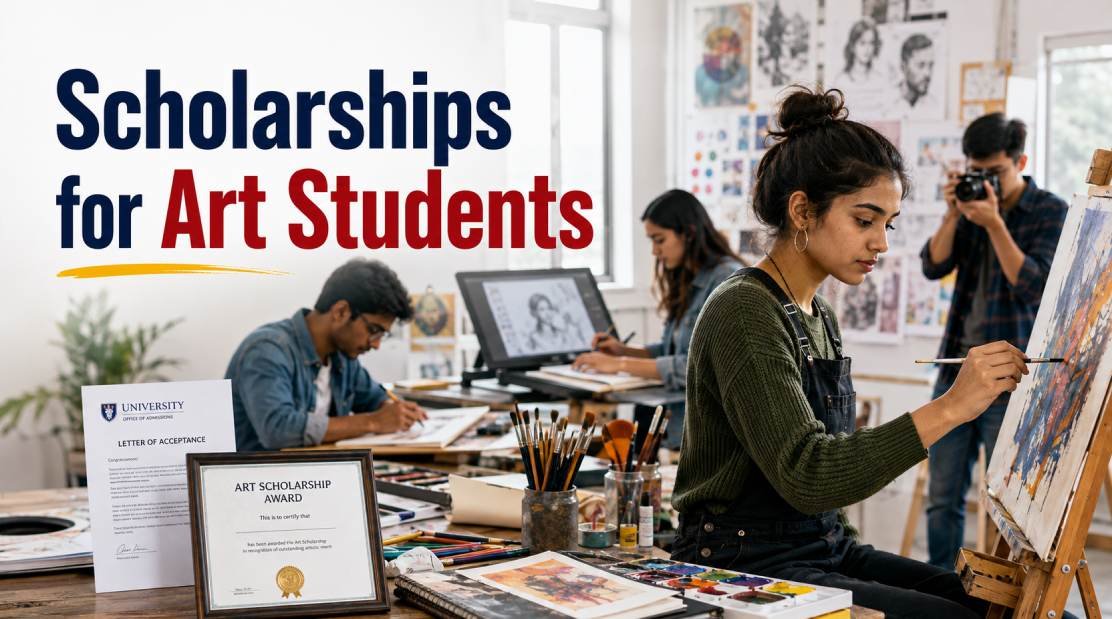
Scholarships for art students can help pay for tuition, fees, books, art supplies, living expenses, or other education costs.
Some art scholarships reward artistic talent. Others combine portfolio quality with academic merit, financial need, residency, field of study, or university admission.
Students can also find funding through art competitions, university merit scholarships, illustration awards, design scholarships, photography awards, and postgraduate study grants.
The important distinction is that not every opportunity called an “art scholarship” works in the same way.
A portfolio competition may provide a cash award. A university merit scholarship may reduce tuition automatically after admission. A postgraduate scholarship may provide a monthly living stipend instead of a one-time prize.
This guide compares current and recurring art scholarships for 2026–2027, explains who should apply, shows how art scholarship portfolios are evaluated, and provides a complete step-by-step application process.
Key fact: Always confirm the current deadline, eligibility rules, award terms, and portfolio specifications on the scholarship provider’s official website before submitting an application.
Quick Comparison of Scholarships for Art Students
| Scholarship or Program | Award | Best For | Level | Portfolio/Artwork | Current Status |
|---|---|---|---|---|---|
| YoungArts National Arts Competition | USD 250–10,000 | Visual art, photography, design, film and other arts | High school | Yes | Open |
| Scholastic Portfolio Awards | Up to USD 12,500 | Strong high school portfolios | Graduating seniors | Yes, six-work portfolio | Opens October 1, 2026 |
| Society of Illustrators Student Scholarship | More than USD 60,000 awarded collectively | Illustration, comics, animation | Undergraduate | Yes | Opens January 2027 |
| Doodle for Google | USD 10,000 for each finalist in latest cycle | K–12 artists | K–12 | One themed artwork | Latest cycle closed |
| VFW Young American Creative Patriotic Art Contest | Up to USD 15,000 | 2D visual art | Grades 9–12 | Artwork + statement | Annual/next cycle |
| DAAD Fine Art, Design, Visual Communication and Film Scholarship | Approx. USD 1,149 monthly* | International postgraduate artists | Graduate/postgraduate | Yes | Open |
| University of Washington Art Scholarships | USD 1,000–5,000 | UW art, art history and design students | Undergraduate | Depends on award | 2026–27 cycle |
| J.R. Hopes Art Scholarship at UCF | USD 3,000 | UCF art students with financial need | Undergraduate | Yes | Current cycle closed |
| Pratt Merit Scholarships | Varies | Art/design applicants | Undergraduate | Portfolio considered | Admission-based |
| SAIC Merit Scholarships | Varies | Art-school applicants | Undergraduate | Admission portfolio | Admission-based |
*DAAD officially awards EUR 992 per month. That equaled approximately USD 1,149 per month on August 30, 2026. Currency values change.
What Are Scholarships for Art Students?
An art scholarship is financial support awarded to a student based partly or entirely on artistic talent, art-related study, academic achievement, financial need, or another eligibility factor.
Art scholarships can support students studying:
- Fine art
- Painting
- Drawing
- Illustration
- Graphic design
- Photography
- Animation
- Digital art
- Sculpture
- Ceramics
- Film
- Visual communication
- Art history
- Art education
- Interdisciplinary art
- UI/UX or communication design
Students should not assume that every art scholarship requires an art major.
Some competitions reward artistic achievement regardless of the student’s intended college major. Other scholarships specifically require enrollment in a BFA, BA, MFA, design, photography, or related degree.
Art Scholarships vs Grants vs Art Competitions
These funding types overlap, but they are not identical.
Art scholarship
An art scholarship normally supports education and does not need to be repaid.
The award may depend on artistic ability, academic performance, financial need, or university admission.
Art competition
An art competition evaluates a specific artwork or portfolio.
A competition may offer scholarship money, unrestricted cash, exhibition opportunities, recognition, or several benefits together.
YoungArts and the Scholastic Art & Writing Awards are important examples.
Institutional art scholarship
An institutional scholarship comes directly from a college, university, or art school.
Students may receive consideration automatically through the admission process.
Pratt Institute, for example, states that merit scholarships for most high-school applicants consider GPA and portfolio, with no separate merit scholarship application required.
Art grant
A grant provides financial support for education, projects, research, materials, professional development, or artistic activity.
Some grants are intended for practicing artists rather than degree-seeking students.
That distinction matters when searching for funding.
Best Scholarships for Art Students in 2026–2027
1. YoungArts National Arts Competition
The YoungArts National Arts Competition is one of the strongest opportunities for talented young artists in the United States.
The 2027 competition accepts applications in ten disciplines, including Visual Arts, Design, Photography, and Film.
The 2027 application closes on October 6, 2026, at 8 p.m. Eastern Time.
YoungArts scholarship details
| Attribute | Details |
|---|---|
| Award | USD 250–10,000 |
| Deadline | October 6, 2026 |
| Status | Open |
| Age/grade | Ages 15–18 or grades 10–12 under program rules |
| Eligible location | U.S. eligibility requirements apply |
| Visual Arts portfolio | 10 images representing 8–10 works |
| Other disciplines | Design, photography, film and more |
| Selection | Multi-round discipline-specific adjudication |
| Renewability | Not a traditional renewable tuition scholarship |
All YoungArts winners receive at least USD 250. Winners with distinction may be evaluated for awards of up to USD 10,000.
Visual Arts applicants must submit 10 images representing eight to ten of their strongest works made during the previous two years. YoungArts asks applicants to demonstrate original thinking, technical rigor, execution, creative risk, and artistic voice.
Students can review the official YoungArts application requirements before preparing a portfolio.
Who should apply?
Apply if you:
- Meet YoungArts age, grade, and U.S. eligibility requirements.
- Have a developed body of recent artwork.
- Can demonstrate a distinctive artistic point of view.
- Can follow exact discipline-specific submission rules.
Who should not apply?
Do not apply if you fail the age, grade, tax-status, residency, or other eligibility conditions.
Do not submit a random collection of unrelated work simply to reach the required image count.
2. Scholastic Art & Writing Awards Portfolio Scholarships
The Scholastic Art & Writing Awards offer several scholarships for young artists.
The most significant portfolio awards provide:
- USD 12,500 to Gold Medal Portfolio winners.
- USD 2,000 to Silver Medal Portfolio winners.
Graduating seniors submit a collection of six works plus an Artist Statement and Personal Statement.
The 2027 Scholastic Awards open October 1, 2026.
Regional deadlines begin December 1, 2026 and can run as late as January 6, 2027 depending on region. National results are scheduled for March 31, 2027.
Scholarship details
| Attribute | Details |
|---|---|
| Maximum portfolio scholarship | USD 12,500 |
| Silver Medal Portfolio | USD 2,000 |
| 2027 opening date | October 1, 2026 |
| Regional deadlines | December 1, 2026–January 6, 2027, depending on region |
| Portfolio | Six works |
| Applicant stage | Graduating high school seniors for Portfolio Awards |
| Selection signals | Originality, skill, personal voice or vision |
Other Scholastic opportunities include the Herblock Award for Editorial Cartoon, which has offered USD 2,000 scholarships, and additional themed awards.
Students should consult the official Scholastic Awards calendar because the deadline depends on the applicant’s region.
What do previous winners tell us?
Scholastic’s 2026 Gold Medal Portfolio winners were selected for portfolios demonstrating originality, skill, and an emerging personal vision or voice.
Each Gold Medal Portfolio winner received USD 12,500.
That selection language provides an important lesson.
A strong art scholarship portfolio should not function only as proof of technical ability.
The portfolio should also reveal what the applicant thinks about, investigates, communicates, or repeatedly returns to as an artist.
3. Society of Illustrators Student Scholarship
The Society of Illustrators Student Scholarship Competition is particularly relevant to students interested in illustration, comics, and animation.
The organization states that its 2027 Student Scholarship will award more than USD 60,000 collectively in scholarships.
The competition is limited to undergraduate students currently enrolled in the United States and Canada.
The 2027 competition is scheduled to open in January 2027.
Scholarship details
| Attribute | Details |
|---|---|
| Total scholarship pool | More than USD 60,000 |
| Opens | January 2027 |
| Level | Undergraduate |
| Location | Students enrolled in U.S. and Canadian institutions |
| Fields | Illustration, comics and animation |
| Additional benefit | Selected works may be exhibited at the Museum of Illustration |
Review the Society of Illustrators competition portal once the 2027 submission window opens.
Best candidate
This opportunity is a particularly strong fit for an undergraduate whose portfolio focuses on visual storytelling, editorial illustration, comics, sequential art, or animation rather than traditional studio art alone.
4. Doodle for Google
Doodle for Google is an annual U.S. student art competition rather than a conventional college scholarship.
It remains relevant because it combines art, creative communication, public exposure, and education funding.
In the latest completed 2025–2026 competition, each finalist received a USD 10,000 college scholarship.
The competition is open to eligible K–12 students.
Google evaluates entries using three primary criteria:
- Artistic merit
- Creativity
- Communication of the contest theme
The official rules also prohibit AI-generated final artwork. AI may only be used within Google’s narrowly defined brainstorming rules for eligible students.
Current status
The latest U.S. competition cycle has concluded.
Students interested in the next competition should monitor the official Doodle for Google page rather than relying on an old deadline.
Who should apply?
This opportunity is best for younger artists who can communicate an idea clearly through one strong themed image.
It is not a substitute for broader portfolio-based college art scholarships.
5. VFW Young American Creative Patriotic Art Contest
The VFW Auxiliary Young American Creative Patriotic Art Contest awards scholarships to eligible high-school artists.
The first-place national award is USD 15,000.
Recent national awards have totaled USD 37,000, with multiple students receiving scholarships.
Eligibility
The competition generally accepts students in grades 9–12 enrolled in qualifying schools or home-study programs in the United States and eligible overseas schools.
Residency requirements apply.
Key restrictions
The contest has specific artistic restrictions.
The official information states that digital art and photography are not accepted for the relevant patriotic art contests.
The annual student entry deadline is March 31 under the published contest schedule.
Students should confirm the current year’s form before applying.
Award structure from the recent cycle
| Place | Scholarship |
|---|---|
| First | USD 15,000 |
| Second | USD 7,500 |
| Third | USD 3,500 |
| Fourth | USD 1,500 |
| Fifth | USD 1,500 |
| Sixth | USD 1,000 |
| Seventh | USD 1,000 |
| Eighth–Nineteenth | USD 500 each |
Applicants should use the official VFW Auxiliary patriotic art contest page to verify the next cycle.
6. DAAD Scholarship for Fine Art, Design, Visual Communication and Film
The DAAD Study Scholarship for Postgraduate Studies in Fine Art, Design, Visual Communication and Film is one of the most important options in this guide for international and postgraduate students.
The scholarship supports eligible graduates pursuing postgraduate education in Germany.
Applicants must normally hold a first university degree in the arts.
DAAD scholarship details
| Attribute | Details |
|---|---|
| Monthly funding | Approx. USD 1,149 per month* |
| Official amount | EUR 992 per month |
| Deadline | October 15, 2026 |
| Selection | April 2027 |
| Funding begins | Normally October 2027 |
| Level | Postgraduate |
| Destination | Germany |
| Fields | Fine Art, Design, Visual Communication, Film |
| Portfolio | Required in a separate submission stage |
| Other support | Travel allowance, study allowance and insurance-related support under program rules |
*Approximate USD conversion as of August 30, 2026.
DAAD requires application documents through its portal and artistic work samples through the DAAD media database after the formal application check.
Applicants should examine the official DAAD Fine Art, Design, Visual Communication and Film scholarship page carefully because nationality restrictions and eligible countries vary.
Who should apply?
This is appropriate for applicants who:
- Already hold an eligible first university degree in art.
- Want postgraduate art education in Germany.
- Meet the country-specific eligibility conditions.
- Can prepare both formal academic documents and a competitive artistic portfolio.
Who should not apply?
Undergraduate applicants should not treat this as a bachelor’s scholarship.
Applicants should also avoid assuming that every nationality is eligible without checking the DAAD country-specific requirements.
University Scholarships for Art Students
External scholarship websites are only one source of funding.
Art departments and universities frequently offer scholarships that never rank prominently for broad searches such as “art scholarships.”
This makes university-level research essential.
7. University of Washington Art Scholarships
The University of Washington School of Art + Art History + Design awards more than 30 undergraduate scholarships annually.
The school currently lists scholarships generally ranging from USD 1,000 to USD 5,000.
Incoming freshmen and transfer students may qualify for scholarships such as:
- Crabby Beach Foundation Scholarship
- Kathryn Hinckley-Martin Scholarship in Art
These opportunities target students planning to major in art, art history, or design.
The 2026–2027 incoming-student cycle listed an August 30, 2026 deadline.
The School also reported awarding USD 280,000 in scholarships during 2025–2026, including USD 117,000 to incoming students.
Students considering UW should examine the official School of Art undergraduate scholarship page.
8. J.R. Hopes Art Scholarship at UCF
The J.R. Hopes Art Scholarship demonstrates how specialized university art funding can work.
For 2026–2027, three University of Central Florida students received USD 3,000 each.
Eligibility includes
Applicants must:
- Demonstrate financial need through FAFSA.
- Be full-time undergraduate students in an eligible UCF art-related program.
- Maintain at least a 3.0 overall GPA.
- Meet the specific artistic-category requirements.
The scholarship can support tuition, textbooks, fees, and other eligible components of an art education.
The 2026 deadline was March 13, 2026, so that cycle is closed.
Students can monitor the official J.R. Hopes Art Scholarship page for the following cycle.
9. Pratt Institute Merit Scholarships
Pratt Institute provides an important example of an admission-based art scholarship.
A student does not necessarily complete a separate scholarship application.
Pratt states that merit scholarships for high-school applicants are generally based on GPA and portfolio for programs requiring a portfolio.
Transfer scholarships consider the student’s college GPA and portfolio.
Pratt also offers additional awards to qualified Scholastic Art Awards recipients.
Pratt National Scholastic Scholarships
Pratt currently lists:
- Gold Portfolio Award recipients in General Art or Photography: USD 3,000 per year for four years
- Silver Portfolio Award recipients: USD 2,000 per year for four years
- Individual Gold Award recipients: USD 1,000 per year for four years
These can be awarded in addition to other Pratt merit scholarships under the institution’s rules.
Pratt undergraduate merit recipients generally need to maintain a 2.5 GPA for scholarship renewal.
International students are also eligible for Pratt international merit scholarships and are automatically considered after admission.
Students can review the official Pratt scholarship information before applying.
10. SAIC Merit Scholarships
The School of the Art Institute of Chicago illustrates why an admission portfolio can have direct financial consequences.
SAIC states that the portfolio submitted for undergraduate admission is also evaluated for merit scholarship consideration.
BFA Studio applicants normally submit 10–15 pieces of their best and most recent work.
SAIC allows portfolios to include media such as:
- Drawing
- Painting
- Prints
- Photography
- Film
- Video
- Sculpture
- Ceramics
- Fashion
- Graphic design
- Furniture
- Architecture
- Websites
- Video games
- Sketchbooks
- Storyboards
- Zines
The institution encourages applicants to experiment, take creative risks, communicate personal interests, and consider thematic relationships among works.
Students should follow the official SAIC undergraduate portfolio requirements.
The key lesson is simple.
Your college-admission portfolio may also function as your scholarship portfolio.
Art Scholarships by Field
Students should search by artistic discipline instead of using only the general phrase “art scholarships.”
Fine art scholarships
Use terms such as:
- Fine arts scholarships
- Painting scholarships
- Drawing scholarships
- Studio art scholarships
- BFA scholarships
Portfolio reviewers may prioritize technical control, conceptual development, composition, experimentation, and artistic voice.
Illustration scholarships
Search:
- Illustration scholarships
- Editorial illustration scholarships
- Children’s illustration awards
- Comic art scholarships
- Sequential art scholarships
The Society of Illustrators is especially relevant in this category.
Graphic design scholarships
Search:
- Graphic design scholarships
- Communication design scholarships
- Visual communication scholarships
- Typography scholarships
- Design merit scholarships
YoungArts includes Graphic Design within its Design discipline.
Digital art scholarships
Digital artists should search beyond the phrase “digital art scholarship.”
Relevant terms include:
- Digital media scholarships
- Emerging media scholarships
- New media scholarships
- Interactive design scholarships
- Game art scholarships
Always inspect the rules.
Some art competitions explicitly prohibit digital art even when broader art scholarships accept it.
Animation scholarships
Animation students should search:
- Animation scholarships
- Character animation scholarships
- Motion design scholarships
- Illustration and animation scholarships
- Film and animation funding
The Society of Illustrators Student Scholarship specifically includes animation among its relevant fields.
Photography scholarships
Photography students can investigate:
- Photography scholarships
- Photo/media scholarships
- Visual journalism awards
- Fine-art photography scholarships
YoungArts has a separate Photography discipline and asks applicants to present a unified series or series-based portfolio.
Sculpture and ceramics scholarships
Students working in three-dimensional media should search:
- Sculpture scholarships
- Ceramics scholarships
- 3D art scholarships
- Craft scholarships
- Studio art scholarships
University art departments can be particularly valuable because many departmental awards target specific concentrations.
Scholarships for Art Students by Education Level
Art scholarships for high school students
High-school students have access to some of the largest nationally recognized art competitions.
Strong options include:
- YoungArts
- Scholastic Art & Writing Awards
- Doodle for Google for eligible K–12 students
- VFW Young American Creative Patriotic Art Contest
Students should begin researching during grades 10 and 11 instead of waiting until the final semester of grade 12.
Art scholarships for undergraduate students
Undergraduate students should search four sources:
- Their university.
- Their art department.
- Professional arts organizations.
- External scholarship providers.
The Society of Illustrators and university awards such as UCF and UW demonstrate why institutional and professional-organization searches matter.
Art scholarships for transfer students
Transfer students should examine institutional merit policies carefully.
Pratt bases transfer merit consideration on portfolio and college GPA.
The University of Washington also lists scholarship opportunities for eligible incoming transfer students intending to major in art, art history, or design.
Art scholarships for graduate students
Graduate artists should search for:
- MFA scholarships
- Graduate assistantships
- Fellowships
- Department scholarships
- International postgraduate scholarships
- Research and project grants
DAAD provides a particularly important international pathway for eligible postgraduate artists studying in Germany.
Art Scholarships for International Students
International students face a different scholarship landscape.
A scholarship may have three separate geographic rules:
- Citizenship eligibility
- Current country of study
- Country where funded education takes place
These are not interchangeable.
For example, the DAAD art scholarship supports eligible postgraduate students studying in Germany but restricts eligibility according to its published country rules.
Pratt, by contrast, states that international students can receive institutional merit scholarships and are automatically considered upon acceptance.
International art students should search:
- International art scholarships
- Fine art scholarships for international students
- Design scholarships for international students
- MFA scholarships abroad
- Art study abroad scholarships
- Government scholarships for artists
- University international merit scholarships
Do not assume that a scholarship is open internationally because the application form is accessible online.
Read the citizenship and residency rules first.
Who Should Apply for Art Scholarships?
Students should apply when they meet the scholarship’s eligibility requirements and can provide credible evidence of the qualities the funder evaluates.
You should apply if you have a strong portfolio
A strong portfolio does not require every artwork to look identical.
It should demonstrate deliberate selection.
The reviewer should understand your technical ability, interests, ideas, development, or artistic voice.
You should apply if you have a developing artistic voice
Technical perfection is not the only selection factor.
YoungArts explicitly considers artistic thinking and personal voice.
Scholastic identifies originality, skill, and personal vision as important judging signals.
You should apply if you match a niche
Niche scholarships can be more strategically relevant than broad national awards.
Examples include scholarships limited by:
- Artistic medium
- University
- State
- Academic major
- Career goal
- Financial need
- Grade level
- Geographic area
The smaller eligible population can create a better opportunity than an unrestricted national competition.
You should apply even if the award is relatively small
A USD 1,000 scholarship can still reduce textbook, material, studio, software, or transportation expenses.
Multiple smaller scholarships can also be combined when school and scholarship policies allow.
Who Should Not Apply for an Art Scholarship?
Students should not apply blindly to every art-related opportunity.
Do not apply if you fail a mandatory eligibility rule
Do not apply when the scholarship requires a residency status, academic level, university, art major, or age group that you do not satisfy.
Selection committees cannot normally waive core eligibility requirements.
Do not apply if your medium is prohibited
A digital artist should not submit digital work to a competition that prohibits digital art.
A photographer should not submit photography where photography is excluded.
Read the medium rules before investing time in an application.
Do not apply after a final deadline
Some scholarships accept no late materials.
A beautiful portfolio cannot correct a late submission.
Do not apply using artwork you cannot legitimately claim as your own
Scholarships increasingly specify originality and intellectual-property standards.
Never misrepresent:
- Another person’s artwork
- AI-generated artwork
- Collaborative work
- Commercial assets
- Traced copyrighted imagery
- Uncredited source material
unless the competition explicitly permits the relevant use and you disclose it correctly.
Do not reject yourself simply because you are not an art major
This is equally important.
Some opportunities require an art-related degree.
Others do not.
A student studying engineering, business, medicine, or another subject may still qualify for an independent art competition.
Determine eligibility from the official rules rather than the scholarship’s name.
What Documents Do You Need for an Art Scholarship?
The exact requirements vary.
Most applications use some combination of the following materials.
| Document | Purpose | Common Mistake |
|---|---|---|
| Application form | Establishes applicant information and eligibility | Leaving required fields incomplete |
| Portfolio | Demonstrates artistic ability and voice | Ignoring portfolio specifications |
| Artist statement | Explains ideas, process or body of work | Describing only materials |
| Personal statement | Explains applicant background and goals | Repeating the résumé |
| Essay | Responds to scholarship-specific prompt | Recycling an unrelated essay |
| Transcript | Shows academic performance | Uploading unofficial records when official records are required |
| Recommendation | Provides third-party evaluation | Asking recommender too late |
| FAFSA information | Establishes financial data for some U.S. awards | Assuming every scholarship requires FAFSA |
| Enrollment verification | Confirms student status | Submitting an outdated record |
| Residency documents | Confirms geographic eligibility | Ignoring nationality restrictions |
| Artwork captions | Provides title, medium, date and dimensions | Missing or inconsistent information |
Art portfolio
The portfolio is the core evidence for many talent-based scholarships.
Follow the provider’s rules before applying general portfolio advice.
YoungArts Visual Arts requires 10 images.
SAIC generally asks BFA applicants for 10–15 works.
Scholastic Portfolio Awards use six works.
There is no universal “correct” portfolio length.
Artist statement
An artist statement explains the thinking behind the work.
A strong statement can answer:
- What do you investigate?
- Why do you make this work?
- What ideas connect the pieces?
- Why did you choose these materials?
- How has your practice developed?
- What should the viewer understand?
Do not turn the artist statement into a list of techniques.
Transcript
Academic scholarships and university merit awards may consider grades.
A portfolio can be strong while an applicant still becomes ineligible because the GPA falls below the program’s minimum.
FAFSA
FAFSA is relevant primarily to U.S. financial aid.
Submitting the FAFSA gives eligible students access to federal financial aid, and states, colleges, and some private aid providers also use FAFSA information when determining aid eligibility.
Use the official Federal Student Aid FAFSA guidance rather than paying a third party to complete a FAFSA application.
How to Build an Art Scholarship Portfolio
The best scholarship portfolio is not necessarily the portfolio with the most artwork.
It is the portfolio that provides the clearest evidence that you satisfy the scholarship’s selection criteria.
1. Read the portfolio rules before choosing artwork
Start with:
- Required number of works
- Required number of images
- Accepted file formats
- File-size limits
- Allowed media
- Date restrictions
- Video length
- Image dimensions
- Naming conventions
- Whether identifying information is permitted
Missing one technical requirement can make the rest of the portfolio irrelevant.
2. Select your strongest work
Do not include weak work simply because you want to demonstrate variety.
Ten consistently strong pieces usually communicate more than ten strong pieces plus five weak pieces.
3. Show artistic voice
Artistic voice is the recognizable combination of the artist’s:
- Ideas
- Questions
- Subject matter
- Visual decisions
- Processes
- Perspective
Voice does not require one color palette or one medium.
It requires evidence of deliberate artistic thinking.
4. Show technical competence
Concept and technical execution support each other.
Reviewers should see that you can control the medium sufficiently to communicate the intended result.
5. Build relationships between works
A portfolio should feel curated.
Ask:
- Why does Piece 2 follow Piece 1?
- What connects these works?
- Is there unnecessary repetition?
- Does the final piece leave a strong impression?
- Does the sequence show development?
SAIC specifically advises applicants to think about the portfolio like a curated gallery exhibition.
Portfolio Priorities by Art Discipline
| Discipline | What to Demonstrate |
|---|---|
| Fine art | Concept, composition, observation, experimentation, material control |
| Illustration | Storytelling, visual communication, originality, composition |
| Graphic design | Typography, hierarchy, layout, problem-solving, communication |
| Photography | Point of view, series cohesion, light, framing, editing |
| Animation | Movement, storytelling, timing, design, process where permitted |
| Sculpture | Form, material understanding, space, scale, documentation |
| Digital art | Technical execution, originality, concept, process |
| Ceramics | Form, surface, construction, material understanding |
The scholarship’s published criteria always override this table.
How to Photograph Artwork for a Scholarship Portfolio
Poor documentation can weaken strong physical work.
Use:
- Even lighting
- A neutral background
- Straight camera alignment
- High-resolution images
- Correct white balance
- Minimal distractions
Avoid:
- Heavy filters
- Reflections
- Visible clutter
- Extreme perspective distortion
- Cropped artwork edges
- Artificial sharpening
For sculpture and installation work, provide additional angles only when the application permits them.
Step-by-Step Guide to Applying for Art Scholarships
Step 1: Define your applicant profile
Write down:
- Age
- Grade
- Degree level
- Country
- State or province
- University
- Major
- GPA
- Art discipline
- Financial-need status
- Citizenship or residency
- Graduation year
This prevents wasted applications.
Step 2: Search broadly
Search national scholarship programs, but also investigate:
- Art departments
- Financial-aid offices
- Community foundations
- Professional art organizations
- Museums
- Employers
- Local businesses
- Cultural organizations
- State agencies
Federal Student Aid specifically recommends colleges, community organizations, local businesses, community foundations, state agencies, and organizations connected with a student’s interests.
Step 3: Create an eligibility filter
Before reading application instructions, answer:
Am I definitely eligible?
Check the non-negotiable rules first.
Step 4: Verify the scholarship on the official website
Scholarship databases are discovery tools.
The funder’s official website is the source of truth for:
- Deadline
- Award
- Eligibility
- Application method
- Documents
- Portfolio specifications
Step 5: Create a deadline tracker
Track:
| Scholarship | Deadline | Portfolio | Essay | Recommendation | Status |
|---|
Set an internal deadline several days before the official deadline.
Step 6: Build a master portfolio
Create an organized library of your strongest work.
Store:
- High-resolution images
- Web-sized images
- Artwork titles
- Dimensions
- Media
- Completion dates
- Descriptions
- Process images where relevant
Step 7: Customize the portfolio
Do not automatically send the same portfolio to every program.
An illustration scholarship may require different evidence than a fine-art scholarship.
A photography competition may value a coherent series.
A design competition may prioritize communication and problem-solving.
Step 8: Prepare the artist statement
Write a master statement.
Then adapt it to the application’s requested word count and question.
Step 9: Prepare scholarship essays
Answer the actual prompt.
Use concrete details.
Explain the relationship between your art practice, education, goals, and the scholarship where relevant.
Step 10: Request recommendations early
Give recommenders:
- Your résumé
- Portfolio link
- Scholarship description
- Deadline
- Submission instructions
- Relevant achievements
A recommendation improves when the recommender understands what the scholarship evaluates.
Step 11: Complete financial-aid documents
Submit FAFSA when required or relevant to your U.S. college funding strategy.
FAFSA is free.
Step 12: Complete the application
Enter information consistently.
Your dates, education history, residency information, and artistic details should agree across documents.
Step 13: Run a compliance check
Before submitting, verify:
- Eligibility
- Deadline
- Time zone
- Portfolio count
- File format
- Word count
- Signatures
- Recommendation status
- Transcript
- Artwork labels
- Working URLs
Step 14: Submit before deadline day
Technical failures are common near deadlines.
YoungArts explicitly recommends submitting before deadline day rather than waiting until the final hours.
Step 15: Save evidence of submission
Keep:
- Confirmation email
- Application PDF
- Submitted portfolio
- Essay copy
- Reference number
- Screenshot where appropriate
You may need these materials later.
How Are Art Scholarship Winners Selected?
Selection depends on the scholarship.
Talent-based competitions often prioritize artistic evidence.
Need-based institutional scholarships may combine portfolio review with financial data.
Artistic merit
Artistic merit describes the quality and effectiveness of the submitted work.
It can include technique, composition, visual communication, process, and execution.
Originality
Reviewers want evidence that the applicant contributes an individual perspective.
Originality does not require inventing a completely new art medium.
It means avoiding derivative work and demonstrating independent choices.
Artistic voice
Artistic voice helps a reviewer understand the artist behind the portfolio.
Scholastic’s judging language emphasizes the emergence of a personal voice or vision.
Technical skill
Technical control supports artistic intention.
The required skill differs by medium.
A photographer is not judged by the same technical indicators as a ceramic artist.
Communication
Some competitions assess how clearly the artwork communicates a specific theme.
Doodle for Google explicitly considers theme communication alongside creativity and artistic merit.
Academic merit
Institutional scholarships may consider:
- GPA
- Transcript
- Academic rigor
- Academic progress
Pratt explicitly uses GPA and portfolio in relevant undergraduate merit decisions.
Financial need
Some scholarships require financial need.
The UCF J.R. Hopes Scholarship uses FAFSA information as part of the eligibility framework.
Common Mistakes Art Scholarship Applicants Make
1. Applying without checking eligibility
This is the most preventable mistake.
Check eligibility before doing time-intensive work.
2. Using one portfolio for every scholarship
A master portfolio is useful.
An identical submission is not always strategic.
Select the works that best answer each opportunity.
3. Ignoring submission specifications
Wrong file types, oversized files, broken links, or too many works can create problems.
Follow instructions exactly.
4. Submitting too many weak artworks
More work does not automatically mean more evidence.
Weak work can lower the perceived quality of the overall portfolio.
5. Showing technique without ideas
Technical ability is valuable.
Strong competitive portfolios often add personal inquiry, storytelling, experimentation, or conceptual coherence.
6. Writing a generic artist statement
Avoid vague statements such as:
“Art has always been my passion.”
Explain what you make, why you make it, and what connects the work.
7. Missing the deadline’s time zone
A deadline may use:
- Eastern Time
- Pacific Time
- Central European Time
- Local university time
Record the time zone.
8. Using unofficial deadline information
Old scholarship articles remain indexed for years.
Verify the deadline on the provider’s official website.
9. Ignoring originality and AI policies
Do not assume every scholarship treats AI-assisted work the same way.
Google currently prohibits AI-generated Doodle submissions, while art schools may have their own responsible-use policies.
10. Paying unnecessary scholarship-search fees
Students do not need to pay to search for scholarships or federal financial aid.
Federal Student Aid specifically warns applicants to verify legitimacy and avoid scholarship scams.
Use the official Federal Student Aid scholarship guidance when evaluating suspicious opportunities.
Previous Years’ Art Scholarship Trends
Historical results reveal several useful patterns.
Portfolio voice matters alongside technique
Recent Scholastic Portfolio Award criteria emphasize originality, skill, and personal voice or vision.
YoungArts similarly evaluates technique together with artistic thinking and point of view.
The consistent signal is important.
Students should not build portfolios that resemble technical exercises alone.
Major art competitions attract substantial competition
YoungArts received more than 9,000 applications for its 2024 competition, with 660 artists receiving recognition that year.
Its 2025 competition drew nearly 11,000 applications across ten disciplines.
Applicants should therefore treat large national competitions as reach opportunities rather than their entire scholarship strategy.
University scholarships represent significant funding
University-level art scholarships are often underrepresented in general scholarship lists.
The University of Washington School of Art + Art History + Design reported USD 280,000 in scholarships for 2025–2026, including USD 117,000 for incoming students.
That demonstrates why students should search individual department websites.
Niche competitions remain valuable
The recent VFW competition received more than 2,500 entries and distributed USD 37,000 in national scholarships.
The Society of Illustrators plans to award more than USD 60,000 collectively in its 2027 Student Scholarship competition.
The implication is clear.
“Art scholarship” should be the beginning of the search, not the final search term.
Our Research Notes: What Art Students Should Know
Our review of current scholarship pages reveals several patterns that students can use strategically.
1. “Art scholarship” describes several different funding models
The search results combine:
- Scholarships
- Portfolio competitions
- Art contests
- Institutional merit awards
- Postgraduate grants
Students should identify the funding model before comparing award amounts.
2. Eligibility matching should happen before portfolio preparation
Do not spend six hours customizing a portfolio before discovering that the award excludes your nationality, university, major, age, or art medium.
Run eligibility first.
3. Portfolio rules vary dramatically
There is no universal scholarship portfolio.
Current examples include:
- YoungArts Visual Arts: 10 images representing 8–10 works.
- Scholastic Portfolio Awards: six works.
- SAIC admission/merit portfolio: generally 10–15 works.
The correct portfolio length is whatever the scholarship requires.
4. Institutional funding is easy to overlook
A student searching only national scholarship databases can miss university funding.
Search your intended university using combinations such as:
[university] + art scholarships
[university] + BFA scholarships
[university] + design merit scholarship
[university] + school of art financial aid
5. Large awards are not always the best applications
A USD 15,000 award with thousands of eligible applicants may be less strategically attractive than a USD 3,000 departmental award limited to a small group of qualifying students.
Consider both award size and applicant fit.
6. Previous deadlines are useful—but not authoritative
Many scholarships operate annually.
Last year’s deadline can help predict when the next cycle may open.
It should never replace the current official deadline.
7. Students should build a scholarship portfolio system
Instead of creating every application from zero, maintain a reusable scholarship library containing:
- 15–25 documented artworks
- Master artist statement
- Short bio
- Résumé
- Transcript
- Recommendation contacts
- Financial-aid documents
- Awards list
- Portfolio captions
- Personal statement
- High-resolution images
Then customize the required subset for each opportunity.
A Better Way to Prioritize Art Scholarships
Students can evaluate each opportunity using six factors.
Scholarship Priority Framework
Give each factor a score from 1 to 5:
| Factor | Question |
|---|---|
| Eligibility match | Do I clearly meet every requirement? |
| Portfolio match | Does my current work fit the selection criteria? |
| Award value | Is the funding meaningful for my education costs? |
| Competition fit | Does my artistic style or discipline match? |
| Application effort | How much new work is required? |
| Deadline feasibility | Can I submit excellent materials on time? |
Prioritize opportunities with strong eligibility and portfolio alignment.
Do not rank scholarships by award amount alone.
How to Find More Scholarships for Art Students
A complete scholarship strategy uses multiple discovery channels.
Search your college financial-aid office
Federal Student Aid recommends checking the financial-aid office because colleges frequently maintain institutional scholarship opportunities.
Search the art department separately
The department may administer scholarships that never appear prominently on the central financial-aid page.
Search:
- School of Art scholarships
- Department of Design scholarships
- Photography scholarships
- Art history awards
- Studio art funding
Search community foundations
Local scholarships may attract smaller applicant pools than national awards.
Federal Student Aid specifically notes the potential advantage of community and local scholarship sources.
Search professional organizations
Look for organizations associated with:
- Illustration
- Graphic design
- Photography
- Ceramics
- Animation
- Architecture
- Film
- Art education
- Museum studies
Search by medium
“Scholarships for artists” is broad.
“Undergraduate illustration scholarship” has clearer entity matching.
Combine art with another eligibility attribute
Examples:
- Art scholarships for women
- Art scholarships for first-generation students
- Art scholarships for international students
- Art scholarships for transfer students
- Art scholarships in California
- Art scholarships for students with financial need
This narrows the applicant pool.
Can You Combine Art Scholarships With Financial Aid?
Often, yes, but institutional rules matter.
Students may receive a financial-aid package containing several forms of assistance, including:
- Scholarships
- Grants
- Federal aid
- Work-study
- Loans
- Institutional funding
Federal Student Aid describes the financial-aid offer as the combination of aid a school provides to an eligible student.
However, an outside scholarship can affect an existing institutional aid package.
Pratt, for example, tells students that outside awards must be reported and may change the original institutional financial-aid package.
Therefore: Before assuming that two scholarships will stack, ask the university’s financial-aid office how outside scholarships are treated.
Art Scholarship Application Checklist
Use this checklist before every submission.
- I meet every eligibility requirement.
- I verified the deadline on the official website.
- I checked the deadline time zone.
- I submitted the correct number of portfolio works.
- Every artwork uses an accepted format.
- Images are clear and correctly oriented.
- Artwork captions are complete.
- My artist statement answers the requested prompt.
- My essay meets the word limit.
- My transcript is the required type.
- Recommendations have been submitted.
- Financial documents are complete where required.
- Portfolio links work without requesting permission.
- My application uses accurate contact information.
- I reviewed originality and AI rules.
- I saved a copy of the completed application.
- I received submission confirmation.
Frequently Asked Questions About Scholarships for Art Students
What scholarships are available for art students?
Art students can apply for talent-based competitions, university merit scholarships, need-based awards, illustration competitions, design scholarships, photography awards, and postgraduate grants. Current examples include YoungArts, Scholastic Portfolio Awards, Society of Illustrators scholarships, university art scholarships, Pratt merit aid, SAIC merit consideration, and DAAD postgraduate art funding.
Can you get a scholarship for being good at art?
Yes. Many scholarships evaluate artistic talent through a portfolio, individual artwork, audition, or competition submission. Artistic ability may be the primary criterion or one part of a broader evaluation involving GPA, financial need, residency, or academic major. Always check whether the award requires enrollment in an art-related degree.
Do art scholarships require a portfolio?
Many talent-based art scholarships require a portfolio, but not every scholarship does. Portfolio requirements also differ significantly. YoungArts Visual Arts currently requires 10 images representing 8–10 works, while Scholastic senior portfolios contain six works. University merit programs may use the same portfolio submitted for college admission.
What should an art scholarship portfolio include?
An art scholarship portfolio should include the strongest work that matches the provider’s rules and selection criteria. Prioritize technical quality, artistic voice, originality, conceptual development, and appropriate variety. Include accurate titles, media, dimensions, and dates when requested. Do not add weak work merely to demonstrate additional techniques.
How many pieces should be in an art scholarship portfolio?
There is no universal number. The scholarship provider determines the correct portfolio length. Current requirements range considerably: Scholastic Portfolio Awards use six works, YoungArts Visual Arts reviews 10 images representing 8–10 works, and SAIC generally asks undergraduate BFA applicants for 10–15 pieces.
What GPA do you need for an art scholarship?
The GPA requirement depends on the scholarship. Some national art competitions focus primarily on artistic work and have no traditional college GPA threshold. University scholarships may impose academic requirements. UCF’s J.R. Hopes Art Scholarship requires a 3.0 overall GPA, while Pratt merit recipients generally maintain at least a 2.5 GPA for renewal.
Can you get a full-ride scholarship for art?
Full-tuition or high-value art scholarships exist, especially through universities, but not every portfolio award covers the complete cost of attendance. Students seeking full funding should investigate institutional merit scholarships alongside external awards. Compare tuition, fees, housing, supplies, renewal conditions, and total scholarship value rather than focusing on the headline award alone.
Are there art scholarships for international students?
Yes. International art students can find government scholarships, university merit awards, study-abroad scholarships, and postgraduate programs. DAAD offers eligible international graduates funding for postgraduate study in Fine Art, Design, Visual Communication and Film in Germany. Pratt also states that international applicants are considered automatically for institutional merit scholarships.
Can I get an art scholarship if I am not majoring in art?
Yes, depending on the opportunity. Some art competitions reward artistic talent without requiring the winner to major in art in college. Other awards specifically require enrollment in an art, design, photography, or related degree. Read the major requirement before excluding yourself or spending time on an application.
Are there scholarships for digital art and animation students?
Yes. Digital artists should search terms such as digital media scholarships, animation scholarships, new media scholarships, illustration scholarships, and emerging-media awards. The Society of Illustrators Student Scholarship includes animation. However, some traditional competitions prohibit digital work, so students must verify accepted media before submitting artwork.
Can transfer students receive art scholarships?
Yes. Some institutions specifically consider transfer students for art scholarships. Pratt bases transfer merit scholarship decisions on portfolio quality and college GPA. The University of Washington also lists incoming scholarships for eligible freshmen and transfer students intending to study art, art history, or design.
Do art scholarships cover art supplies?
Some do, but coverage varies. A scholarship may be restricted to tuition or may support broader educational expenses. UCF states that its J.R. Hopes Art Scholarship may be used for tuition, textbooks, fees, and other qualifying art-education costs. Always read the award’s disbursement and permitted-use terms.
Can art scholarships be combined with FAFSA financial aid?
Often, but the university determines how outside scholarships interact with an existing financial-aid package. FAFSA itself is an application used to establish eligibility for federal and other forms of aid. Students receiving external scholarships should report them when required and ask the school’s financial-aid office whether other institutional aid will change.
How are art scholarship portfolios judged?
Portfolios may be judged for technical skill, originality, artistic voice, concept, communication, experimentation, and overall cohesion. Criteria vary by organization. Scholastic emphasizes originality, skill, and personal vision, while YoungArts considers factors including technical rigor, artistic thinking, execution, risk, and personal voice in Visual Arts submissions.
Is an artist statement required for art scholarships?
Not always, but artist statements are common in portfolio-based applications. An effective statement explains the applicant’s ideas, process, artistic questions, materials, and relationship among works. Students should answer the exact prompt rather than submitting one unchanged generic statement to every scholarship provider.
When should students start applying for art scholarships?
Students should begin searching as early as possible and maintain a year-round scholarship calendar. Federal Student Aid advises students not to wait because many opportunities have early deadlines. High-school artists should ideally develop portfolio documentation before senior year so they can respond quickly when major competitions open.
Where can I find local art scholarships?
Start with community foundations, local arts councils, museums, school counselors, civic organizations, universities, cultural organizations, local businesses, and professional art groups. Federal Student Aid notes that local scholarships can have smaller applicant pools, which can make them strategically useful alongside major national competitions.
Can I reuse the same art portfolio for different scholarships?
You can maintain one master portfolio, but you should customize the submitted portfolio whenever the rules permit. Different scholarships value different disciplines, concepts, formats, and selection criteria. Select the subset of work that best matches each opportunity rather than automatically sending identical pieces in identical order.
Final Takeaway
Scholarships for art students are available through national competitions, universities, professional organizations, international programs, and local institutions.
The strongest strategy is not to apply to the largest number of scholarships.
The strongest strategy is to identify opportunities where your eligibility, artistic discipline, portfolio, education level, and goals align closely with the funder’s criteria.
Start with currently actionable opportunities such as YoungArts and DAAD where eligible. Prepare now for upcoming cycles such as the Scholastic Art & Writing Awards and Society of Illustrators Student Scholarship.
At the same time, search every university on your list for institutional art and design funding.
A strong scholarship application combines three things:
Eligibility accuracy + portfolio quality + application compliance.
Students who build those three elements early can pursue art funding more efficiently and avoid wasting time on scholarships that do not match their profile.

You may like

Check Student Scholarship Status Online: SSP Karnataka Application and Payment Status

Government Scholarship for College Students 2022 in India: Eligibility, Amount, and Application Guide

Digital Gujarat Scholarship for OBC Students 2026 to 27: Eligibility, Amount, Last Date and Application Guide

Turkey Burslari Scholarship 2026: Eligibility, Benefits, Deadline, Interview, and Results

SBI Asha Scholarship 2026-27: Eligibility, Amount, Last Date and Apply Online

Scholarship for J&K Students: Eligibility, Amount, Deadlines, and How to Apply
Trending
-
 Scholarships2 months ago
Turkey Burslari Scholarship 2026: Eligibility, Benefits, Deadline, Interview, and Results
-
 Scholarships1 month ago
SBI Asha Scholarship 2026-27: Eligibility, Amount, Last Date and Apply Online
-
 Scholarships2 months ago
Scholarship for J&K Students: Eligibility, Amount, Deadlines, and How to Apply
-
 By Country2 months ago
Korean Government Scholarship for Indian Students: GKS Eligibility, Benefits, Deadlines and Application
-

 Scholarships1 month ago
Scholarships for PG Students in Kerala 2026: Eligibility, Amounts, Deadlines and Application Links
-
 By Country2 months ago
Scholarship for MBBS Students in India
-

 Scholarships1 month ago
West Bengal Student Scholarship 2026-27: Eligibility, Amounts, Last Dates and Apply Online
-
 Scholarships2 months ago
Abdul Kalam Scholarship for Class 10 Students: Verified Programs, Eligibility and Application Guide