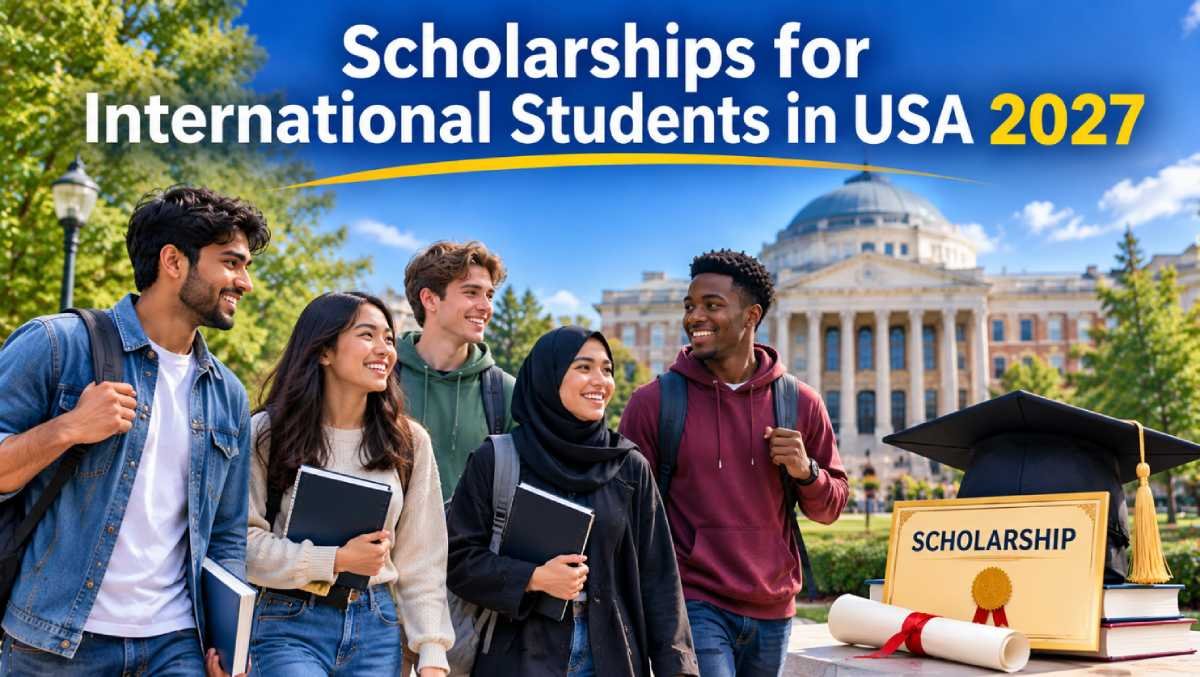
Scholarships for international students in the USA are financial awards that help non-US citizens pay for study at American institutions. Four types of funders issue them: the US government, universities, private foundations, and home-country sponsors. The term “2027” usually means Fall 2027 entry (August to September 2027) or academic year 2027-28. This guide uses Fall 2027 entry as its base.
Quick facts:
Fully funded awards exist, but they are rare and highly competitive.
FAFSA federal aid is generally not available to international students.
Undergraduate aid comes mainly from universities. Master’s funding comes from Fulbright and departments. PhD funding comes mainly from assistantships and tuition waivers.
Most Fulbright Foreign Student 2027-28 country deadlines closed between April and August 2026.
MIT’s published cost of attendance for 2026-27 is USD 92,760.
What Are Scholarships for International Students in the USA?
Short answer: They are grants, fellowships, tuition waivers, and assistantships that reduce or cover study costs for non-US citizens.
International students cannot use federal aid in most cases. Funding therefore comes from institutions and programs that accept non-citizens. The table below maps each funding type.
Funding type
Typical funder
Typical level
What it often covers
Best suited to
Government scholarship
US Department of State (Fulbright, Global UGRAD, Humphrey)
Master’s, PhD, exchange
Tuition, stipend, insurance, airfare (varies by program)
Applicants from eligible countries with leadership records
Need-based institutional aid
Need-blind and other universities
Undergraduate
Grants that fill the gap between cost and family contribution
Students with documented financial need
University merit scholarship
Individual universities
Undergraduate, Master’s
Partial or full tuition
High academic achievers
Graduate assistantship
Academic departments
Master’s, PhD
Tuition waiver plus stipend for research or teaching work
Research-oriented graduate applicants
Private foundation fellowship
Foundations and associations
Graduate
Varies widely
Applicants matching a specific mission or field
“Fully funded” and “full tuition” are different terms. A fully funded award typically covers tuition plus living costs. A full-tuition award covers tuition only, so living costs remain your responsibility.
USA Scholarship Deadline Calendar for 2027 Entry (as of October 31, 2026)
Short answer: Most government routes for 2027-28 have closed. University deadlines for Fall 2027 mostly fall between November 2026 and February 2027.
Each Fulbright country program sets its own deadline, so no single global date exists. Deadlines I reviewed included April 8, 2026 in South Africa, April 20, 2026 in Kenya, April 30, 2026 in the Philippines, and August 6, 2026 in Bosnia and Herzegovina. A few programs run later. The Greek PhD track, for example, closes on November 15, 2026.
Route
Typical deadline window
Status on Oct 31, 2026
Action
Fulbright Foreign Student Program 2027-28
Set per country, mostly April to August 2026
Closed in most countries
Check your country’s Fulbright page for late tracks and next cycle
Undergraduate early rounds
Typically early to mid November
Closing or closed
Check each university’s calendar today
Undergraduate regular decision
Typically early to mid January 2027
Upcoming
Finish essays, tests, and aid forms
Master’s and PhD programs
Typically December 2026 to February 2027
Upcoming
Confirm each department’s funding deadline
Global UGRAD (eligible countries only)
Mid-December in recent cycles
Upcoming for some countries
Confirm with your US Embassy
Dates change every year. Confirm each date on the official program page before you plan around it.
Best Scholarships for International Students in the USA 2027
Short answer: The best option depends on your level of study. Undergraduates look first at need-blind universities, Master’s applicants at Fulbright and departmental funding, and PhD applicants at funded admission offers.
Undergraduate Scholarships
International undergraduates find the most reliable aid at need-blind universities. A need-blind university decides admission without considering your ability to pay. It then funds admitted students according to demonstrated need.
University
Need-blind for international applicants
Aid structure
Harvard University
Yes
Need-based grants, no loans
Princeton University
Yes
Need-based grants, no loans
Yale University
Yes
Need-based aid
Massachusetts Institute of Technology (MIT)
Yes
Need-based aid, meets demonstrated need
Amherst College
Yes
Need-based aid
Dartmouth College
Yes
Need-based aid
Bowdoin College
Yes
Need-based aid
Sources disagree on the exact count of need-blind universities. Some 2026 lists add Notre Dame, Brown (for the Class of 2029 onward), and Washington and Lee. Verify each policy on the university’s official financial aid page.
Three facts shape your strategy at these schools:
Need-blind schools mostly award need-based aid only, not merit scholarships.
Admit rates at these schools are typically in the single digits.
Published costs are high. MIT lists USD 92,760 for 2026-27, Harvard lists about USD 91,634, and Dartmouth lists about USD 98,946.
Need-aware universities may consider your ability to pay during admission. Many of them offer merit scholarships instead. A balanced list therefore includes both categories.
Global UGRAD is a US Department of State exchange program for undergraduates from eligible countries. It is a non-degree program, so it does not fund a full US bachelor’s degree.
Master’s Scholarships
Master’s applicants fund study through government scholarships, departmental awards, and foundations.
The Fulbright Foreign Student Program funds graduate study and research in the USA. Binational Fulbright Commissions or US Embassies process applications. Applicants therefore apply through their home country’s commission or embassy, not directly to a US university. Country programs typically offer funding for up to two years for one degree. Benefits usually include tuition, a stipend, health insurance, and airfare, but they vary by country.
Funding uncertainty is worth knowing. In 2025, the Fulbright board resigned, citing alleged political interference. A federal budget proposal later sought a 93% cut to exchange programs, and Congress ultimately funded the programs at USD 667 million. A subsequent budget request proposed a near 70% cut to State Department study-abroad funding. Treat Fulbright as one strong option, not your only plan.
Humphrey Fellowships support non-degree study for mid-career professionals. They do not fund a full Master’s degree.
PhD Funding
A funded PhD offer works as the scholarship. Many US PhD programs fund admitted students through tuition waivers and stipends tied to research or teaching assistantships. Funding varies by university, department, and field. Review each offer letter for tuition coverage, stipend, health insurance, and funding duration.
Competition has shifted. A campus-report roundup cited international PhD applications down 21% for fall 2026. Treat that figure as a reported signal and verify it before relying on it.
Foundation and External Fellowships
Several private programs fund graduate study:
Knight-Hennessy Scholars funds graduate study at Stanford University.
Rotary Peace Fellowships fund master’s and certificate study at partner universities.
AAUW International Fellowships support women from outside the USA in graduate study.
Check each program’s 2027 cycle. Some deadlines for 2027 entry may already have passed.
Comparison Table
Scholarship
Level
Funder
Typical coverage
Application route
Fulbright Foreign Student
Master’s, PhD
US Department of State
Tuition, stipend, insurance, airfare
Home-country commission or embassy
Global UGRAD
Undergraduate exchange
US Department of State
Exchange-term support
US Embassy in eligible countries
Humphrey Fellowship
Non-degree, mid-career
US Department of State
Program support
Embassy or commission
Need-blind institutional aid
Undergraduate
Universities
Need-based grants
University application plus aid forms
University merit scholarship
Undergraduate, Master’s
Universities
Partial or full tuition
University application
Graduate assistantship
Master’s, PhD
Departments
Tuition waiver plus stipend
Department application
Knight-Hennessy Scholars
Graduate
Stanford University
Full funding
Direct to program
Rotary Peace Fellowship
Master’s, certificate
Rotary Foundation
Funded study
Direct to program
AAUW International Fellowship
Graduate, postdoctoral
AAUW
Fellowship award
Direct to AAUW
Who Should Apply (and Who Should Not)
Short answer: Apply if you are a non-US citizen with a strong academic record, a clear goal, and time before the deadline. Think twice if you need money quickly or have no backup plan.
Apply if you…
Think twice if you…
Hold citizenship in an eligible country and are not a US citizen
Hold US citizenship or dual citizenship that excludes you
Rank near the top of your class or hold strong professional achievements
Need funding within weeks, because aid cycles run for months
Can document financial need where need-based aid applies
Cannot show proof of funds for the remaining cost gap
Can meet English proficiency requirements
Plan to rely on one “fully funded” award with no alternatives
Have a clear field, goal, and plan to contribute
Cannot accept program conditions such as J-1 return requirements
Start 8 to 12 months before the intake
Were asked to pay a fee to “secure” a scholarship
J-1 status can carry a two-year home-country residence requirement. Check your program’s conditions before accepting an award.
Step-by-Step Application Guide
Short answer: Define your level and budget, match funding routes, shortlist 8 to 12 programs, prepare documents, apply, and then complete visa steps after you receive an offer.
Define level, field, and budget. Calculate full cost of attendance. Use published figures such as MIT’s USD 92,760 as a high-end benchmark.
Choose funding routes. Combine government, university, and foundation options.
Verify eligibility and deadlines for your country. Contact your local EducationUSA advising center for official guidance.
Build a balanced list of 8 to 12 programs. Include need-blind reach schools, need-aware merit schools, and affordable matches.
Complete required tests. Take TOEFL, IELTS, or Duolingo English Test. Take SAT, ACT, GRE, or GMAT only where required.
Prepare documents. Use the checklist in the next section.
Submit applications and financial aid forms. Use the CSS Profile or each university’s own aid form. FAFSA is not the right form for most international students.
After an offer, secure your visa. Accept the offer, receive your I-20 (or DS-2019 for J-1), pay the SEVIS fee, and attend your visa interview.
Short answer: Most applications need identity, academic, language, written, and financial documents. Gaps in any one category delay or end an application.
Document
Purpose
Common problem
Passport
Confirms identity and citizenship
Expiry date too close to program start
Transcripts and certificates
Prove academic record
Missing certified translations
English proficiency score
Shows language readiness
Score expires or falls below the minimum
Standardized test scores (SAT, ACT, GRE, GMAT)
Support academic evaluation where required
Assuming tests are required or waived without checking
Statement of purpose or essay
Explains goals and fit
Generic text reused across programs
Letters of recommendation
Provide third-party evaluation
Recommender submits late
CV or resume
Summarizes experience
Missing achievements and dates
Study or research plan (Fulbright)
Defines academic objectives
Vague objectives or originality problems
Financial documents
Support aid forms and the I-20
Bank statements that do not match the stated funding
CSS Profile or university aid form
Calculates demonstrated need
Missed aid deadline separate from admission deadline
How the Selection Process Works
Short answer: Selection combines academic merit, leadership, and fit, then moves through program-specific stages.
Fulbright selection follows several stages. One country’s 2027-28 calendar shows how these stages unfold: online application, interviews in January 2027, nomination notices in January 2027, review by the J. William Fulbright Foreign Scholarship Board in February to March 2027, and final steps by June 2027. Other countries use different dates.
University selection works in two parts. An admissions committee reviews your application. A financial aid office then calculates your award. At need-blind schools, the second step cannot influence the first. At need-aware schools, it can.
Graduate assistantships depend on departmental decisions. Faculty members evaluate research fit, academic record, and available funding.
Criterion
What reviewers look for
Academic achievement
Strong grades, rigorous coursework, test results where required
Leadership
Responsibility, initiative, and measurable impact
Community service
Contribution beyond academic work
Program fit
Clear alignment between your goals and the program
Potential to contribute
Plans to apply your education in your community or field
Common Mistakes Applicants Make
Short answer: Most failures come from timing errors, wrong forms, and weak applications, not from low ability.
Missing your country’s Fulbright deadline. Deadlines differ by country and mostly close months before university deadlines.
Applying to Fulbright directly. Applications run through your home country’s commission or embassy.
Assuming FAFSA applies. International students use institutional aid forms instead.
Applying only to need-blind schools. Single-digit admit rates leave little margin.
Submitting generic essays. Reviewers can tell when one essay is reused across programs.
Ignoring the aid deadline. Financial aid forms often carry their own dates.
Trusting outdated listings. Some aggregator pages show past-year deadlines next to future start dates.
Paying for a “guaranteed” scholarship. Real scholarships do not charge fees to guarantee an award.
Starting the visa process late. Interview scheduling and vetting add time after admission.
Visa and Policy Check for 2027 Applicants
Short answer: Visa rules for students changed in 2025 and 2026. Plan for in-person interviews, social media review, and a fixed admission period.
Official guidance for F-1 and J-1 students is available through Study in the States. Four changes matter for 2027 applicants:
Change
What it means
In-person interviews
Interview waivers were sharply curtailed from September 2, 2025, so most F-1 applicants attend an interview
Social media vetting
F, M, and J applicants are instructed to set profiles to public and disclose usernames from the past five years
End of Duration of Status
A final rule published July 17, 2026 took effect September 15, 2026, replacing open-ended stays with fixed admission periods capped at four years
Shorter grace period
The post-program grace period for F-1 students falls from 60 days to 30 days
The rule also creates an extension-of-stay process through USCIS for students who need more time. Fee figures reported by secondary sources include USD 350 for the SEVIS I-901 fee and USD 185 for the visa application fee. Confirm both on official government pages before paying.
PhD students should ask their department how it handles programs longer than four years.
Previous Years’ Trends
Short answer: New international enrollment has fallen two years in a row, with graduate programs hit hardest.
Metric
Finding
New international students, 2024-25
277,118, down 7%
New international enrollment, fall 2025 (IIE Fall 2025 Snapshot)
Down 17%
Total international enrollment, fall 2025
Down 1%
Graduate enrollment, fall 2025
Down 12%
Undergraduate enrollment, fall 2025
Up 2%
Largest sending country, 2024-25
India, with 363,019 students
Institutions citing visa concerns for declines
96%
Fall 2026 projection (NAFSA)
Up to 111,000 fewer international students
Fulbright 2027-28 country calendars
Opened in early 2026, mostly closed April to August 2026
Three implications follow for applicants:
Undergraduate numbers held steady while graduate numbers fell, so graduate applicants face the most uncertainty.
Fewer applicants does not guarantee easier funding, because scholarship budgets and visa outcomes also shape results.
Government program funding has been unstable, so backup options matter.
Our Research Notes
These notes come from comparing official program pages, university announcements, and enrollment reports.
Closed versus open map. Of nine Fulbright country calendars reviewed, eight closed between April and August 2026. One, the Greek PhD track, closes November 15, 2026. Applicants outside that track should shift focus to university and foundation routes.
Need-blind lists disagree. Sources count between six and ten need-blind universities. Seven names appear consistently: Harvard, Yale, Princeton, MIT, Amherst, Dartmouth, and Bowdoin. Newer additions need confirmation on official pages.
Listing freshness gap. Some aggregator listings pair 2025 deadlines with 2026-27 start dates. Always trace a deadline to the funder’s own page.
Scholarship length versus admission length. A fixed four-year admission period can conflict with five or six year PhD programs. The extension process makes this manageable, but you should ask about it before you accept an offer.
Cost anchor. Published costs at three need-blind schools run from about USD 91,000 to USD 99,000 for 2026-27. A USD 10,000 partial award covers roughly 11% of MIT’s published USD 92,760. Partial awards help, but they rarely solve the full cost.
Plan for dependency risk. Fulbright depends on country calendars and on federal funding decisions. A strong plan includes at least two funding routes that do not depend on the same funder.
FAQs: Scholarships for International Students in the USA 2027
Can international students get full scholarships in the USA?
Yes, but they are rare and competitive. Full funding comes from programs like the Fulbright Foreign Student Program, need-blind universities that meet 100% of demonstrated need, and funded PhD offers. Partial awards are far more common, so applicants should plan for several funding sources.
How do I get a scholarship in the USA as an international student?
Choose your level, then match it to a funding route: need-based aid at need-blind universities for undergraduates, Fulbright or departmental funding for Master’s, and assistantships for PhDs. Apply to a balanced list of universities, submit financial aid forms on time, and prepare strong essays and recommendations.
Which US universities offer the most aid to international students?
Need-blind universities offer the most reliable aid because they meet full demonstrated need. Harvard, Yale, Princeton, MIT, Amherst, Dartmouth, and Bowdoin appear consistently on need-blind lists. These schools award need-based aid only, not merit scholarships, and admit very few applicants, so each applicant needs additional options.
Is Fulbright open for 2027-2028, and how do I apply?
The Fulbright Foreign Student Program accepted 2027-2028 applications during 2026, with deadlines set by each country’s commission or U.S. Embassy. Most deadlines we reviewed fell between April and August 2026. Check your country’s Fulbright page for the next cycle, because applications run through your home country’s commission or embassy.
Is FAFSA available to international students?
No. Federal student aid through FAFSA is generally limited to US citizens and eligible noncitizens. International students apply for institutional aid instead, often using the CSS Profile or the university’s own financial aid form. Each university publishes its own international aid process, so read the official financial aid page carefully before applying.
What GPA is needed for a USA scholarship?
No single GPA applies to every scholarship. Competitive awards usually go to applicants ranking near the top of their class, and selective programs also weigh essays, leadership, and recommendations. Check each scholarship’s stated minimum and treat it as a floor, not a guarantee of selection.
Do I need IELTS, TOEFL, SAT, or GRE?
Most programs require proof of English proficiency through TOEFL, IELTS, or Duolingo English Test, though some grant exemptions. SAT, ACT, GRE, or GMAT requirements differ by university and program, and many are optional. Confirm test policies on each program page, because requirements change between admission cycles.
Can I work on an F-1 visa to cover costs?
F-1 students may work on campus, generally up to 20 hours per week during the academic term, and off-campus work needs specific authorization such as CPT or OPT. Work income rarely covers full tuition. Treat part-time work as a supplement, and confirm current rules with your school’s international student office.
What is the difference between need-blind and need-aware admissions?
Need-blind universities decide admission without considering your ability to pay, then fund admitted students based on demonstrated need. Need-aware universities may consider your ability to pay during admission decisions. Only a small group of US universities are need-blind for international applicants, so most applicants should include need-aware schools with merit scholarships in their list.
When should I start applying for Fall 2027?
Start now. Early undergraduate rounds typically close in November, and regular undergraduate deadlines typically fall in early to mid January 2027. Master’s and PhD deadlines commonly run from December 2026 to February 2027. Most Fulbright 2027-2028 country deadlines have already passed, so check your country’s calendar immediately.
Is a PhD in the USA free for international students?
Many US PhD programs fund admitted students through tuition waivers and stipends tied to research or teaching assistantships, but funding varies by university, department, and field. Funding is not automatic, and offers depend on department budgets. Read each offer letter to confirm tuition coverage, stipend, health insurance, and duration of funding.
How can I spot a fake scholarship offer?
Real scholarships do not charge fees to guarantee an award. Warning signs include requests for payment, unsolicited winner notices, guaranteed results, and pressure to share bank or passport details. Verify the funder through official government or university websites and your EducationUSA advising center before sharing any personal or financial information.
Conclusion
Scholarships for international students in the USA for 2027 come from four routes: government programs, university aid, funded graduate admission, and private foundations. Government deadlines have mostly closed, while university deadlines are opening now. Build a balanced list, verify every date on official pages, and prepare for the visa changes that now shape the process.




 Scholarships4 months ago

 Scholarships3 months ago
 By Country4 months ago
 Scholarships4 months ago
 By Country4 months ago

 Scholarships3 months ago
 Scholarships4 months ago

 Scholarships3 months ago