
Scholarships
Scholarships for Low-Income Students in 2026–2027: 7 Programs, Eligibility, and How to Apply

Published
4 weeks agoon
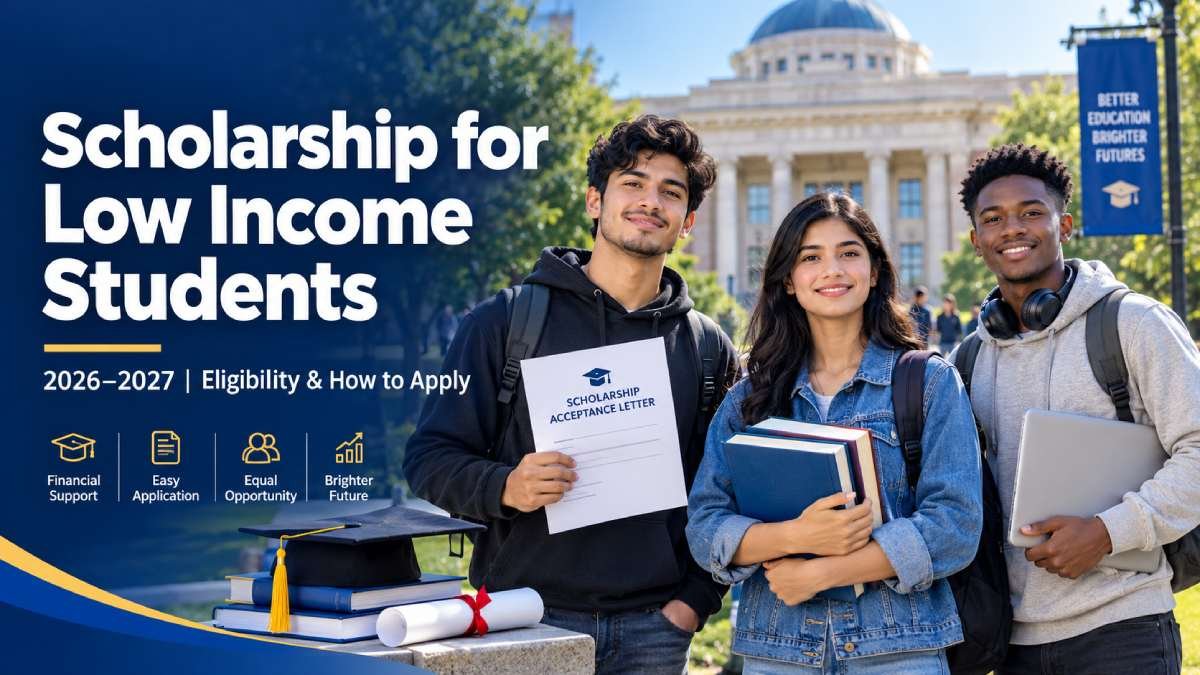
Scholarships for low-income students help financially disadvantaged students pay for college and university education. These awards can cover tuition fees, accommodation, books, living expenses, and other educational costs. Some scholarships provide full funding, while others offer partial financial assistance based on household income and academic eligibility.
Students from low-income families can explore government scholarships, university bursaries, nonprofit foundation awards, and need-based financial aid. However, each program has different requirements for income, nationality, academic performance, and enrollment.
For 2026–2027, major funding opportunities include QuestBridge, the Jack Kent Cooke College Scholarship, HEC Need-Based Scholarships, Oxford’s Crankstart Scholarship, and the Mastercard Foundation Scholars Program.
This guide compares seven scholarship programs and explains who qualifies, who should apply, required documents, application steps, selection procedures, previous award trends, and common mistakes.
Important: Scholarship deadlines and eligibility rules vary by program. The information below was reviewed on October 9, 2026. Some 2026–2027 application cycles are already closed, while others remain open or accept applications through participating institutions.
Scholarships for Low-Income Students in 2026–2027: Quick Comparison
The following programs support students with demonstrated financial need. Their funding conditions and geographic restrictions differ.
| Scholarship or program | Country or applicant group | Financial support | Application status |
|---|---|---|---|
| QuestBridge National College Match | Eligible US high school seniors | Full four-year college funding | 2026 application closed October 1 |
| Jack Kent Cooke College Scholarship | Eligible students who completed high school in the US | Up to USD 55,000 annually | Open until November 11, 2026 |
| HEC Need-Based Scholarship | Pakistan, participating public universities | Tuition support and monthly stipend | University-specific |
| PM-USP Central Sector Scholarship | India, eligible college students | Fixed annual scholarship assistance | 2026–27 renewals open until October 31 |
| Oxford Crankstart Scholarship | Eligible UK-resident undergraduates | Annual non-repayable bursary | Income-based assessment |
| Mastercard Foundation Scholars Program | Eligible young African applicants | Tuition, living costs, and additional support | Partner-specific |
| Aga Khan Foundation International Scholarship Programme | Selected nationalities, postgraduate study | Tuition and living expenses through a grant-loan arrangement | 2026–27 cycle closed |
Which scholarship should you consider first?
- US high school seniors: Compare QuestBridge and the Jack Kent Cooke College Scholarship.
- Pakistani undergraduates: Check HEC Need-Based Scholarship availability at participating universities.
- Indian students: Review PM-USP eligibility and the current National Scholarship Portal application category.
- Eligible UK residents: Consider Oxford’s Crankstart Scholarship if applying to or attending Oxford.
- African students: Explore Mastercard Foundation partner institutions.
- Eligible postgraduate applicants: Review the Aga Khan Foundation program’s funding and repayment conditions.
Students should prioritize scholarships that match their nationality, academic level, household finances, and preferred university.
What Is a Scholarship for Low-Income Students?
A scholarship for low-income students is financial assistance awarded to an eligible student whose family has limited resources to pay for education.
Most need-based scholarships assess financial circumstances. Some also consider academic achievement, leadership, personal circumstances, or community involvement.
Scholarships can be funded by government agencies, universities, charitable foundations, or private organizations.
How Do Need-Based Scholarships Work?
Need-based scholarships assess whether students require financial assistance to afford education.
Scholarship administrators may examine:
- Annual household income.
- Parents’ employment status.
- Family savings and other assets.
- Number of financially dependent family members.
- Existing educational expenses.
- Exceptional financial circumstances.
- Tuition fees and expected living costs.
A scholarship committee may compare the applicant’s financial resources with the estimated cost of studying.
Financial need alone does not always guarantee selection. Competitive scholarships may also evaluate academic records, motivation, and leadership.
Need-Based vs. Merit-Based Scholarships
| Feature | Need-based scholarship | Merit-based scholarship |
|---|---|---|
| Main criterion | Demonstrated financial need | Academic or other achievement |
| Household income | Usually evaluated | May not be considered |
| GPA requirement | Depends on the program | Often important |
| Financial documents | Usually required | Not always required |
| Award determination | Need, eligibility, and available funds | Achievement and selection criteria |
| Suitable applicants | Students with limited financial resources | Students meeting specified performance standards |
Some programs combine both approaches. These are commonly called merit-cum-need scholarships.
Scholarships vs. Grants, Bursaries, and Student Loans
These funding types have different financial obligations.
A scholarship is generally non-repayable support awarded under specified criteria.
A grant is generally non-repayable funding, often connected to financial need or a particular educational purpose.
A bursary commonly provides financial assistance based on circumstances such as household income.
A student loan is borrowed money that normally must be repaid under agreed conditions.
Applicants should examine the award agreement before accepting funding. A program described as a scholarship may contain a repayable component.
Who Qualifies as a Low-Income Student for Scholarships?
Students qualify for low-income scholarships when they satisfy the financial requirements established by the scholarship provider.
There is no universal household income limit for all scholarships.
Eligibility depends on the country, scholarship program, family circumstances, and sometimes the institution’s cost of attendance.
Household Income Requirements
Scholarship providers use different methods to evaluate family income.
For example:
- QuestBridge: Typical applicants come from households earning below USD 65,000 annually for a family of four with minimal assets. This is not an absolute cutoff.
- Jack Kent Cooke College Scholarship: The foundation considers applicants with annual gross family income up to USD 95,000, alongside a broader financial review.
- Oxford Crankstart Scholarship: Eligible UK-resident students beginning their first undergraduate degree in 2027 generally require assessed annual household income of GBP 32,500 or less.
- India’s PM-USP Central Sector Scholarship: Published scheme guidance specifies a family income ceiling of INR 450,000 annually for fresh applicants, together with academic requirements.
These figures are not interchangeable. A student who meets one program’s income standard may not qualify for another.
Does Family Size Affect Eligibility?
Family size can affect the financial assessment.
Some scholarship providers consider how many people depend on the same household income. They may also examine family assets, expenses, and special circumstances.
For example, a household supporting several dependent children may have different financial obligations from a smaller household earning the same income.
Applicants should report family composition according to the scholarship provider’s instructions.
Can Students With Unemployed Parents Qualify?
Yes. Students whose parents are unemployed may qualify for need-based scholarships if they meet the program’s other requirements.
However, applicants must document their financial circumstances accurately.
Possible supporting records include unemployment documentation, previous income statements, tax records, or an explanation of how the household currently meets its expenses.
A scholarship provider may request additional verification.
Are GPA and Academic Results Important?
Many need-based scholarships also consider academic performance.
The Jack Kent Cooke College Scholarship requires a minimum cumulative unweighted GPA of 3.75 for its 2027 entry cycle.
Other programs may use different GPA requirements or assess the student’s academic record holistically.
Applicants with lower grades should investigate awards that place greater emphasis on demonstrated financial hardship rather than assuming every need-based scholarship has the same academic threshold.
Who Should Apply for Low-Income Scholarships and Who Should Not?
Students should apply when their financial, academic, geographic, and enrollment circumstances match the scholarship’s published requirements.
Who Should Apply?
Low-income scholarships may be appropriate for:
- Students from financially disadvantaged households who cannot meet the full cost of education.
- First-generation college students who satisfy the program’s financial and academic requirements.
- Students with unemployed or underemployed parents who can provide acceptable financial documentation.
- High-achieving students with financial need who qualify for competitive merit-cum-need programs.
- Students from rural or underserved communities where the scholarship supports those populations.
- Eligible international students applying to programs that accept their nationality or residency status.
- Currently enrolled university students when the scholarship permits applications after enrollment.
Who Should Not Apply?
Applicants should generally avoid submitting applications when they clearly fail a mandatory requirement.
Examples include:
- Applying to a domestic-only scholarship without eligible citizenship or residency.
- Applying for an undergraduate-only award while pursuing a postgraduate degree.
- Applying after the scholarship’s final deadline.
- Applying for a first-year scholarship when already enrolled and continuing students are excluded.
- Applying when household income exceeds a strict maximum threshold.
- Applying while holding another award that the program explicitly prohibits.
Applicants should also reconsider funding arrangements that contain repayment obligations they cannot reasonably meet.
Eligibility checklist: Before applying, confirm your education level, nationality, income eligibility, academic requirements, enrollment status, program deadline, and documents.
7 Scholarships for Low-Income Students in 2026–2027
The following scholarship programs serve different student populations. Applicants should compare them by eligibility rather than ranking awards only by financial value.
1. QuestBridge National College Match, United States
The QuestBridge National College Match helps academically outstanding high school seniors from low-income backgrounds apply for admission and full four-year scholarships at participating US colleges.
For the 2026 application cycle, QuestBridge partnered with 55 colleges.
Scholarship details
| Attribute | Details |
|---|---|
| Funding organization | QuestBridge college partners |
| Study level | Undergraduate |
| Country | United States |
| Financial profile | Typically below USD 65,000 annual household income for a family of four with minimal assets |
| Award coverage | Tuition, housing, food, and other eligible educational expenses |
| Duration | Four years |
| 2026 application deadline | October 1, 2026 |
| Application status | Closed for new 2026 National College Match applications |
The full four-year scholarship packages have an advertised estimated value exceeding USD 360,000 at participating institutions. This figure represents the estimated scholarship package value, not a cash payment to the student.
Eligibility: Applicants generally must be current high school seniors attending high school in the United States or eligible US citizens and permanent residents living abroad. International students living outside the United States are not eligible under the standard published rules.
Selection process: QuestBridge evaluates academic achievement, financial need, personal qualities, and college readiness. Finalists who rank colleges must complete additional requirements. Matching applicants receive early admission and a four-year scholarship.
How to apply: Eligible students register for the National College Match, complete the application, and follow the college ranking and additional submission instructions. Applicants should also understand that ranking colleges can create binding admission commitments, subject to program exceptions.
For official requirements and future application cycles, visit the QuestBridge National College Match scholarship program.
2. Jack Kent Cooke College Scholarship, United States
The Jack Kent Cooke College Scholarship Program supports academically exceptional high school seniors with unmet financial need.
The scholarship offers up to USD 55,000 per year toward eligible undergraduate expenses.
Scholarship details
| Attribute | Details |
|---|---|
| Funding organization | Jack Kent Cooke Foundation |
| Study level | Bachelor’s degree |
| Maximum award | USD 55,000 per year |
| Minimum GPA | 3.75, unweighted |
| Financial criterion | Family annual gross income up to USD 95,000, with further financial review |
| Application period | August 19 to November 11, 2026 |
| Application status | Open as of October 9, 2026 |
| Application platform | Common App |
Who is eligible?
Applicants must be graduating high school seniors who have completed the required high school education in the United States, a US territory, or an eligible US military base setting.
US citizenship is not mandatory, but the foundation imposes specific US schooling and residency conditions.
The program also requires an eligible standardized test score from the SAT, ACT, AP, or IB examinations. Applicants must meet the minimum GPA and other application conditions.
What does the scholarship cover?
The award can contribute toward tuition, required fees, books, and living expenses. The final value depends on the student’s educational costs and other financial aid.
It is a last-dollar award, meaning institutional financial assistance is considered when calculating the foundation’s contribution.
How to apply: Applicants complete the Common App, add the Jack Kent Cooke Foundation, submit required financial information and essays, and arrange teacher and counselor recommendations.
Selection process: Reviewers assess academic ability, unmet financial need, perseverance, leadership, and service.
The award is renewable, subject to annual academic, financial, and conduct requirements.
Eligible students can review the Jack Kent Cooke College Scholarship official application information.
3. HEC Need-Based Scholarship, Pakistan
The Higher Education Commission (HEC) Need-Based Scholarship provides financial assistance to eligible students studying at selected public-sector universities and degree-awarding institutions in Pakistan.
The program primarily supports undergraduate education.
Scholarship details
| Attribute | Details |
|---|---|
| Funding authority | Higher Education Commission, Pakistan |
| Country | Pakistan |
| Academic level | Undergraduate |
| Eligible institutions | Participating public-sector universities |
| Financial assistance | University fee support and monthly stipend |
| Published monthly stipend | PKR 6,000 |
| Duration | Normally the approved degree period |
| Application deadline | Determined by the participating university |
Who can apply?
Students must obtain admission to, or already be enrolled in, an eligible undergraduate program at a participating institution.
The university’s Institutional Scholarship Award Committee assesses the applicant’s financial background.
Students admitted through self-finance arrangements are not eligible under the published HEC Need-Based Scholarship criteria.
What expenses are covered?
The program supports university fees and provides a published monthly stipend. Actual administration and award conditions should be confirmed through the university’s Financial Aid Office.
How to apply:
- Confirm that the university participates in the scholarship program.
- Obtain the scholarship application form from the university’s Financial Aid Office.
- Complete household financial details.
- Attach the required supporting documents.
- Submit the application to the university’s Financial Aid Office.
- Follow the university’s verification and selection procedure.
Applications are administered through participating universities rather than sent directly to HEC.
For verified eligibility and program restrictions, consult the HEC Need-Based Scholarship eligibility criteria.
4. PM-USP Central Sector Scholarship, India
The PM-USP Central Sector Scheme of Scholarship for College and University Students is a merit-cum-means scholarship administered under India’s Ministry of Education.
It supports eligible students undertaking regular higher education courses.
Scholarship details
| Attribute | Details |
|---|---|
| Country | India |
| Administering authority | Ministry of Education |
| Study level | Eligible college and university courses |
| Financial criterion | Annual family income up to INR 450,000 under published fresh-application guidance |
| Academic requirement | Above the 80th percentile of successful Class XII candidates in the relevant stream |
| Application platform | National Scholarship Portal |
| 2026–27 status | Renewal applications advertised through October 31, 2026 |
Who can apply?
The scheme combines academic merit with household income requirements.
Under the published eligibility rules, fresh applicants must meet the Class XII performance threshold, pursue an eligible regular course, and satisfy the annual family income ceiling.
Additional restrictions apply to students receiving other scholarships, diploma students, and students who took a gap after Class XII.
How to apply: Applicants use the National Scholarship Portal, complete the required registration and submit the relevant scholarship application.
Important: The portal currently advertises 2026–27 renewal applications for this scheme. Applicants must not assume that fresh applications are open simply because renewal submissions are being accepted.
5. Oxford Crankstart Scholarship, United Kingdom
The University of Oxford Crankstart Scholarship provides financial assistance and additional development opportunities to eligible UK-resident students from lower-income households.
The program supports students pursuing their first undergraduate degree.
Scholarship details
| Attribute | Details |
|---|---|
| University | University of Oxford |
| Country | United Kingdom |
| Academic level | First undergraduate degree |
| Household income | GBP 32,500 or less annually |
| Financial support | Non-repayable annual bursary |
| Maximum bursary for 2027 entrants | GBP 6,500 annually |
| Application process | Automatic assessment using relevant student finance information |
Who is eligible?
Eligible students generally must have lived in the UK for at least three years for reasons other than education and meet Oxford’s first-degree and household income requirements.
What does the scholarship provide?
The bursary helps with educational and living costs. The scholarship also offers access to professional development, internships, volunteering opportunities, and community activities.
How to apply: Oxford does not require a separate Crankstart Scholarship application. Eligible students are assessed using household income information from the relevant regional student funding agency.
This scholarship should not be presented as a general award for international students who do not meet the UK residency requirements.
6. Mastercard Foundation Scholars Program
The Mastercard Foundation Scholars Program supports talented young African applicants who face financial and educational barriers.
The program operates through participating universities and organizations.
Scholarship details
| Attribute | Details |
|---|---|
| Funding organization | Mastercard Foundation |
| Main target audience | Eligible young African applicants |
| Study level | Eligible undergraduate and master’s programs |
| Host institutions | Participating universities in Africa and other regions |
| Financial assistance | Tuition, accommodation, academic materials, and other program support |
| Application deadline | Varies by partner institution |
| Selection authority | Participating institution |
Who can apply?
Eligibility depends on the institution and study program.
Selection commonly emphasizes academic ability, demonstrated need, leadership potential, and commitment to community development.
The broader program supports secondary, undergraduate, and master’s education, but it does not currently provide PhD scholarships.
How to apply:
- Identify an eligible Mastercard Foundation partner institution.
- Choose an available degree program.
- Review the institution’s scholarship eligibility.
- Prepare the required academic and financial documents.
- Submit the application through the partner’s instructions.
An admission offer from a partner university does not automatically guarantee Mastercard Foundation scholarship funding.
Applicants should also verify whether admission fees, test costs, and travel are covered or reimbursed.
7. Aga Khan Foundation International Scholarship Programme
The Aga Khan Foundation International Scholarship Programme supports outstanding postgraduate applicants from selected countries who have demonstrated financial need.
The program prioritizes candidates who cannot finance their studies through other available resources.
Scholarship details
| Attribute | Details |
|---|---|
| Funding organization | Aga Khan Foundation |
| Study level | Primarily master’s, with some PhD consideration |
| Eligible applicants | Selected nationalities and qualifying circumstances |
| Financial support | Tuition and eligible living expenses |
| Award structure | 50% grant and 50% repayable loan |
| 2026–27 status | Application cycle closed |
| Next expected cycle | Early 2027 |
Who can apply?
Applicants must demonstrate strong academic performance, genuine financial need, leadership potential, and admission to a reputable postgraduate institution.
The foundation gives preference to younger professionals, particularly applicants under 30.
Candidates must normally be entering the first year of postgraduate study.
Important funding condition: This program is not a fully non-repayable scholarship.
Recipients must repay 50% of the award under the foundation’s loan agreement, which includes additional repayment conditions.
The award supports tuition and student living expenses but does not normally cover international travel or the living expenses of accompanying family members.
Applicants should compare the repayment obligation with non-repayable postgraduate scholarships before accepting an award.
What Other Financial Aid Is Available for Low-Income Students?
Students who do not qualify for the seven programs above may still obtain financial assistance.
Federal Pell Grant, United States
The Federal Pell Grant is a US federal grant for eligible undergraduate students with financial need.
For the 2026–2027 award year, the maximum award is USD 7,395.
Eligible students normally apply for federal financial aid by completing the Free Application for Federal Student Aid (FAFSA).
Pell Grant eligibility depends on federal student aid rules. It is not a scholarship available to all international students.
Unlike student loans, Pell Grants generally do not require repayment, subject to specific exceptions.
University Financial Hardship Funds
Some universities provide emergency financial assistance for enrolled students experiencing unexpected hardship.
These funds may help students facing temporary financial difficulties, such as family income loss or essential living expenses.
Eligibility, funding limits, and application procedures vary by institution.
Tuition Waivers and Institutional Bursaries
A tuition waiver reduces some or all university tuition charges.
An institutional bursary provides non-repayable support under the university’s financial aid policies.
Students should contact the university financial aid office to determine which options are available alongside other funding.
How Much Financial Support Do Low-Income Scholarships Provide?
Financial support depends on the type of award and the recipient’s educational expenses.
A fully funded scholarship may cover tuition and most necessary living costs. A partial scholarship may cover only a portion of tuition or provide a fixed annual amount.
Fully Funded vs. Partially Funded Scholarships
| Expense | Fully funded scholarship | Partially funded scholarship |
|---|---|---|
| Tuition fees | Usually covered | Partly covered or fixed contribution |
| Accommodation | Often included | May be excluded |
| Living expenses | Often included | Limited or excluded |
| Books and materials | Often included | Program-dependent |
| Travel expenses | Sometimes included | Often excluded |
| Medical insurance | Program-dependent | Program-dependent |
A scholarship advertised as full tuition does not necessarily cover accommodation, meals, visa charges, or transportation.
How to Calculate Your Remaining Funding Gap
Students should calculate their actual cost of attendance before accepting financial aid.
Funding gap = Total eligible educational expenses − Confirmed non-repayable financial assistance
Consider this example:
| Expense or funding | Annual amount |
|---|---|
| Tuition and mandatory fees | USD 12,000 |
| Accommodation and food | USD 7,000 |
| Books and transportation | USD 1,000 |
| Total annual expenses | USD 20,000 |
| Confirmed scholarships and grants | USD 15,000 |
| Remaining funding gap | USD 5,000 |
This example is illustrative, not an actual university budget.
Applicants should include only confirmed funding when calculating the remaining amount. They should also distinguish loans and work-study opportunities from non-repayable scholarships.
Required Documents for Low-Income Scholarship Applications
Most need-based scholarship applications require evidence of the student’s academic background and financial circumstances.
The exact documents depend on the scholarship provider.
| Required document | Purpose | Typical issuing authority |
|---|---|---|
| Income certificate | Verifies reported household income | Relevant government or authorized office |
| Tax returns | Confirms declared earnings and financial details | Tax authority or official tax records |
| Salary statement | Documents employment income | Employer |
| Unemployment proof | Supports an unemployment claim | Relevant agency or employer |
| Bank statements | Helps verify financial resources when requested | Bank |
| Academic transcripts | Confirms academic results | School or university |
| Enrollment or admission letter | Confirms admission or student status | Educational institution |
| Identity document | Establishes identity | Government authority |
| Recommendation letter | Evaluates academic or personal qualifications | Teacher, counselor, or other permitted referee |
| Personal statement | Explains motivation and relevant circumstances | Prepared by applicant |
How to Prepare Financial Documents
Applicants should first identify the financial reporting period required by the scholarship.
Some programs request the previous year’s income. Others assess several years of household financial information.
Students must ensure that declared income matches their supporting records.
Documents should be accurate, readable, complete, and submitted in the specified format.
What if Your Family Does Not File Income Tax Returns?
Applicants should not create false tax records or enter zero income unless that accurately reflects the requested financial information.
Some scholarship providers accept estimated income declarations, explanations of informal employment, or alternative financial evidence.
For example, the Jack Kent Cooke Foundation allows applicants whose families did not file taxes to submit estimated financial information with an explanation.
The applicant must follow the relevant scholarship’s accepted documentation rules.
Personal Statement and Recommendation Letters
A scholarship personal statement should explain the student’s educational objectives, relevant achievements, and financial circumstances.
It should not simply repeat the applicant’s household income.
A strong recommendation letter provides specific examples of academic ability, persistence, leadership, or responsibility.
Students should give recommenders sufficient time and the correct submission instructions.
How to Apply for Scholarships for Low-Income Students: Step-by-Step Guide
Students should follow a structured application process to reduce errors and avoid missing deadlines.
Step 1: Identify Scholarships That Match Your Profile
Create a shortlist based on nationality, academic level, household income, GPA, and enrollment status.
Do not begin with award value alone. A smaller scholarship for which you qualify may be more useful than a large award for which you are ineligible.
Step 2: Verify the Official Eligibility Requirements
Review the latest official instructions for each program.
Check income thresholds, accepted nationalities, university restrictions, academic conditions, and whether applications are currently open.
Confirm whether you need to apply before admission or after enrolling.
Step 3: Prepare Your Documents
Collect income records, academic transcripts, identification, recommendation letters, and any additional evidence.
Check whether financial documents require translation, certification, or verification.
Use a checklist for each scholarship because document requirements differ.
Step 4: Register on the Official Application Portal
Create an applicant account when required.
Some scholarships use independent portals, others use university systems, and some accept submissions through Common App.
Government schemes may require registration on a national scholarship platform.
Step 5: Complete Academic and Financial Information
Provide accurate personal details, academic results, household income, family information, and financial circumstances.
Read every question carefully.
If a family member has no income, explain the circumstances as the application requires.
Step 6: Submit Essays and Recommendations
Write scholarship essays that answer the actual questions.
Explain your academic goals and relevant experiences using specific examples.
Invite recommenders through the correct system and confirm they understand their submission deadlines.
Step 7: Review and Submit Your Application
Check all uploaded files before submission.
Confirm that financial figures, dates, contact details, and academic records are consistent.
Submit before the official deadline. Do not rely on last-minute uploads.
Step 8: Track Application Status
Save the application confirmation.
Monitor your email and official portal for verification requests, interviews, missing documents, or selection announcements.
Respond to legitimate requests before the stated deadline.
Step 9: Review Your Financial Aid Offer
If selected, examine the final award letter.
Confirm the scholarship value, eligible expenses, disbursement process, duration, and renewal conditions.
Ask the scholarship administrator about any unclear repayment or funding obligations before accepting.
How Are Low-Income Scholarship Recipients Selected?
Scholarship committees evaluate applicants against program-specific eligibility and selection criteria.
The assessment process often involves several stages.
1. Initial Eligibility Screening
Administrators check whether an applicant meets mandatory requirements.
These may include nationality, household income, education level, academic results, enrollment, and submission deadlines.
Applications that fail mandatory criteria may be rejected before further assessment.
2. Financial Need Assessment
The scholarship provider reviews financial information.
This may include income verification, family circumstances, assets, and educational costs.
Some university programs use a dedicated financial aid committee.
Financial need may be reassessed if documentation is incomplete or inconsistent.
3. Academic and Personal Evaluation
Competitive programs may evaluate:
- Academic achievement.
- Persistence despite obstacles.
- Motivation for the chosen course.
- Leadership or community participation.
- Recommendation letters.
- Written application responses.
Different scholarship providers assign different importance to these criteria.
4. Interviews and Final Selection
Some programs interview shortlisted applicants.
Interviews may address educational goals, financial circumstances, leadership experience, or commitment to the scholarship’s objectives.
Other programs select recipients without interviews.
Successful candidates may receive a conditional award that depends on admission, enrollment, or document verification.
5. Scholarship Renewal Assessment
Renewable scholarships may require continued enrollment, satisfactory academic progress, updated financial information, and compliance with scholarship rules.
Recipients should understand the renewal requirements before their first academic year begins.
Common Mistakes Students Make When Applying for Low-Income Scholarships
Small application errors can prevent an otherwise eligible applicant from receiving financial assistance.
| Common mistake | Possible consequence | How to avoid it |
|---|---|---|
| Ignoring nationality restrictions | Application rejected | Read eligibility rules first |
| Reporting incorrect family income | Verification failure or disqualification | Match figures to official records |
| Uploading incomplete documents | Application delayed or rejected | Follow the document checklist |
| Missing the deadline | Submission not accepted | Track dates and time zones |
| Writing a generic personal statement | Weak application | Address the program’s specific questions |
| Choosing an ineligible degree program | Funding denied | Confirm academic level and course eligibility |
| Ignoring additional verification requests | Application becomes incomplete | Monitor email and applicant portal |
| Misunderstanding scholarship renewal | Funding interrupted | Review annual requirements |
Applying to Every Scholarship Without Checking Eligibility
Submitting many applications is not automatically an effective strategy.
Applicants should first eliminate programs with mandatory restrictions they cannot satisfy.
This allows more time for scholarships where they have a realistic eligibility match.
Submitting Inconsistent Income Information
Scholarship administrators may compare financial declarations with tax records, employment documents, and other evidence.
Students must not intentionally omit income or assets that the application requires.
If a financial record contains an error, contact the administrator for instructions.
Missing Deadlines
Scholarship deadlines can differ from university admission deadlines.
Some programs also have separate dates for recommendations, college rankings, financial verification, and interviews.
Applicants should track every requirement rather than recording only the main application deadline.
Ignoring Scholarship Terms
Applicants sometimes focus on the advertised amount without reading the award agreement.
This can lead to misunderstandings about tuition coverage, renewal, work commitments, or repayment obligations.
Students should review the full financial terms before accepting funding.
Previous Years’ Trends in Scholarships for Low-Income Students
Historical scholarship figures can help applicants understand program scale, selection activity, and changes in award availability.
However, different scholarship providers report results using different methods. Recipient counts should not be treated as acceptance rates without reliable applicant and eligibility data.
QuestBridge National College Match: 2024 vs. 2025
QuestBridge reported:
| Year | National College Match recipients |
|---|---|
| 2024 | 2,627 |
| 2025 | 2,550 |
The number of matched recipients was lower in 2025 than in 2024, although the number of participating college partners increased from 52 to 55.
This demonstrates that a growing number of participating colleges does not necessarily mean more students will receive match scholarships in every cycle.
The figures describe students matched through the National College Match. They do not include all students later admitted through other QuestBridge-related admission pathways.
Jack Kent Cooke College Scholarship: Recent Results
The Jack Kent Cooke Foundation reported 70 new College Scholars selected in 2025.
In April 2026, the foundation selected 60 new College Scholars, in addition to 56 Young Scholar seniors receiving the College Scholarship.
The different recipient categories should be kept separate when comparing years.
These figures also show why meeting a scholarship’s financial and academic requirements does not guarantee selection.
HEC Need-Based Scholarships: Pakistan
According to HEC’s published information, 3,946 scholarships were awarded through the Need-Based Scholarship Programme in the 2024–2025 academic year.
HEC reported in April 2026 that 46,824 financially disadvantaged students had benefited from the program since its introduction.
These figures demonstrate the program’s continued role in supporting students at participating Pakistani universities.
What Do Previous Scholarship Cycles Tell Applicants?
Three practical conclusions follow from these records.
First, scholarship availability can change between award cycles.
Second, reported recipient counts do not establish an individual applicant’s probability of success.
Third, the current year’s eligibility rules and award conditions matter more than historical figures when deciding whether to apply.
Applicants should use past results as background information rather than a prediction of selection.
Research Notes: Important Findings About Low-Income Scholarships
A comparison of official scholarship rules reveals several differences that are easy to overlook.
1. Low Income Does Not Mean the Same Thing Everywhere
A student’s household income must be interpreted within the relevant scholarship’s assessment framework.
US foundation scholarships, Pakistani university awards, Indian government schemes, and UK bursaries use different eligibility rules.
Applicants should never assume one country’s definition applies internationally.
2. The Largest Advertised Award Is Not Always the Best Financial Option
A high scholarship amount may represent a maximum, an estimated four-year educational package, or a contribution after other grants.
For example, the Jack Kent Cooke College Scholarship is calculated after considering institutional financial aid.
QuestBridge Match packages represent the full cost of attendance at participating colleges rather than unrestricted payments to recipients.
Applicants should compare actual uncovered costs instead of headline amounts alone.
3. A Scholarship May Require No Separate Application
Oxford’s Crankstart Scholarship is assessed using the student’s relevant income assessment.
By contrast, other scholarships require dedicated applications, essays, and financial documents.
Understanding the application method prevents students from missing a required university or student finance process.
4. Some Scholarship Programs Include Repayment
The Aga Khan Foundation International Scholarship Programme provides half of its award as a repayable loan.
Students should distinguish non-repayable funding from mixed grant-loan arrangements.
The word scholarship alone does not establish that an award is entirely free of repayment obligations.
5. University Admission and Scholarship Selection Are Different Decisions
A student may obtain university admission without receiving additional scholarship assistance.
The Mastercard Foundation states that admission to a participating university does not automatically guarantee selection for the Scholars Program.
Applicants should verify both processes independently.
6. Historical Scholarship Pages Can Contain Expired Deadlines
Scholarship websites may retain information from previous cycles.
Applicants must check the current application year, exact deadline, and whether the portal accepts fresh applications or renewals only.
A scholarship listed on a directory does not necessarily have an open application.
How to Improve Your Chances of Receiving a Need-Based Scholarship
A competitive scholarship application should demonstrate eligibility clearly and provide complete evidence.
Build a Targeted Scholarship Shortlist
Focus on scholarships that match your circumstances.
A useful shortlist includes the program name, country, degree level, income requirements, deadline, funding coverage, and documents.
Prioritize eligible opportunities with confirmed application procedures.
Explain Financial Need Accurately
Provide a clear account of the family’s financial circumstances.
Explain relevant hardships when the application asks for them.
Use supporting evidence wherever required.
Do not exaggerate financial difficulties or submit unverifiable information.
Demonstrate Academic and Personal Strengths
Scholarship reviewers may consider more than grades.
Relevant evidence can include academic improvement, leadership, volunteering, employment responsibilities, or community involvement.
Choose examples that directly support the scholarship’s stated selection criteria.
Apply Before the Deadline
Prepare documents and recommendation requests early.
Some financial records require additional processing.
Submitting early also allows time to resolve technical or documentation problems.
Understand the Scholarship’s Renewal Conditions
A renewable scholarship can provide more useful long-term assistance than a one-time award.
However, renewal may depend on academic performance, enrollment, or financial reassessment.
Students should confirm the conditions before relying on the award for future academic years.
Frequently Asked Questions About Scholarships for Low-Income Students
1. What qualifies a student as low income for scholarships?
A student qualifies as low income when their household’s financial circumstances satisfy a scholarship provider’s eligibility requirements. Programs may evaluate annual income, family size, assets, dependents, and educational costs. There is no single income threshold that applies to every scholarship, university, or country. Applicants must follow each program’s published criteria.
2. What is the maximum family income to qualify for a scholarship?
The maximum family income depends on the scholarship. For example, the Jack Kent Cooke College Scholarship considers eligible applicants with annual gross family income up to USD 95,000. QuestBridge typically serves students from substantially lower-income households. Other programs apply their own thresholds or assess financial need without one universal published cutoff.
3. Can I get a scholarship if my parents are unemployed?
Yes. Students with unemployed parents may qualify for need-based scholarships if they satisfy the program’s other eligibility requirements. Applicants may need to submit unemployment evidence, previous income records, or explanations of financial support. The scholarship administrator determines which documents are acceptable. Unemployment does not automatically guarantee an award.
4. Can international students receive low-income scholarships?
Yes, but international eligibility varies significantly. Some scholarships accept applicants from selected countries, while others require domestic citizenship, residency, or schooling. The Mastercard Foundation Scholars Program supports eligible young African applicants through partner institutions. Applicants should verify nationality, residence, degree level, and university restrictions before preparing an application.
5. Are there fully funded scholarships for students from poor families?
Yes. Some need-based programs offer financial packages covering tuition, accommodation, meals, and other educational costs. QuestBridge National College Match scholarships are one example for eligible students. However, full funding has different meanings across programs. Applicants must check whether travel, insurance, personal expenses, and additional university charges are included.
6. Can I get a need-based scholarship with a low GPA?
Possibly. Some scholarships place greater emphasis on financial need, while others have strict academic requirements. The Jack Kent Cooke College Scholarship, for example, requires a minimum unweighted GPA of 3.75. Students with lower GPAs should research university hardship funds, income-assessed bursaries, and programs without the same academic cutoff.
7. What documents prove financial need for a scholarship?
Common financial documents include income certificates, tax returns, salary statements, bank records, and unemployment evidence. Some programs also request information about household members, dependents, or exceptional expenses. The exact requirements vary by scholarship provider. Applicants should submit only the documents requested and ensure all declarations are accurate and consistent.
8. Can I apply for a scholarship without income tax returns?
Yes, some scholarship providers allow alternative evidence when applicants or their parents do not file tax returns. The Jack Kent Cooke Foundation, for example, permits estimated financial information with an explanation in relevant circumstances. However, each scholarship controls acceptable documentation. Applicants should request guidance before replacing required tax records with other documents.
9. Can I apply for more than one need-based scholarship?
Yes, students can often apply for multiple scholarships, but some programs restrict simultaneous funding. An applicant may need to disclose existing scholarships or grants. Receiving additional aid can also change the amount awarded by a need-based provider. Students should review award-combination rules before accepting multiple scholarships.
10. Do scholarships for low-income students cover living expenses?
Some scholarships cover living expenses, while others pay only tuition or provide a fixed allowance. QuestBridge Match packages include eligible living costs at participating colleges. The HEC Need-Based Scholarship includes a published monthly stipend. Applicants should examine accommodation, meals, books, transportation, and personal expense provisions individually before calculating their remaining funding needs.
11. How are students selected for need-based scholarships?
Selection usually begins with an eligibility review and financial assessment. Competitive programs may also evaluate grades, essays, recommendations, leadership, persistence, and interviews. Some universities use dedicated scholarship committees. The final decision depends on program rules, verified applicant information, and available funding. Meeting the minimum requirements does not guarantee selection.
12. Can I apply for a low-income scholarship if I am already enrolled at university?
Yes, some programs accept currently enrolled students. Pakistan’s HEC Need-Based Scholarship permits eligible students already enrolled at participating universities to apply. Other awards, including certain first-year college scholarships, require applicants to apply before beginning their degrees. Applicants must confirm enrollment restrictions and application timing for each program.
Conclusion: Finding the Right Scholarship for Your Financial Situation
Scholarships for low-income students can reduce the financial barriers to higher education, but eligibility differs significantly across countries and programs.
Students should start by identifying scholarships that match their household income, academic qualifications, nationality, and enrollment status. They should then compare funding coverage, prepare accurate documents, and follow the official application instructions.
The QuestBridge National College Match, Jack Kent Cooke College Scholarship, HEC Need-Based Scholarship, Oxford Crankstart Scholarship, and Mastercard Foundation Scholars Program demonstrate the different ways financial assistance can support eligible students.

You may like

Fully Funded Scholarships in UK for Indian Students (2027-28 Intake)

Scholarships Without IELTS for Indian Students (2027 Intake): Verified List, Eligibility and How to Apply

Fully Funded Scholarships in Canada for Indian Students (2027–28 Intake)
Trending
-
 Scholarships4 months ago
Turkey Burslari Scholarship 2026: Eligibility, Benefits, Deadline, Interview, and Results
-

 Scholarships3 months ago
SBI Asha Scholarship 2026-27: Eligibility, Amount, Last Date and Apply Online
-
 By Country4 months ago
Scholarship for MBBS Students in India
-
 Scholarships4 months ago
Scholarship for J&K Students: Eligibility, Amount, Deadlines, and How to Apply
-
 By Country4 months ago
Korean Government Scholarship for Indian Students: GKS Eligibility, Benefits, Deadlines and Application
-

 Scholarships3 months ago
Scholarships for PG Students in Kerala 2026: Eligibility, Amounts, Deadlines and Application Links
-
 Scholarships4 months ago
Abdul Kalam Scholarship for Class 10 Students: Verified Programs, Eligibility and Application Guide
-

 Scholarships3 months ago
West Bengal Student Scholarship 2026-27: Eligibility, Amounts, Last Dates and Apply Online