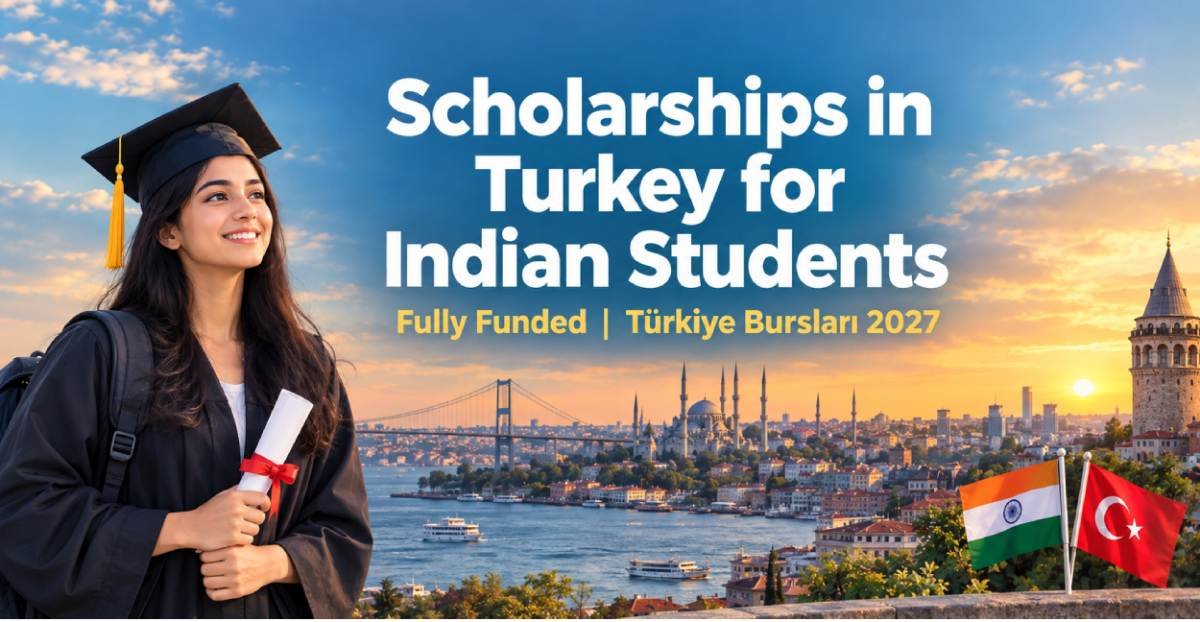
Türkiye Bursları (Türkiye Scholarships) is the Turkish government’s fully funded scholarship for international students. The Presidency for Turks Abroad and Related Communities (YTB) runs the program. Indian students can apply for undergraduate, master’s and PhD study at Turkish universities.
The scholarship covers university placement, accommodation, health insurance and a monthly stipend. It also includes a Turkish language course. Competition is intense, with nearly 200,000 applications in 2026.
This guide explains who should apply, who should not, the application steps, the documents, the selection process and the trends from previous years.
Scholarships in Turkey for Indian Students at a Glance
Do Indian students qualify for Turkish government scholarships? Yes. Türkiye Bursları accepts applications from citizens of all countries, including India.
Attribute
Detail
Scholarship name
Türkiye Bursları (Türkiye Scholarships)
Funder and administrator
Government of Türkiye, through YTB
Levels
Associate, undergraduate, master’s, PhD
Application window
10 January to 20 February each year (2027 expected)
Application fee
None
Age limit
Under 21 (undergraduate), under 30 (master’s), under 35 (PhD)
Minimum academic achievement
70% (undergraduate), 75% (master’s and PhD), 90% (medicine, dentistry, pharmacy)
Applications allowed
One per applicant per cycle
University preferences
Up to 12
Language requirement
Turkish C1, reached through a 1-year course if not already held
Portal
Türkiye Scholarships Application System (TBBS)
What Does Türkiye Bursları Cover?
Türkiye Bursları is a full-funding package, not only a cash award. YTB combines the scholarship with university and program placement. Applicants do not need a university admission before applying.
Benefit
What it means for an Indian awardee
University and program placement
YTB places you in a program from your preference list
Tuition
The scholarship covers university fees
Monthly stipend
Paid in Turkish lira (TRY), higher at higher levels
Accommodation
YTB arranges housing for awardees
Health insurance
Included for the scholarship period
Turkish language course
One year, required unless you already hold C1
Flight ticket
Reported as part of the package in YTB summaries
How long does the funding last? YTB brochures describe the study path as follows:
Undergraduate: 1 year of Turkish, then 4 to 6 years of study, depending on the program.
Master’s: 1 year of Turkish, then 2 years.
PhD: 1 year of Turkish, then 4 years.
Who Should Apply and Who Should Not Apply
Who is the right candidate? The right candidate meets the age and grade limits, has complete documents and accepts one year of Turkish study.
Who should apply
Indian Class 12 graduates under 21 with at least 70% academic achievement who want a fully funded bachelor’s degree.
Indian bachelor’s graduates under 30 with at least 75% who want a funded master’s degree.
Indian master’s graduates under 35 with at least 75% and a research proposal who want a funded PhD.
Applicants who can commit to Turkish. Every awardee without a C1 certificate studies Turkish for a year, even for English-taught programs.
Applicants who want placement handled for them. YTB assigns the university, so no separate admission search is needed.
Who should not apply
Applicants over the age limit. Applicants who are 21 or older at undergraduate level, 30 or older at master’s level, or 35 or older at PhD level fail the first screening.
Applicants below the grade minimum. A 68% undergraduate profile or a 72% master’s profile does not meet the stated minimum.
Medicine, dentistry and pharmacy applicants below 90%. These fields carry a higher bar.
Students already studying in Türkiye at their own expense. The separate Success Scholarship exists for this group (see the alternatives section).
PhD holders seeking research funding. The Research Scholarship is the correct route.
Students who need to start within months. The timeline from application to degree start can take nearly two years.
Tip for Indian applicants: Convert your CGPA to a percentage using your university’s official formula. Keep the conversion proof ready, because the evaluation uses percentage-based minimums.
Application Dates for Indian Students
When can Indian students apply? The standard window runs from 10 January to 20 February. Past cycles followed this pattern, including 2021 and 2025. Third-party guides project the same dates for 2027.
Stage
Expected timing for the 2027 cycle
Portal opens
10 January 2027
Portal closes
20 February 2027
Screening and evaluation
March to April 2027
Interviews
Spring to early summer 2027
Final results
June to early August 2027
Arrival and Turkish language year
September 2027
Degree program begins
September 2028 (after the language year)
What is the deadline in Indian time? Third-party guides report a 17:00 closing time in Turkey. Türkiye is on UTC+3 and India is on UTC+5:30. A 17:00 Turkey deadline is therefore 19:30 IST. Submit at least a few days early to avoid portal congestion.
Step-by-Step Application Guide
How do you apply for Türkiye Bursları from India? Applicants submit one online application through TBBS. YTB states that no institution or person is authorized to apply on a candidate’s behalf.
Check eligibility. Confirm your age, percentage and level before creating an account.
Register on TBBS. Create your account on the Türkiye Scholarships Application System through the official website.
Choose your level. Select undergraduate, master’s or PhD. The system allows one application per cycle.
Review the program guide. TBBS lists universities and programs. Note language of instruction and extra requirements.
Rank up to 12 preferences. Choose programs that match your degree background. Mix highly competitive and less competitive options.
Upload your documents. Use clear scans of originals (see the next section).
Complete the form and submit. Reviewers read your academic record and details. Third-party guides report that the application locks after submission, so proofread first.
Track your status. YTB communicates through TBBS and your registered email. Check both regularly.
Attend the interview if shortlisted. Prepare academic, motivation and country-fit answers.
Accept and sign the agreement. Successful candidates receive an acceptance letter through TBBS and then complete the scholarship agreement.
Class 12 board marksheet for undergraduate applicants
Missing results
Diploma or temporary graduation certificate
Degree certificate, or provisional certificate if still awaiting the final one
Wrong document type
Transcript
Official, certified transcript
Online screenshots and uncertified copies
International exam scores (if required)
GRE, GMAT or SAT, only where your chosen program asks
Assuming all programs need them
Language test results (if required)
TOEFL or similar, only where the program asks
Skipping the program guide
Research proposal and written work sample (PhD only)
Focused proposal and a sample of your own writing
Generic, unfocused proposal
Key fact: YTB advises that uncertified transcripts and online screenshots weaken the evaluation of an application.
How YTB Selects Awardees
How does the selection process work? YTB evaluates applications in stages, and each stage filters candidates.
Basic screening. Reviewers check minimum grades, age limit and required documents. Failing any item ends the application.
Expert evaluation. Evaluation committees assess the academic record of candidates who pass screening.
Interview. Shortlisted candidates meet a panel that includes YTB representatives and academic staff from Turkish universities. Interviews generally take place in the candidate’s own country, and some are held online or by phone.
Selection committee. A committee reviews interview results and decides the final list.
Acceptance. Successful candidates receive an acceptance letter through TBBS and sign a scholarship agreement.
Third-party guides add that reviewers weigh academic strength, motivation, interview performance and suitability for the program. YTB has not published a numeric scoring formula in the sources reviewed.
Common Mistakes Indian Applicants Make
Mistake
Why it matters
Fix
Using an agent
YTB states no institution or person is authorized to apply for candidates
Apply yourself on the official portal
Uploading screenshots or uncertified transcripts
Weakens evaluation
Upload certified, clear scans
Ignoring the age cap
Applicants outside the limit fail screening
Check age before registering
Misreading CGPA conversion
Percentage minimums decide eligibility
Use your university’s official formula
Choosing 12 preferences carelessly
Placement depends on the list
Match programs to your degree and field
Assuming English programs skip Turkish
The one-year Turkish course applies unless you hold C1
Plan for the language year
Waiting until the last day
Deadline is fixed and portal traffic peaks
Submit a week early
Using an expired passport
The identity document must be valid
Renew before January
Confusing programs
Success Scholarship, KATİP and Research Scholarship are separate
Apply to the correct program
Skipping interview preparation
The interview is a selection stage
Prepare academic and motivation answers
Previous Years’ Trends
How has Türkiye Bursları changed in recent years? Application volume grew sharply, while the annual number of awards stayed near 5,000.
Year
Signal
Note
2018
A separate India and Nepal application window ran from 5 February to 5 March
What changed for stipends? Third-party guides reported monthly stipends of TRY 4,500 (undergraduate), TRY 6,500 (master’s) and TRY 9,000 (PhD) around 2023. Guides for 2026 reported TRY 6,500, TRY 13,000 and TRY 19,500. These figures come from secondary sources, so confirm the current amounts on the official website.
Research Notes: What Most Guides Miss
The India-specific window is gone. An India and Nepal window existed in 2018. The recent cycle is a single global window, so Indian applicants compete with candidates from every country.
The overall selection rate is low. YTB brochures describe about 5,000 new scholarships a year. Against nearly 200,000 applications in 2026, the implied rate is about 2.5%. This is an approximate calculation, not an official figure, and YTB has published no India-specific rate in the sources reviewed.
The preference list is a strategy tool. One application can carry up to 12 preferences, and YTB places you in one of them. Applicants who list only famous universities reduce their placement chances.
The real timeline is long. Results arrive in mid-2027, the language year starts in September 2027, and the degree starts in 2028 for most awardees.
Attestation rules have changed over time. A 2012 notice from the Turkish Embassy in New Delhi asked Indian winners to get documents notarized and attested and to sign contracts at the Mumbai Consulate General. Procedures may differ now, so follow current TBBS and embassy instructions.
Stipend amounts move with the lira. Published figures differ widely between years, so avoid budgeting from an outdated blog.
Other Scholarship Routes if You Miss the Window
Program
Who it suits
Key rule
Research Scholarship
PhD holders or PhD candidates at dissertation stage
Age under 50; invitation letter from a Turkish university; separate cycle
Success Scholarship (Türkiye Başarı Bursu)
International students already studying in Türkiye at their own expense
One year, stipend only; separate October to November window
KATİP
Short-term program with Turkish language component
Separate application period; confirm eligibility on the official site
University-specific awards
Applicants admitted directly to a Turkish university
Terms differ; check each university’s international office
Türkiye vs Other Government-Funded Options
Feature
Türkiye Bursları
GKS (Korea) and MEXT (Japan)
How you apply
Online through YTB’s TBBS in a single annual window
Usually through an embassy route or a university route
Language preparation
One-year Turkish course unless you hold C1
Language training is common for degree students
University placement
Included; YTB places you from your preference list
1. Can Indian students apply for Türkiye Bursları?
Yes. Türkiye Bursları accepts applications from citizens of all countries, including India. Indian applicants apply individually through the Türkiye Scholarships Application System (TBBS) and compete in the same global pool as everyone else. The standard cycle uses one global application window, not a separate India round, so grades, age and documents decide eligibility.
2. What is the age limit for Türkiye Bursları?
Applicants must be under 21 for undergraduate programs, under 30 for master’s programs and under 35 for PhD programs. Research Scholarship applicants must be under 50. YTB checks age during the first screening stage, so applicants outside the limit do not reach the interview.
3. What minimum percentage do Indian applicants need?
Undergraduate applicants need at least 70% academic achievement, and master’s and PhD applicants need at least 75%. Applicants to medicine, dentistry and pharmacy need 90%. Indian students should convert CGPA to a percentage using their institution’s official formula and keep that conversion document ready for the application.
4. Is IELTS or TOEFL required?
IELTS or TOEFL is not required for every applicant. YTB asks for language test results only when the chosen university or program requires them. Check the program guide inside TBBS before you submit. Programs taught in English may request a test, but all awardees without Turkish C1 still complete the one-year Turkish course.
5. Is the Türkiye Bursları application free?
Yes. The application is entirely online and carries no fee. YTB states that no institution or person is authorized to apply on a candidate’s behalf. Indian students should therefore avoid agents who charge money to submit applications and should apply only through the official TBBS portal linked on the Türkiye Scholarships website.
6. Do I need to know Turkish before applying?
No. Applicants do not need Turkish before applying. Awardees without a C1 Turkish certificate attend a one-year Turkish language course and must reach C1 by the end of that academic year. This rule applies even when the degree program is taught in English or another language.
7. How many Indian students get selected?
YTB has no published India-specific selection figure in the sources reviewed. The program awards about 5,000 new scholarships each year to applicants from all countries. With nearly 200,000 applications in 2026, the overall selection rate implies about 2.5%, so Indian applicants should treat the scholarship as highly competitive.
8. When are interviews held, and where?
Interviews for shortlisted candidates typically take place between March and July, depending on the cycle. YTB announced in 2026 that interviews would be conducted face to face in candidates’ own countries. Some candidates have been interviewed online or by phone. Indian shortlisted applicants should monitor TBBS and their registered email for invitations.
9. Can I apply to more than one level in one cycle?
No. Türkiye Bursları allows one application per applicant in each cycle, so you must choose one level: undergraduate, master’s or PhD. Within that single application you can list up to 12 university and program preferences. Choose the level that matches your latest completed qualification and your age.
10. Does the stipend cover living costs?
The monthly stipend is paid in Turkish lira and rises with the level of study. YTB also provides accommodation and health insurance, which reduces major expenses. Whether the stipend fully covers living costs depends on the city and lifestyle. Because the lira changes in value, applicants should check the current amount on the official YTB website.
11. What happens if I miss the 20 February deadline?
The TBBS portal closes at the deadline, so a missed deadline means waiting for the next annual cycle. In the meantime, Indian applicants can strengthen their documents and plan for the following January. Other routes include the Research Scholarship, KATİP or Success Scholarship, each with separate eligibility rules and application periods.
12. Which documents do Indian applicants need?
Applicants upload a valid passport or ID, a recent photograph, the diploma or temporary graduation certificate, and transcripts. They add national exam results, international exam scores or language test results when required. PhD applicants also upload a research proposal and a written work sample. Uncertified transcripts and screenshots weaken the evaluation.
Conclusion
Türkiye Bursları offers Indian students a fully funded route to a Turkish degree. The scholarship combines placement, accommodation, health insurance, a stipend and a Turkish language year. Success depends on meeting the age and grade limits, submitting certified documents and applying inside the 10 January to 20 February window.




 Scholarships4 months ago

 Scholarships3 months ago
 By Country4 months ago
 Scholarships4 months ago
 By Country4 months ago

 Scholarships3 months ago
 Scholarships4 months ago

 Scholarships3 months ago