
Scholarships
Student Scholarship Portal 2026: NSP Registration, Login, Apply and Status

Published
7 days agoon
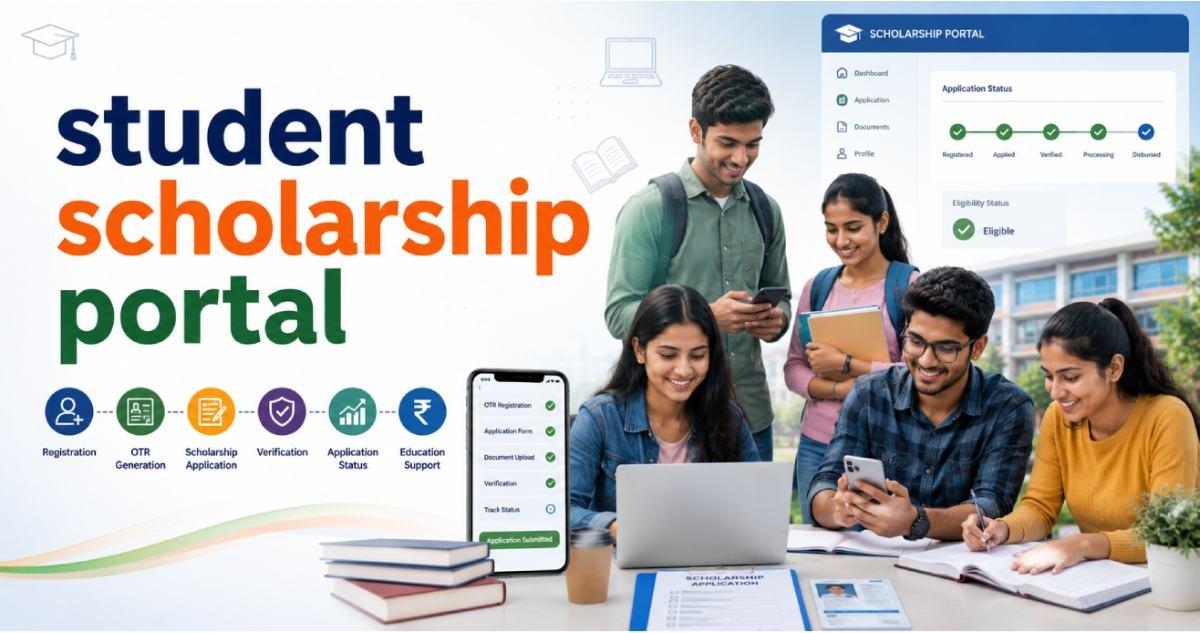
The Student Scholarship Portal most users are looking for is the National Scholarship Portal, or NSP. NSP is the Government of India platform used to discover, apply for, verify, sanction and track multiple scholarship schemes. NSP is not one scholarship. Each scholarship on the portal has its own eligibility, amount, income limit, study level and deadline. For Academic Year 2026 to 2027, the portal is open and One Time Registration is mandatory.
Fast answer: create or retrieve your OTR first, confirm the scholarship scheme you qualify for, check the correct student deadline, prepare the scheme specific documents, submit the application, monitor institute and higher verification, then track sanction and payment separately.
The official portal describes NSP as a common electronic platform for scholarship application, processing, sanction and disbursement. See the National Scholarship Portal overview.
Student Scholarship Portal at a Glance
| Attribute | Current Answer |
|---|---|
| Official portal | National Scholarship Portal |
| Academic year | 2026 to 2027 |
| Portal status | Open |
| Portal opening date | June 1, 2026 |
| Student identity | One Time Registration |
| OTR format | Unique 14 digit number |
| OTR validity | Entire academic career |
| Fresh application | Available according to scheme status |
| Renewal | Available according to scheme status |
| Scholarship amount | Scheme specific |
| Income ceiling | Scheme specific |
| Student deadline | Scheme specific |
| Institute verification | Scheme specific |
| Payment tracking | PFMS linked tracking |
| Institute search | Available on NSP |
| Grievance | Available through the public section |
What Is the Student Scholarship Portal?
The National Scholarship Portal is a Government of India scholarship platform. It brings multiple scholarship schemes into one digital system so students can discover opportunities, submit applications, complete verification workflows and receive approved benefits through government payment systems.
NSP connects students, institutions, ministries, departments, States and Union Territories. It also supports scholarship eligibility discovery, institution search, nodal officer information, grievance registration and payment tracking.
The Government lists these functions on the official National Scholarship Portal.
Is NSP a Scholarship?
No. NSP is a portal. The individual scheme is the scholarship.
This distinction matters because NSP does not have one universal scholarship amount, one income limit, one course list or one closing date. Those attributes belong to each scheme hosted on the portal.
Correct question: Which scholarship scheme on NSP matches my profile? Incorrect question: How much money does NSP give every student?
Is the National Scholarship Portal Open for 2026 to 2027?
Yes. The National Scholarship Portal is open for Academic Year 2026 to 2027 from June 1, 2026.
The portal opening date is not the same as the closing date for every scholarship. Each scheme publishes its own student application date, defective application verification date, institute verification date and higher authority verification date.
The current academic year announcement appears on the official NSP student page.
Current 2026 to 2027 Deadline Examples
| Scheme Example | Student Deadline | Defective Verification | Institute Verification | Higher Verification |
|---|---|---|---|---|
| National Means Cum Merit Scholarship | September 30, 2026 | October 15, 2026 | October 15, 2026 | October 31, 2026 |
| PM USP Central Sector Scholarship renewal | September 30, 2026 | October 15, 2026 | October 15, 2026 | October 30, 2026 |
| AICTE Pragati Technical Degree | October 31, 2026 | November 15, 2026 | November 15, 2026 | November 30, 2026 |
| Post Matric Scholarship for Students With Disabilities | October 31, 2026 | November 15, 2026 | November 15, 2026 | November 30, 2026 |
| Prime Minister Scholarship Scheme for Central Armed Police Forces and Assam Rifles | October 31, 2026 | November 15, 2026 | November 15, 2026 | November 30, 2026 |
Live timelines should always be checked on the official NSP scholarship scheme list.
Who Should Use the Student Scholarship Portal?
Use NSP when the scholarship you want is officially onboarded on the portal and your profile matches the scheme.
School students applying for eligible school level scholarship schemes.
College and university students applying for eligible higher education scholarships.
Diploma and technical education students where their scheme is onboarded.
Students seeking merit based scholarships listed on NSP.
Students seeking welfare based scholarships listed on NSP.
Students with disabilities applying through an eligible NSP scheme.
Existing recipients who need to submit a renewal application.
Students who need to track institute verification or payment status.
Who Should Not Use NSP for a Particular Scholarship?
Do not use NSP if the scholarship provider directs applicants to a separate official portal.
Do not assume every State scholarship is available on NSP.
Do not apply if your study level does not match the scheme.
Do not apply if your income, category, domicile or academic status fails a mandatory rule.
Do not submit a fresh form when the scheme requires renewal.
Do not choose a similarly named scholarship only because it appears in search results.
Do not continue with a scheme if your institution or course is not eligible.
Not Eligible Versus Scheme Not Available
Not eligible means you fail a mandatory rule of a scholarship. Scheme not available means the scholarship may exist but is not currently open, is not onboarded for your State or category, or uses another official portal. These are different problems and require different next steps.
How to Find Which Scholarship You Are Eligible For
Eligibility should be checked before document preparation. NSP provides a scholarship eligibility tool, but the final authority is the specification of the individual scheme.
Opportunity Scholarship Eligibility Router
Select your current education level.
Confirm your State or domicile.
Confirm your category where the scheme uses a beneficiary category.
Check annual family income where the scheme uses an income ceiling.
Confirm your institution and course type.
Check academic marks, rank or merit requirements.
Check disability status where relevant.
Confirm whether you need a fresh application or renewal.
Check whether the scholarship is currently open.
Read the scheme specification before submitting.
Students can use the official NSP scholarship eligibility tool to narrow the available schemes.
Which Scholarships Are Available on NSP?
NSP hosts scholarship schemes from different ministries and departments. The live list changes by academic year and opening status.
| Student Need | Current Scheme Example | NSP Classification |
|---|---|---|
| School merit | National Means Cum Merit Scholarship | Merit based |
| College and university | PM USP Central Sector Scholarship for College and University Students | Merit based |
| Technical education | AICTE Pragati Scholarship for Girl Students | Merit based |
| Technical education welfare | AICTE Swanath Scholarship | Welfare based |
| Students with disabilities | Post Matric Scholarship for Students With Disabilities | Welfare based |
| Students with disabilities | Top Class Education for Students With Disabilities | Welfare based |
| ST higher education | National Fellowship and Scholarship for Higher Education of ST Students | Merit based |
| Security force families | Prime Minister Scholarship schemes for eligible wards | Merit based |
| North Eastern Region | NEC Merit Scholarship renewal | Merit based |
This list is illustrative. Students should use the live scheme list because schemes can open, close or change status during the academic year.
Can You Apply for More Than One Scholarship on NSP?
For Academic Year 2026 to 2027, NSP states that a student may apply for one merit based scholarship scheme and one or more welfare based scholarship schemes, subject to the eligibility criteria of each scheme.
This does not mean every combination can be paid together. Individual scheme rules can still restrict duplicate benefits or overlapping assistance.
The current combination rule is published in the official NSP student announcement.
What Is OTR?
OTR means One Time Registration. It is a unique 14 digit student number issued on the basis of Aadhaar or Aadhaar Enrolment ID.
OTR is required to apply for scholarships on NSP. The number is intended to remain valid throughout the student’s academic career.
The current OTR definition is published on the official NSP student page.
Why OTR Comes Before the Scholarship Application
OTR creates the persistent student identity used by NSP. From Academic Year 2024 to 2025 onward, the OTR number is required for fresh and renewal scholarship applications.
This means the correct journey is identity first and scholarship application second.
The Government introduced the redesigned OTR process as part of the 2024 NSP cycle. See the Press Information Bureau OTR announcement.
What You Need Before Creating OTR
An active mobile number you control.
Aadhaar or Aadhaar Enrolment ID as permitted by the current process.
Access to the required Aadhaar authentication route.
Correct name, date of birth and identity information.
A compatible mobile device when face authentication is required.
Updated Aadhaar Face RD application where face authentication is used.
Unlocked Aadhaar biometrics before face authentication.
Step by Step OTR Registration
Open the official National Scholarship Portal.
Choose the One Time Registration option.
Enter the requested mobile and identity information.
Complete the electronic identity verification process.
Provide Aadhaar or Aadhaar Enrolment ID as permitted.
Generate the reference number if the workflow provides one before final OTR.
Install the required face authentication applications when instructed.
Complete face authentication.
Confirm the OTR has been generated.
Save the 14 digit OTR securely for future academic years.
Do not create duplicate identities. Keep the OTR with your scholarship records because it is designed to continue across your academic career.
Why Face Authentication Fails
Face authentication can fail because Aadhaar biometrics are locked, the Aadhaar Face RD application is outdated, the device cannot complete the authentication correctly, or identity details do not match.
What does error 904 mean?
NSP currently advises students receiving error 904 during face authentication to update the UIDAI Aadhaar Face RD application and try again.
Check biometric lock status
NSP also warns that face authentication can fail when the Aadhaar holder has locked biometric authentication. Unlock the biometric setting before retrying the NSP OTR process.
The current troubleshooting instructions are published in NSP student announcements.
Aadhaar biometric controls are managed through the official UIDAI Aadhaar services.
Required Documents for Student Scholarship Portal Applications
There is no single universal document list for every NSP scholarship. OTR identity requirements and scholarship scheme documents are separate.
| Document | Why It Is Needed | Common Mistake |
|---|---|---|
| Aadhaar | Identity and OTR | Name or birth details do not match |
| OTR | Persistent NSP identity | Lost number or wrong student identity |
| Mobile number | Authentication and communication | Using a number the student cannot access |
| Domicile certificate | State eligibility where required | Wrong State or outdated record |
| Community certificate | Category eligibility where required | Wrong certificate type |
| Income certificate | Financial eligibility where required | Expired or wrong income period |
| Academic marksheet | Merit or progression evidence | Uploading the wrong academic year |
| Admission proof | Confirms current course | Course name differs from NSP record |
| Bonafide certificate | Confirms current enrollment | Old session document |
| Fee receipt | Supports fee details where requested | Unreadable or incomplete receipt |
| Bank information | Scholarship payment | Wrong account or holder information |
| Disability or UDID record | Disability scholarship eligibility | UDID consent not completed |
| Scheme specific proof | Special eligibility | Assuming generic documents are enough |
Step by Step Student Scholarship Portal Application Guide
Use this sequence after your OTR is ready.
Log in with your OTR and password.
Complete or review your student profile.
Use the eligibility tool to identify possible scholarships.
Open the specification of the scholarship you want.
Check the student deadline and verification dates.
Confirm that your institution is registered where required.
Decide whether the application is fresh or renewal.
Prepare the current scheme specific documents.
Enter academic information exactly as shown in official records.
Enter institution and course information carefully.
Enter bank information accurately.
Upload the required certificates and evidence.
Review every field before final submission.
Submit the application before the student closing date.
Save the Application ID and acknowledgement.
Confirm that your institution has received the application for verification.
Respond quickly if the application becomes defective.
Monitor higher verification after institute approval.
Check sanction status after final verification.
Track payment separately when the scholarship enters the payment system.
Fresh Application Versus Renewal
| Attribute | Fresh Application | Renewal |
|---|---|---|
| Who uses it | Student entering the scheme for the first eligible time | Existing scholarship recipient continuing in the scheme |
| OTR | Required | Required |
| Academic evidence | Used to establish entry eligibility | Used to show continuation and progress |
| Current enrollment | Must match scheme rules | Must remain eligible for continuation |
| Documents | Full scheme requirements | Updated documents according to renewal rules |
| Deadline | Scheme specific | Can differ from fresh application |
| Verification | Required | Usually required again |
How Does Scholarship Selection Work on NSP?
NSP does not centrally choose every scholarship recipient. The individual scholarship scheme and its implementing authorities control selection.
NSP provides the digital workflow. The scheme owner defines eligibility and the verification chain.
Typical NSP selection and verification funnel
The student submits the scholarship application.
The institution checks enrollment and application details.
The application moves to the next scheme authority where required.
District, State, ministry or department level verification is completed according to the scheme.
The eligible application is approved or sanctioned.
The payment enters the government payment workflow.
The approved amount reaches the beneficiary bank account after successful payment processing.
Institute Verification Explained
Institute verification is the stage where the school, college, university or other registered institution confirms that the student is genuinely enrolled and that the course and application details are consistent.
The institute can verify identity and admission information.
The institute can check course and academic session details.
The institute can identify missing or incorrect documents.
The institute may return a defective application for correction.
The application cannot progress normally when required institute verification remains incomplete.
If institute verification is pending, contact the institution scholarship office or Institute Nodal Officer before assuming that the ministry has rejected the application.
L1 and L2 Verification Explained
L1 and L2 are verification levels used in some NSP schemes. The exact authority depends on the scheme.
A Government example is the National Means Cum Merit Scholarship workflow, where L1 verification is completed by the Institute Nodal Officer and L2 verification is completed by the District Nodal Officer.
The Government documented the two level verification model in the Press Information Bureau NSP scholarship notice.
Do not assume every scholarship uses the same officer names. Read the live scheme specification and deadline table.
What Does Defective Application Mean?
A defective application contains an error, inconsistency or missing item that requires student correction before the verification process can continue.
| Defect Type | Typical Problem |
|---|---|
| Identity mismatch | Name, birth date or Aadhaar details conflict |
| Academic mismatch | Marks, course or session details are incorrect |
| Institution mismatch | Institute or course does not match the registered record |
| Certificate problem | Income, category or domicile evidence is invalid or unreadable |
| Bank problem | Account data is incorrect or incomplete |
| Missing document | A scheme required attachment was not uploaded |
A defective application has its own correction or verification deadline. Do not wait until the institute deadline to check whether the application has been returned for correction.
How to Check Student Scholarship Portal Status
| Status | Meaning | Student Action |
|---|---|---|
| Submitted | The application was sent successfully | Save the acknowledgement and monitor verification |
| Defective | A correction is required | Open the application and correct the issue before the allowed date |
| Institute pending | The institution has not finished verification | Contact the scholarship office or Institute Nodal Officer |
| Institute verified | The institution approved the application | Wait for the next scheme authority |
| Higher verification pending | District, State, ministry or department review is incomplete | Monitor the portal |
| Approved | The application passed the required eligibility review | Check whether sanction is generated |
| Sanctioned | The scholarship amount is approved for payment | Monitor payment processing |
| Sent for payment | Payment data entered the government payment workflow | Track the payment |
| Credited | The scholarship reached the bank account | Keep the payment record |
What Does Sent to PFMS Mean?
PFMS means Public Financial Management System. When a scholarship reaches the payment stage, PFMS can be used to track disbursement.
Sent to PFMS does not mean the money is already visible in your bank account. Payment processing, bank validation and final credit are separate stages.
NSP provides a direct payment tracking route to the Public Financial Management System.
How to Check Scholarship Payment
Check the latest scholarship status inside NSP.
Confirm that the application is sanctioned or sent for payment.
Use the official PFMS payment tracking route where the scheme supports it.
Check that your bank account details remain correct.
Confirm Aadhaar bank seeding when the scheme uses DBT.
Check your bank balance or transaction history after payment processing.
Use the NSP or PFMS helpdesk when the status and bank record do not match for an extended period.
Why Aadhaar Bank Seeding Matters
Direct Benefit Transfer can require a bank account linked and seeded with Aadhaar through the NPCI mapper. A scholarship may be approved while payment still fails or redirects if the bank seeding is not correct.
UIDAI explains the DBT bank seeding process and checking options on the official Aadhaar Direct Benefit Transfer guidance.
NSP also provides a bank seeding status link in the student area.
Why Does NSP Show No Eligible Scholarship?
No eligible scholarship does not always mean that no scholarship exists for the student.
The relevant scholarship may not be open yet.
The selected study level may not match the scheme.
The domicile or State information may be wrong.
The family income may exceed a scheme limit.
The category may not match the scheme.
The institution or course may not be mapped correctly.
The student may have selected the wrong fresh or renewal route.
The scholarship may use another official State or ministry portal.
Recheck the profile against the scheme specification before changing documents or creating another account.
What If My Institute Is Not Showing on NSP?
NSP maintains a searchable register of participating schools, colleges and institutes. If your institution is not found, first verify the official institution name and code.
New institutions that are not onboarded can register when they hold a valid AISHE, UDISE Plus or NCVT code, according to the institution type.
Students and institutions can use the official NSP registered institute search.
Institution onboarding requirements are published on the official NSP institute page.
If the institution should be available but does not appear, contact the college or school scholarship office rather than selecting a different institution.
Special Requirement for Students With Disabilities
For the current 2026 to 2027 cycle, NSP states that disabled students must log in to the UDID portal and provide consent to share their UDID details before submitting the NSP application.
The student should complete the UDID step before attempting final scholarship submission. The individual scholarship can still require additional disability documents.
The current requirement is stated in the official NSP student announcements.
Can a Common Service Centre Help With NSP?
Yes. NSP currently states that scholarship related services are available through Common Service Centres.
CSC assistance can include reference generation, biometric authentication, OTR generation and application filing. Students should still keep control of their OTR, Application ID, password and personal records.
Current CSC assistance information appears in the official NSP student announcements.
How to Get NSP Help
Use the support path that matches the problem.
| Problem | Best First Contact |
|---|---|
| OTR or NSP login problem | NSP helpdesk |
| Institute verification problem | Institute scholarship office or Institute Nodal Officer |
| Scheme eligibility problem | Scheme specification or scheme nodal officer |
| Higher verification problem | Relevant district, State or ministry nodal officer |
| Payment problem | PFMS helpdesk after confirming sanction status |
| Aadhaar problem | UIDAI |
| Formal portal complaint | NSP grievance registration |
NSP provides nodal officer, grievance and helpdesk access through the official NSP public section.
Current NSP and PFMS support contact information is available on the official NSP helpdesk page.
Common Student Scholarship Portal Mistakes
Treating NSP as one scholarship.
Searching for one universal NSP scholarship amount.
Ignoring the live scheme specification.
Creating OTR under deadline pressure.
Losing the OTR and Application ID.
Entering identity details that do not match Aadhaar.
Retrying face authentication without checking biometric lock status.
Using an outdated Aadhaar Face RD application.
Selecting the wrong domicile.
Selecting the wrong scholarship scheme.
Choosing fresh instead of renewal or renewal instead of fresh.
Uploading an expired income or category certificate.
Ignoring institution registration.
Submitting documents that are unreadable.
Assuming form submission means approval.
Ignoring institute verification.
Missing a defective application correction deadline.
Assuming institute verification means final sanction.
Assuming PFMS status means immediate bank credit.
Ignoring Aadhaar bank seeding where DBT applies.
Using a previous academic year deadline.
Entering personal information into unofficial websites or chat services.
Current NSP Deadline Strategy for 2026 to 2027
Do not create one national NSP deadline in your personal calendar. Create four dates for the scholarship you selected.
Student application deadline.
Defective application correction or verification deadline.
Institute verification deadline.
District, State, ministry or other higher verification deadline.
Some current schemes close student applications on September 30, 2026. Many others close on October 31, 2026. Verification can continue into October or November.
The live scheme listing should be checked again immediately before submission because official dates can be extended or modified.
Previous Years’ Student Scholarship Portal Trends
| Period or Trend | What Changed |
|---|---|
| Academic Year 2024 to 2025 | OTR became required for fresh and renewal NSP applications and the redesigned OTR web and mobile process was launched |
| Academic Year 2025 to 2026 | OTR continued as the persistent scholarship identity across the academic lifecycle |
| Academic Year 2026 to 2027 | The portal opened June 1, 2026 and explicitly supports one merit based scheme plus one or more welfare based schemes where eligible |
| Identity trend | Aadhaar and face authentication became more central to registration and verification |
| Payment trend | PFMS and Aadhaar bank seeding remain key parts of the payment journey |
| Accessibility trend | Current disabled applicant workflow includes UDID consent before NSP submission |
| Assisted access trend | Common Service Centre support now covers the scholarship application workflow |
The 2024 OTR rollout is documented by the Press Information Bureau.
Opportunity Research Notes: What Students Usually Miss
| Research Insight | Why It Matters |
|---|---|
| NSP is infrastructure, not the scholarship | Amount, income ceiling and academic rules belong to the scheme. |
| OTR is the start of the journey | Identity setup should happen before deadline pressure begins. |
| Portal opening is not the scholarship deadline | Each scheme has its own student and verification dates. |
| One profile can surface different scheme types | Eligibility depends on the data entered and the live scheme list. |
| One merit plus welfare combinations are now explicit | Older advice saying only one scholarship can be applied for may be incomplete for the 2026 to 2027 cycle. |
| Submission is only the first status | Verification and sanction come after the form is submitted. |
| Institute verification is a real dependency | A valid student application can remain stuck before government review. |
| No eligible scheme can be a system or mapping issue | Timing, profile data, course mapping and portal choice should be checked before assuming ineligibility. |
| PFMS is a payment stage, not automatic bank credit | Payment processing and final bank credit are separate. |
| Aadhaar bank seeding matters after approval | DBT can fail even after scholarship sanction if payment mapping is not correct. |
| State portals can coexist with NSP | Students should verify the official application route for the specific scheme. |
| Disabled applicants have an extra current step | UDID consent must be completed before final NSP submission in the current cycle. |
Frequently Asked Questions About the Student Scholarship Portal
What is the Student Scholarship Portal?
The Student Scholarship Portal most users mean is the National Scholarship Portal. NSP is a Government of India platform that hosts multiple scholarship schemes and supports student registration, eligibility checking, scholarship applications, institutional verification, sanction and payment tracking. The portal itself is not a scholarship and does not have one universal award amount.
Is Student Scholarship Portal the same as NSP?
For most India focused searches, yes. The query usually refers to the National Scholarship Portal. However, some State Governments and scholarship providers operate separate official portals. Always check the individual scholarship instructions before assuming that an opportunity must be submitted through NSP.
What is the official NSP website?
The official platform is the National Scholarship Portal operated on the Government domain scholarships.gov.in. Students should use the official portal for OTR, scholarship applications, scheme specifications, eligibility tools, institute search, grievances and payment links. Avoid entering Aadhaar, bank or password information on imitation websites.
Is NSP open for 2026 to 2027?
Yes. The National Scholarship Portal is open for Academic Year 2026 to 2027 from June 1, 2026. Individual scholarship opening and closing dates differ. Some current schemes close student applications on September 30, while many others close on October 31, followed by separate verification dates.
How do I register on NSP?
Start with One Time Registration. Open the official NSP, enter the requested mobile and identity information, complete Aadhaar based verification, follow the face authentication process where required and generate your OTR. After OTR is ready, log in and apply for the scholarship scheme that matches your profile.
What is OTR on NSP?
OTR means One Time Registration. It is a unique 14 digit number issued using Aadhaar or Aadhaar Enrolment ID. NSP uses OTR as the student’s persistent identity for scholarship applications. The number is designed to remain valid throughout the academic career, so students should store it securely.
Is OTR mandatory for NSP?
Yes. NSP states that OTR is required to apply for scholarships. The requirement applies to applications from Academic Year 2024 to 2025 onward. Students who already received an OTR should use the existing number rather than creating a duplicate identity for the new academic year.
How long is OTR valid?
NSP states that OTR is applicable for the student’s entire academic career. It is therefore not meant to be recreated every year. A scholarship Application ID can change with the application, but the OTR remains the persistent identity connecting the student to NSP scholarship activity.
Can I register without Aadhaar?
NSP states that OTR can be generated using Aadhaar or Aadhaar Enrolment ID according to the current process. Students who do not yet have Aadhaar should follow the permitted EID route and the latest portal instructions. Do not invent identity information or use another person’s Aadhaar.
How do I complete face authentication?
Follow the OTR instructions shown by NSP. Students may need the NSP OTR application and the UIDAI Aadhaar Face RD application on a compatible device. Ensure Aadhaar biometrics are unlocked before authentication. If the process fails, update the required applications and confirm that Aadhaar data is correct.
Why is NSP face authentication failing?
Common reasons include locked Aadhaar biometrics, an outdated Aadhaar Face RD application, device issues or identity mismatch. NSP specifically advises students receiving error 904 to update the UIDAI Aadhaar Face RD application. If authentication continues to fail, check Aadhaar settings before repeating the process.
What is error 904 on NSP?
Error 904 is a face authentication problem addressed in current NSP announcements. The portal advises students to update the UIDAI Aadhaar Face RD application from the official app store and retry. Students should also ensure that Aadhaar biometrics are unlocked before attempting face authentication again.
How do I find scholarships I qualify for?
Use the NSP scholarship eligibility tool and then read the scheme specification. Eligibility can depend on study level, State, domicile, community, income, disability, course, institution, academic merit and application type. The eligibility tool helps narrow choices, but the live scheme rules remain the final authority.
Why does NSP show no eligible scheme?
The result can appear because your profile does not meet a scheme, the relevant scheme is not open, your course or institution is not mapped correctly, your State uses another portal, or a profile field is wrong. Recheck the scheme specification and student profile before assuming no scholarship exists.
Can I apply for more than one scholarship on NSP?
For Academic Year 2026 to 2027, NSP states that students may apply for one merit based scholarship scheme and one or more welfare based scholarship schemes, subject to eligibility. Individual schemes can still restrict overlapping benefits, so application permission does not automatically guarantee that every award can be received together.
What documents are required for NSP?
There is no universal document list for every scheme. Common records include Aadhaar, OTR, academic marksheets, admission evidence, income certificate, community certificate, domicile proof, bank details and disability records where applicable. Open the current scholarship specification to confirm the exact required documents before uploading anything.
How do I apply for a scholarship on NSP?
Generate OTR, log in, complete the profile, find an eligible scheme, check its deadline and specification, prepare documents, select fresh or renewal, complete the form and submit it. Save the Application ID. After submission, monitor institute verification, correction notices, higher verification, sanction and payment.
What is the difference between Fresh and Renewal?
A fresh application is for a student entering the scholarship scheme for the first eligible time. Renewal is for an existing recipient continuing in the scheme. Both use OTR, but documents and academic continuation rules can differ. Always choose the application type shown for your current scholarship history.
What does defective application mean?
A defective application contains an error or missing item that must be corrected. Common causes include identity mismatch, wrong course details, invalid certificates, unreadable documents and incorrect bank information. Open the application immediately, review the defect reason and correct it before the published defective verification deadline.
Why is institute verification pending?
The institution may not have completed its scholarship verification batch, or your admission, course, academic or document information may require review. Contact the institution scholarship office or Institute Nodal Officer first. The application may not progress to higher government verification until the institute completes its required action.
How do I check NSP scholarship status?
Log in with your OTR credentials and open the scholarship application status. Track the sequence from submitted to institute verification, higher verification, approval, sanction and payment. If the application becomes defective, correct it before the allowed date. Keep your Application ID for follow up.
What is L1 verification?
L1 means the first verification level in schemes that use this terminology. In the National Means Cum Merit Scholarship example, L1 is completed by the Institute Nodal Officer. Other schemes can use different structures, so students should not assume that every NSP scholarship assigns the same officer to L1.
What is L2 verification?
L2 is a higher verification stage used by some schemes. In the National Means Cum Merit Scholarship example, the District Nodal Officer performs L2 verification. The relevant authority can vary by scheme. Check the live scheme specification and deadline table for the exact verification chain.
What does sent to PFMS mean?
It means the scholarship has entered the government payment workflow involving the Public Financial Management System. It does not mean the amount is already credited to the bank. Payment can still pass through validation and banking stages. Track PFMS status and confirm bank details before raising a payment complaint.
When will scholarship money be credited?
There is no one payment date for every NSP scholarship. Credit depends on scheme verification, sanction, payment processing and the beneficiary bank account. A student should first confirm that the application is approved and sanctioned, then track PFMS and check the bank account rather than relying on unofficial payment dates.
How do I check Aadhaar bank seeding?
NSP provides an Aadhaar bank seeding status option. UIDAI also explains that DBT bank seeding information can be checked through official Aadhaar services or the NPCI seeding system. Bank seeding matters because approved government benefits can depend on the correctly mapped DBT enabled bank account.
What if my institution is not listed on NSP?
Search the institution using its official name and code. NSP allows registered institution searches and supports onboarding for eligible institutions with valid AISHE, UDISE Plus or NCVT codes. If the institution should be registered but is missing, contact the institution scholarship office instead of selecting another college.
How do I renew an NSP scholarship?
Use your existing OTR, log in and select the renewal option for the relevant scholarship when it is open. Update current academic and enrollment information, upload any required new documents and submit before the renewal deadline. Renewal still requires verification and can have a separate schedule from fresh applications.
Can I change my domicile after submitting?
Do not assume that a major eligibility field can be freely changed after final submission. Domicile can determine scheme eligibility and State routing. If you entered it incorrectly, check whether the application can be edited or returned for correction. Use the NSP helpdesk or scheme authority when the portal locks the field.
How do I file an NSP grievance?
Use the grievance registration option in the public section of NSP. Choose the issue carefully and keep the OTR, Application ID, scheme name and relevant status available. For institute verification issues, contact the institution first. For payment problems after sanction, PFMS support may be the more relevant route.
How do I contact NSP support?
NSP provides a helpdesk through the official portal, along with separate PFMS support for payment issues. The public section also lists nodal officers and grievance officers. Use the support channel that matches the problem so a payment issue is not sent to an institution and an eligibility issue is not sent to PFMS.
Final Student Scholarship Portal Checklist
Use the official National Scholarship Portal.
Create or retrieve your OTR early.
Confirm your scholarship scheme before preparing documents.
Check the scheme specific student deadline.
Check defective and institute verification dates.
Confirm your institution is registered where required.
Prepare current scheme specific certificates.
Choose fresh or renewal correctly.
Save your Application ID.
Monitor institute and higher verification.
Track PFMS only after the application reaches payment stages.
Confirm Aadhaar bank seeding where DBT applies.
Use official grievance and helpdesk routes for unresolved problems.
Conclusion
The Student Scholarship Portal is most useful when students treat it as a complete scholarship lifecycle rather than only a login page. Start with OTR. Then identify the correct scholarship scheme, verify eligibility, confirm the live deadline, prepare the correct documents and submit the application. After submission, continue monitoring institute verification, higher verification, sanction and payment.

You may like

Check Student Scholarship Status Online: SSP Karnataka Application and Payment Status

Government Scholarship for College Students 2022 in India: Eligibility, Amount, and Application Guide

Digital Gujarat Scholarship for OBC Students 2026 to 27: Eligibility, Amount, Last Date and Application Guide

Turkey Burslari Scholarship 2026: Eligibility, Benefits, Deadline, Interview, and Results

SBI Asha Scholarship 2026-27: Eligibility, Amount, Last Date and Apply Online

Scholarship for J&K Students: Eligibility, Amount, Deadlines, and How to Apply
Trending
-
 Scholarships2 months ago
Turkey Burslari Scholarship 2026: Eligibility, Benefits, Deadline, Interview, and Results
-
 Scholarships1 month ago
SBI Asha Scholarship 2026-27: Eligibility, Amount, Last Date and Apply Online
-
 Scholarships2 months ago
Scholarship for J&K Students: Eligibility, Amount, Deadlines, and How to Apply
-
 By Country2 months ago
Korean Government Scholarship for Indian Students: GKS Eligibility, Benefits, Deadlines and Application
-

 Scholarships1 month ago
Scholarships for PG Students in Kerala 2026: Eligibility, Amounts, Deadlines and Application Links
-
 By Country2 months ago
Scholarship for MBBS Students in India
-

 Scholarships1 month ago
West Bengal Student Scholarship 2026-27: Eligibility, Amounts, Last Dates and Apply Online
-

 Scholarships2 months ago
Abdul Kalam Scholarship for Class 10 Students: Verified Programs, Eligibility and Application Guide