
Scholarships
Scholarship for SC Students in Gujarat 2026–27: Digital Gujarat Eligibility, Amount, Last Date & Apply Online

Published
1 week agoon
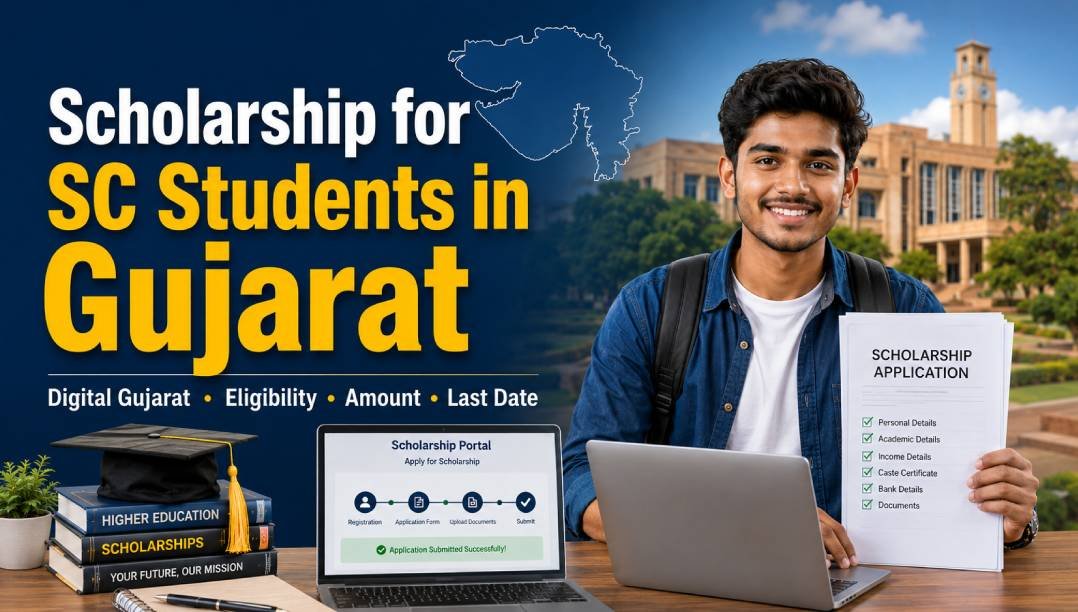
Scheduled Caste students in Gujarat can receive financial assistance for school, college, professional education, ITI, hostel expenses, research, and overseas study.
There is no single scheme officially called only the “SC Scholarship Gujarat.”
The Government of Gujarat operates several Scheduled Caste education schemes through the Director, Scheduled Caste Welfare.
Most post-matric students apply through the Digital Gujarat scholarship portal.
For the 2026–27 academic year, Digital Gujarat SC scholarship applications are currently open from July 6, 2026 to September 30, 2026.
Students can check the current application cycle through the Government Polytechnic Palanpur 2026–27 scholarship notice and use the Digital Gujarat scholarship portal to apply.
The main Post-Matric Scholarship is GOI’s Post Matric Scholarship for SC Students, BCK-6.1.
BCK-6.1 generally applies to eligible SC students with annual family income up to INR 250,000, approximately USD 2,620 at the August 31, 2026 reference exchange rate.
However, INR 250,000 is not the final income limit for every SC scholarship in Gujarat.
Gujarat separately operates state schemes for students above the central Post-Matric Scholarship income threshold.
Quick answer: SC students with annual family income up to INR 250,000 should check BCK-6.1 first. SC girls above INR 250,000 should investigate the Bhagwan Buddha Scholarship BCK-5. SC boys above the central income limit should check BCK-5A and its current conditions.
SC Scholarship Gujarat 2026–27: Quick Overview
| Attribute | Current details |
|---|---|
| Category | Scheduled Caste |
| State | Gujarat |
| Main portal | Digital Gujarat |
| Main authority | Director, Scheduled Caste Welfare |
| Main post-matric scheme | BCK-6.1 |
| Main BCK-6.1 income limit | INR 250,000 |
| Approx. USD equivalent | USD 2,620 |
| 2026–27 application opening | July 6, 2026 |
| Current last date | September 30, 2026 |
| Tuition support | Approved tuition and eligible fees under applicable schemes |
| Academic allowance | Group-based |
| Hosteller benefit | Higher allowance under applicable post-matric groups |
| SC girls above INR 250,000 | BCK-5 |
| SC boys above INR 250,000 | BCK-5A subject to current rules |
| Engineering/medical/diploma aid | BCK-12 |
| Hostel food assistance | BCK-10 |
| ITI stipend | BCK-13 |
| M.Phil/PhD assistance | BCK-11 |
| Application mode | Online for major schemes |
| Payment | DBT / applicable government payment mechanism |
| Renewal | Available for recurring schemes |
USD amounts in this guide are approximate references only.
Gujarat scholarship authorities calculate eligibility and benefits in Indian rupees.
What Scholarships Are Available for SC Students in Gujarat?
Gujarat operates a broad Scheduled Caste education-support system.
The Director, Scheduled Caste Welfare educational schemes directory currently lists more than 30 education-related SC schemes.
The correct scholarship depends on the student’s class, income, gender, course, hostel status, and academic stage.
1. GOI Post Matric Scholarship for SC Students — BCK-6.1
BCK-6.1 is the central scholarship for many SC students studying after SSC.
The official BCK-6.1 Post-Matric Scholarship page states that the applicant must:
- belong to a Scheduled Caste;
- satisfy the Government of India Post-Matric Scholarship conditions; and
- have annual family income within INR 250,000.
The scheme provides:
- approved tuition fees;
- approved other educational fees;
- group-based academic allowance; and
- additional disability allowance where applicable.
Students apply online through Digital Gujarat.
The District Deputy Director of Scheduled Caste Welfare is the implementing office.
2. Bhagwan Buddha Scholarship for SC Girls — BCK-5
BCK-5 is one of the most important Gujarat-specific schemes.
The Bhagwan Buddha Scholarship serves eligible Scheduled Caste female students whose family income is above INR 250,000.
The official Bhagwan Buddha Scholarship BCK-5 page states that only SC girls are eligible.
For diploma-level study, the student must satisfy the specified 50% percentile requirement in Class 10 or 12.
For graduate-level study, the student must satisfy the applicable Class 12 percentile requirement.
The scholarship provides the same broad group-based academic allowance structure as BCK-6.1.
Approved tuition fees and approved other fees can also be admissible.
This scheme is especially important because it prevents the INR 250,000 central PMS income threshold from becoming an automatic financial-aid cutoff for every SC girl.
3. State Post-SSC Scholarship for SC Boys — BCK-5A
Gujarat also lists a separate State Post-SSC Scholarship for SC male students, BCK-5A.
The official Scheduled Caste Welfare educational scheme directory currently identifies BCK-5A as a distinct SC boys’ post-SSC scheme.
Current Government Engineering College guidance describes BCK-5A as a route for SC male students whose income falls above the central PMS threshold and within the applicable state ceiling.
Students should verify the exact current BCK-5A income and marks conditions when applying because state resolutions can be updated.
4. Parixitlal Majmudar Pre-SSC Scholarship — BCK-2/71
The Parixitlal Majmudar Scholarship supports SC school students.
The official Parixitlal Majmudar Scholarship page states that there is no income limit.
Current annual rates are:
| Standard | Student | Annual amount |
|---|---|---|
| Classes 1–5 | Boys and girls | INR 750 |
| Classes 6–8 | Boys | INR 750 |
| Classes 6–8 | Girls | INR 1,000 |
| Classes 9–10 | Boys and girls | INR 1,000 |
Applications are processed online through school principals using Digital Gujarat.
This means the student or parent may not follow exactly the same self-application workflow as a college student.
5. GoI Pre-Matric Scholarship for SC Students in Classes 9–10
Gujarat also administers the centrally sponsored Pre-Matric Scholarship for SC students in Classes IX and X.
The scheme generally uses an annual family-income ceiling of INR 250,000.
It operates separately from the Parixitlal Majmudar state scholarship.
Students should therefore avoid assuming that every pre-matric SC scheme has the same income rule.
6. Food Bill Assistance for SC Students — BCK-10
BCK-10 supports eligible SC students living in qualifying college-affiliated hostels.
The official BCK-10 Food Bill Assistance page specifies:
- SC category;
- residence in a hostel affiliated with the college;
- annual family income up to INR 600,000; and
- assistance of INR 1,500 per month for up to 10 months.
The maximum listed benefit is therefore:
INR 15,000 per year, approximately USD 157.
Food Bill Assistance is separate from the ordinary academic allowance available under the Post-Matric Scholarship.
7. Assistance for M.Phil and PhD SC Students — BCK-11
Research students have a separate financial-aid route.
The Maharaja Sayajirao Gayakvad Assistance BCK-11 supports eligible M.Phil and PhD students.
The official M.Phil and PhD assistance scheme page lists:
| Level | Monthly amount | Maximum period | Approx. total |
|---|---|---|---|
| M.Phil | INR 2,500 | 10 months | USD 262 |
| PhD | INR 10,000 | 10 months | USD 1,048 |
The annual income ceiling is INR 600,000.
The assistance is connected with submission of the thesis.
8. Medical, Engineering and Diploma Assistance — BCK-12
BCK-12 provides additional assistance to eligible SC students entering professional or technical education.
The official BCK-12 professional-course assistance page states that the scheme applies to students studying:
- medical courses;
- degree engineering; and
- diploma programmes.
The current amounts are:
| Course | Assistance |
|---|---|
| Medical | INR 15,000 ≈ USD 157 |
| Degree Engineering | INR 10,000 ≈ USD 105 |
| Diploma | INR 5,000 ≈ USD 52 |
The annual income limit is INR 600,000.
A critical condition is that BCK-12 assistance is available in the first year only.
Students should not treat this amount as a recurring annual payment throughout the entire degree.
9. ITI and Professional Course Stipend — BCK-13
Eligible SC students studying ITI and specified vocational or professional courses can investigate BCK-13.
The official BCK-13 ITI and professional-course stipend page currently lists a stipend of:
INR 400 per month, approximately USD 4.19 per month.
The relevant income limit shown by the scheme is INR 600,000.
Students apply online through Digital Gujarat.
10. Dr. Babasaheb Ambedkar Overseas Study Loan — BCK-15
SC students planning higher study abroad should not restrict their search to domestic scholarships.
The Scheduled Caste Welfare educational scheme directory also lists the Dr. Babasaheb Ambedkar Loan for Higher Study in Foreign Countries.
This is an education-loan programme rather than the same type of grant as BCK-6.1.
Students considering overseas study should check:
- eligible degree level;
- income criteria;
- loan ceiling;
- approved foreign institution;
- repayment conditions; and
- required guarantees or supporting documents.
Which Gujarat SC Scholarship Should You Apply For?
The table below provides a practical starting point.
| Student situation | Scheme to investigate |
|---|---|
| SC student Classes 1–5 | Parixitlal Majmudar BCK-2/71 |
| SC student Classes 6–8 | Parixitlal Majmudar BCK-2/71 |
| SC student Classes 9–10 | Pre-SSC + GoI Pre-Matric routes |
| Class 11/12 SC student | Post-Matric scheme |
| College student with income ≤ INR 250,000 | BCK-6.1 |
| SC girl with income > INR 250,000 | BCK-5 |
| SC boy above BCK-6.1 income ceiling | BCK-5A, subject to current conditions |
| First-year engineering student | BCK-6.1/BCK-5/BCK-5A + BCK-12 as applicable |
| First-year medical student | Main Post-Matric route + BCK-12 |
| First-year diploma student | Main Post-Matric route + BCK-12 |
| College hosteller | BCK-10 + main scholarship where independently eligible |
| ITI student | BCK-13 |
| M.Phil student | BCK-11 |
| PhD student | BCK-11 |
| Student planning foreign study | BCK-15 |
The important principle is simple:
Do not choose a scholarship only because the title contains “SC.”
Match the scheme to your income, course, gender, academic level, and purpose.
SC Scholarship Gujarat Income Limit Explained
There is no single universal income limit.
Different Gujarat SC schemes use different financial criteria.
Income Up to INR 250,000
The main BCK-6.1 Post-Matric Scholarship uses an annual income ceiling of INR 250,000.
That equals approximately USD 2,620 using the August 31, 2026 reference rate.
Income Above INR 250,000 for SC Girls
SC girls above the BCK-6.1 income limit should check BCK-5.
The official BCK-5 page explicitly states an income condition above INR 250,000.
Academic conditions also apply.
Income Above INR 250,000 for SC Boys
SC boys above the central PMS income threshold should check BCK-5A.
Current Gujarat government-college guidance describes this scheme as the relevant state Post-SSC route for eligible SC male students in the higher-income band.
Students should verify the current upper ceiling during application.
Schemes With INR 600,000 Income Limit
Several important SC schemes currently use an annual income ceiling of INR 600,000, approximately USD 6,286.
Examples include:
- BCK-10 Food Bill Assistance;
- BCK-11 M.Phil/PhD assistance;
- BCK-12 medical/engineering/diploma assistance; and
- BCK-13 ITI/professional-course stipend.
SC Scholarship With No Income Limit
The Parixitlal Majmudar Pre-SSC Scholarship currently lists no income limit.
This demonstrates why a page that states “Gujarat SC scholarship income limit is INR 250,000” is semantically incomplete.
How Much Scholarship Do SC Students Get in Gujarat?
The main Post-Matric Scholarship amount depends on the student’s course group and residential status.
BCK-6.1 Academic Allowance
| Course group | Hosteller | Day scholar |
|---|---|---|
| Group A | INR 13,500 ≈ USD 141 | INR 7,000 ≈ USD 73 |
| Group B | INR 9,500 ≈ USD 100 | INR 6,500 ≈ USD 68 |
| Group C | INR 6,000 ≈ USD 63 | INR 3,000 ≈ USD 31 |
| Group D | INR 4,000 ≈ USD 42 | INR 2,500 ≈ USD 26 |
These amounts are academic allowances.
They do not represent the entire potential financial benefit.
The official BCK-6.1 framework separately allows approved tuition fees and approved other fees.
Hosteller vs Day Scholar
Hostellers receive a higher academic allowance because residential education creates additional living expenses.
For example, a Group A hosteller can receive INR 13,500 in academic allowance.
A Group A day scholar receives INR 7,000.
The student’s residential category must be genuine and verifiable.
Does Digital Gujarat Pay Full Tuition Fees for SC Students?
Eligible SC scholarships can cover approved tuition fees and approved other fees, but students should not interpret this as a promise that every charge on a college invoice will be reimbursed.
The official BCK-6.1 scholarship rules state that approved tuition and approved other fees are admissible in addition to the academic allowance.
The word approved matters.
A college fee statement can include:
- tuition;
- examination fee;
- enrollment fee;
- laboratory charges;
- development charges;
- hostel fees;
- mess fees;
- transport;
- refundable deposits; and
- optional services.
Not every component necessarily falls within the scholarship’s reimbursable fee definition.
Students should ask the institution for an itemized fee statement.
What Is a Freeship Card for SC Students in Gujarat?
A Freeship Card is connected with the Post-Matric Scholarship fee-support framework for eligible SC students.
The card can allow an eligible beneficiary to secure admission under the applicable fee-protection mechanism without being treated like an ordinary full-fee-paying student at the initial stage.
The exact operational process can depend on:
- institution;
- admission category;
- scholarship year;
- Freeship Card status; and
- current government instructions.
Digital Gujarat may display different scholarship options for students with and without Freeship Card status.
Select the option that matches your actual admission record.
Selecting the wrong Freeship route can delay verification.
Scholarship for SC Engineering Students in Gujarat
Engineering students can potentially qualify for more than one type of SC financial support.
The first scholarship to investigate is the relevant Post-Matric scheme.
For family income up to INR 250,000, this will generally be BCK-6.1.
Students above that threshold should check the appropriate state route according to gender and current eligibility rules.
BCK-12 Additional Engineering Assistance
First-year degree engineering students can also investigate BCK-12.
The current BCK-12 benefit for degree engineering is:
INR 10,000, approximately USD 105.
The annual income ceiling is INR 600,000.
The scheme is available in the first year only.
This benefit should be treated separately from regular Post-Matric tuition reimbursement and academic allowance.
Scholarship for SC Medical Students in Gujarat
SC medical students should check their main Post-Matric Scholarship eligibility first.
Eligible first-year medical students can also investigate BCK-12.
BCK-12 currently provides:
INR 15,000, approximately USD 157, for eligible medical students.
The income limit is INR 600,000.
The benefit is first-year assistance.
Medical students staying in qualifying college-affiliated hostels should also check BCK-10 Food Bill Assistance.
Scholarship for SC Diploma Students in Gujarat
Diploma students can qualify for the applicable Post-Matric route after SSC.
First-year diploma students should also check BCK-12.
The BCK-12 diploma amount is:
INR 5,000, approximately USD 52.
The income ceiling is INR 600,000.
The BCK-12 benefit applies only in the first year.
Scholarship for SC ITI Students in Gujarat
ITI students have a separate vocational-support route.
BCK-13 provides eligible SC students a stipend for ITI and specified professional education.
The current listed stipend is:
INR 400 per month.
That is approximately USD 4.19 per month.
The scheme uses an income ceiling of INR 600,000.
Applications are made online through Digital Gujarat.
Food Bill Assistance for SC Hostellers
BCK-10 can reduce meal costs for qualifying college hostellers.
The scheme requires the student to live in a hostel affiliated with the college.
The current benefit is:
INR 1,500 per month for up to 10 months.
The maximum annual assistance is:
INR 15,000, approximately USD 157.
The income ceiling is INR 600,000.
BCK-10 vs Post-Matric Academic Allowance
These are different benefits.
The Post-Matric Scholarship provides a course-group academic allowance.
BCK-10 specifically addresses food-bill costs for eligible college hostellers.
A student should assess eligibility for each scheme separately rather than assuming one automatically includes the other.
Scholarship for SC M.Phil and PhD Students in Gujarat
Research students can receive thesis-related assistance under BCK-11.
M.Phil Assistance
Eligible M.Phil students can receive:
INR 2,500 per month for 10 months.
The total listed assistance is INR 25,000, approximately USD 262.
PhD Assistance
Eligible PhD students can receive:
INR 10,000 per month for 10 months.
The total listed assistance is INR 100,000, approximately USD 1,048.
The applicant must satisfy the thesis-related condition.
The annual income ceiling is INR 600,000.
Who Should Apply for an SC Scholarship in Gujarat?
You should investigate a Gujarat SC scholarship if the following attributes broadly match your circumstances.
You should apply if:
- you belong to a Scheduled Caste;
- you satisfy the relevant Gujarat residence or scheme conditions;
- you study in an eligible class or course;
- your family income fits the selected scheme;
- you have a valid SC caste certificate;
- you possess current academic records;
- you meet scheme-specific marks or percentile rules;
- your institution is eligible;
- you can provide valid bank information;
- you can complete Aadhaar/eKYC requirements where requested;
- you can complete institution verification;
- you select the correct scheme code;
- you meet hostel conditions for BCK-10;
- you are in the first year for BCK-12; or
- you meet thesis requirements for BCK-11.
Every scheme should be tested independently.
Who Should Not Apply?
Do not apply under a specific scheme when you clearly fail its mandatory conditions.
You should not apply to that scheme if:
- you do not belong to the SC category;
- your caste certificate is invalid;
- your income exceeds the scheme limit;
- your course is excluded;
- you study at an ineligible institution;
- you choose a girls-only scheme as a male applicant;
- you choose a boys-only scheme as a female applicant;
- you apply for BCK-10 without qualifying hostel residence;
- you apply for BCK-12 after the first year;
- you apply for M.Phil/PhD thesis assistance without meeting its research conditions;
- you knowingly claim an incompatible duplicate government benefit;
- you enter incorrect bank or identity data.
Important exception: Do not stop searching merely because your income exceeds INR 250,000. Check BCK-5, BCK-5A, BCK-10, BCK-11, BCK-12, BCK-13, and other schemes according to your profile.
Documents Required for SC Scholarship in Gujarat
Exact requirements differ by scheme and academic year.
Prepare the following documents before starting.
| Document | Why it is required | Common mistake |
|---|---|---|
| Aadhaar | Identity verification | Name mismatch |
| SC caste certificate | Category proof | Wrong/invalid certificate |
| Income certificate | Income eligibility | Outdated income year |
| Bank passbook | Payment information | Wrong account |
| Aadhaar-seeded bank account | DBT readiness | Seeding incomplete |
| Previous marksheet | Progress/marks criteria | Missing pages |
| Current admission letter | Enrollment | Wrong academic year |
| Fee receipt | Fee verification | Amount unreadable |
| Bonafide/study certificate | Current student status | Old certificate |
| College ID | Enrollment evidence | Expired ID |
| Freeship Card | Applicable fee route | Wrong scholarship selected |
| Hostel certificate | BCK-10 | Hostel not qualifying |
| Disability certificate | Additional allowance | Invalid certification |
| Diploma/degree marks proof | BCK-5 eligibility | Percentile misunderstood |
| Research/thesis documents | BCK-11 | Thesis condition incomplete |
| First-year admission proof | BCK-12 | Applying in later year |
Documents Should Match Each Other
The applicant’s:
- name;
- date of birth;
- caste details;
- course;
- institution;
- bank details; and
- academic year
should remain consistent across the application and uploaded records.
Small inconsistencies can trigger verification queries.
Step-by-Step Digital Gujarat SC Scholarship Application Guide
The portal interface can change, but the scholarship journey normally follows the sequence below.
Step 1: Open Digital Gujarat
Visit the Digital Gujarat scholarship portal.
Use the government portal rather than an unofficial scholarship website.
Step 2: Register or Log In
New applicants should complete the current registration process.
Renewal students should use their existing profile when instructed.
Step 3: Complete Your Personal Profile
Enter:
- full name;
- date of birth;
- contact information;
- address;
- category; and
- other requested demographic data.
Use information that matches Aadhaar and educational records.
Step 4: Complete Aadhaar or eKYC Requirements
Follow the identity-verification process shown by Digital Gujarat.
Do not enter another person’s Aadhaar.
Step 5: Enter Scheduled Caste Information
Select the SC category only when supported by a valid caste certificate.
Upload or connect the requested category evidence.
Step 6: Enter Family Income
Use the income shown on the valid certificate.
The income value can determine which scheme appears or whether you qualify for BCK-6.1, BCK-5, BCK-5A, BCK-10, BCK-12, or another route.
Step 7: Enter Academic Information
Provide:
- previous qualification;
- marks;
- current course;
- year or semester;
- institution;
- admission date; and
- other requested details.
Step 8: Choose Academic Year 2026–27
Make sure you are applying under the current academic year.
Do not accidentally submit a previous-year application.
Step 9: Select the Correct SC Scheme
Read the scheme name carefully.
Common options can include:
- BCK-6.1;
- BCK-5;
- BCK-5A;
- BCK-10;
- BCK-11;
- BCK-12; and
- BCK-13.
Do not select a scheme only because it appears first.
Step 10: Enter Bank Details
Provide the account information required for scholarship payment.
Make sure the account is active.
Step 11: Upload Supporting Documents
Upload clear and complete files.
Do not upload:
- cropped certificates;
- blurred images;
- password-protected files; or
- unrelated documents.
Step 12: Review the Application
Verify:
- name;
- category;
- family income;
- course;
- college;
- scholarship code;
- hostel status;
- Freeship Card status; and
- bank details.
Step 13: Final Submit
Complete the Final Submit action.
Saving a draft does not complete the scholarship application.
Step 14: Download or Print the Application
Keep a copy of the final submitted form.
Save the application/reference number.
Step 15: Complete Institution Document Verification
This is critical.
Current Government Engineering College Dahod guidance states that completing the online application alone does not complete the scholarship process.
Document verification is compulsory.
Review the Government Engineering College Dahod 2026–27 scholarship instructions for the current verification warning.
Step 16: Track the Application
Monitor Digital Gujarat after submission.
Respond quickly if the institution or department returns the application for correction.
SC Scholarship Selection Process Explained
The main SC Post-Matric Scholarship is primarily an eligibility-verification programme.
It is not usually a competition in which only the student with the highest marks receives funding.
A typical application moves through:
Applicant → Digital Gujarat → Final Submission → Institution Verification → Scheduled Caste Welfare Verification → Approval → Sanction → Payment
Applicant Stage
The student enters the required profile and scheme information.
Institution Stage
The school, college, or other authorized institution verifies enrollment and documents.
Department Stage
The relevant Scheduled Caste Welfare authority verifies scheme eligibility.
Sanction Stage
An eligible application is approved for the applicable benefit.
Payment Stage
The sanctioned benefit is processed through the applicable government payment system.
Some separate schemes can use merit.
For example, certain coaching or bright-student programmes have limited seats and marks requirements.
Do not apply that competitive-selection logic to every SC scholarship.
What Is Institution Verification?
Institution verification is the process through which the applicant’s school or college confirms educational information.
The institution may check:
- current admission;
- course;
- semester/year;
- fee receipt;
- marksheet;
- hostel information;
- Freeship Card;
- student identity; and
- uploaded certificates.
An application can remain pending even after successful online submission if institution verification is incomplete.
Common Mistakes SC Scholarship Applicants Make
1. Selecting the Wrong BCK Scheme
BCK-6.1, BCK-5, BCK-5A, BCK-10, BCK-11, BCK-12, and BCK-13 serve different contexts.
2. Assuming Every Student Uses BCK-6.1
BCK-6.1 is central, but it is not universal.
3. Stopping After Crossing INR 250,000 Income
Gujarat operates alternative state schemes.
Check the full scheme ecosystem.
4. Ignoring Gender-Specific Post-SSC Schemes
SC girls and boys above the central PMS income limit may follow different state routes.
5. Entering Incorrect Income
Use the official income certificate.
Do not estimate.
6. Aadhaar Name Mismatch
Spelling should remain consistent across Aadhaar, bank, caste certificate, and academic records.
7. Incorrect Bank Information
A correct scholarship application can still encounter payment problems when banking information is incorrect.
8. Applying for BCK-12 Every Year
BCK-12 is first-year assistance only.
9. Claiming BCK-10 Without an Eligible Hostel
The official BCK-10 scheme requires qualifying college-affiliated hostel residence.
10. Confusing Tuition Reimbursement With Academic Allowance
These are separate benefit components.
11. Selecting the Wrong Freeship Option
Use the scholarship option matching your actual Freeship Card status.
12. Uploading Blurry Documents
Every document must be readable.
13. Saving Without Final Submit
A draft application is not a submitted application.
14. Ignoring College Verification
Online submission alone does not complete the process.
15. Missing a Returned Application
Returned applications normally require correction.
16. Applying Under the Wrong Academic Year
Use A.Y. 2026–27 for the current cycle.
17. Waiting Until September 30
The portal can become difficult to access near the closing date.
Institution-level verification can also require additional time.
Digital Gujarat Scholarship Status: What Different Stages Mean
Scholarship terminology can vary, but students commonly encounter the following stages.
| Status concept | What it generally means |
|---|---|
| Draft | Application not finally submitted |
| Submitted | Student completed final submission |
| Institution pending | College/school verification incomplete |
| Verified | Institution has checked the application |
| Returned | Correction required |
| Department pending | Government verification ongoing |
| Approved | Eligibility accepted |
| Sanctioned | Benefit approved for payment |
| Payment pending | Financial processing incomplete |
| Paid/DBT | Payment processed |
| Rejected | Application failed a mandatory condition |
Always read the specific remark attached to the application.
How to Correct a Digital Gujarat Scholarship Application
The correction process depends on the current application status.
Before Final Submit
Review and correct editable fields directly.
After Final Submit
Some information may become locked.
The student may need the institution or portal workflow to return the application for correction.
When the Institution Returns an Application
Read the stated reason.
Correct only the actual problem.
Then resubmit according to the portal instructions.
Do Not Create Duplicate Applications Without a Reason
Duplicate applications can create confusion during verification.
Use the correction or return mechanism where available.
How to Renew an SC Scholarship in Gujarat
Recurring scholarships generally require academic-year renewal.
Renewal students should update:
- current course year;
- semester;
- previous marksheet;
- current admission;
- fee receipt;
- income certificate where required;
- bank information;
- hostel status; and
- other changed details.
Do not assume that last year’s data remain correct.
The applicant should still verify the current scheme conditions before renewing.
SC Scholarship Gujarat Last Date 2026–27
The current 2026–27 Digital Gujarat SC scholarship application period is:
Opening date: July 6, 2026
Current last date: September 30, 2026
The date is currently published through Gujarat government educational-institution scholarship information, including the Government Polytechnic Palanpur scholarship page.
Deadline advice: Submit before September 30, 2026. Do not treat the final calendar date as the ideal submission date because document verification can remain pending after the online form is completed.
Government authorities can extend or revise scholarship schedules.
Always recheck Digital Gujarat before relying on an older article.
What Should You Do if Your Digital Gujarat Scholarship Is Pending?
First identify where the application is pending.
If the application is pending at the institution, contact your college scholarship section.
If the application has been returned, read the correction reason.
Common problems include:
- incomplete institution verification;
- wrong scheme;
- unclear document;
- caste verification issue;
- income mismatch;
- bank mismatch;
- incorrect academic details;
- Freeship Card mismatch;
- incorrect hostel information; or
- missing Final Submit.
Do not immediately create another application.
What Should You Do if Your SC Scholarship Is Rejected?
A rejection should be investigated based on the reason shown in the system.
Possible reasons include:
- category not verified;
- income not eligible;
- wrong scholarship scheme;
- course not eligible;
- marks criteria not met;
- invalid institution;
- duplicate claim;
- incorrect academic year;
- BCK-12 claimed outside first year;
- BCK-10 hostel requirement not met; or
- documents not verified.
Contact the institution scholarship section first when the rejection relates to academic verification.
For department-level questions, applicants can use the Scheduled Caste Welfare contact information published on the official scheme portal.
Previous Years’ SC Scholarship Trends in Gujarat
Gujarat’s Scheduled Caste scholarship system shows three important trends: digital verification is becoming more important, the state continues to maintain multiple specialized schemes, and Post-Matric support operates at substantial scale.
| Period | Important trend |
|---|---|
| Earlier years | Gujarat maintained separate pre-SSC, post-SSC, professional, hostel, research, and overseas schemes |
| 2021 | Current central BCK-6.1 Post-Matric framework incorporated updated Government of India PMS guidelines |
| 2022 | Multiple state SC education schemes received updated government resolutions |
| 2024–25 | Gujarat continued separate BCK-based financial-aid routes rather than merging all SC benefits into one scholarship |
| 2025 | BCK-12 received an updated Gujarat government resolution |
| 2025–26 | Official DSCW expenditure reporting showed BCK-6.1 operating at large scale |
| January 2026 | DSCW reported 149,763 physical achievements against a BCK-6.1 target of 140,000 |
| 2026–27 | Digital Gujarat applications opened July 6, 2026 with a current September 30, 2026 deadline |
The January 2026 Director of Scheduled Caste Welfare expenditure report recorded 149,763 physical achievements under BCK-6.1 against a target of 140,000 at that reporting point.
This figure demonstrates the scale of the programme.
It should not be interpreted as the scholarship amount per student.
Our Research Notes: Important Facts Most Gujarat SC Scholarship Guides Miss
1. “SC Scholarship Gujarat” Is an Ecosystem Query
Students search for one scholarship.
Gujarat administers many SC education programmes.
A useful guide must identify the correct scheme rather than forcing every student into BCK-6.1.
2. INR 250,000 Is Not a Universal SC Scholarship Income Limit
The INR 250,000 limit belongs primarily to the Government of India Post-Matric Scholarship route.
Gujarat operates additional state schemes above that limit.
3. Gender Changes the Higher-Income Post-SSC Route
SC girls above the central income threshold should investigate BCK-5.
SC boys should investigate BCK-5A under current state conditions.
4. Academic Allowance and Tuition Reimbursement Are Different
BCK-6.1 provides a group-based academic allowance.
Approved tuition and other eligible fees are separate benefit attributes.
5. Professional Students Have an Additional First-Year Scheme
BCK-12 provides:
- INR 15,000 for medical;
- INR 10,000 for engineering; and
- INR 5,000 for diploma.
The benefit applies only in the first year.
6. Hostellers Should Check Two Different Financial Components
An eligible hosteller can receive a higher Post-Matric academic allowance.
A qualifying college hosteller may also investigate BCK-10 Food Bill Assistance.
7. Gujarat SC Education Assistance Extends Beyond College Degrees
The scheme network covers:
- school;
- ITI;
- diploma;
- degree;
- medical;
- engineering;
- M.Phil;
- PhD; and
- overseas study.
8. Final Submit Is Not the End of the Process
Current government-college instructions explicitly warn that institution document verification is compulsory.
9. A Higher Family Income Does Not Always Mean No Scholarship
The correct question is not only “What is my income?”
The correct semantic sequence is:
Income + gender + course + academic level + hostel status + scheme.
10. Scholarship Articles Must Be Updated Every Academic Year
Deadlines, portal requirements, scheme versions, government resolutions, and verification workflows can change.
Simply replacing “2025–26” with “2026–27” creates unreliable scholarship content.
FAQs About Scholarship for SC Students in Gujarat
1. What scholarship is available for SC students in Gujarat?
Gujarat offers multiple SC scholarships rather than one universal scheme. Major options include BCK-6.1 Post-Matric Scholarship, BCK-5 for eligible SC girls, BCK-5A for eligible SC boys, BCK-10 Food Bill Assistance, BCK-12 professional-course assistance, BCK-13 ITI stipend, and BCK-11 research assistance.
2. What is the last date for SC Scholarship Gujarat 2026–27?
The current Digital Gujarat application window for the 2026–27 SC scholarship cycle runs from July 6, 2026 to September 30, 2026. Students should apply before the final date because institution-level document verification can continue after online submission. Always recheck Digital Gujarat for extensions or revised schedules.
3. What is the income limit for the Digital Gujarat SC scholarship?
The main BCK-6.1 Government of India Post-Matric Scholarship uses an annual family-income ceiling of INR 250,000, approximately USD 2,620. However, Gujarat operates other SC schemes with different limits, including INR 600,000 for several professional, hostel, ITI, and research-support programmes.
4. Can an SC student with income above INR 250,000 get a scholarship in Gujarat?
Yes, depending on the student’s profile. INR 250,000 is primarily the BCK-6.1 Post-Matric Scholarship ceiling. Gujarat separately provides higher-income state routes. Eligible SC girls should check BCK-5, while eligible SC boys should investigate BCK-5A and its current income and academic requirements.
5. What scholarship is available for SC girls above INR 250,000 income?
The Bhagwan Buddha Scholarship, BCK-5, is a Gujarat state Post-SSC scholarship for eligible Scheduled Caste female students above the INR 250,000 central Post-Matric income threshold. Academic requirements apply to relevant diploma and graduate applicants. The scheme can include academic allowance and approved tuition and other fees.
6. How much scholarship do SC students get in Gujarat?
The amount depends on the scheme. Under BCK-6.1, academic allowance ranges from INR 2,500 for certain day scholars to INR 13,500 for Group A hostellers. Approved tuition and other eligible fees are separate. Additional programmes can provide food, ITI, professional-course, or research assistance.
7. Does the Gujarat SC Post-Matric Scholarship cover full tuition fees?
BCK-6.1 states that approved tuition and approved other fees are admissible in addition to the academic allowance. This does not mean every charge on a college invoice is automatically covered. Students should request an itemized fee statement and distinguish government-approved educational fees from deposits, optional services, or unrelated charges.
8. What is a Freeship Card in Gujarat?
A Freeship Card is connected with fee protection for eligible SC Post-Matric Scholarship beneficiaries. It can affect how tuition is handled during admission and which Digital Gujarat application option the student selects. Applicants should use their actual Freeship Card status and follow current institution and government instructions.
9. What documents are required for Digital Gujarat SC Scholarship?
Typical documents include Aadhaar, SC caste certificate, income certificate, bank details, previous marksheets, admission proof, fee receipt, bonafide certificate, and current academic records. Scheme-specific documents can include Freeship Card, hostel certificate, disability certificate, first-year professional-course proof, or thesis documents for research assistance.
10. Can SC engineering students get additional assistance in Gujarat?
Yes. Eligible engineering students can first check the applicable Post-Matric Scholarship. First-year degree engineering students can also investigate BCK-12, which currently provides INR 10,000, approximately USD 105, subject to an annual family-income ceiling of INR 600,000 and other eligibility conditions.
11. How much assistance do SC medical students receive under BCK-12?
Eligible first-year medical students can receive INR 15,000, approximately USD 157, under BCK-12. The scheme applies only in the first year and uses an annual income limit of INR 600,000. Medical students should separately check their Post-Matric Scholarship and hostel assistance eligibility.
12. What is the Food Bill Assistance scheme for SC students?
BCK-10 supports eligible SC students living in hostels affiliated with their colleges. The scheme currently provides INR 1,500 per month for up to 10 months, for a maximum of INR 15,000. The annual family-income limit is INR 600,000, and qualifying hostel residence is mandatory.
13. Can SC ITI students get a scholarship in Gujarat?
Yes. Eligible SC ITI and specified professional-course students can investigate BCK-13. The current scheme lists a stipend of INR 400 per month and an annual income ceiling of INR 600,000. Students apply through Digital Gujarat and should verify that their ITI or vocational programme is covered.
14. Is there a scholarship for SC PhD students in Gujarat?
Yes. BCK-11 provides research assistance to eligible SC M.Phil and PhD students. Current PhD assistance is INR 10,000 per month for 10 months. The annual income ceiling is INR 600,000. Payment is subject to the scheme’s thesis-related condition and current verification requirements.
15. Why is my Digital Gujarat scholarship application pending?
An application can remain pending because institution verification, department verification, caste or income validation, bank information, or document review is incomplete. Check the application’s current stage first. If the application is pending at the college, contact the institution scholarship section instead of immediately creating a duplicate application.
16. How do I renew my SC scholarship on Digital Gujarat?
Log in during the current scholarship cycle and update the new academic-year information. Check your current course year, previous marksheet, fee receipt, income certificate where required, bank information, and other documents. Submit the renewal application and complete institution verification before the applicable 2026–27 deadline.
Conclusion
The scholarship for SC students in Gujarat should be understood as a network of education-support schemes rather than a single programme.
The main post-matric route is BCK-6.1.
BCK-6.1 supports eligible SC students with annual family income up to INR 250,000.
SC girls above the central income threshold should investigate BCK-5.
SC boys above the threshold should check BCK-5A and its current conditions.
Professional students should also examine BCK-12.
College hostellers should check BCK-10.
ITI students should investigate BCK-13.
M.Phil and PhD students should check BCK-11.

You may like

Check Student Scholarship Status Online: SSP Karnataka Application and Payment Status

Government Scholarship for College Students 2022 in India: Eligibility, Amount, and Application Guide

Digital Gujarat Scholarship for OBC Students 2026 to 27: Eligibility, Amount, Last Date and Application Guide

Turkey Burslari Scholarship 2026: Eligibility, Benefits, Deadline, Interview, and Results

SBI Asha Scholarship 2026-27: Eligibility, Amount, Last Date and Apply Online

Scholarship for J&K Students: Eligibility, Amount, Deadlines, and How to Apply
Trending
-
 Scholarships2 months ago
Turkey Burslari Scholarship 2026: Eligibility, Benefits, Deadline, Interview, and Results
-
 Scholarships1 month ago
SBI Asha Scholarship 2026-27: Eligibility, Amount, Last Date and Apply Online
-
 Scholarships2 months ago
Scholarship for J&K Students: Eligibility, Amount, Deadlines, and How to Apply
-
 By Country2 months ago
Korean Government Scholarship for Indian Students: GKS Eligibility, Benefits, Deadlines and Application
-
 Scholarships1 month ago
Scholarships for PG Students in Kerala 2026: Eligibility, Amounts, Deadlines and Application Links
-
 By Country2 months ago
Scholarship for MBBS Students in India
-
 Scholarships1 month ago
West Bengal Student Scholarship 2026-27: Eligibility, Amounts, Last Dates and Apply Online
-
 Scholarships2 months ago
Abdul Kalam Scholarship for Class 10 Students: Verified Programs, Eligibility and Application Guide