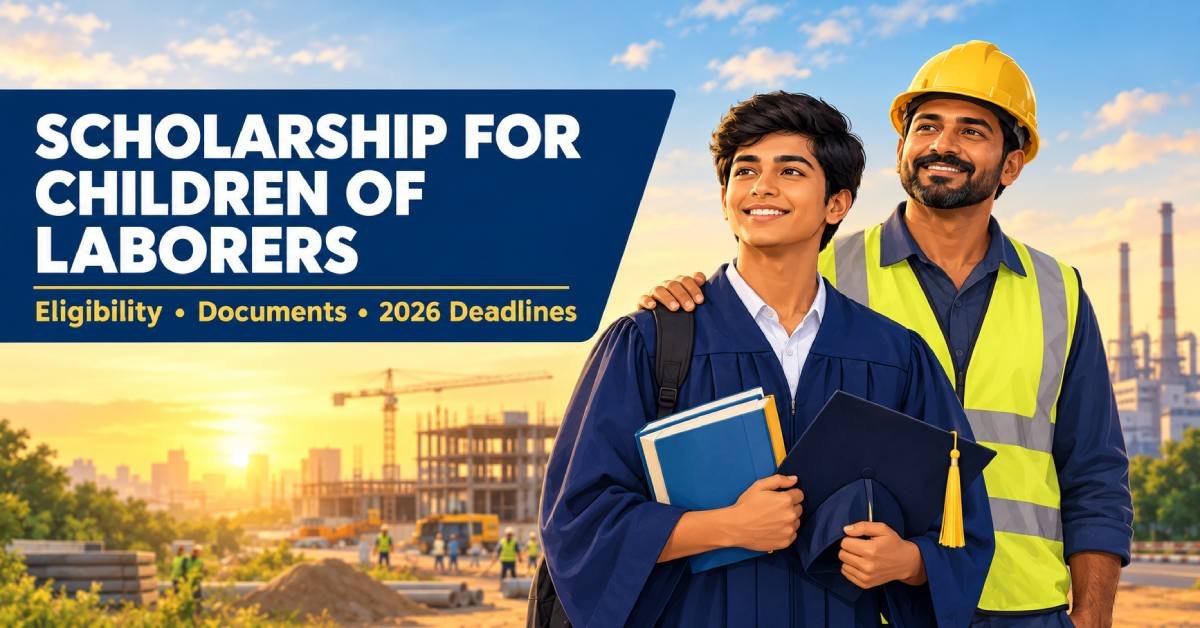
A scholarship for children of laborers is an education grant that depends on a parent’s work category, not only on the child’s marks. Welfare boards, trade unions, universities and foundations fund these awards. In most schemes, the parent’s registration status decides eligibility. This guide explains who qualifies, who should not apply, which documents are required, how to apply, how selection works and what past cycles show.
Key facts as of 13 October 2026
Open now: Wisconsin Laborers’ District Council (deadline 13 November 2026) and Karnataka Labour Welfare Board (deadline 31 December 2026).
Closed for 2026: PWWF at GCU Lahore (28 August), COMSATS Labour Quota (8 and 24 July), LIUNA Local 2 (31 March) and Ohio Laborers (15 April).
Main rule: The parent must be registered with a welfare board or be a union member in good standing.
What Is a Scholarship for Children of Laborers?
What is it? It is financial aid for the dependent child of a worker who belongs to a recognised labour category.
Four types of funders offer these awards. Each type verifies eligibility in a different way.
Funder type
Examples
Who verifies
Typical coverage
Government welfare fund
Punjab Workers Welfare Fund (PWWF), KP Workers Welfare Board, BOCW boards in India
District labour offices and scrutiny committees
Full costs or annual grants
Trade union fund
LIUNA locals, Union Plus
Union local or scholarship committee
One-time cash awards
University quota
COMSATS Labour Quota
University admissions office
Reserved seats with funded costs
Foundation
Cleveland Foundation (Ohio Laborers award)
Foundation staff
Annual awards paid to the institution
The next section explains who counts as a laborer, because each scheme defines the term differently.
Who Counts as a Laborer? Definitions by Scheme
Who is a laborer under these schemes? A laborer is a worker who holds a registration or membership that the scheme recognises.
The definition changes by country and funder. The table below maps parent categories to schemes.
Parent category
Typical schemes
Proof usually required
Key condition
Industrial worker or miner (Pakistan)
PWWF, KP Workers Welfare Board, federal Workers Welfare Fund
CNIC, Social Security card, service proof
Employer registered under the Factories Act 1934 or Mines Act 1923; minimum 3 years of service
Construction worker (India)
BOCW boards in Delhi, Punjab, Himachal Pradesh, West Bengal, J&K
BOCW registration or labour card
At least 90 days of construction work in the preceding 12 months
Unorganised worker (Karnataka)
Karnataka Labour Welfare Board
Registered-worker proof, income certificate
Family income up to INR 4.2 lakh per year
Union member (USA)
LIUNA locals, Union Plus
Union membership certification
Member in good standing
Farmworker, daily-wage or informal worker
Not named in the schemes reviewed
Varies
Check whether the local board registers this category
The PWWF requires the worker to qualify under the Industrial Relations Act, hold a valid Social Security card and have at least 3 years of experience in a registered factory or mine. The Indian BOCW boards register workers aged 18 to 60 in several states. Daily-wage and informal workers should confirm registration options before applying.
Scholarships Available by Country (2026 Snapshot)
Which scholarships exist for laborers’ children? Pakistan, India and the USA have the most documented schemes. Amounts differ widely, from small annual grants to fully funded degrees.
Admission, tuition, transport, hostel, library, computer and exam fees, plus a monthly stipend
Current cycle unconfirmed
Federal Workers Welfare Fund (via IIU)
University
Fee, hostel and stipend
Applications routed through district labour offices
PWWF school scheme
Danish Schools, District and Divisional Public Schools, Centers of Excellence
All educational expenses
2022 notice; check the current call
The federal programme serves children of industrial workers in Islamabad, Khyber Pakhtunkhwa and Punjab. The PWWF school scheme requires the employer to pay the statutory welfare contribution.
India: BOCW Boards and Karnataka
INR amounts below are converted to USD at roughly 88 INR per USD. Exchange rates change.
Scheme
Level
Amount
Key conditions
Karnataka Labour Welfare Board
Class 1 to PhD, diploma, ITI
INR 1,100 to 11,000 per year (about USD 12 to 125)
Minimum 50% marks; income up to INR 4.2 lakh; two children per family; deadline 31 December 2026
J&K BOCW Welfare Board
Class 9 to 12
INR 1,200 per child per year (about USD 14)
Registered parent; up to two children; applied through the National Scholarship Portal
Delhi BOCW Welfare Board
School to graduation, polytechnic, ITI, LLB
Paid after the year of study ends
Up to two nominated children of a live member
Punjab BOCW Welfare Board
Primary to professional degrees
Stipend including hostel fees
Registered worker or child; worker not in another welfare fund
Himachal Pradesh BOCW
Class 1 to professional and PhD
Annual assistance
Active membership renewed every year; up to two children
West Bengal BOCW
Higher secondary to postgraduate
Financial assistance
Registered member with 90 days of work in the previous year
US awards are mostly one-time cash grants for children of union members.
Scholarship
Amount
Key conditions
Deadline
Ohio Laborers Future Leaders of America
Set annually; renewable up to 4 years
3.0 GPA; full-time enrolment; US citizen or legal resident
15 April 2026 (closed)
LIUNA Local 2 (Chicago)
Two awards of USD 2,500
High school senior; 2.5 GPA; transcript and essay
31 March 2026 (closed)
LIUNA Local 270 (California)
Up to USD 1,000
Dependent of a Local 270 member
May 2026 (closed)
LIUNA Local 1001
Four awards of USD 1,500 (2024-25 cycle)
Child of a member; undergraduate
Check the current cycle
Wisconsin Laborers’ District Council
Set by trustees each year
Child or grandchild of a member; past winners excluded
13 November 2026 (open)
Southern California Laborers (Mike Quevedo, Sr. Fund)
USD 678,500 across 120 students in 2023
Dependent child of a LIUNA member
Check the current cycle
The Union Plus scholarship programme is open to members of participating unions, their spouses and dependent children. In 2026 it awarded USD 300,000 to 181 recipients, with awards from USD 1,000 to USD 4,000.
Other Countries
Trade-union federations in Vietnam also give study gifts and scholarships to workers’ children. The Can Tho City Labor Federation distributed more than 11,000 gifts in 2026, and a microfinance branch in An Giang awarded 75 scholarships and study gifts. Local labour federations are the main source in such countries.
Who Should Apply and Who Should Not
Who should apply? Students whose parent holds a valid registration and whose education level matches the scheme.
You Should Apply If
Your parent is a registered worker, miner, construction worker or union member in good standing.
Your parent’s employer pays the required welfare contribution, where the scheme asks for it.
Your parent meets the minimum service period, such as 3 years in Pakistani schemes or 90 days in the past 12 months in Indian BOCW schemes.
You meet the marks or GPA requirement, such as 50% in Karnataka or a 3.0 GPA in the Ohio award.
Your family income is under the cap, where one exists.
You are applying for a level the scheme covers.
You Should Not Apply If
Your parent is not registered and cannot register before the deadline.
Your parent’s membership has lapsed.
Your family already used the two-child limit, where a limit exists.
You already hold a full scholarship from the same fund for the same study period.
Your parent belongs to another statutory welfare fund, in schemes that exclude this, such as Punjab’s BOCW stipend scheme.
Your parent is a union officer or fund trustee, in schemes that exclude their families, such as the Wisconsin council award.
You previously won the award, where the scheme bars repeat winners.
If You Do Not Qualify
Explore need-based scholarships and fully funded scholarships. Ask the welfare board whether the parent can register in the next cycle.
Required Documents Explained
Which documents do I need? You need identity, registration, service, admission and academic documents. Some schemes add income, essay or special-case proof.
Document
Why it is asked
Common problem
Parent’s CNIC or national ID
Confirms the worker’s identity
Expired or unattested copy
Registration proof (Social Security card, BOCW labour card, union membership certificate)
Confirms the parent belongs to the eligible category
Registration not renewed
Service or employment proof
Confirms minimum service (3 years or 90 days)
Missing employer certificate
Attestation by factory management or union
KP forms need factory management or collective bargaining agent attestation
Signature or stamp missing
Student’s admission proof or merit-list letter
Confirms the course and institution
Applying before admission is confirmed
Academic transcript
Confirms marks or GPA
Below the minimum or unofficial copy
Income certificate
Verifies the income cap (Karnataka)
Certificate older than allowed
Death grant or disability pension proof
Needed only if the worker died or became disabled
Submitted when not applicable, or missing when needed
Essay
Required by some US union locals
Ignoring the prompt
Upload clear scans when the portal asks for digital copies. The PWWF requires scanned copies of all required documents with the online form.
Special Case: Deceased or Disabled Workers
Children of deceased or disabled workers can qualify under the PWWF and the COMSATS Labour Quota. The worker must have been registered with EOBI or Social Security. The widow or legal heir must have received a death grant from the Punjab Workers Welfare Board or a pension from EOBI or Social Security.
Step-by-Step Application Guide
How do I apply? Confirm the parent’s registration, pick the right scheme, prepare documents, submit before the deadline and pass verification.
Step 1: Confirm the Parent’s Registration
Check that the parent holds a valid Social Security card, BOCW labour card or union membership. Registration is the entry gate for almost every scheme.
Step 2: Match the Parent’s Job to a Scheme
Use the matrix in the definitions section. A factory worker looks at PWWF or KP schemes. A construction worker looks at the state BOCW board.
Step 3: Check the Deadline and Cycle Status
Many 2026 deadlines have passed. Open cycles include Wisconsin on 13 November 2026 and Karnataka on 31 December 2026. For closed schemes, prepare early for the next cycle.
Step 4: Collect and Attest Documents
Gather every document from the table above. Obtain attestation from factory management, the collective bargaining agent or the union local when the form requires it.
Step 5: Complete the Application
Punjab applicants use the PWWF website and upload scans. COMSATS Labour Quota applicants apply for regular admission first. US applicants submit online or by post, depending on the union local. Some locals require a postmark by the deadline date.
Step 6: Submit and Keep Proof
Save the submission receipt, tracking number or postal proof. Keep a full copy of the application.
Step 7: Pass Verification
In Pakistani federal schemes, District Labour Offices scrutinise applications and a district scrutiny committee reviews them. In university quota schemes, the selected candidate visits the admissions office to verify eligibility and submit documents.
Step 8: Confirm the Award
Confirm the coverage, the payment route and the renewal rules in writing. Ohio awards, for example, are paid directly to the institution.
Selection Process Explained
How are recipients selected? Four models are used: scrutiny committees, university merit lists, merit-cum-need ranking and judged applications.
Model
How it works
Example
Scrutiny committee
District labour office and committee review the case file
Federal Workers Welfare Fund
Merit list plus eligibility check
University ranks candidates, then verifies worker status
PWWF and COMSATS Labour Quota
Merit-cum-need
Marks and family income are weighed together
Karnataka Labour Welfare Board
Holistic review
Academics, community service, motivation, character and self-help are scored; need is a tiebreaker
Ohio Laborers award
Independent judging
A third party or outside committee scores applications
LIUNA Local 2 and Local 4
Quotas shape outcomes. COMSATS reserves 30% of seats for workers and their children. PWWF at GCU Lahore offered 30 BS seats, two per programme.
Common Mistakes Applicants Make
Why do applications fail? Most failures come from paperwork and timing, not marks.
Applying before the parent is registered. Registration must be active at the time of application.
Missing attestation. KP forms need factory management or collective bargaining agent attestation.
Confusing admission and scholarship deadlines. COMSATS and PWWF use separate application steps.
Uploading unreadable scans. Verification officers cannot approve what they cannot read.
Ignoring caps. Indian boards limit support to two children, and Karnataka sets an income ceiling.
Holding parallel full scholarships. The PWWF does not allow two full awards for the same study period.
Using outdated session information. Several listing sites reuse old dates, so confirm on the official board page.
Trusting paid agents. Official applications go through the welfare board, the university or the union local.
Previous Years’ Trends
What do earlier cycles show? Deadlines follow predictable seasons, and award models differ by region.
Season
Months
Examples
Spring
March to May
LIUNA Local 2 (31 March), Ohio Laborers (15 April), Local 270 (May)
Summer
July to August
COMSATS Labour Quota (8 and 24 July 2026), PWWF at GCU (28 August 2026), Local 1001 (31 July in the 2024 cycle)
Autumn
October to November
KP Inter/DAE (31 October in the 2023 and 2024 listings), Wisconsin (13 November 2026)
Year-end
December
Karnataka (31 December 2026), KP undergraduate (31 December in earlier listings)
Late winter
March
KP MBBS, engineering and postgraduate (31 March in earlier listings)
Award-size patterns
Pakistani schemes fund full costs: tuition, hostel and stipend.
Indian schemes pay small annual grants, from INR 1,100 to INR 11,000 in Karnataka (about USD 12 to 125).
US awards are one-time grants: USD 1,000 in Local 270, USD 1,500 in Local 1001, USD 2,500 in Local 2.
Union Plus 2026 averaged about USD 1,657 per recipient (USD 300,000 across 181 awards, our calculation).
The Mike Quevedo, Sr. Fund averaged about USD 5,650 per student in 2023 (USD 678,500 across 120 students, our calculation).
Fund history: The Mike Quevedo, Sr. Scholarship Fund reached its 28th year in 2023 and has given more than USD 4,250,000 to over 1,500 children of LIUNA members. Union Plus has run since 1991.
Our Research Notes
How was this guide researched? We compared official notices, university announcements, board scheme pages and union documents on 13 October 2026.
Verified: PWWF-GCU details and deadline, COMSATS Labour Quota terms, Karnataka conditions, BOCW eligibility rules, LIUNA Local 2, Ohio Laborers and Wisconsin terms, and Union Plus 2026 figures.
Not confirmed: The current KP Workers Welfare Board cycle dates, the current PWWF school scheme call, and the 2026 Local 1001 and Southern California cycles. Earlier KP listings show deadlines for the 2023-24 and 2024-25 sessions, so treat them as trend data.
Limits: Currency conversions are approximate. Scheme rules change between cycles. Always confirm on the official board, university or union page before you apply.
After You Are Selected: Renewal and Maintenance
Can the scholarship continue? Often yes, if you keep the required status. The Ohio Laborers award has historically been renewable for up to 4 years for full-time students who meet the requirements. Wisconsin does not let past winners win again. Keep the parent’s registration active, maintain the required marks and confirm payment rules each year.
Frequently Asked Questions
Who can apply for a scholarship for children of laborers?
Dependent children of registered or union-member workers can apply. The parent usually needs registration with a welfare board or good standing in a union. The child must also meet the level, marks and income conditions of the specific scheme. Eligibility therefore depends on the parent’s status first and the child’s record second.
Do children of daily-wage or unregistered workers qualify?
Usually not. Most schemes reviewed require a valid registration, such as a Social Security card, a BOCW labour card or union membership. Indian boards require 90 days of work in the preceding 12 months. Unregistered parents should register first and apply in the next cycle.
Is the labour quota scholarship fully funded?
Yes, under the 2026 PWWB Labour Quota at COMSATS, the Punjab Workers Welfare Board bears all educational expenses of selected students. COMSATS reserves 30% of seats in single-degree programmes for eligible workers and their children. Coverage can change, so confirm the current notice before applying.
Which documents are required?
Core documents include the parent’s CNIC or ID, registration proof, service or employment proof, the student’s admission and academic records, and attested forms. Income certificates apply in some Indian schemes. Death grant or disability pension proof applies only when the worker has died or become disabled.
Is there an income limit?
Some schemes set one. Karnataka’s Labour Department scheme sets an income limit of INR 4.2 lakh per year, roughly USD 4,800. The Pakistani welfare-fund schemes reviewed focus on worker registration rather than a stated income cap. Many US union awards use membership first and treat need as a tiebreaker.
How many children per family can receive the scholarship?
Indian BOCW boards and Karnataka commonly cap support at two children per family. The Delhi, Himachal Pradesh, J&K and Dadra and Nagar Haveli and Daman and Diu boards state this limit. The Pakistani and US schemes reviewed do not publish a per-family cap, so check each notice.
Can I apply if my parent has died or is disabled?
Yes, in several schemes. The PWWF and the COMSATS Labour Quota accept children of workers who died or became disabled during service. The worker must have been registered with EOBI or Social Security, and the family must hold proof of a death grant or disability pension.
How long does the scholarship last?
Duration depends on the scheme. The Ohio Laborers scholarship has historically been renewable for up to 4 years. The PWWF and COMSATS programmes fund the selected degree under the board’s terms. Indian grants are paid annually, so confirm renewal rules with the board before relying on future payments.
Can I hold two scholarships at once?
Not always. A PWWF Talent Scholarship cannot run alongside another full PWWF scholarship for the same study period. Punjab’s BOCW registration requires that the worker not belong to another welfare fund. Read the stacking rule in each notice before accepting a second award.
When are the deadlines?
Deadlines vary by scheme. As of 13 October 2026, the Wisconsin Laborers’ District Council closes on 13 November 2026 and Karnataka’s scheme closes on 31 December 2026. PWWF at GCU, COMSATS, LIUNA Local 2 and Ohio Laborers have closed for 2026. Expect similar months next year.
How are recipients selected?
Selection models include scrutiny committees, merit lists and judged essays. Pakistani federal schemes route applications through district labour offices and scrutiny committees. Karnataka uses merit-cum-need ranking. Ohio weighs academics, service, motivation, character and self-help, with need as a tiebreaker. LIUNA Local 2 uses independent judges.
Why do applications get rejected?
Common causes include an unregistered parent, a lapsed membership, missing attestation, unreadable scans, a missed deadline and exceeding a child or income cap. Parents in another welfare fund, or students holding a parallel full scholarship, may also be excluded. Following the notice checklist prevents most rejections.
Conclusion
A scholarship for children of laborers depends on the parent’s registration, the scheme’s definition of a laborer and the student’s level. Start by confirming the parent’s registration, match the job category to a scheme, prepare attested documents and submit before the deadline. Next, read our guide to scholarship deadlines this month and our overview of scholarships in Pakistan or scholarships in India to plan the next cycle.




 Scholarships4 months ago

 Scholarships3 months ago
 By Country4 months ago

 Scholarships4 months ago
 By Country4 months ago

 Scholarships3 months ago

 Scholarships4 months ago

 Scholarships3 months ago