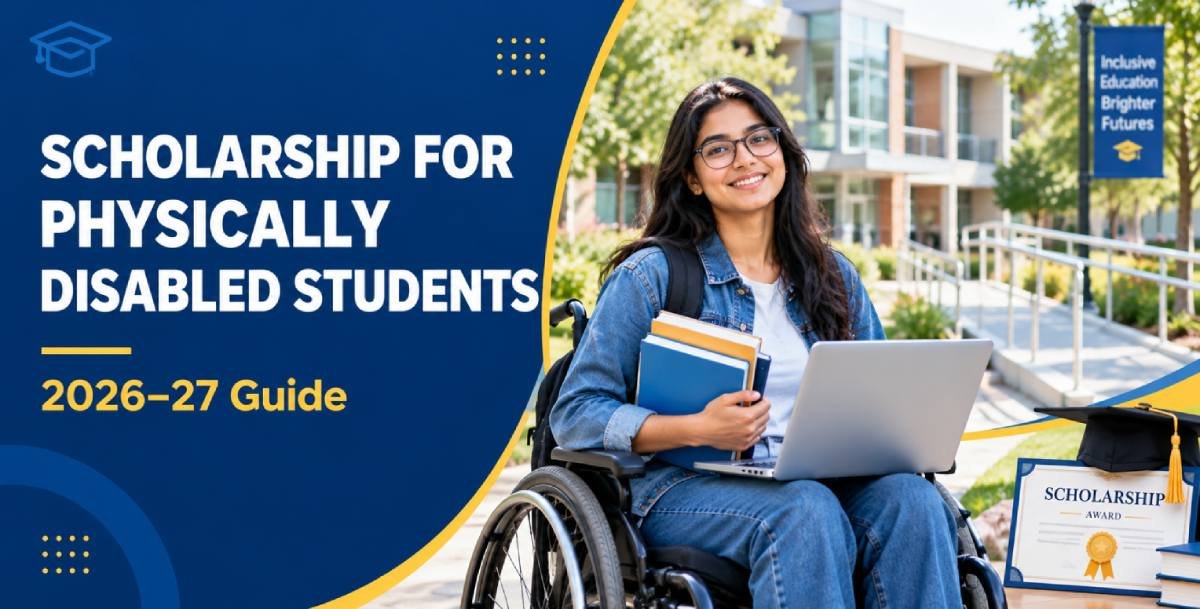
A scholarship for physically disabled students is a financial award that funds the education of applicants with a documented physical disability. Universities, charities, corporations and government bodies fund these awards. The programs reviewed for this guide range from USD 500 to USD 28,000, although the largest award serves legally blind students in the United States only. Most programs ask for three things: proof of disability, proof of enrollment and a minimum GPA between 2.75 and 3.0. This guide explains who should apply, which documents funders accept, how selection works and when deadlines fall.
Key facts
Typical award: USD 500 to USD 3,000 for US disability-specific awards
Typical GPA threshold: 2.75 to 3.0
Typical proof: a signed physician letter or Disability Support Services (DSS) verification
Deadline cluster: February to May, with a smaller cluster in September
Open now (as of October 12, 2026): Tommy Tranchin Award, closing December 31, 2026
Currency note: All amounts appear in USD. Foreign amounts are approximate conversions.
What Is a Scholarship for Physically Disabled Students?
What does the term mean? The term describes any scholarship that restricts eligibility to students with a physical disability. Each funder writes its own definition, so the definition decides whether you qualify.
How funders define physical disability
Easter Seals Ontario requires a permanent physical disability that affects mobility.
The University of Washington’s Robert H. Soper Endowed Scholarship Fund covers a physical disability that limits one or more major life activities. It gives preference to students with paraplegia or quadriplegia.
The Ron Halsey Memorial Scholarship at Colorado Mesa University gives preference to accident-related paralysis, Multiple Sclerosis, or severe vision or hearing impairment.
The Snowden Trust in the United Kingdom funds students with a physical or sensory impairment.
The York Trade Scholarship for the Disabled lists hearing loss, sight loss, wheelchair use and limb difference.
The definitions overlap but do not match. Read the funder’s wording before you invest time in an application.
Permanent versus temporary conditions
Easter Seals Ontario states that the disability must be permanent. Many other funders do not use the word. A temporary injury may fall outside these definitions, so confirm eligibility with the funder.
Types of funders
Funder type
Example
Typical restriction
University
Elmer A. Sondrol Physically Impaired Scholarship (USD 800)
Enrolled at that university
Charity or association
Easter Seals Ontario; KY AHEAD (USD 500)
Residency or state
Corporate
Google scholarships for students with disabilities
Computer science field
Government-linked fund
Sir Edward Youde Memorial Fund, Hong Kong
Residency and overseas study
Community foundation
Dallas Foundation, Tommy Tranchin Award (up to USD 3,000)
Local residency and school grade
Disability-specific, merit-based and need-based criteria
Most awards combine criteria. The Ron Halsey scholarship adds a 3.0 GPA and community involvement. Michigan State University’s education abroad award asks about financial need and your disability experience.
Who Should Apply and Who Should Not
Who should apply? Apply when you meet the funder’s disability definition, hold the required proof and match the residency, institution and study-level rules.
Who should apply
Students with a documented physical disability, such as paralysis, mobility impairment, limb difference or Multiple Sclerosis
Applicants who are enrolled in, or accepted by, an accredited college or university
Students whose GPA meets the stated minimum, commonly 2.75 or 3.0
Residents of the region, or students at the institution, that the funder names
Study-abroad students applying to disability-specific travel grants
Who should not apply
Applicants outside the funder’s residency area. Easter Seals Ontario requires Ontario residency, and KY AHEAD requires a Kentucky institution.
Students below the GPA minimum
Applicants who cannot produce a physician or DSS verification
Students in the wrong level of study. The Wanda J. Meek Scholarship serves graduate students only.
Part-time students applying to full-time-only awards, such as the Ron Halsey scholarship
Applicants whose field does not match field-restricted awards, such as Google’s computer science scholarships
Quick self-check
Question
If the answer is no
Does the funder’s definition include my condition?
Look for a funder with a broader definition
Can I obtain a signed diagnosis letter?
Ask your doctor or DSS office before applying
Do I meet the GPA minimum?
Choose awards without a GPA floor
Do I live in, or study at, the required place?
Skip the award
Does my study level match?
Skip the award
Scholarships for Physically Disabled Students by Region and Level
Which scholarships exist? The table below lists awards reviewed for this guide. Deadlines show the latest cycle found. Most 2027 dates are not yet published, so treat them as timing indicators and confirm on the official page.
Comparison table
Scholarship
Funder and location
Amount (USD)
Latest deadline reviewed
Level
Key condition
Easter Seals Ontario Scholarships
Easter Seals Ontario, Canada
About 360 to 3,600 (CAD 500 to 5,000)
April 17, 2026
University or college
Ontario resident; permanent mobility disability
Elmer A. Sondrol Physically Impaired Scholarship
University of North Dakota, US
800
March 1, 2026
Enrolled students
Physical impairment
Wanda J. Meek Scholarship
Fresno State, US
Varies
March 2, 2026
Graduate
3.0 GPA; physician letter
Ron Halsey Memorial Scholarship
Colorado Mesa University, US
1,000
September 1, 2026
Full-time students
3.0 GPA; community involvement
KY AHEAD Student Scholarship
KY AHEAD, Kentucky
500
April 24, 2026
Incoming and current
2.75 GPA; DSS verification
D Center Joint Scholarship Application
University of Washington, US
Varies by fund
April 3, 2026
UW students
One form covers three funds
Education Abroad Scholarship for Students with Disabilities
Michigan State University, US
1,000 to 2,000
January 30, 2026
Study abroad
Documented disability
Kevin Cecil Study Abroad Scholarship
University of Pittsburgh, US
1,000 (two awards yearly)
January 20, 2026
Summer study abroad
Pitt Global Experience application
Tommy Tranchin Award
Dallas Foundation, US
Up to 3,000
December 31, 2026
Grades 8 to 12
North Texas students
Sir Edward Youde Memorial Overseas Fellowship
Hong Kong
Not stated in announcement
September 4, 2026
Overseas study from 2027/28
One disabled Hong Kong student
Google Europe Scholarship for Students with Disabilities
Google
About 8,000 (EUR 7,000)
Not verified
Computer science
Check Google’s page
United States
The United States offers the densest set of awards, and most are university-based. The University of Washington’s D Center runs one joint application for the Mary Ellen Waite Memorial Scholarship, the John Armstrong Memorial Endowed Fund and the Robert H. Soper Endowed Scholarship Fund. The Krause Scholarship from the American Association on Health and Disability awards up to USD 1,000 to students at US universities, according to Times Higher Education. Google’s Lime Scholarship, listed by the same source, has supported students with disabilities in computer science at US and Canadian institutions.
The American Foundation for the Blind (AFB) also deserves a mention as a sensory-inclusive example. Its Lulu J. Alonso scholarships offer USD 20,000 for undergraduates and USD 28,000 for graduates. They renew annually and serve legally blind US citizens at US accredited institutions.
Canada
Easter Seals Ontario has supported more than 300 students with physical disabilities since 1996, awarding more than CAD 600,000 in total. Each year it grants 10 to 20 awards of CAD 500 to CAD 5,000. The 2026 window opened on January 19 and closed on April 17. The program requires a permanent mobility-affecting disability, Ontario residency and enrollment or acceptance at an accredited institution.
United Kingdom
The Snowden Trust funds students with a physical or sensory impairment who study at a UK college or university, according to Times Higher Education. Confirm the current amounts and deadlines with the Trust.
Hong Kong
The Sir Edward Youde Memorial Fund finances one outstanding disabled Hong Kong student for overseas study. The 2027/28 round closed on September 4, 2026, and the fund states that late applications are not normally considered. The Student Financial Assistance Agency of Hong Kong hosts the forms. Expect the next round to open around the same time of year, then verify.
Pakistan and South Asia
Pakistan’s Higher Education Commission (HEC) maintains a policy for students with disabilities at higher education institutions and names a focal person for disabled students. An HEC letter dated April 2, 2026 directs universities to comply with the government-mandated disability quota and cites Ehsaas Undergraduate Scholarship benchmarks for financial facilitation. Third-party summaries report a disability quota of about 2% in the Ehsaas Undergraduate Scholarship. Confirm the current quota on the official HEC portal. Ask your university’s financial aid office about disability fee waivers as well.
International students and study abroad
Study-abroad grants exist for disabled students. Michigan State University awards USD 1,000 to USD 2,000 to students with a documented disability who apply to a credit-bearing MSU education abroad program. The University of Pittsburgh awards two USD 1,000 Kevin Cecil scholarships each year for summer study abroad. Read the scholarships for international students guide for broader options.
Graduate-level options
The Wanda J. Meek Scholarship funds a graduate student with a physical disability at Fresno State. The AFB graduate tier reaches USD 28,000 for legally blind students. Explore graduate scholarships for additional programs.
Required Documents Explained
Which documents do funders ask for? Funders ask for proof of disability, proof of enrollment, academic records, a personal statement and, for need-based awards, financial information.
Medical verification letter
A medical verification letter confirms your diagnosis. Fresno State asks for a memorandum from a physician or specialist on office letterhead with the physician’s signature. The same page states that clinical test results without a diagnosis are not acceptable. Ask your doctor to name the diagnosis, state that the condition is physical and add the signature and letterhead.
Disability Support Services verification
Some funders accept verification from your university’s disability office. KY AHEAD requires a disability verified by the Disability Support Services officer at your current institution. Michigan State University links its award to registration with its disability resource office. Register early, because registration can take time.
Easter Seals Ontario proof
Easter Seals Ontario accepts current or past client status, or a letter confirming diagnosis from a health care professional. The program page also says its scholarships are available only to Easter Seals Ontario clients. Contact the program to confirm which route applies to you.
Transcripts and enrollment proof
Transcripts prove your GPA. An enrollment or acceptance letter proves your student status. Easter Seals Ontario accepts students who have applied or been accepted, while the Ron Halsey scholarship requires full-time enrollment.
Personal statement
The personal statement explains your experience and goals. Michigan State’s application asks you to describe your disability experience, especially related to learning and access, and to explain how study abroad supports your career.
Recommendation letters
Recommenders confirm your character, academic ability and community involvement. Give each recommender your resume, the scholarship description and the deadline.
Financial documents
Need-based awards ask for financial information. Michigan State asks for the Estimated Family Contribution Index from your FAFSA. US applicants complete the Free Application for Federal Student Aid to generate this figure.
Document checklist
Document
Purpose
Who issues it
Signed medical letter with diagnosis
Proves disability
Physician or specialist
DSS verification
Confirms documented disability
University disability office
Transcript
Proves GPA
Registrar
Enrollment or acceptance letter
Proves student status
Admissions or registrar
Personal statement
Shows goals and need
You
Recommendation letters
Confirm character
Teachers, supervisors
Financial form
Shows need
Aid office or tax agency
Request medical letters and recommendations at least four to six weeks before a deadline. This is a practical recommendation, not a funder rule.
Step-by-Step Application Guide
How do you apply? Follow these eight steps in order.
Confirm eligibility. Compare your condition, GPA, residency and study level with each funder’s published criteria.
Request your medical letter. Ask your physician for a signed letter on letterhead that states the diagnosis.
Register with your disability office. Complete DSS registration so the office can verify your disability.
Shortlist five to ten awards. Mix institution-based, regional and corporate awards, because most awards are small and restricted.
Build a deadline calendar. Add every deadline and set reminders two weeks ahead.
Draft your essay. Explain how your disability affects access to education and how the award supports your career. Read the scholarship essay guide for structure.
Submit a complete package. Check every required document, upload clear scans and submit before the deadline.
Track and follow up. Save confirmation emails, answer verification requests quickly and note the decision date.
Application Deadline Calendar
When do deadlines fall? Most deadlines in the 2026 cycle fell between January and May, with a second group in September and one in December.
Sondrol (March 1); Frank and Patty Skerl Educational Scholarship for the Physically Disabled (March 1); Wanda J. Meek (March 2)
April
UW D Center (April 3); Easter Seals Ontario (April 17); KY AHEAD (April 24)
May
York Trade Scholarship for the Disabled (May 11)
September
Ron Halsey (September 1); Sir Edward Youde Memorial (September 4)
December
Tommy Tranchin Award (December 31)
These are 2026 dates. Expect similar timing for 2027, then verify each date on the official page.
How the Selection Process Works
How do funders choose winners? Funders screen for eligibility, check documents and then rank the remaining applications. Most funders do not publish scoring weights, so the stages below come from published criteria and application questions.
Stage 1: Eligibility screening and document check
Reviewers confirm disability proof, enrollment, residency and GPA. Incomplete files usually stop here.
Stage 2: Scoring
Published criteria point to four scoring areas:
Academic standing: GPA minimums of 2.75 or 3.0
Community involvement: The Ron Halsey scholarship asks for an outstandingly community-minded student
Financial need: Michigan State asks for the Estimated Family Contribution Index
Essay quality: Michigan State asks about disability experience, access and career goals
Stage 3: Committee review and notification
A committee reviews finalists, and some programs add interviews. Easter Seals Ontario awards 10 to 20 scholarships each year, which signals a small, competitive pool.
What reviewers look for in the essay
Reviewers look for specific barriers, specific goals and a clear link between the award and your plan. Generic statements score poorly.
Common Mistakes Applicants Make
Mistake
Why it fails
Fix
Submitting test results without a diagnosis
Fresno State rejects them
Obtain a letter that names the diagnosis
Letter missing letterhead or signature
Funder cannot verify the source
Request a signed letter on official letterhead
Ignoring residency or institution limits
Easter Seals Ontario, KY AHEAD and Tranchin restrict by place
Filter by location first
Applying below the GPA minimum
Automatic rejection
Choose awards without a GPA floor
Skipping DSS registration
Some funders require DSS verification
Register early
Trusting aggregator dates
Sites can show a different cycle than the official page
Confirm dates on the funder’s page
Writing only about the disability
Essay lacks goals
Link barriers to goals and the award
Applying to one award
Awards are small and competitive
Apply to five to ten
Misreading study mode
Ron Halsey requires full-time study
Check enrollment rules
Missing acceptance status
Easter Seals Ontario requires application or acceptance
Apply to schools first
Previous Years’ Trends
What patterns appear? The data reviewed shows consistent patterns in amount, timing and eligibility.
Award sizes
Disability-specific US awards cluster between USD 500 and USD 3,000. Examples include KY AHEAD at USD 500, Sondrol at USD 800, Ron Halsey at USD 1,000 and Tranchin at up to USD 3,000. Large awards exist but restrict eligibility, as AFB does with legally blind US citizens.
Deadline timing
On one major listing, 19 of 22 dated deadlines fell between February and May 2026. The listing showed only part of 54 disability scholarships, so treat the pattern as an indicator.
Eligibility patterns
GPA minimums sit at 2.75 to 3.0. Many awards also require enrollment at a named institution, residency in a named region or a named field of study.
Competition level
Easter Seals Ontario reports more than 300 recipients since 1996 and more than CAD 600,000 awarded. That equals roughly 10 recipients and about CAD 20,000 per year, with an average near CAD 2,000 per recipient. This is our calculation from the program’s totals.
Policy attention in Pakistan
The April 2, 2026 HEC letter on disability quota compliance shows active policy focus on higher education access for students with disabilities.
Our Research Notes
Definitions differ. Easter Seals Ontario focuses on mobility. Ron Halsey, York Trade and Snowden Trust also name sensory conditions. Always match your condition to the exact wording.
Four verification routes exist. Funders accept a physician letter, DSS verification, registration with a disability resource office or health care professional confirmation.
Aggregators can mislead. The official Michigan State page shows January 30, 2026, while a scholarship portal listed January 17, 2027. The two may reflect different cycles, which shows why the official page must be your final check.
Every award is tied to a place, institution, program or field. None of the 11 awards in the comparison table is open to any disabled student anywhere.
Source conflict at Easter Seals Ontario. The page says scholarships are for Easter Seals Ontario clients, while the criteria also allow a diagnosis letter. Ask the program which rule applies.
Small awards reward volume. Because many awards are USD 500 to USD 3,000, applying to several raises the total funding you can collect.
One deadline is still open. As of October 12, 2026, the Tommy Tranchin Award closes on December 31, 2026 for North Texas students in grades 8 to 12.
After You Win: Renewal, Stacking and Reporting
Some awards renew. The AFB Lulu J. Alonso scholarships renew annually. Check each award letter for renewal conditions, such as GPA and enrollment status. Tell your financial aid office about every award, because some programs restrict overlapping funding. A third-party summary of Ehsaas says recipients must not hold another scholarship or continuous grant. Keep a copy of every award letter and thank-you note.
Scholarship Scams and Red Flags
Legitimate scholarships do not charge application fees.
No legitimate funder guarantees a win.
Send medical records only through official portals or university offices.
Verify the funder through your university’s financial aid office.
Read scholarship scam warning signs before sharing personal data.
Frequently Asked Questions
Are there scholarships for physically disabled students?
Yes. Universities, charities, corporations and government bodies fund scholarships for physically disabled students. Examples include Easter Seals Ontario Scholarships in Canada, the Elmer A. Sondrol Physically Impaired Scholarship at the University of North Dakota, and the Ron Halsey Memorial Scholarship at Colorado Mesa University. Most awards require proof of disability and enrollment.
Who qualifies as physically disabled for a scholarship?
Qualification depends on each funder’s definition. Easter Seals Ontario requires a permanent physical disability affecting mobility. The University of Washington’s Soper fund covers a physical disability limiting major life activities. Some funders, such as the Snowden Trust, also include sensory impairments. Always read the funder’s definition before applying.
What documents prove a physical disability?
Funders usually accept a signed letter from a physician or specialist on office letterhead that states the diagnosis. Some accept verification from a university Disability Support Services office. Fresno State’s Wanda J. Meek Scholarship rejects clinical test results without a diagnosis. Check each funder’s accepted proof before requesting documents.
Can international students apply?
Some programs accept international students, but many restrict eligibility by residency or institution. Google’s Lime Scholarship, which targets computer science students with disabilities, has been open to international students studying in the United States or Canada. Easter Seals Ontario requires Ontario residency. Confirm nationality and residency rules on the official page.
Is there a fully funded scholarship for disabled students?
No physical-disability award reviewed for this guide is described as fully funded. The American Foundation for the Blind’s Lulu J. Alonso scholarships reach USD 20,000 for undergraduates and USD 28,000 for graduates, renewable annually, but serve legally blind US citizens. Applicants often combine several smaller awards.
How much money can a disabled student receive?
Amounts among reviewed awards range from USD 500 (KY AHEAD) to USD 28,000 (AFB graduate tier). Most US disability-specific awards fall between USD 500 and USD 3,000, including the Sondrol award at USD 800, the Halsey award at USD 1,000, and Tommy Tranchin awards of up to USD 3,000.
Is a high GPA required?
Many programs set a minimum GPA, but the threshold is moderate. KY AHEAD requires 2.75, and both the Wanda J. Meek and Ron Halsey scholarships require 3.0. Some programs, such as the Easter Seals Ontario program, list enrollment and disability criteria without a published GPA minimum in the source reviewed.
Can I apply for a master’s or PhD scholarship?
Yes, some awards target graduate students. The Wanda J. Meek Scholarship at Fresno State funds a graduate student with a physical disability and requires a 3.0 GPA. The AFB offers a USD 28,000 graduate tier for legally blind students. Check each program’s level of study, because eligibility varies.
Does the disability need to be permanent?
Some funders require it. Easter Seals Ontario requires a permanent physical disability that affects mobility. Other programs, such as the University of Washington’s Soper fund, describe a disability that limits major life activities without using the word permanent. Temporary injuries may fall outside these definitions, so confirm eligibility with the funder.
Can I combine a disability scholarship with other awards?
Often yes, but rules vary by program. Some programs restrict overlapping funding. A third-party summary of Pakistan’s Ehsaas Undergraduate Scholarship says recipients must not receive another scholarship or continuous grant. Read each program’s terms and tell your financial aid office about every award you accept.
Do universities offer fee waivers or quotas for disabled students?
Some do. Universities may offer fee waivers, quotas or internal disability scholarships. The University of Washington, for example, runs one joint application for several disability-related funds, and some Pakistani universities list a disability fee waiver. Contact your university’s financial aid or disability office to confirm what exists.
Are there scholarships for physically disabled students in Pakistan?
Yes. Pakistan’s Higher Education Commission has a policy for students with disabilities, and its April 2, 2026 letter directs universities to apply the disability quota. Third-party summaries report a quota of about 2% in the Ehsaas Undergraduate Scholarship. Verify current rules on the HEC portal.
When should I start applying?
Start in autumn for the following spring’s deadlines. In the 2026 cycle, 19 of 22 dated deadlines on one major listing fell between February and May, and Easter Seals Ontario opened applications on January 19. Gathering medical letters, transcripts and essays early prevents last-minute delays.
Conclusion
Scholarships for physically disabled students exist at universities, charities, corporations and government-linked funds, but each award restricts eligibility by definition, place, institution or field. Three actions raise your chances: match your condition to each funder’s definition, secure a signed medical letter or DSS verification early, and calendar every deadline from January through May. Most awards are small, so apply to several. Your next step is to compare funding for related needs in our guide to scholarships for students with learning disabilities, and to review fully funded scholarships for larger awards.




 Scholarships4 months ago

 Scholarships3 months ago
 By Country4 months ago
 Scholarships4 months ago
 By Country4 months ago

 Scholarships3 months ago
 Scholarships4 months ago

 Scholarships3 months ago