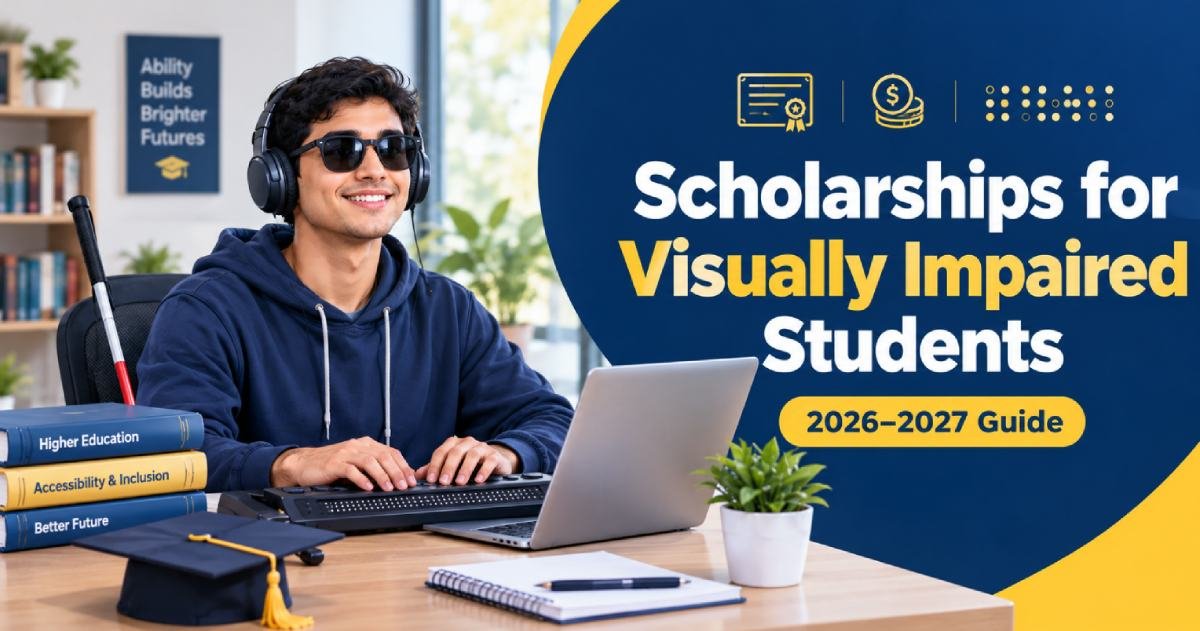
A scholarship for visually impaired students is a non-repayable award for blind or low-vision learners who attend a college, university, or technical school. Blindness organizations, state agencies, university foundations, and governments fund these awards. The two largest US programs, run by the National Federation of the Blind (NFB) and the American Council of the Blind (ACB), award between USD 2,000 and USD 10,000 per student. This guide compares the main programs, explains who should apply, and covers documents, selection, mistakes, and recent trends.
NFB: 30 awards of USD 10,000 each. The 2027 application opens December 1 and closes March 31.
ACB: USD 2,000 to USD 7,500 per award. ACB awarded USD 112,300 to 21 students in 2026.
Dale M. Schoettler Scholarship: up to USD 10,000 for California State University (CSU) students.
Common gate: most awards require legal blindness and a verification letter from an eye-care professional.
Next windows: ACB’s cycle historically opens November 1, and NFB’s opens in December.
What Is a Scholarship for Visually Impaired Students?
Short answer: It is a scholarship whose eligibility rules require vision loss that meets the funder’s definition.
Funders define vision loss differently, so the definition decides whether you can apply. Most national awards use legal blindness. A person is legally blind when corrected vision in the better eye is 20/200 or worse, or when the visual field is 20 degrees or less at its widest point.
Legally Blind, Low Vision, and Visually Impaired: Which Term Applies to You?
Term
Meaning
Effect on eligibility
Legally blind
Corrected acuity of 20/200 or worse, or a field of 20 degrees or less
Required by ACB; NFB requires it in both eyes
Low vision
Reduced vision that glasses cannot fully correct, possibly above the legal threshold
Accepted by CCLVI and some state awards
Visually impaired
An umbrella term used by agencies and universities
Each funder sets its own criteria in the application
Types of Scholarships by Funder
Funder type
Examples
Typical amount (USD)
Common restriction
Blindness organizations
NFB, ACB, CCLVI
1,000 to 10,000
Legal blindness; US residency or US school
State agencies and nonprofits
NJ CBVI, Wisconsin Council
1,000 to 5,000
State residency; agency client status
University foundations
CSU Foundation (Schoettler)
Up to 10,000
Enrollment at that university
Professional-field funders
AER Global Issues Division
500 to 1,000
Study field in blindness services
Governments
Chevening, Commonwealth Scholarships
Study-abroad awards with disability support
Country of study; open to all qualified applicants
Students with other disabilities can browse our scholarships for students with disabilities hub.
Scholarships for Visually Impaired Students 2026–2027: Comparison Table
Short answer: Seven programs cover most applicants, and they differ mainly by residency, school location, and the proof of vision they require.
Scholarship
Funder
Amount (USD)
Window or deadline
Level
Key rule
NFB Scholarship Program
National Federation of the Blind
10,000 (30 awards)
Opens December 1; closes March 31
Degree programs; full-time (up to five part-time in 2026)
Legally blind in both eyes; resident of the 50 states, DC, or Puerto Rico; US institution
ACB Scholarship Program
American Council of the Blind
2,000 to 7,500
November 1 to February 14 (2025–26 window)
Entering freshman, undergraduate, graduate, technical college
Legally blind; US institution
Dale M. Schoettler Scholarship
CSU Foundation
Up to 10,000
January 1 to December 31, 2026
Bachelor’s and graduate
Visual impairment; GPA 2.80; US resident; CSU campus
Fred Scheigert Scholarship
CCLVI
1,000 (3 awards)
Confirm with CCLVI
Undergraduate and graduate
Diagnosed low vision; US citizen or permanent resident
NJ CBVI Scholarships
NJ Commission for the Blind and Visually Impaired
1,000 to 5,000 (5 awards)
April 30 (2026)
High school seniors and college students
Active or eligible CBVI client
Council Scholarship
Wisconsin Council of the Blind & Visually Impaired
2,000 full-time; 1,000 half-time
March 25 (2026)
Post-secondary
Wisconsin resident; GPA 3.0
Global Issues Scholarship
AER
500 to 1,000
Varies
Students preparing to serve blind people
Student from outside the US and Canada; two related courses
Dates for state and low-vision awards follow the 2026 cycle. Confirm each date on the funder’s page before you apply.
Scholarship Profiles
NFB Scholarship Program
The NFB Scholarship Program is a merit-based national award for blind college students. The National Federation of the Blind describes itself as the oldest and largest nationwide organization of blind Americans. The NFB Scholarship Program page lists the current rules.
What it offers. The NFB gives thirty scholarships of USD 10,000 each. Its board raised each award from USD 8,000 to USD 10,000 for the 2026 cycle. The federation reports more than USD 300,000 in cash and prizes each year.
Who qualifies. Applicants must be legally blind in both eyes and at least 18 years old by the July convention. They must live in the 50 states, the District of Columbia, or Puerto Rico. They must plan study in a degree program at a US institution. The 2026 program allowed up to five of the thirty awards for part-time students. Certificate programs for a trade or profession do not qualify.
How it works. The application opens December 1 and closes March 31. Applicants submit a form, the documents on the NFB checklist, and one interview with an NFB affiliate president. Finalists are announced in spring. The NFB selects individual winners at its national convention in July. Finalists receive assistance to attend and must take part in the entire convention.
What it ignores. NFB membership is not required. The committee awards on academic excellence, community service, and leadership. It does not consider financial need.
ACB Scholarship Program
The ACB Scholarship Program is a national award that the American Council of the Blind has run since 1982. The ACB scholarship page lists documents and past recipients.
Awards range from USD 2,000 to USD 7,500. They go to entering freshmen, undergraduates, graduate students, and technical-college students at US institutions. ACB awarded USD 111,400 to 24 students in 2025 and USD 112,300 to 21 students in 2026.
Applicants must be legally blind, with certification from an ophthalmologist, optometrist, or physician. They register a free ACB account and apply online. ACB expects full-time enrollment, but part-time students who work at least 32 hours a week also qualify. The program is listed as non-renewable. Winners attend ACB’s national conference and convention in July.
ACB’s 2025–26 window ran from November 1, 2025 to February 14, 2026. A third-party listing shows the 2026–27 window as November 1, 2026 to February 14, 2027. Confirm the dates on ACB’s site.
Named awards. The Norma Schecter Scholarship supports blind undergraduates in any field. Its listing asks for proof of legal blindness in both eyes, SAT or ACT scores, extracurricular and employment records, and a 500-word autobiographical sketch. It generally expects a 3.3 GPA. The Eunice Fiorito Scholarship supports legally blind students who prepare for service or advocacy for people with disabilities. It gives preference to applicants with little or no vision.
Citizenship note. Third-party listings describe ACB’s program as open to US citizens and permanent residents. Older web pages say international students with a US acceptance letter may apply. International students should email ACB before applying.
Dale M. Schoettler Scholarship (CSU Students)
The Dale M. Schoettler Scholarship supports visually impaired students at California State University. Dale M. Schoettler, a California businessman who was blind during the last eight years of his life, established it in 1991.
The award pays up to USD 10,000. Applicants need a visual impairment, a minimum 2.80 GPA, US residency, and enrollment at a CSU campus as a full-time or part-time bachelor’s or graduate student. The College Board’s BigFuture listing shows no essay requirement. The 2026 window runs from January 1 to December 31, 2026, so CSU students should apply through the CSU Foundation portal now. Earlier applicants and winners can apply again each year they qualify. Check the CSU Foundation for the next window.
Fred Scheigert Scholarship (Low Vision)
The Fred Scheigert Scholarship comes from the Council of Citizens with Low Vision International (CCLVI). It targets students diagnosed with low vision, not only total blindness. CCLVI gives three awards of USD 1,000 to US citizens or permanent residents who study at the undergraduate or graduate level.
Applicants submit an application form, a transcript, a recommendation letter, an acceptance letter, and verification of low vision. CCLVI interviews semi-finalists by phone. Winners attend the CCLVI conference, held with the ACB convention in early July. A third-party listing shows a June 30 deadline but also says CCLVI notifies winners in late spring, so confirm the dates with CCLVI.
State Awards: New Jersey and Wisconsin
State agencies and nonprofits fund smaller awards with local rules.
New Jersey CBVI: five privately funded scholarships of USD 1,000 to USD 5,000 for high school seniors and college students of any age. Applicants must be active or eligible clients of the Commission for the Blind and Visually Impaired and attend a qualified US institution. Named awards include the Cathy and Herb Bodensiek Scholarship for STEM or business majors and the Mary Louise Buckley Scholarship for health services or communications majors. The 2026 deadline was April 30.
Wisconsin Council of the Blind & Visually Impaired: USD 2,000 for full-time and USD 1,000 for half-time students. Applicants must be Wisconsin residents with a 3.0 GPA who meet the vision criteria in the application. Applications typically open in February. The 2026 deadline was March 25.
Wisconsin Hearing/Visually Impaired Student Grant: USD 250 to USD 1,800 for Wisconsin undergraduates. Applicants submit the Free Application for Federal Student Aid (FAFSA) and the grant application. The listed 2026 deadline was June 30.
AER Global Issues Scholarship (Students Outside the US and Canada)
The Association for Education and Rehabilitation of the Blind and Visually Impaired (AER) Global Issues Division funds students from outside the US and Canada. The award supports students who study to work with people who are blind or low-vision. The 2024 call offered two awards of USD 1,000.
Applicants show proof of two related courses. They also submit an essay, recommendation letters, and a description of paid or volunteer experience. The committee weighs commitment, regional need for professionals, and experience. Recipients must use the funds for education in blindness and visual impairment.
UK Government Scholarships with Disability Funding
Chevening and Commonwealth Scholarships are government-backed UK programs open to all qualified applicants. Neither is blindness-specific, but both add disability support.
Chevening scholars who disclose a disability may receive additional funding and support. UK universities must make reasonable adjustments for disabled students under Part 6 of the Equality Act 2010. The Commonwealth Scholarship Commission pays a disability allowance when a disability raises day-to-day costs, and Disability Rights UK assesses the level independently. The commission’s disability support statement explains how to disclose. Scholars can disclose on the Health and Disability form after provisional selection or notify the commission at any point.
In 2026, the British Embassy in Liberia partnered with the country’s disability commission to encourage disabled applicants to apply to Chevening. The embassy cited a visually impaired scholar as a success story.
Who Should Apply and Who Should Not
Short answer: Apply when your vision loss, residency, and school match a funder’s written rules. Skip an award when one rule clearly excludes you, and redirect that effort to a better match.
Eligibility Decision Matrix
Your situation
Best-fit awards
Watch out for
US resident, legally blind, full-time at a US school
NFB, ACB, state awards
Apply to several; the awards do not exclude each other
Legally blind student at a CSU campus
Schoettler, plus NFB and ACB
Schoettler’s 2026 window closes December 31, 2026
Low vision above the legal threshold
CCLVI Scheigert, some state and university awards
NFB and ACB require legal blindness
Technical or vocational student
ACB (includes technical college)
NFB excludes certificate programs
International student admitted to a US university
University aid; AER if your field is blindness services
NFB limits residency; ACB listings describe a citizen or permanent-resident rule. Read our scholarships for international students in the USA guide.
Your home address sits outside the 50 states, DC, and Puerto Rico, and you are targeting NFB.
Your program is a certificate or trade credential, and you are targeting NFB.
You have low vision above the legal threshold, and you are targeting ACB or NFB.
You cannot attend the July convention and the award requires attendance.
You do not meet the funder’s GPA minimum, such as ACB’s usual 3.3.
Step-by-Step Application Guide
Short answer: Start in October. Verify your vision first, then shortlist, collect documents, write, and schedule any interview before the deadline.
Check the vision definition. Read each funder’s rule. NFB requires legal blindness in both eyes. CCLVI accepts diagnosed low vision.
Match location and program. Confirm residency, school country, degree type, and enrollment status.
Build a shortlist of three to six awards. Mix national, state, and university awards to raise your chances.
Book vision verification. ACB accepts certification from an ophthalmologist, optometrist, or physician. Request the letter early.
Request recommendations and transcripts. Our guide on how to ask for a recommendation letter explains the request.
Write the essay or autobiographical sketch. Follow our scholarship essay guide.
Submit and interview. NFB requires an interview with an affiliate president. Request it as soon as your application is ready.
Application Calendar, October 2026 to July 2027
When
Action
October 2026
Shortlist awards, book the eye-care appointment, request transcripts. CSU students check the Schoettler window.
November 1, 2026
ACB account registration and application window opens (based on the prior cycle).
December 1, 2026
NFB application opens.
December 2026 to January 2027
Collect recommendation letters and draft the essay or sketch.
February 2027
ACB closes in mid-February (February 14 in 2026). Wisconsin Council applications typically open.
March 2027
NFB closes March 31. Wisconsin Council closed March 25 in 2026.
April 2027
NJ CBVI closed April 30 in 2026.
May to June 2027
NFB notifications arrive by mid-May. Wisconsin grant deadline was June 30 in 2026.
July 2027
NFB and ACB conventions; final winners are selected or honored.
Required Documents Explained
Short answer: Most awards ask for proof of vision, transcripts, proof of enrollment, recommendations, and a personal statement. Each document answers one question for the committee.
Document
What it proves
Who provides it
Tip
Verification of vision
You meet the funder’s definition
Ophthalmologist, optometrist, or physician
Ask for a signed letter stating acuity or field; match each funder’s wording
Transcript
Academic record
School registrar
Entering freshmen send high school records; graduate applicants send undergraduate records
Acceptance or enrollment letter
You will study at a qualifying school
Admissions office
CCLVI requires it
Recommendation letters
Character, leadership, and service
Teacher, employer, or advisor
Give recommenders several weeks
Autobiographical sketch or essay
Goals, strengths, and field of study
You
Norma Schecter asks for 500 words
SAT or ACT scores
Academic ability
Testing agency
Required by the Norma Schecter award
Activities and employment record
Service and work history
You
Lead with leadership and community roles
Application form and account
Official submission
Funder portal
ACB requires a free account first
How Selection Works
Short answer: Committees rank complete applications on stated criteria, interview shortlisted applicants, and announce winners after a final review.
The NFB scores applications on academic excellence, community service, and leadership. It does not weigh financial need. ACB’s Schecter and Fiorito awards also exclude financial need and generally expect a 3.3 GPA. State awards add residency and GPA tests, such as 3.0 at the Wisconsin Council.
The NFB process runs in order. Applicants complete the form, documents, and interview. Finalists are announced in spring, and winners are selected at the July convention. NFB notifies applicants by mid-May. CCLVI interviews semi-finalists by phone. Incomplete applications do not advance, so every document and interview matters.
Our reading: Committees reward evidence of impact, not only grades. Convention attendance rules also signal that funders value community involvement.
Common Mistakes Applicants Make
Mistake
Consequence
Fix
Assuming low vision equals legal blindness
Rejection by NFB or ACB
Read the definition first
Trusting an aggregator’s amount or rule
Wrong expectations
Check the funder’s own page
Skipping the NFB interview
Incomplete application
Request it before March
Applying with a certificate program to NFB
Ineligible
Choose ACB or state awards
Ignoring convention attendance
Lost award
Plan July travel before applying
Requesting the eye-care letter late
Missed deadline
Book the appointment in October
Budgeting for renewal
Funding gap
ACB’s program is non-renewable; reapply each year
Applying only to national awards
Fewer chances
Add state and university awards
Previous Years’ Trends
Short answer: Award values are rising, and ACB is giving larger average awards to fewer students.
Metric
Earlier
Latest
Change
NFB award per student
USD 8,000
USD 10,000 (2026)
+25%
NFB total pool (30 awards)
USD 240,000
USD 300,000
+25%
ACB total awarded
USD 111,400 (2025)
USD 112,300 (2026)
+0.8%
ACB recipients
24 (2025)
21 (2026)
−12.5%
ACB average per recipient
USD 4,642
USD 5,348
+15.2%
Totals and averages are our calculations from published figures. Two data points do not prove a long-term trend.
Deadline Patterns
Program
Opens
Closes
Result timing
NFB
December 1
March 31
Notices by mid-May; July convention
ACB
November 1
Mid-February
July convention
NJ CBVI
Late February (2026)
April 30
Awards ceremony July 29, 2026
Wisconsin Council
February
Late March
Recipients announced July 13, 2026
Funding Beyond Scholarships
Short answer: Scholarships rarely cover every cost, so combine them with allowances, state grants, and agency services.
Disability allowances: The Commonwealth Scholarship Commission and Chevening add support for UK study.
Assistive technology: The Wisconsin Council reports that recipients use funds for adaptive devices and access technology. Ask each funder whether its award can cover a screen reader or braille display.
Agency services: NJ CBVI requires client status, so register with your state agency early.
State grants: The Wisconsin Hearing/Visually Impaired Student Grant requires the FAFSA. See our FAFSA guide.
University disability offices: They provide accommodations, not cash, so contact them alongside funders.
Our Research Notes
Short answer: Third-party sites disagree on amounts, dates, and eligibility. We trusted funder announcements first and flagged anything else.
Source Conflict: NFB Award Value
Source type
Reported value
Our reading
NFB Braille Monitor, December 2025
USD 8,000 per award
Superseded
NFB Braille Monitor, January 2026
USD 10,000 per award
Current
University disability-services directory
USD 3,000 to 12,000
Older range
Scholarship-search site
USD 4,066
Describes one sub-program total
Outdated Claims We Found
An older broadcast says NFB scholarships carry no citizenship rule. Current NFB rules limit applicants to residents of the 50 states, DC, and Puerto Rico.
An older page says international students with a US acceptance letter can apply to ACB. Current third-party listings describe a citizen or permanent-resident rule.
CCLVI’s listing shows a June 30 deadline and a late-spring notification date, which conflict.
Data Gaps
ACB’s 2026–27 dates come from a third-party listing.
The Schoettler 2027–28 window is unpublished.
State award dates follow the 2026 cycle.
Frequently Asked Questions
Are there scholarships specifically for blind and visually impaired students?
Yes. The National Federation of the Blind, the American Council of the Blind, the Council of Citizens with Low Vision International, state agencies such as the NJ Commission for the Blind and Visually Impaired, and university foundations such as the CSU Foundation award scholarships to students with vision loss. Amounts range from USD 1,000 to USD 10,000.
Do I need to be legally blind to apply?
Not always. NFB and ACB require legal blindness, which means 20/200 or worse vision in the better eye with correction, or a visual field of 20 degrees or less. The CCLVI Fred Scheigert Scholarship accepts diagnosed low vision, and some state awards use their own vision criteria.
Can international students apply for NFB or ACB scholarships?
NFB limits its national scholarships to residents of the 50 states, DC, and Puerto Rico who study in US degree programs. Third-party listings describe ACB as open to US citizens and permanent residents. International students should email each funder first and also review university aid and UK programs such as Chevening and Commonwealth Scholarships.
What GPA do I need?
GPA minimums vary by award. ACB scholarships generally expect 3.3 or higher, the Wisconsin Council requires 3.0, and the Schoettler Scholarship requires 2.80. NFB publishes no fixed minimum in the sources we reviewed. It evaluates academic excellence together with community service and leadership.
Is there a fully funded scholarship for visually impaired students?
No blindness-specific award in this guide covers all costs. NFB and ACB awards are partial and reach up to USD 10,000. Government programs such as Chevening and Commonwealth Scholarships fund study in the UK and add disability support, but they are open to all qualified applicants. Browse our fully funded scholarships list for more options.
Do low-vision students qualify?
Sometimes. The Fred Scheigert Scholarship from CCLVI targets students diagnosed with low vision. NFB and ACB require legal blindness, so low-vision students above the legal threshold usually do not qualify. Check state agency awards, university foundations, and general disability scholarships for additional options.
What counts as proof of blindness?
ACB requires certification from an ophthalmologist, optometrist, or physician. NFB lists its required documents in a submission checklist. A signed letter that states your visual acuity or visual field is the usual format, but confirm the exact wording against each funder’s checklist. Request the letter early because appointments can take weeks.
Can scholarship money buy a screen reader or braille display?
Often yes, but confirm with the funder. ACB-related listings say awards help pay school costs and adaptive technology, and the Wisconsin Council reports that recipients use funds for adaptive devices and access technology. Awards paid directly to schools may restrict uses, so ask before you purchase equipment.
Do I have to attend the national convention?
NFB finalists must participate in person in the entire national convention and its scholarship activities, and finalists receive assistance to attend. ACB winners are expected to attend its July convention. CCLVI winners attend its conference alongside the ACB convention. Plan July travel before you apply.
Are these scholarships renewable?
ACB’s national program is listed as non-renewable. NFB allows earlier applicants to apply again when they still meet the requirements. The Schoettler Scholarship lets previous nominees and winners apply each year they qualify. Budget on a one-year basis unless the funder states otherwise.
Can part-time students apply?
Sometimes. NFB’s 2026 program allowed up to five of its thirty awards for part-time students. ACB expects full-time study but accepts part-time students who work at least 32 hours a week. The Wisconsin Council awards USD 1,000 to half-time students, and Schoettler accepts part-time CSU students.
Do I need to be a member of the organization?
No for NFB, because recipients need not be members. ACB requires a free website account, which is not a membership. NJ CBVI requires client status with the agency, so register as a client before you apply. Always read each funder’s eligibility page for membership or registration rules.
When do applications open?
ACB’s window historically opens November 1 and closes mid-February. The NFB application opens December 1 and closes March 31. State awards often open in February and close between March and April. Confirm each date on the funder’s page, because dates shift between cycles.




 Scholarships4 months ago
 Scholarships3 months ago
 By Country4 months ago
 Scholarships4 months ago
 By Country4 months ago
 Scholarships3 months ago
 Scholarships4 months ago
 Scholarships3 months ago