
Scholarships
Scholarships for First Generation College Students: Eligibility, Awards and How to Apply

Published
4 weeks agoon
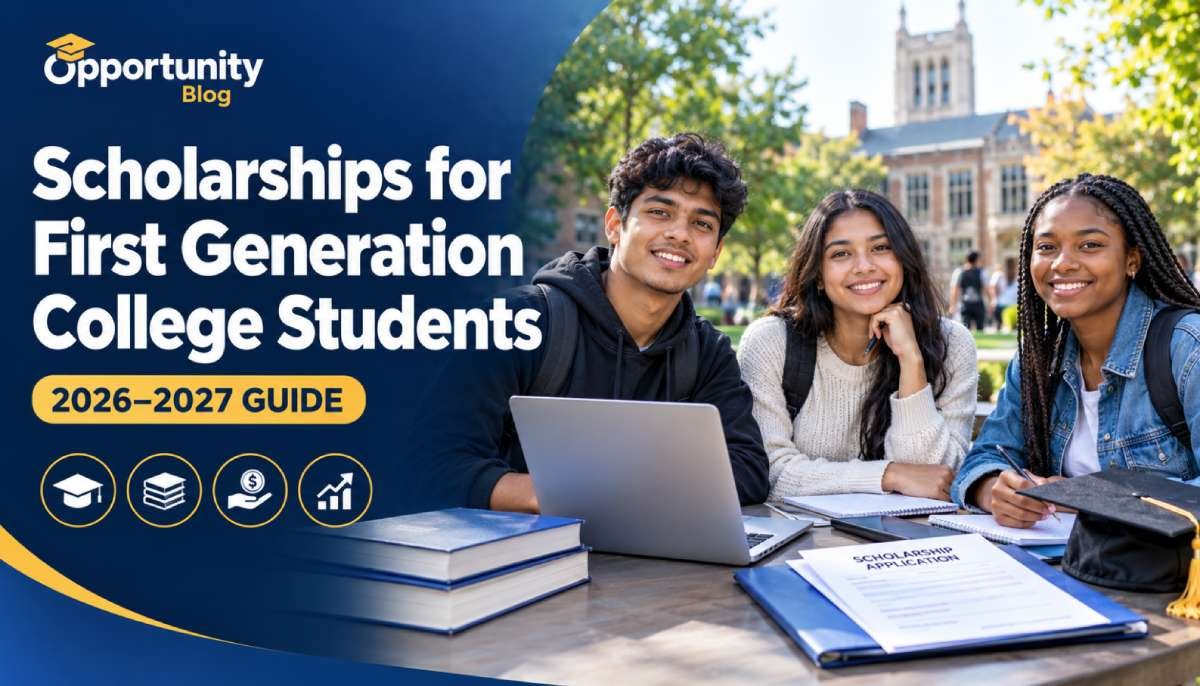
Scholarships for first generation college students help students whose parents have not completed a bachelor’s degree afford higher education. These scholarships can provide tuition assistance, housing support, book allowances, mentoring, and other resources that reduce the financial challenges of attending college.
Several organizations offer funding for first-generation students in the United States. Programs such as Dell Scholars, Clarkston Scholars, and the Florida First Generation Matching Grant have different academic, financial, and residency requirements. Some specifically require first-generation status, while others prioritize first-generation applicants.
For the 2026–2027 application season, students can explore opportunities offering awards from USD 2,500 to USD 20,000, alongside institutional grants and full-cost college scholarship programs. However, not every scholarship is open to every student, and application deadlines vary.
This guide explains available first-generation scholarships, who should apply, required documents, application steps, selection procedures, previous years’ trends, and common mistakes to avoid.
Important: Scholarship information was reviewed on October 11, 2026. Applicants should verify deadlines, eligibility, funding, and application availability before submitting an application.
What Are Scholarships for First Generation College Students?
Scholarships for first-generation college students are educational funding awards designed to support students whose parents have not completed a four-year college degree. These awards may be funded by nonprofit organizations, universities, private foundations, businesses, or state governments.
Some programs make first-generation status mandatory. Others consider it alongside financial need, academic achievement, leadership, and community involvement.
Most scholarships do not require repayment when recipients meet their award conditions. This makes them an important funding option for students who want to reduce education-related debt.
What Does First-Generation College Student Mean?
A first-generation college student generally refers to a student whose parents have not earned a bachelor’s degree.
The federal TRIO definition considers a student first-generation when neither parent has completed a bachelor’s degree. A separate provision addresses students who regularly lived with and received support from only one parent.
Scholarship providers may use different definitions, so students must read the specific program rules.
| Family education situation | Possible first-generation status |
|---|---|
| Neither parent attended college | Generally qualifies |
| Parents graduated from high school only | Generally qualifies |
| One parent earned an associate degree | Often qualifies |
| A parent attended college but never completed a bachelor’s degree | Often qualifies |
| One parent earned a bachelor’s degree | Usually does not qualify under the standard two-parent definition |
| An older sibling graduated from college | May still qualify |
| A parent earned a degree outside the United States | Depends on the program’s definition |
| Student was raised by one parent or a legal guardian | Requires review of applicable family circumstances and program rules |
Key distinction: First-generation status does not automatically establish financial need. A student may qualify as first-generation without being eligible for every need-based scholarship.
Are First-Generation Scholarships Different From Regular Scholarships?
Yes. First-generation scholarships specifically consider parental educational attainment, whereas general scholarships may focus on grades, athletics, academic majors, community service, or financial circumstances.
However, first-generation students can apply for both categories.
For example, a first-generation engineering student may qualify for a first-generation award, a STEM scholarship, and a university merit scholarship if all eligibility requirements are satisfied.
Who Should Apply for First Generation Scholarships and Who Should Not?
Students should apply when they meet the scholarship provider’s definition of first-generation status and any additional requirements relating to income, location, academic performance, or enrollment.
Students should avoid applications that clearly exclude their residency, study level, or educational circumstances.
Who Should Apply?
The following applicants should actively investigate first-generation funding opportunities:
- High school seniors: Students planning to enter an undergraduate degree program.
- Current undergraduates: Students enrolled in qualifying colleges or universities.
- Community college students: Students pursuing associate degrees or preparing to transfer.
- Students with financial need: Applicants who may qualify for need-based assistance.
- Students with strong academic performance: Applicants meeting merit or achievement requirements.
- Graduate students: Students seeking programs that specifically support first-generation graduate education.
- Students with nontraditional educational backgrounds: Applicants whose family circumstances meet a sponsor’s eligibility definition.
First-generation students with lower GPAs should not automatically exclude themselves. Some programs emphasize persistence, academic improvement, and personal achievements rather than exceptionally high grades.
Who Should Not Apply?
| Applicant situation | Recommendation |
|---|---|
| Does not meet the sponsor’s first-generation definition | Avoid programs where first-generation status is mandatory |
| Lives outside a required state or region | Search for nationally available awards |
| Already holds a bachelor’s degree | Avoid undergraduate-only programs |
| Does not meet a compulsory GPA minimum | Identify scholarships with different academic standards |
| Does not satisfy citizenship or residency requirements | Find programs that accept the applicant’s immigration or residency category |
| Cannot meet required enrollment conditions | Consider part-time or alternative funding programs |
| Does not demonstrate required financial need | Prioritize merit-based or non-need-restricted scholarships |
International students should pay particular attention to citizenship and immigration requirements. Studying at a U.S. university does not automatically establish eligibility for U.S.-funded scholarships.
Best Scholarships for First Generation College Students in 2026–2027
First-generation students can explore scholarships funded by nonprofit organizations, corporate foundations, universities, and state financial aid programs.
The following opportunities have different eligibility conditions. Some explicitly require first-generation status, while others offer priority consideration or support students from underserved backgrounds.
First Generation Scholarship Comparison Table
| Scholarship or program | Funding | First-generation requirement | Application status as of October 11, 2026 |
|---|---|---|---|
| Dell Scholars | USD 20,000 plus additional support | Not listed as a standalone mandatory condition for the 2027 cycle | Open; deadline January 12, 2027 |
| APIA Scholarship | USD 2,500 to USD 20,000 | Priority focus, not mandatory | Opens November 15, 2026 |
| Clarkston Scholars Program | USD 10,000 over two years | Required | 2026 closed; 2027 details pending |
| TELACU College Success Program | Varies by award | Priority consideration | Ongoing application process; deadlines vary |
| Florida First Generation Matching Grant | Determined by institution and financial need | Required | Institution-specific |
| QuestBridge National College Match | Full four-year college scholarship for matched students | Not mandatory | October 1, 2026 deadline passed |
| David C. Lizárraga Fellowship | Amount requires sponsor confirmation | Required | Confirm current availability with TELACU |
Note: These are not seven universally available scholarships. Each program has its own eligibility restrictions, and some application cycles have already closed.
1. Dell Scholars Program
The Dell Scholars Program supports eligible high school seniors with financial assistance, academic advising, professional development, and wellness resources.
The program is administered through the Michael & Susan Dell Foundation’s college success initiative.
Scholarship benefits
- Scholarship funding of USD 20,000.
- Laptop and book credits.
- Emergency financial assistance.
- Academic advising and career coaching.
- Wellness support, including teletherapy.
Eligibility for the 2027 application cycle
Applicants must:
- Graduate from a Texas high school.
- Participate in an approved college readiness program during grades 11 and 12.
- Plan to attend an accredited four-year public college or university in Texas.
- Demonstrate Federal Pell Grant eligibility.
- Have a GPA of at least 2.4.
The program also considers determination, motivation, educational goals, and the applicant’s ability to overcome challenges.
Important dates
| Event | Date |
|---|---|
| Applications open | October 1, 2026 |
| Application deadline | January 12, 2027 |
| Finalists announced | January 21, 2027 |
| Finalist materials due | March 31, 2027 |
| Scholarship recipients announced | May 20, 2027 |
How to apply: Complete the online application through the official Dell Scholars application and eligibility page.
Who should apply? Texas high school seniors who meet the program’s college readiness, GPA, Pell eligibility, and university requirements.
Who should not apply? Students who do not meet the mandatory Texas education requirements or are already enrolled in college.
2. APIA Scholarship
APIA Scholars offers undergraduate scholarships with an emphasis on supporting students experiencing significant financial barriers.
First-generation students and applicants from low-income households receive particular consideration.
Scholarship amount: USD 2,500 for certain one-year awards and up to USD 20,000 for multi-year awards.
Eligibility requirements
Applicants must:
- Demonstrate substantial financial need.
- Plan to enroll or already be enrolled in an undergraduate degree program at an accredited U.S. institution.
- Meet the program’s citizenship or permanent-residency criteria.
Eligible applicants include citizens, nationals, and legal permanent residents of the United States, as well as citizens of certain Freely Associated States identified by the program.
Students pursuing associate or bachelor’s degrees can apply. Applicants who have already earned a bachelor’s degree are excluded.
Application timeline for 2027–2028
| Event | Date |
|---|---|
| Applications open | November 15, 2026 |
| Application deadline | January 15, 2027, at 5 p.m. Eastern Time |
| Award notifications | April 15, 2027 |
| Scholarship distribution | Summer 2027 |
How to apply: Review eligibility and submit the application through the official APIA Scholars scholarship page.
Who should apply? Eligible undergraduate students with substantial financial need, including first-generation college students.
Important: APIA Scholars does not require every applicant to be a first-generation college student.
3. Clarkston Scholars Program
The Clarkston Scholars Program provides financial assistance and mentorship to qualifying first-generation college students with demonstrated financial need.
The program is sponsored by Clarkston Consulting.
Scholarship amount: USD 10,000, distributed as USD 5,000 during the junior year and USD 5,000 during the senior year.
Eligibility requirements
Applicants generally must:
- Be college sophomores at eligible accredited institutions.
- Have first-generation college student status.
- Demonstrate financial need.
- Show an interest in consulting, life sciences, consumer products, or retail.
- Participate in professional mentorship.
- Meet the program’s relationship restrictions regarding Clarkston employees.
The scholarship combines funding with professional mentoring and networking.
Application status: The 2026 application cycle is closed. Clarkston has indicated that information for the 2027 cycle will be available in the fall.
Selection process: Shortlisted applicants should be prepared for an interview with a Clarkston representative.
Who should apply? Eligible first-generation sophomores interested in business-related careers who can participate in the mentorship program.
4. TELACU College Success Program
The TELACU College Success Program provides educational funding and student development support.
The program prioritizes applicants who demonstrate financial need and first-generation status, alongside other academic and geographic considerations.
Funding: Scholarship amounts vary according to the award and program arrangements.
The program also offers:
- Academic and career advising.
- Leadership and personal development sessions.
- Internship and employment preparation.
- Mentorship opportunities.
- Community engagement activities.
Priority consideration generally includes students who:
- Are first-generation college students.
- Demonstrate financial need.
- Have a GPA of 2.5 or above.
- Attend a four-year institution full-time.
- Reside in California, Illinois, New York, or Texas.
- Pursue STEAM or business-related studies.
These are priority factors, not necessarily absolute requirements for every applicant.
Application status: TELACU accepts applications on an ongoing basis, subject to academic-year availability and deadlines displayed in its application system.
Renewal conditions: Continuing recipients generally must maintain at least a 2.75 GPA, fulfill participation requirements, complete community service, and submit renewal materials.
Who should apply? Students seeking both financial assistance and academic or professional support throughout college.
5. Florida First Generation Matching Grant
The Florida First Generation Matching Grant is a need-based program for eligible first-generation undergraduate students attending participating public institutions in Florida.
Participating institutions administer the grants and determine award amounts according to applicable rules and available funds.
Scholarship amount: Varies according to financial need, institutional funding, and cost of attendance.
Eligibility requirements
Applicants generally must:
- Meet Florida residency requirements.
- Be U.S. citizens or eligible noncitizens.
- Have parents who have not earned a bachelor’s degree, subject to applicable rules.
- Demonstrate substantial financial need.
- Attend an eligible Florida state university or Florida College System institution.
- Meet enrollment and satisfactory academic progress requirements.
- Complete the FAFSA according to institutional deadlines.
How to apply: Contact the financial aid office at the participating Florida institution. Applications and deadlines are institution-specific.
Who should apply? Eligible Florida undergraduate students whose parents have not completed a bachelor’s degree.
6. QuestBridge National College Match
QuestBridge National College Match connects academically strong high school seniors from low-income backgrounds with participating U.S. colleges.
Students who successfully match receive early admission and a full four-year scholarship provided through the college partner’s financial aid package.
The package covers major components of the cost of attendance, including tuition, housing, meals, books, and travel.
Eligibility considerations
- Strong academic performance.
- Significant financial need.
- High school senior status.
- Compliance with program citizenship, residency, and school attendance policies.
First-generation students are well represented among the population QuestBridge serves, but first-generation status is not mandatory.
Application status: The 2026 National College Match deadline was October 1, 2026. That deadline has passed.
Students preparing for a future cycle should monitor QuestBridge’s updated application schedule.
Important: A successful Match is generally binding, with program-specific exceptions. Applicants should understand college ranking and admission commitments before participating.
7. David C. Lizárraga Fellowship
The David C. Lizárraga Fellowship is a graduate-level opportunity associated with the TELACU Education Foundation.
It targets first-generation graduate students pursuing advanced education in relevant professional fields.
Eligibility considerations include:
- First-generation college student status.
- Full-time graduate enrollment.
- Financial need.
- A minimum GPA of 2.5.
- Permanent residency within California, Illinois, New York, or Texas.
- Studies in business or engineering, with some other fields considered at the foundation’s discretion.
Selection also considers leadership, achievements, professional interests, and community commitment.
Funding and deadlines: Applicants should confirm the current fellowship amount and application cycle with TELACU before making financial plans.
What Types of First Generation College Scholarships Are Available?
First-generation students can qualify for several scholarship categories, including awards that do not specifically require first-generation status.
Fully Funded and Partial Scholarships
Fully funded scholarships generally cover the full defined cost of attendance or a substantial range of educational expenses.
Partial scholarships cover only selected expenses or a fixed award amount.
| Scholarship type | Typical coverage | Example |
|---|---|---|
| Full-cost scholarship | Tuition, housing, meals, and other approved expenses | QuestBridge Match package |
| Fixed-value scholarship | A specific monetary award | Clarkston Scholars |
| Renewable scholarship | Funding over multiple academic periods | Eligible TELACU awards |
| Need-based institutional grant | Award determined by financial need and institutional rules | Florida First Generation Matching Grant |
A scholarship advertised as USD 20,000 is not necessarily worth USD 20,000 every year. Applicants should establish whether the amount is a total award or an annual benefit.
Need-Based and Merit-Based Scholarships
Need-based scholarships prioritize a student’s financial circumstances.
Merit-based scholarships emphasize academic achievement, leadership, extracurricular activities, or specialized abilities.
Some first-generation scholarships combine both approaches.
A student with a strong academic record but limited financial need may find more options through merit-based programs. Students with substantial financial need should investigate need-based institutional grants and scholarships.
Government, University, and Private Scholarships
Government-administered programs may use residency, income, and enrollment rules.
Universities may award scholarships through admissions offices, financial aid departments, or first-generation student support programs.
Private foundations and companies may combine funding with career development, networking, and mentoring.
Students should search all three funding sources instead of relying only on national scholarship lists.
How Much Financial Support Can First Generation Students Receive?
Financial support depends on the scholarship, institution, financial need, and other available aid.
An individual student may receive a small award, multiple scholarships, or a full-cost college funding package.
Scholarships may cover tuition, mandatory fees, books, transportation, housing, meals, or approved academic expenses. The allowed uses depend on the sponsor’s terms.
Can First-Generation Scholarships Be Combined With FAFSA and Pell Grants?
Yes, students can often receive private scholarships alongside federal or institutional financial aid.
FAFSA is an application for student aid, not a scholarship. Eligible students use it to be considered for assistance such as Federal Pell Grants, work-study, and federal student loans.
Students attending college during the 2027–2028 academic year can complete the official FAFSA application.
The FAFSA uses financial information to calculate a Student Aid Index (SAI). A lower SAI may indicate greater financial need. The SAI is not the amount a family must pay or the amount of aid a college will award.
Example: Calculating remaining college expenses
| Expense or financial aid | Illustrative amount |
|---|---|
| Annual cost of attendance | USD 30,000 |
| Combined grants and institutional scholarships | USD 18,000 |
| Additional outside scholarship | USD 5,000 |
| Estimated remaining cost | USD 7,000 |
This calculation assumes the outside scholarship does not cause other aid to be reduced. Actual financial aid packages may be adjusted to comply with institutional and federal rules.
Students should notify their financial aid office whenever they receive outside scholarship funding.
How to Apply for Scholarships for First Generation College Students: Step-by-Step Guide
The scholarship application process typically involves confirming eligibility, preparing documents, completing forms, and responding to selection requests.
The following eight steps apply to most first-generation scholarship searches.
Step 1: Confirm Your First-Generation Status
Review your parents’ educational history.
Identify whether either parent completed a bachelor’s degree and whether the specific sponsor has exceptions for household arrangements or foreign degrees.
Do not assume every program uses the same definition.
Step 2: Identify Scholarships Matching Your Profile
Create a shortlist based on:
- Current academic level.
- Residency and citizenship.
- GPA.
- Financial need.
- College or university.
- Intended major.
- Application deadline.
Separate scholarships where first-generation status is mandatory from those where it provides priority consideration.
Step 3: Check Eligibility and Deadlines
Read each sponsor’s latest application instructions.
Confirm whether the deadline applies to the year you plan to begin college, the current academic year, or a future funding cycle.
Record the time zone associated with each deadline.
An expired scholarship listing should not be treated as an active opportunity.
Step 4: Complete FAFSA When Required
Many need-based scholarships use FAFSA information to verify financial circumstances.
Choose the FAFSA form corresponding to your intended academic year.
For example, the 2027–2028 form relates to attendance between July 1, 2027, and June 30, 2028.
Complete the form accurately and review the processed FAFSA Submission Summary.
Some private scholarships do not require FAFSA. Follow each sponsor’s instructions rather than submitting unnecessary personal financial records.
Step 5: Prepare Supporting Documents
Gather transcripts, recommendation letters, personal statements, and financial documents before the deadline.
Confirm which documents are mandatory and which are required only from finalists.
Save files in the requested format and use descriptive filenames.
Step 6: Write Your Scholarship Essay
Explain your educational background, academic goals, achievements, and reasons for seeking financial support.
Use specific examples rather than broad claims.
Follow each essay prompt, word limit, and submission requirement.
Step 7: Submit the Application
Create an account on the official application portal.
Complete every required field and upload the correct documents.
Check that the entered information matches your academic and personal records.
Submit before the closing date rather than relying on the final hours.
Step 8: Monitor Application Status
Keep a copy of the submission confirmation.
Check email regularly for interview invitations, document requests, or scholarship decisions.
Respond before any additional deadlines.
If selected, read the award agreement and confirm renewal, enrollment, and reporting requirements.
Required Documents for First Generation Scholarship Applications
First-generation scholarship applications may require academic, financial, personal, and enrollment records.
Document requirements differ by sponsor. Applicants should not assume that every scholarship requests the same materials.
| Document | Purpose | Usually obtained from |
|---|---|---|
| Academic transcript | Verifies courses, GPA, and progress | High school or college |
| FAFSA Submission Summary | Provides financial aid application information | Federal Student Aid |
| Income documentation | Supports financial need assessment | Applicant or household financial records |
| First-generation declaration | Confirms parental educational history | Application form or sponsor instructions |
| Personal statement | Explains educational background and goals | Written by applicant |
| Recommendation letter | Provides an independent assessment | Teacher, counselor, professor, or supervisor |
| Résumé or activity list | Summarizes achievements and involvement | Prepared by applicant |
| Enrollment or admission verification | Confirms attendance at an eligible institution | College or university |
| Residency or citizenship documentation | Establishes eligibility when required | Appropriate official records |
Academic Transcripts and GPA Records
An academic transcript documents coursework, grades, and academic performance.
Scholarship sponsors may accept unofficial transcripts during initial screening but request official transcripts from finalists.
Applicants must verify which version is required.
Proof of First-Generation Status
Programs may ask applicants to declare their parents’ educational attainment.
Some organizations may request additional verification or clarification.
There is no universal document that every first-generation scholarship accepts as proof.
Students should never misrepresent parental education to satisfy a scholarship requirement.
Financial Documents
Need-based scholarships may request financial aid information, income records, or supporting financial statements.
Only submit sensitive documents through an authorized application system.
Applicants should confirm a sponsor’s legitimacy before sharing tax records or identity documents.
Personal Statements and Recommendation Letters
A personal statement explains the applicant’s motivation, experiences, and goals.
Recommendation letters provide external evidence of academic strengths, character, leadership, or persistence.
Request recommendations early and give referees sufficient information about the scholarship.
Application note: Some programs use simplified initial applications and request additional documents only from shortlisted candidates.
How to Write a Strong First Generation Scholarship Essay
A strong scholarship essay explains how an applicant’s experiences, achievements, and educational goals align with a scholarship’s purpose.
It should provide evidence rather than repeat general statements about determination or financial hardship.
Explain Your Educational Background
Describe your educational journey and any challenges that materially influenced it.
For example, an applicant might explain how they researched admission requirements, completed financial aid forms, or obtained academic support without family experience navigating U.S. higher education.
The explanation should be accurate and relevant to the prompt.
Demonstrate Achievements and Leadership
Use concrete examples of academic progress, employment, volunteering, family responsibilities, or community involvement.
Leadership does not always require holding a formal title.
Managing important responsibilities while maintaining academic progress may demonstrate organization and persistence.
Connect Education to Future Goals
Explain what you intend to study, why the subject matters, and how the scholarship would support your plans.
A specific academic or professional objective is more informative than a generic statement about wanting a successful future.
Avoid Common Essay Problems
Applicants should avoid:
- Copying generic scholarship essays.
- Exaggerating personal circumstances.
- Ignoring the essay prompt.
- Repeating a résumé without explaining its significance.
- Submitting unedited, inconsistent, or inaccurate statements.
A strong application does not require applicants to disclose traumatic experiences. Relevant evidence of preparation, goals, and achievement can be equally important.
How Are First Generation Scholarship Recipients Selected?
Scholarship committees evaluate applicants according to each program’s stated eligibility and selection criteria.
Some sponsors prioritize financial need. Others assess academic performance, personal circumstances, leadership, or a combination of factors.
Stage 1: Eligibility Screening
Administrators verify whether applications meet mandatory conditions.
These may include residency, parental education, GPA, study level, and submission completeness.
Applications that fail compulsory eligibility requirements may not advance.
Stage 2: Academic and Financial Assessment
Reviewers consider academic progress and financial circumstances where relevant.
A minimum GPA qualifies a student for consideration but does not guarantee selection.
Similarly, substantial financial need does not automatically result in an award.
Stage 3: Essay and Personal Achievement Review
Committees may evaluate motivation, educational objectives, community involvement, employment, and other responsibilities.
The relative importance of these factors depends on the sponsor.
Applicants should not assume that a particular category represents a fixed percentage of a selection score unless the program publishes one.
Stage 4: Finalist Interviews and Verification
Some scholarships invite finalists to interviews.
Clarkston Scholars explicitly identifies finalist interviews as part of its application process.
Other programs may request transcripts, financial documents, or additional application information.
Not every first-generation scholarship requires an interview.
Stage 5: Final Decisions and Award Notification
Recipients generally receive instructions explaining award conditions and next steps.
The sponsor or institution determines how funds are disbursed.
Before accepting an award, students should establish whether funds are paid directly to the university, applied to a student account, or distributed through another permitted arrangement.
Common Mistakes First Generation Scholarship Applicants Make
Many application problems can be prevented through careful eligibility screening and early preparation.
| Common mistake | Why it matters | How to avoid it |
|---|---|---|
| Assuming all programs use the same first-generation definition | May cause eligibility problems | Read sponsor-specific definitions |
| Applying without checking residency | Can make the application ineligible | Confirm geographic restrictions |
| Confusing total funding with annual funding | Creates unrealistic budget expectations | Check award duration and payment schedule |
| Submitting incomplete documents | May prevent review | Follow the official checklist |
| Missing the deadline time zone | Can result in late submission | Record date and exact time |
| Sending a generic essay | Weakens evidence of program fit | Address the specific prompt |
| Ignoring finalist requests | May prevent completion of selection | Monitor email and applicant portal |
| Trusting outdated scholarship directories | Can lead to expired or closed programs | Verify sponsor announcements |
| Paying suspicious application charges | Creates fraud risk | Investigate requests for payment or sensitive information |
| Ignoring renewal rules | May lead to lost future funding | Review ongoing conditions before acceptance |
Practical recommendation: Create a spreadsheet containing scholarship name, eligibility, deadline, required documents, application status, and follow-up date.
Tracking applications makes it easier to manage multiple opportunities without confusing their requirements.
Previous Years’ Trends in First Generation College Scholarships
Historical scholarship information can help applicants understand program continuity, changing requirements, and funding opportunities.
However, the number of scholarships awarded in one year does not reliably predict an individual student’s probability of receiving an award.
1. Established Scholarship Programs Continue to Support College Access
Dell Scholars began in 2004 and reports supporting approximately 6,000 scholars, including more than 4,500 college graduates.
The program currently describes annual support for 500 new Dell Scholars.
These figures demonstrate the program’s established history. They do not indicate the number of first-generation students admitted in any specific year.
2. QuestBridge Recipient Numbers Changed Between 2024 and 2025
QuestBridge published the following National College Match results:
| Year | Matched scholarship recipients | Participating college partners |
|---|---|---|
| 2024 | 2,627 | 52 |
| 2025 | 2,550 | 55 |
The number of matched students decreased by 77, or approximately 2.9%, between the two reported cycles, while the number of participating college partners increased.
These are overall QuestBridge National College Match figures, not first-generation-only scholarship statistics.
The figures also do not establish a trend in application success rates without comparing the relevant applicant and finalist populations.
3. Scholarship Requirements Can Change Between Cycles
Dell Scholars’ published 2027 eligibility criteria include specific Texas high school and public university conditions.
Students reviewing historical articles may encounter different or incomplete descriptions.
The 2027 program rules should take precedence over older scholarship summaries.
4. Scholarship Availability Is Not Permanent
The Dorrance Scholarship Program previously offered funding to eligible first-generation students in Arizona.
Its official program announcement now states that it is no longer accepting new applications and that operations will conclude after its final supported class graduates.
This demonstrates why historical scholarship availability should not be confused with an active opportunity.
What Do These Trends Mean for 2027 Applicants?
Students should:
- Check current sponsor eligibility instead of relying on older requirements.
- Distinguish historical recipient counts from current application availability.
- Compare published award values across relevant years.
- Prepare for new applications even when previous rounds have closed.
- Avoid assuming future acceptance rates or award increases from limited historical data.
Historical evidence is useful for evaluating program continuity. It cannot guarantee future funding.
Research Notes: What Applicants Should Verify Before Applying
Official scholarship information sometimes differs from the descriptions published in general scholarship directories.
The following research findings are particularly relevant to applicants preparing for 2027.
| Program or issue | Research finding | Applicant action |
|---|---|---|
| Dell Scholars | The 2027 program has specific Texas-related eligibility requirements | Confirm Texas high school, approved program, and public university conditions |
| APIA Scholarship | First-generation status is prioritized, but not mandatory | Check financial need and citizenship requirements |
| Clarkston Scholars | The 2026 application is closed | Look for the announced 2027 application |
| TELACU College Success Program | Funding includes services and participation commitments | Read both award and renewal requirements |
| Florida First Generation Matching Grant | Institutions determine applications and available awards | Contact the college financial aid office |
| QuestBridge | The 2026 National College Match deadline has passed | Monitor the next applicable cycle |
| Dorrance Scholarship | The program is no longer accepting new applications | Do not prepare a new application based on outdated listings |
| FAFSA | The 2027–2028 form is available | Use the correct academic-year form |
Research Insight: The Largest Award Is Not Always the Most Suitable
A student comparing scholarships should evaluate more than the highest advertised monetary value.
Consider these questions:
- Does the applicant satisfy every mandatory requirement?
- Is the advertised amount annual or cumulative?
- Can the award be renewed?
- Does the scholarship cover living expenses?
- Does the program include mentoring or academic support?
- Will the award affect the student’s existing financial aid package?
- Are ongoing service, GPA, or enrollment commitments manageable?
A smaller renewable scholarship may provide more predictable support than a larger one-time award.
Likewise, academic advising and emergency assistance can have practical value beyond direct tuition funding.
Research Insight: Compare Scholarships Using a Consistent Framework
Students can use a weighted personal comparison rather than ranking scholarships solely by advertised value.
| Comparison factor | What to check |
|---|---|
| Eligibility fit | Whether all mandatory rules are satisfied |
| Award usefulness | How much of the student’s actual unmet cost can be covered |
| Funding reliability | Whether the award is renewable and under what conditions |
| Application readiness | Whether documents can be completed before the deadline |
| Additional support | Mentoring, advising, emergency assistance, and professional services |
| Ongoing commitments | GPA, full-time status, volunteering, meetings, or interviews |
Important: This comparison framework is an editorial tool for applicants, not an official scoring system used by scholarship committees.
How to Keep and Renew a First Generation College Scholarship
Renewal requirements determine whether a recipient can continue receiving scholarship funding after an initial award.
Not every scholarship is renewable. Students must review the funding agreement before making long-term financial commitments.
Maintain Academic Requirements
Some scholarships establish a minimum cumulative GPA.
If a recipient’s performance falls below the required level, continued eligibility may be affected.
Students should seek academic advising early if they are at risk of missing the renewal threshold.
Meet Enrollment Conditions
Scholarship programs may require full-time enrollment, continued progress toward a degree, or attendance at an approved institution.
Recipients should check whether changing majors, transferring universities, or taking a semester off affects their award.
Complete Renewal Applications
Renewable programs may require updated transcripts, financial information, interviews, or annual application forms.
For example, TELACU’s renewal framework includes academic, participation, community service, and application requirements.
Report Outside Scholarships
Recipients should inform the financial aid office when they receive additional funding.
The institution may need to recalculate elements of the financial aid package to comply with cost-of-attendance and other applicable rules.
Students should keep copies of award notices, renewal agreements, and funding correspondence.
Frequently Asked Questions About First Generation College Scholarships
1. What qualifies you as a first-generation college student?
A first-generation college student generally has parents who have not completed bachelor’s degrees. However, universities and scholarship providers may use different definitions. Some also consider household circumstances, including whether the student was raised and supported by one parent. Applicants should verify the specific scholarship’s definition before submitting an application.
2. Am I first-generation if my parents attended college but did not graduate?
Yes, you may qualify as a first-generation college student if your parents attended college but did not earn bachelor’s degrees. The commonly used federal TRIO definition focuses on degree completion rather than college attendance alone. However, individual scholarship programs can establish narrower rules, so check the sponsor’s eligibility policy.
3. Does my sibling’s college degree affect first-generation scholarship eligibility?
A sibling’s college degree generally does not prevent someone from qualifying as a first-generation college student under definitions based on parental education. However, sponsors may use different family education criteria. Review the actual program definition and provide accurate information about your parents or guardians when completing the application.
4. Can I get a first-generation scholarship with a low GPA?
Yes, some scholarships for first-generation students consider applicants with modest GPAs. The academic requirement varies by program. For example, Dell Scholars specifies a minimum 2.4 GPA for its 2027 cycle, alongside other mandatory criteria. Students who do not meet one scholarship’s threshold should research awards with different requirements.
5. Are there fully funded scholarships for first-generation college students?
Yes, some full-cost scholarship opportunities are accessible to first-generation students. QuestBridge National College Match, for example, provides matched recipients with full four-year college funding through participating institutions. However, first-generation status alone does not qualify someone for QuestBridge. Applicants must also meet the program’s academic and financial criteria.
6. Do first-generation scholarships require FAFSA?
Not every first-generation scholarship requires FAFSA. Many need-based programs use FAFSA information to assess financial eligibility, while some private scholarships request different documents. Students who qualify for federal aid should complete the appropriate FAFSA form and check school deadlines. Always follow the sponsor’s requirements for submitting financial records.
7. Can I apply if my family does not qualify for need-based aid?
Yes, first-generation students who do not qualify for need-based assistance may still be eligible for certain scholarships. First-generation status and financial need are separate criteria. However, programs that explicitly require Pell eligibility or substantial financial need may exclude them. Merit-based, institutional, and major-specific awards may provide additional options.
8. Can community college students get first-generation scholarships?
Yes, eligible community college students can receive first-generation scholarships and grants. APIA Scholars considers students pursuing associate degrees, while Florida’s First Generation Matching Grant can support eligible students at participating Florida College System institutions. Other programs focus exclusively on four-year universities. Applicants should verify enrollment and transfer-related requirements.
9. Are first-generation scholarships available to graduate students?
Yes, although many first-generation scholarship programs primarily serve undergraduates, some opportunities support graduate education. The David C. Lizárraga Fellowship associated with TELACU is one example with first-generation eligibility requirements. Graduate applicants should also investigate university assistantships, professional fellowships, departmental scholarships, and funding specific to their academic discipline.
10. Can international students apply for first-generation college scholarships?
Some international students may qualify, but many U.S. scholarships have citizenship, permanent residency, or geographic restrictions. First-generation status does not override those requirements. International applicants should check whether their nationality, immigration status, intended university, and parents’ educational qualifications meet the program’s definition before preparing an application.
11. Can I receive multiple first-generation scholarships at the same time?
Yes, students can sometimes receive several scholarships simultaneously when the sponsors and educational institution permit it. However, outside awards may change other components of a financial aid package. Recipients should report all scholarships to their financial aid office and confirm award limits, disbursement restrictions, and any institutional adjustment policies.
12. When should I start applying for first-generation scholarships?
Students should begin researching scholarships several months before their intended college enrollment date. Application windows vary considerably, and some close during the preceding academic year. For example, the 2027 Dell Scholars deadline falls in January 2027. Create a scholarship calendar, collect documents early, and monitor official sponsor announcements.
Conclusion: Finding the Right First Generation College Scholarship
Scholarships for first generation college students can reduce educational expenses and provide academic, financial, and professional support throughout higher education.
Programs such as Dell Scholars, Clarkston Scholars, APIA Scholars, TELACU, and Florida’s First Generation Matching Grant offer different types of assistance. Eligibility depends on the particular scholarship’s academic, financial, geographic, and first-generation requirements.
Students should prioritize scholarships that match their circumstances, compare annual and total funding, prepare accurate documents, and submit applications before official deadlines

You may like

Fully Funded Scholarships in UK for Indian Students (2027-28 Intake)

Scholarships Without IELTS for Indian Students (2027 Intake): Verified List, Eligibility and How to Apply

Fully Funded Scholarships in Canada for Indian Students (2027–28 Intake)
Trending
-
 Scholarships4 months ago
Turkey Burslari Scholarship 2026: Eligibility, Benefits, Deadline, Interview, and Results
-
 Scholarships3 months ago
SBI Asha Scholarship 2026-27: Eligibility, Amount, Last Date and Apply Online
-
 By Country4 months ago
Scholarship for MBBS Students in India
-
 Scholarships4 months ago
Scholarship for J&K Students: Eligibility, Amount, Deadlines, and How to Apply
-
 By Country4 months ago
Korean Government Scholarship for Indian Students: GKS Eligibility, Benefits, Deadlines and Application
-
 Scholarships3 months ago
Scholarships for PG Students in Kerala 2026: Eligibility, Amounts, Deadlines and Application Links
-
 Scholarships4 months ago
Abdul Kalam Scholarship for Class 10 Students: Verified Programs, Eligibility and Application Guide
-
 Scholarships3 months ago
West Bengal Student Scholarship 2026-27: Eligibility, Amounts, Last Dates and Apply Online