
Scholarships
TN Scholarship for School Students: Tamil Nadu Scholarships 2026–27, Eligibility & Apply Online

Published
2 weeks agoon
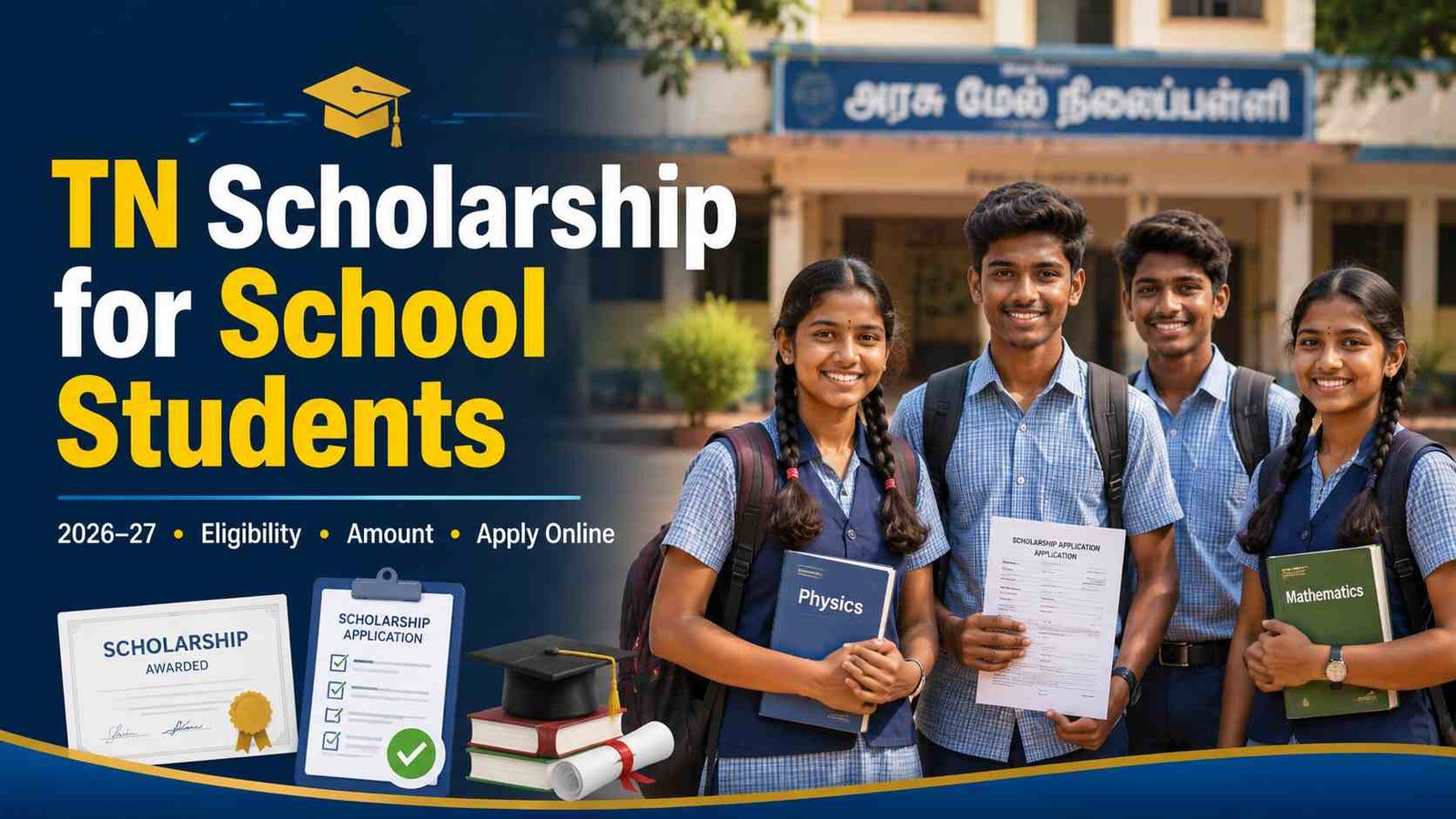
The TN scholarship for school students search refers to multiple Tamil Nadu and Central Government scholarship schemes available to students studying in Tamil Nadu.
There is no single scholarship officially called the “TN Scholarship.”
School students can qualify for financial assistance based on their class, family income, community, gender, disability status, school type, academic performance, and place of residence.
Major options include the National Means-cum-Merit Scholarship Scheme (NMMSS/NMMS), PM-YASASVI Top Class Education in Schools, Tamil Nadu State Scholarship Portal schemes, BC/MBC/DNC benefits, Adi Dravidar and Tribal Welfare scholarships, rural girls’ incentives, and scholarships for students with disabilities.
For the 2026–27 academic year, the National Scholarship Portal is open from 1 June 2026. Current student applications for NMMSS and the Pre-Matric Scholarship for Students with Disabilities close on 31 August 2026. PM-YASASVI Top Class Education in Schools currently shows a renewal application deadline of 31 August 2026.
Last verified: 30 August 2026. Scholarship deadlines and application status can change. Always check the relevant official portal before submitting an application.
Which TN Scholarship Should a School Student Check First?
The correct scholarship depends on the student’s profile.
| Student profile | Scholarship or funding route to check first |
|---|---|
| Class VIII student from a lower-income family in an eligible Government, Government-aided or local-body school | NMMSS / NMMS |
| OBC, EBC or DNT student in an eligible Top Class School | PM-YASASVI Top Class Education in Schools |
| Adi Dravidar / SC school student | Tamil Nadu Adi Dravidar Welfare schemes |
| ST school student | Tamil Nadu Tribal Welfare schemes |
| BC student in Classes IX–XII | BC Welfare school benefits |
| MBC or DNC student | MBC/DNC Welfare schemes |
| MBC/DNC rural girl in Classes III–VI | Rural Girls’ Incentive Scheme |
| Student with 40% or more benchmark disability in Classes IX–X | Central Pre-Matric Scholarship for Students with Disabilities |
| Differently abled student in Classes IX–XII | Tamil Nadu disability scholarship |
| Muslim girl in eligible Classes III–VIII | Muslim Girls Educational Scheme, subject to current scheme rules |
| Student seeking a merit-based school scholarship | NMMS and other current merit examinations |
Tamil Nadu’s scholarship ecosystem includes school schemes administered through several welfare departments. The state’s policy documentation lists school-level schemes under the Adi Dravidar Welfare, Tribal Welfare, BC Welfare, MBC/DNC Welfare, WAQF Board and Minorities Welfare systems.
What Is the TN Scholarship for School Students?
A TN scholarship for school students is a financial-aid, incentive, fee-concession or scholarship programme available to eligible school students in Tamil Nadu.
The term covers more than one funding model.
A benefit can be:
- a direct cash scholarship;
- a tuition-fee concession;
- an examination-fee reimbursement;
- a maintenance allowance;
- a book grant;
- a disability allowance;
- an incentive for girls;
- a merit scholarship renewable across several classes.
This distinction matters.
A student receiving a fee waiver may not receive the same amount as cash in a bank account.
A student receiving NMMSS receives a defined annual scholarship through the National Scholarship Portal and Direct Benefit Transfer.
Tamil Nadu’s State Scholarship Portal is designed to centralize state and Central welfare schemes and integrate student information with databases such as EMIS, Aadhaar, e-Sevai, NPCI and DBT systems.
TN Scholarships for School Students at a Glance
| Scholarship | Classes | Main target group | Approx. financial value | Main application route |
|---|---|---|---|---|
| National Means-cum-Merit Scholarship Scheme | IX–XII after Class VIII selection | Meritorious students from lower-income households | Approx. USD 126/year | NSP after state selection |
| PM-YASASVI Top Class Education in Schools | IX–XII | OBC, EBC and DNT students in shortlisted schools | Up to approx. USD 784/year for IX–X; USD 1,307/year for XI–XII | NSP |
| Pre-Matric Scholarship for Students with Disabilities | IX–X | Students with 40%+ benchmark disability | Monthly support + allowances | NSP |
| Post-Matric Scholarship for Students with Disabilities | XI–XII and higher | Students with 40%+ benchmark disability | Monthly support + fees + allowances | NSP |
| Tamil Nadu Differently Abled Student Scholarship | IX–XII | Eligible differently abled students | Approx. USD 42/year | District Differently Abled Welfare Officer |
| BC school assistance | IX–XII depending benefit | Tamil Nadu BC students | Fee concession/reimbursement | School/welfare route |
| MBC/DNC school assistance | IX–XII depending benefit | Tamil Nadu MBC/DNC students | Fee concession/reimbursement | School/welfare route |
| MBC/DNC Rural Girls’ Incentive | III–VI | Eligible MBC/DNC rural girls | Approx. USD 5/year for III–V; USD 10/year for VI | School Headmaster |
| Adi Dravidar Welfare schemes | I–XII depending scheme | Eligible SC/Adi Dravidar students | Scheme-specific | TNSSP/school welfare route |
| Tribal Welfare schemes | III–XII depending scheme | Eligible ST students | Scheme-specific | TNSSP/school welfare route |
USD values are approximate and rounded from official scheme amounts.
TN Scholarships by School Class
The easiest way to find the correct Tamil Nadu school scholarship is to start with the student’s current class.
Scholarships for Classes I to V
Students in the early school years usually encounter targeted welfare and incentive schemes rather than broad merit scholarships such as NMMS.
Tamil Nadu’s State Scholarship Portal documentation includes an Adi Dravidar Pre-Matric Scholarship for eligible occupation-linked students from Classes I–X.
The TNSSP ecosystem also includes girls’ incentive programmes beginning in Class III.
Eligible MBC/DNC girls studying in rural Government or Government-aided schools can also check the Rural Girls’ Incentive Scheme.
Scholarships for Classes VI to VIII
Classes VI–VIII are important because several targeted girls’ incentive programmes extend through this period.
Students in Class VIII should also begin checking NMMS eligibility.
The NMMS selection examination takes place at the Class VIII stage.
Selected students receive the scholarship beginning in Class IX and may renew the scholarship through Class XII if they satisfy continuation conditions.
Scholarships for Classes IX and X
Classes IX and X have some of the widest school scholarship coverage.
Students should investigate:
- NMMSS;
- PM-YASASVI Top Class Education in Schools;
- Pre-Matric Scholarship for Students with Disabilities;
- Adi Dravidar pre-matric schemes;
- Tribal Welfare pre-matric schemes;
- BC pre-matric support;
- MBC/DNC pre-matric support.
Tamil Nadu’s TNSSP policy documentation explicitly lists Pre-Matric Scholarship schemes for Classes IX and X under Adi Dravidar, Tribal, BC and MBC/DNC Welfare.
Scholarships for Classes XI and XII
Higher-secondary students should check:
- NMMSS renewal;
- PM-YASASVI Top Class Education in Schools;
- Post-Matric Scholarship for Students with Disabilities;
- Adi Dravidar post-matric schemes;
- Tribal Welfare post-matric schemes;
- BC/MBC/DNC examination-fee assistance.
The term “post-matric” can be confusing.
For school-level welfare schemes, Classes XI and XII can already fall within the post-matric category.
National Means-cum-Merit Scholarship Scheme: NMMS Tamil Nadu
The National Means-cum-Merit Scholarship Scheme, commonly called NMMSS or NMMS, is one of the most important scholarships for school students in Tamil Nadu.
The Central Government created the scheme to reduce school dropout after Class VIII and encourage meritorious students from economically weaker households to continue through secondary and higher-secondary education.
The scheme provides 100,000 fresh scholarships nationally each year for students entering Class IX. Scholarships can continue through Classes X, XI and XII.
How Much Is the NMMS Scholarship?
The official scholarship amount is equivalent to approximately:
USD 126 per year per student.
The official scheme amount is paid annually and corresponds to approximately USD 10.50 per month when averaged across 12 months.
The scholarship is transferred to selected students through Direct Benefit Transfer using the National Scholarship Portal and PFMS systems.
Who Is Eligible for NMMS?
A student must satisfy several conditions.
The current Central guidelines state that:
- parental income from all sources must not exceed the equivalent of approximately USD 3,661 per year;
- the student should normally have at least 55% marks or an equivalent grade in Class VII;
- SC/ST students receive a 5-percentage-point relaxation in the Class VII marks condition;
- the student should be a regular student of a Government, Government-aided or local-body school;
- the student must pass the relevant state-level selection process.
Students studying in Kendriya Vidyalayas, Jawahar Navodaya Vidyalayas and specified residential schools are not eligible.
Students in private schools are also excluded under the NMMSS guidelines.
How Does Tamil Nadu Select NMMS Students?
Tamil Nadu conducts a state-level selection examination at the Class VIII stage.
The NMMSS examination contains two major tests:
- Mental Ability Test — MAT
- Scholastic Aptitude Test — SAT
MAT assesses reasoning and related cognitive abilities.
SAT assesses scholastic knowledge.
The State applies qualifying criteria, quota allocation and reservation rules when identifying scholarship candidates.
The student journey is therefore:
Eligibility → State NMMS examination → selection → NSP application → school/institute verification → district verification → scholarship payment
Passing or being selected in the state examination does not mean a student should ignore the NSP process.
The selected student still needs to complete the required scholarship registration and verification.
NMMS 2026–27 Deadline
For academic year 2026–27, the National Scholarship Portal currently lists:
- Student application deadline: 31 August 2026
- Defective application verification: 15 September 2026
- Institute verification: 15 September 2026
- DNO/SNO/MNO verification: 30 September 2026
These dates relate to the NSP scholarship application process.
They should not be confused with the separate Tamil Nadu NMMS selection-examination date.
Applicants should use the latest notification from the Tamil Nadu Directorate of Government Examinations for the next state examination.
PM-YASASVI Scholarship for Tamil Nadu School Students
PM-YASASVI Top Class Education in Schools supports high-performing students from eligible OBC, EBC and DNT communities.
The scheme funds education from Class IX through Class XII in shortlisted high-performing schools.
The schools can include eligible public, aided and private institutions affiliated with recognized boards.
Who Can Apply for PM-YASASVI Top Class School Education?
The main eligibility framework includes:
- membership of an eligible OBC, EBC or DNT category;
- household income below approximately USD 2,615 per year;
- study or admission in a school shortlisted under the programme;
- qualifying class and merit requirements.
The programme covers eligible students from Classes IX to XII.
Thirty percent of scholarships are reserved for girls.
How Much Does PM-YASASVI Provide?
The maximum annual support is:
- Classes IX and X: up to approximately USD 784 per year
- Classes XI and XII: up to approximately USD 1,307 per year
The grant can support eligible tuition fees, hostel fees and other required school charges within the scheme ceiling.
Is There Still a PM-YASASVI Entrance Exam?
Students should be careful with old articles.
Many older pages describe the YASASVI Entrance Test.
Current official information for the Top Class Education in Schools component states that students are selected using a merit list prepared through the National Scholarship Portal.
This is an important change.
A student should not follow an outdated entrance-test article without checking the current official scheme instructions.
PM-YASASVI 2026 Application Status
For academic year 2026–27, NSP currently lists the Top Class Education in Schools scheme as open for renewal applications.
The renewal student deadline is 31 August 2026.
Students looking for a fresh application should verify whether a new fresh round becomes available rather than assuming that a renewal listing accepts first-time applicants.
Tamil Nadu State Scholarships Through TNSSP
The Tamil Nadu State Scholarship Portal, or TNSSP, is a centralized state scholarship infrastructure.
The platform is designed to integrate scholarship administration with datasets including:
- EMIS;
- Aadhaar;
- e-Sevai;
- NPCI;
- Direct Benefit Transfer.
Tamil Nadu’s 2025–26 policy note reports 27 scholarship schemes across six departments in the wider State Scholarship Portal ecosystem.
Students can check the official Tamil Nadu State Scholarship Portal for applicable state scholarship workflows.
Adi Dravidar Welfare Scholarships for School Students
Tamil Nadu’s official State Scholarship Portal documentation lists five school-level Adi Dravidar Welfare schemes:
- Post-Matric Scholarship for Classes XI–XII;
- Pre-Matric Scholarship for Classes IX–X;
- State Girls Incentive for Classes III–VIII;
- Pre-Matric Scholarship for eligible occupation-linked students in Classes I–X;
- Special Post-Matric Scholarship for Classes XI–XII.
Applicants should check the current scheme notification for income limits, category rules, exact benefit amounts and application requirements.
Tribal Welfare Scholarships
The TNSSP documentation lists:
- Tribal Welfare Pre-Matric Scholarship for Classes IX–X;
- Girls Incentive Scheme for Classes III–VIII;
- Post-Matric Scholarship for Classes XI–XII.
Students must satisfy ST and scheme-specific eligibility requirements.
BC Welfare Pre-Matric Scholarship
Tamil Nadu provides school-level support for BC students.
The official BC/MBC/DNC Welfare Department states that students in Government and Government-aided schools can receive various tuition, special-fee and examination-fee concessions according to language of instruction and class.
For English-medium BC students in Class X, examination-fee reimbursement is subject to parental annual income not exceeding approximately USD 2,615.
MBC and DNC Pre-Matric Benefits
MBC and DNC students receive related school fee benefits.
A useful distinction is that the BC income condition does not always apply identically to MBC and DNC students.
For example, the official Tamil Nadu welfare page states that qualifying MBC/DNC students can receive specified examination-fee reimbursement without the same parental-income condition applied to BC students.
That is why a student should not treat “BC scholarship,” “MBC scholarship” and “DNC scholarship” as interchangeable terms.
MBC/DNC Rural Girls’ Incentive Scheme
The Rural Girls’ Incentive Scheme targets girls belonging to Most Backward Classes and Denotified Communities in rural Tamil Nadu.
The official state welfare page lists:
- Classes III–V: approximately USD 5 per year
- Class VI: approximately USD 10 per year
The parental income ceiling is approximately USD 1,046 per year.
Students must study in eligible Government or Government-aided schools in rural areas.
Preference is given to girls who are children of widows or destitute women.
The programme is implemented in Tamil Nadu districts except Chennai.
How to Apply for the Rural Girls’ Incentive
Students do not begin with a general national scholarship form.
The appropriate contact is the Headmaster of the Government or Government-aided school concerned.
This illustrates why the correct application channel matters.
Not every Tamil Nadu scholarship uses NSP.
Scholarships for Students With Disabilities in Tamil Nadu
Students with disabilities can potentially have access to both Tamil Nadu state support and Central Government scholarships.
The eligibility rules and benefit structures differ.
Pre-Matric Scholarship for Students With Disabilities
The Central Pre-Matric Scholarship for Students with Disabilities applies to Classes IX and X.
Eligibility
A student must generally:
- study in Class IX or X;
- be an Indian national;
- have a benchmark disability of at least 40%;
- have a UDID card;
- have an Aadhaar card;
- have annual family income up to approximately USD 2,615;
- satisfy the scheme’s restrictions on other scholarships or stipends.
Financial Support
The scheme includes:
- Hosteller: approximately USD 8.40 per month;
- Day scholar: approximately USD 5.20 per month;
- Book grant: approximately USD 10.50 per year;
- Disability allowance: approximately USD 21–42 per year depending on eligible disability category.
Support is distributed through DBT/PFMS.
For 2026–27, the current student application deadline is 31 August 2026.
Students should use the official National Scholarship Portal to check application status and current specifications.
Post-Matric Scholarship for Students With Disabilities
Classes XI and XII fall under the Central Post-Matric Scholarship for Students with Disabilities.
Eligible students can receive:
- maintenance assistance;
- book allowance;
- disability allowance;
- eligible tuition/admission support;
- other approved fees.
The scheme requires benchmark disability of 40% or above and family income within the prescribed limit.
For 2026–27, NSP lists the student application deadline as 31 October 2026.
Tamil Nadu Scholarship for Differently Abled Students
Tamil Nadu separately provides a scholarship for eligible differently abled students.
For school students in Classes IX–XII, the published state benefit is approximately USD 42 per year.
Eligibility includes:
- study in a Government-recognized school, college or training centre;
- at least 40% marks in the previous qualifying examination;
- submission of specified disability and academic documents.
Applications are available through the District Differently Abled Welfare Officer.
Can a Student Receive Both State and Central Disability Scholarships?
Students should not assume that both benefits can automatically be held together.
The Central pre-matric disability scheme states that the student should not be receiving another scholarship or stipend.
Therefore, the student should check compatibility before accepting overlapping financial support.
Tamil Nadu Rural Students Talent Search Examination — TRUST
The Tamil Nadu Rural Students Talent Search Examination, commonly searched as TRUST, is associated with academically talented rural students.
However, applicants should be careful with indexed information.
Some old official Directorate of Government Examinations pages remain visible online even though the financial limits, dates or scholarship amounts shown there may belong to much older cycles.
Freshness rule: Use the latest Tamil Nadu DGE notification for the current TRUST examination date, income ceiling and benefit amount. Do not assume that an old DGE scheme page reflects 2026–27 conditions.
The official Tamil Nadu Directorate of Government Examinations should control current exam-related information.
Who Should Apply for a TN Scholarship — and Who Should Not?
A scholarship application is worth making only when the student’s factual profile matches the scheme.
| Student situation | Should you apply? | Why |
|---|---|---|
| Class VIII lower-income student in Government/aided/local-body school | Yes — check NMMS | Core target group |
| Class VIII student in a private school | Not for NMMS | Private schools are excluded under current NMMSS guidelines |
| OBC/EBC/DNT student in a shortlisted Top Class School | Yes — check PM-YASASVI | Category and school conditions align |
| SC/Adi Dravidar student | Yes — check TNSSP schemes | Dedicated state routes exist |
| ST student | Yes — check Tribal Welfare routes | Dedicated schemes exist |
| MBC/DNC rural girl in Classes III–VI | Yes | Target group for Rural Girls’ Incentive |
| Student with 40%+ benchmark disability | Yes | Central disability schemes may apply |
| Student whose family exceeds a scheme’s income limit | Usually no for that scheme | Income is a qualifying condition |
| Student in the wrong class | No for that class-specific scheme | Class range is mandatory |
| Student using an old deadline | Do not submit based on it | Portal dates change |
| Student without Aadhaar/OTR for NSP scheme | Complete registration first | NSP requires OTR |
| Student expecting every scheme to pay cash | Check benefit type first | Some schemes are fee concessions or reimbursements |
How to Apply for a TN Scholarship: Step-by-Step Guide
The application process depends on the scholarship.
Step 1: Identify the Student’s Current Class
Start with:
- Classes I–V;
- Classes VI–VIII;
- Classes IX–X;
- Classes XI–XII.
Do not search only by community.
Class eligibility eliminates many irrelevant schemes immediately.
Step 2: Identify the Eligibility Category
Check whether the student belongs to a relevant category such as:
- SC / Adi Dravidar;
- ST;
- BC;
- MBC;
- DNC;
- OBC;
- EBC;
- DNT;
- minority;
- differently abled;
- eligible rural girl.
Use the category recognized by the specific scholarship.
Step 3: Check the School Type
School type can determine eligibility.
A scholarship may permit:
- Government schools;
- Government-aided schools;
- local-body schools;
- selected private schools;
- specifically shortlisted schools.
NMMS does not cover ordinary private-school students under the current Central guidelines.
PM-YASASVI Top Class Education can cover eligible shortlisted public, aided and private schools.
Step 4: Check Family Income
Read the exact scheme-specific income ceiling.
For example:
- NMMSS: approximately USD 3,661;
- PM-YASASVI Top Class School: approximately USD 2,615;
- Central disability pre-matric: approximately USD 2,615.
Do not assume every TN scholarship uses the same income limit.
Step 5: Identify the Correct Portal
| Scholarship | Main route |
|---|---|
| NMMSS scholarship application/renewal | National Scholarship Portal |
| PM-YASASVI | National Scholarship Portal |
| Central disability scholarships | National Scholarship Portal |
| TNSSP welfare programmes | Tamil Nadu State Scholarship Portal/school workflow |
| MBC/DNC Rural Girls’ Incentive | School Headmaster |
| Tamil Nadu disability scholarship | District Differently Abled Welfare Officer |
| State scholarship examinations | Relevant Tamil Nadu DGE process |
Step 6: Generate NSP OTR If Required
The One Time Registration, or OTR, is mandatory for NSP scholarship applications.
NSP defines OTR as a unique 14-digit number based on Aadhaar or Aadhaar Enrolment ID.
The same OTR applies throughout the student’s academic career.
Students use the OTR to log in and complete fresh or renewal scholarship applications.
OTR has been required for NSP scholarship applications from academic year 2024–25 onward.
Step 7: Complete Aadhaar Authentication
Aadhaar information should match the student’s other official records.
Name, date of birth and other identity mismatches can create registration or payment problems.
Students with disabilities applying through NSP must also follow current UDID-sharing requirements.
Step 8: Enter Bank Details Carefully
Scholarships paid through DBT require correct banking information.
Where Aadhaar seeding is required, the bank account should be properly linked.
NSP provides a facility for students to check Aadhaar-bank seeding and track scholarship payment through PFMS.
Step 9: Submit Supporting Documents
Upload or provide only current and accurate documents.
Do not estimate household income differently across multiple forms.
Step 10: Submit Before the Student Deadline
A scholarship application deadline is different from the institute-verification deadline.
The student should submit before the student application closing date.
Do not assume that a later verification deadline allows the student to submit late.
Step 11: Complete School or Institute Verification
Many NSP schemes have verification after student submission.
For 2026–27 NMMSS, for example, the current portal lists institute verification through 15 September 2026 after the student deadline of 31 August.
Step 12: Track Status and Payment
After submission, monitor:
- submitted status;
- defective status;
- institute verification;
- district/state verification;
- sanction;
- DBT/payment status.
A submitted application is not yet an approved scholarship.
Required Documents for TN School Scholarships
The exact list differs by programme.
However, these documents appear frequently across state and Central applications.
| Document | Purpose | Common mistake |
|---|---|---|
| Aadhaar | Student identity and authentication | Name or DOB mismatch |
| NSP OTR | NSP login and scholarship identity | Student does not generate OTR |
| Income certificate | Proves income eligibility | Wrong or outdated financial year |
| Community/caste certificate | Proves category | Wrong category selected |
| Previous marksheet | Proves academic eligibility | Incorrect class result |
| School certificate | Confirms current enrollment | School details do not match |
| EMIS/student details | State educational record | Incorrect student record |
| Bank details/passbook | DBT payment | Wrong account number |
| Aadhaar-seeded bank account | DBT validation | Aadhaar not seeded |
| Residence/nativity proof | State/rural eligibility | Address mismatch |
| UDID card | Disability eligibility | Missing/invalid UDID |
| Disability certificate | Confirms benchmark disability | Disability percentage below requirement |
| Photograph | Identity | Wrong file format |
| Fee details/receipt | Reimbursement where relevant | Receipt not retained |
Is an Income Certificate Always Required?
No.
Some Tamil Nadu concessions operate without the same income condition for every community.
For example, BC examination-fee reimbursement can have an income ceiling while equivalent MBC/DNC treatment may have no such condition under the published state welfare framework.
Always check the exact scholarship instead of uploading unnecessary documents based on another scheme.
How TN Scholarship Selection Works
There is no single selection process.
Tamil Nadu school scholarships generally follow one of four models.
Model 1: Examination and Merit Selection
NMMS uses this model.
The process is:
Eligibility → MAT/SAT examination → merit/reservation rules → selection → NSP registration → verification → payment
The scholarship is competitive because each State/UT receives a defined quota.
Model 2: Merit List
PM-YASASVI Top Class School currently uses merit selection based on the National Scholarship Portal framework.
The student must also satisfy category, household-income and shortlisted-school conditions.
Model 3: Welfare Eligibility Verification
Many Tamil Nadu community-based schemes follow an eligibility model.
The department verifies criteria such as:
- class;
- community;
- income;
- school type;
- gender;
- residence.
A student who meets the criteria may receive the benefit subject to scheme rules and administrative verification.
Model 4: School-Administered or Fee-Concession Benefit
Some schemes operate through the school.
The student may not complete a separate competitive scholarship examination.
Instead, the school or relevant department identifies and processes eligible students.
The MBC/DNC Rural Girls’ Incentive, for example, directs applicants through the Headmaster.
Common TN Scholarship Application Mistakes
1. Applying to the Wrong Scholarship for the Student’s Class
A Class VII student cannot simply apply to every Class IX scholarship.
Class eligibility comes first.
2. Confusing TNSSP With NSP
TNSSP is Tamil Nadu’s state scholarship infrastructure.
NSP is the National Scholarship Portal.
A student may use one for a state benefit and the other for a Central scheme.
3. Not Completing NSP OTR
OTR is mandatory for current NSP applications.
Without OTR, the student cannot complete the normal NSP scholarship process.
4. Aadhaar Details Do Not Match School Records
Differences in names, initials or dates of birth can cause verification problems.
Check records before the deadline.
5. Using the Wrong Bank Account
An incorrect or inactive account can delay DBT.
Check Aadhaar seeding where required.
6. Entering Incorrect Family Income
The income declared should match the supporting certificate and actual household circumstances.
7. Applying With an Expired Income Certificate
Use documentation valid for the application cycle.
8. Choosing the Wrong Community Category
BC, MBC, DNC, OBC, EBC, DNT, SC and ST are not interchangeable.
Use the category specified by the scholarship.
9. Assuming Every Private School Student Can Apply for NMMS
Private-school students are excluded under the current NMMSS guidelines.
10. Stopping After Clicking “Submit”
The application may still require institute, district or state verification.
11. Ignoring a “Defective” Application
A defective application may require correction before the verification deadline.
Failure to correct it can end the application.
12. Missing Renewal
Some scholarships continue only when the student completes the renewal process and satisfies academic conditions.
13. Using Fresh Instead of Renewal
Returning recipients should follow the renewal route when the scheme requires renewal.
14. Following Last Year’s Deadline
Always use the current official portal.
15. Following Old PM-YASASVI Entrance-Test Articles
Current Top Class School information uses an NSP merit-list model.
16. Using an Outdated NMMS Amount
Older webpages may contain superseded scholarship amounts.
The current NMMSS amount is approximately USD 126 per year.
17. Assuming Two Scholarships Can Always Be Combined
Scheme compatibility must be checked.
A programme may explicitly prevent a recipient from receiving another scholarship.
18. Ignoring Verification Deadlines
The student deadline and the institute-verification deadline are different.
Both stages matter.
Fresh Application vs Renewal Application
A fresh application is normally the first application for a scholarship.
A renewal application continues a scholarship previously awarded or approved.
The distinction is important for NMMS.
Students selected for fresh NMMS support in Class IX may need renewal in Classes X, XI and XII subject to scheme conditions.
PM-YASASVI Top Class School is another example.
For 2026–27, NSP currently shows the school scheme as open specifically for renewal, not as a general fresh application.
Never submit through the wrong application category simply because the portal is open.
Can Students Apply for More Than One Scholarship?
Current NSP policy provides an important distinction.
For academic year 2026–27, NSP states that a student may apply for:
- one merit-based scholarship scheme, and
- one or more welfare-based scholarship schemes
subject to each scheme’s eligibility rules.
This does not mean every scholarship can be received simultaneously.
Individual scheme conditions still control whether two benefits can be held together.
For example, the Central Pre-Matric Scholarship for Students with Disabilities states that the student should not be receiving another scholarship or stipend.
How to Check TN Scholarship Application Status
The status method depends on where the student applied.
For NSP Scholarships
Use the National Scholarship Portal student section.
Log in with the student’s OTR credentials.
Check the scholarship application and current verification status.
NSP also provides access to payment tracking through PFMS.
Common Scholarship Statuses
A student may encounter statuses such as:
Submitted
The application has been filed but still needs verification.
Defective
The application contains a problem that may need correction.
Institute Verified
The school/institution has completed its verification stage.
District/State Verified
The application has advanced through the relevant nodal verification.
Approved/Sanctioned
The scholarship has passed the required approval stage.
Payment Processed
The payment has entered the DBT/PFMS process.
Rejected
The application did not satisfy the relevant eligibility or verification requirement.
Current TN Scholarship Deadlines for School Students
As of 30 August 2026, current National Scholarship Portal dates include:
| Scholarship | Student deadline | Verification timeline |
|---|---|---|
| NMMSS | 31 August 2026 | Institute: 15 Sep; DNO/SNO/MNO: 30 Sep |
| Pre-Matric Scholarship for Students with Disabilities | 31 August 2026 | Institute: 15 Sep; DNO/SNO/MNO: 30 Sep |
| PM-YASASVI Top Class Education in Schools — renewal | 31 August 2026 | Institute: 15 Sep; higher verification follows portal schedule |
| Post-Matric Scholarship for Students with Disabilities | 31 October 2026 | Institute: 15 Nov; DNO/SNO/MNO: 30 Nov |
Students reading this article after these dates should not assume that the deadline has been extended. Check the portal for the latest application status.
Previous Years’ Trends in Tamil Nadu School Scholarships
Scholarship Administration Is Becoming More Digital
Tamil Nadu has increasingly centralized scholarship administration through the State Scholarship Portal.
The state system integrates scholarship processing with EMIS, Aadhaar, e-Sevai, NPCI and DBT-related infrastructure.
This shifts scholarship administration away from purely manual forms toward database-driven eligibility and direct payment.
TNSSP Covers Multiple Welfare Departments
The Tamil Nadu policy note documents 27 scholarship schemes across six departments in the broader portal ecosystem.
Its school-level list includes schemes from:
- Adi Dravidar Welfare;
- Tribal Welfare;
- BC Welfare;
- MBC/DNC Welfare;
- WAQF Board;
- Minorities Welfare.
NMMSS Remains a Large National Programme
NMMSS provides 100,000 fresh scholarships nationally each year.
The scheme is intended to reduce dropout after Class VIII.
The award continues through higher secondary education for eligible renewal students.
OTR Has Become Central to NSP Applications
Older scholarship tutorials may show students registering for every scholarship cycle from scratch.
Current NSP uses a 14-digit OTR that remains applicable through the student’s academic career.
This is a structural change in the application journey.
PM-YASASVI Selection Information Has Changed
Old content frequently describes the YASASVI Entrance Test as the main application route.
Current official Top Class School information instead states that student selection is based on an NSP merit list.
Applicants should therefore prioritize current government instructions over old coaching or scholarship articles.
Our Research Notes: Important Details Other Guides Often Miss
Research Note 1: Old NMMS Pages Can Show Outdated Information
Some older state and third-party webpages still use historic NMMS figures.
The current Central NMMSS guidelines state:
- approximately USD 126 annual scholarship;
- approximately USD 3,661 parental-income ceiling;
- Government, Government-aided and local-body school requirement.
Use current Ministry of Education rules when an older page conflicts with them.
Research Note 2: “Scholarship” Does Not Always Mean Cash
Tamil Nadu school support can be:
- direct scholarship;
- fee reimbursement;
- examination-fee waiver;
- maintenance support;
- incentive.
A comparison based only on “amount” can therefore be misleading.
Research Note 3: TNSSP and NSP Are Different Systems
A Tamil Nadu resident can use NSP for a Central scholarship and a Tamil Nadu route for a state benefit.
Knowing the scheme name is not enough.
The applicant must know the correct application system.
Research Note 4: NSP OTR Is Mandatory
Students following guides written before 2024 may miss OTR entirely.
Current NSP states that OTR is required for scholarship applications.
Research Note 5: One Merit Scheme Plus Welfare Schemes May Be Possible
NSP’s current rule allows applications for one merit-based scheme and one or more welfare-based schemes, subject to scheme eligibility.
Individual scholarship restrictions still apply.
Research Note 6: School Type Can Be as Important as Income
A low-income Class VIII student in a private school is not automatically an NMMS candidate.
NMMS school eligibility is restrictive.
PM-YASASVI uses a different shortlisted-school framework.
Research Note 7: The Student Deadline Is Not the Final Verification Deadline
For several NSP schemes, schools and nodal officers continue verification after student applications close.
This does not extend the student’s own submission deadline.
Research Note 8: Current Status Matters as Much as Basic Eligibility
A student can theoretically qualify but still be unable to submit a fresh application if only renewal applications are currently open.
PM-YASASVI Top Class School illustrates this issue in the 2026–27 portal cycle.
Which TN Scholarship Should You Apply For?
Use this decision path.
If You Are in Class VIII
Check NMMS first if you:
- attend an eligible Government, Government-aided or local-body school;
- satisfy the family-income condition;
- meet the Class VII marks requirement.
If You Are in Classes IX or X
Check:
- NMMS if previously selected;
- PM-YASASVI if OBC/EBC/DNT and in an eligible shortlisted school;
- community-specific pre-matric schemes;
- disability pre-matric scholarship if applicable.
If You Are in Classes XI or XII
Check:
- NMMS renewal;
- PM-YASASVI;
- state post-matric school benefits;
- Post-Matric Scholarship for Students with Disabilities;
- BC/MBC/DNC fee benefits.
If You Are an SC/ST Student
Check the relevant Adi Dravidar or Tribal Welfare route in addition to eligible national programmes.
If You Are an MBC/DNC Girl in a Rural School
Check the Rural Girls’ Incentive Scheme if you are within the eligible class and income limits.
If You Have a Benchmark Disability
Compare the Central NSP disability scholarship with the Tamil Nadu state scholarship.
Do not assume both can be received simultaneously.
Final TN Scholarship Application Checklist
Before submitting a scholarship application, confirm:
- the student’s current class;
- community/category eligibility;
- annual household income;
- school type;
- minimum marks;
- Aadhaar details;
- NSP OTR if required;
- current income certificate;
- community certificate;
- bank-account details;
- Aadhaar seeding where required;
- UDID if applying under disability schemes;
- fresh versus renewal status;
- student application deadline;
- school/institute verification requirement;
- scholarship compatibility with other benefits.
FAQs About TN Scholarship for School Students
1. Which scholarship is available for school students in Tamil Nadu?
Tamil Nadu school students can access NMMSS, PM-YASASVI, Adi Dravidar and Tribal Welfare schemes, BC/MBC/DNC assistance, rural girls’ incentives, disability scholarships and other targeted programmes. The correct scholarship depends on the student’s class, family income, community, disability status, gender, school type and academic performance.
2. How can I apply for a TN scholarship online?
First identify the exact scheme. Central scholarships such as NMMSS, PM-YASASVI and disability scholarships generally use the National Scholarship Portal. Tamil Nadu welfare schemes can use TNSSP, school-led processes or district welfare offices. NSP applicants need an OTR and should complete all required identity, document and verification steps.
3. What is the last date for TN scholarships in 2026?
There is no single deadline for all Tamil Nadu scholarships. As of 30 August 2026, NSP lists 31 August 2026 for NMMSS and the Pre-Matric Scholarship for Students with Disabilities. PM-YASASVI Top Class School renewal also closes on 31 August. Other schemes can have different deadlines.
4. Which scholarship is available for Class 8 students in Tamil Nadu?
Class VIII students should check the National Means-cum-Merit Scholarship selection process. The NMMS examination is conducted at the Class VIII stage. Selected eligible students receive the scholarship from Class IX and can renew it through Class XII, subject to academic, school and other continuation requirements.
5. How much money does NMMS provide?
The National Means-cum-Merit Scholarship currently provides approximately USD 126 per year to each selected student. The official amount is fixed in Indian currency and paid through the scholarship system. Selected students can receive support from Class IX through Class XII when they meet renewal and academic conditions.
6. What is the income limit for NMMS?
The current NMMSS parental-income ceiling is equivalent to approximately USD 3,661 per year from all sources. A student must also satisfy school-type, marks and state-selection conditions. Income eligibility alone does not guarantee a scholarship because applicants must qualify through the state-level NMMS selection process.
7. Can private school students apply for NMMS?
No, ordinary private-school students are not eligible under the current NMMSS guidelines. The programme applies to regular students in Government, Government-aided and local-body schools. Students in Kendriya Vidyalayas, Jawahar Navodaya Vidyalayas and specified residential schools with provided facilities are also excluded under the Central scheme rules.
8. What documents are required for a Tamil Nadu school scholarship?
Common documents include Aadhaar, income certificate, community certificate, marksheet, school details, bank information and residence records. NSP schemes also require OTR. Students with disabilities can need a UDID card and disability certificate. The exact list varies, so students should follow the current document requirements for the individual scholarship.
9. Is Aadhaar compulsory for TN scholarships?
Aadhaar is important for many current scholarship systems, especially National Scholarship Portal applications and DBT processes. NSP’s OTR is generated using Aadhaar or Aadhaar Enrolment ID. Tamil Nadu’s scholarship infrastructure also integrates Aadhaar data. Applicants should check the individual scheme because identity requirements can differ by programme.
10. What is NSP OTR?
OTR means One Time Registration. NSP issues a unique 14-digit OTR based on Aadhaar or Aadhaar Enrolment ID. The number remains valid throughout the student’s academic career. From academic year 2024–25 onward, students need OTR to apply for scholarships through the National Scholarship Portal.
11. Can a school student apply for more than one scholarship?
Current NSP rules allow students to apply for one merit-based scholarship and one or more welfare-based schemes, subject to individual eligibility. However, this does not mean all scholarships can be received together. Some schemes expressly prohibit another scholarship or stipend, so compatibility should be checked before accepting multiple awards.
12. Which scholarships are available for BC and MBC students in Tamil Nadu?
Tamil Nadu provides pre-matric and post-matric school benefits for eligible BC, MBC and DNC students. These can include examination-fee reimbursement and fee concessions. Income requirements differ. Certain BC benefits use a parental-income ceiling, while comparable MBC/DNC examination-fee concessions can operate without the same income condition.
13. What scholarships are available for SC and ST students in Tamil Nadu?
Tamil Nadu’s State Scholarship Portal framework includes Adi Dravidar and Tribal Welfare schemes. School-level programmes cover pre-matric, post-matric, girls’ incentive and other targeted assistance depending on class and category. SC/ST students should also check Central schemes such as NMMS when they independently satisfy those programmes’ eligibility conditions.
14. Are scholarships available for school students with disabilities?
Yes. The Central Government offers Pre-Matric Scholarships for students with benchmark disabilities in Classes IX–X and Post-Matric support beginning in Class XI. Tamil Nadu also has a state scholarship for eligible differently abled students in Classes IX–XII. Each scheme has separate marks, income, disability and application conditions.
15. How do I check my Tamil Nadu scholarship status?
For NSP schemes, log in to the National Scholarship Portal using the student’s OTR credentials and check the application status. The status can show submission, defective application, verification or approval stages. NSP also links to PFMS payment tracking. Tamil Nadu state schemes should be tracked through their respective state, school or department route.
16. What is PM-YASASVI for school students?
PM-YASASVI Top Class Education in Schools supports eligible OBC, EBC and DNT students from Classes IX–XII who study in shortlisted high-performing schools. Support can reach approximately USD 784 annually in Classes IX–X and USD 1,307 in Classes XI–XII, subject to the programme’s limits and eligibility requirements.
17. Is there a PM-YASASVI entrance exam in 2026?
Applicants should not rely on old articles describing the YASASVI Entrance Test. Current official information for the Top Class Education in Schools component states that selection uses a merit list prepared through the National Scholarship Portal. The 2026–27 NSP listing currently shows renewal applications for the school scheme.
18. Why is my scholarship application marked defective?
A defective application normally means the verifier found missing, incorrect or inconsistent information. Common causes include Aadhaar mismatches, incorrect bank details, invalid certificates or incomplete documents. Students should open the application promptly, identify the stated defect and make permitted corrections before the defective-application verification deadline.
19. How does TN scholarship renewal work?
Renewal continues an existing scholarship into the next eligible academic year. The student normally needs to maintain required academic progress, remain in an eligible institution or class, and complete the renewal process before the deadline. Renewal is not automatically identical across programmes, so students should check the specific scholarship rules.
20. Is every Tamil Nadu school scholarship paid directly into the student’s bank account?
No. Some scholarships use Direct Benefit Transfer and credit money to a qualifying account. Other Tamil Nadu education benefits operate as tuition-fee waivers, examination-fee reimbursements or school-administered incentives. Students should check the benefit type before assuming that the published value will appear as a direct cash payment.
Conclusion
The TN scholarship for school students is not one programme.
It is a scholarship ecosystem covering Tamil Nadu state welfare schemes and Central Government programmes available to eligible students in Tamil Nadu.
The National Means-cum-Merit Scholarship Scheme should be a priority for eligible lower-income Class VIII students who want scholarship support from Class IX through Class XII.
PM-YASASVI Top Class Education in Schools targets eligible OBC, EBC and DNT students studying in shortlisted schools.
Tamil Nadu’s Adi Dravidar, Tribal, BC, MBC/DNC, minority and girls’ incentive schemes provide additional support according to community, class, income and school type.
Students with disabilities should compare both Tamil Nadu and Central disability-scholarship routes.
The most effective application strategy is to start with the student’s class, then check category, income, school type and academic criteria, and finally use the correct portal.
Students applying through NSP should generate their OTR, verify Aadhaar and bank information, submit before the student deadline and monitor school or district verification until the scholarship reaches the sanction and payment stages.

You may like

Check Student Scholarship Status Online: SSP Karnataka Application and Payment Status

Government Scholarship for College Students 2022 in India: Eligibility, Amount, and Application Guide

Digital Gujarat Scholarship for OBC Students 2026 to 27: Eligibility, Amount, Last Date and Application Guide

Turkey Burslari Scholarship 2026: Eligibility, Benefits, Deadline, Interview, and Results

SBI Asha Scholarship 2026-27: Eligibility, Amount, Last Date and Apply Online

Scholarship for J&K Students: Eligibility, Amount, Deadlines, and How to Apply
Trending
-
 Scholarships2 months ago
Turkey Burslari Scholarship 2026: Eligibility, Benefits, Deadline, Interview, and Results
-
 Scholarships1 month ago
SBI Asha Scholarship 2026-27: Eligibility, Amount, Last Date and Apply Online
-
 Scholarships2 months ago
Scholarship for J&K Students: Eligibility, Amount, Deadlines, and How to Apply
-
 By Country2 months ago
Korean Government Scholarship for Indian Students: GKS Eligibility, Benefits, Deadlines and Application
-

 Scholarships2 months ago
Scholarships for PG Students in Kerala 2026: Eligibility, Amounts, Deadlines and Application Links
-
 By Country3 months ago
Scholarship for MBBS Students in India
-

 Scholarships1 month ago
West Bengal Student Scholarship 2026-27: Eligibility, Amounts, Last Dates and Apply Online
-
 Scholarships2 months ago
Abdul Kalam Scholarship for Class 10 Students: Verified Programs, Eligibility and Application Guide