
Scholarships
Taiwan Scholarship for Indian Students 2026-27: Eligibility, Benefits, Documents & Application Guide

Published
2 weeks agoon
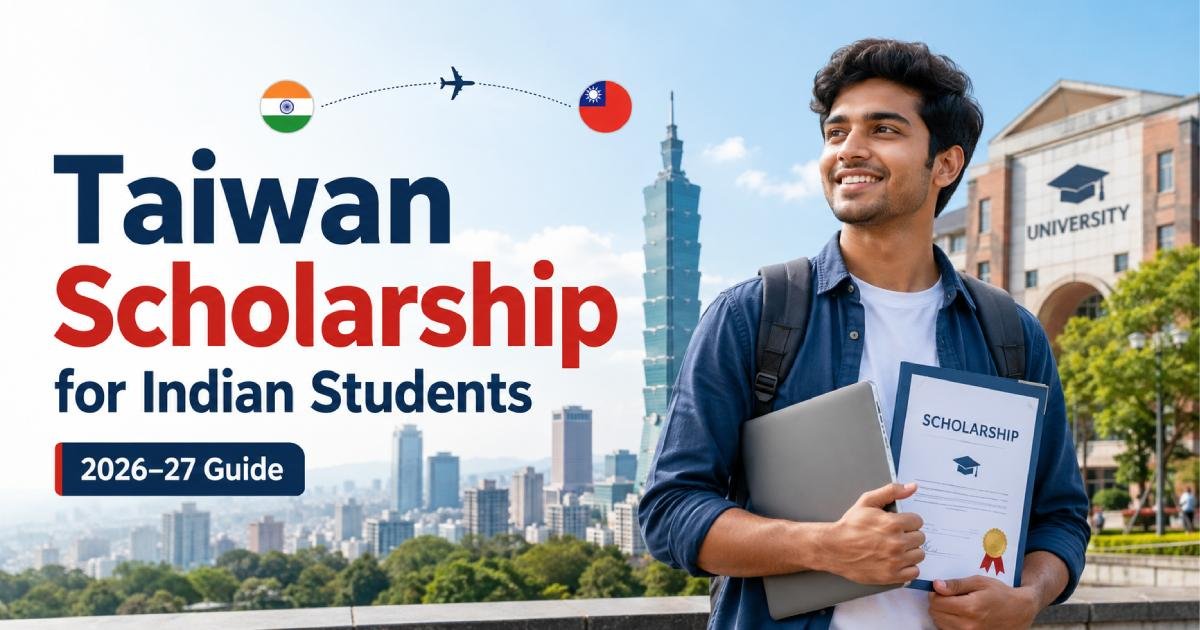
Indian students can apply for several scholarships to study in Taiwan. The main options are the MOE Taiwan Scholarship for bachelor’s, master’s, and PhD degrees, the TaiwanICDF International Higher Education Scholarship for selected degree programs, and the Huayu Enrichment Scholarship for Mandarin language study.
These scholarships are not interchangeable.
The MOE Taiwan Scholarship provides a tuition subsidy and monthly living allowance. TaiwanICDF provides broader financial coverage that includes airfare, accommodation, tuition, insurance, textbooks, and a monthly allowance. The Huayu Enrichment Scholarship funds Mandarin language study rather than a university degree.
The 2026 MOE Taiwan Scholarship application period for Indian students closed on March 31, 2026. TECC India published its 2026 selected-candidate announcement on May 26, 2026. The next MOE India application dates have not yet been officially announced as of August 30, 2026. Applicants should monitor the Taipei Economic and Cultural Center in India scholarship announcements rather than relying on an estimated 2027 deadline.
A separate upcoming opportunity is already confirmed. TaiwanICDF Scholarship applications for 2027 will run from December 1, 2026 to March 15, 2027. TaiwanICDF’s official scholarship page confirms these dates.
Quick answer: Indian students seeking a bachelor’s, master’s, or PhD degree should first examine the MOE Taiwan Scholarship. Master’s and PhD applicants should also compare TaiwanICDF. Students who primarily want intensive Mandarin training should examine the Huayu Enrichment Scholarship.
Taiwan Scholarship for Indian Students: Quick Overview
| Attribute | Current information |
|---|---|
| Main scholarship | MOE Taiwan Scholarship |
| Funder | Ministry of Education, Taiwan |
| Eligible Indian applicants | Yes |
| Degree levels | Bachelor’s, master’s, PhD |
| MOE tuition support | About USD 1,265 per semester |
| MOE bachelor’s stipend | About USD 474 per month |
| MOE master’s/PhD stipend | About USD 632 per month |
| Maximum MOE duration | 4 years bachelor’s, 2 years master’s, 4 years PhD |
| 2026 India application period | February 1-March 31, 2026 |
| 2026 status | Closed |
| Next MOE India deadline | Not officially announced as of August 30, 2026 |
| University application | Required separately |
| Selection | Document review and interview |
| Main alternative | TaiwanICDF Scholarship |
| Mandarin option | Huayu Enrichment Scholarship |
The USD figures in this guide are approximate conversions. They use Taiwan’s Central Bank closing exchange rate of 31.628 Taiwan dollars per USD on August 28, 2026. Exchange rates change, so applicants should treat USD equivalents as planning figures rather than fixed scholarship payments.
Which Taiwan Scholarships Can Indian Students Apply For?
Indian applicants should distinguish four main funding routes.
1. MOE Taiwan Scholarship
The Ministry of Education Taiwan Scholarship is the central degree scholarship for this search intent.
The scholarship supports international students pursuing eligible bachelor’s, master’s, and doctoral programs at universities and colleges in Taiwan.
The current official MOE Taiwan Scholarship rules provide tuition support of approximately USD 1,265 per semester, based on the current reference exchange rate.
Bachelor’s recipients receive approximately USD 474 per month.
Master’s and PhD recipients receive approximately USD 632 per month.
The maximum scholarship periods are:
- Bachelor’s degree: 4 years
- Master’s degree: 2 years
- PhD: 4 years
A person cannot receive the MOE Taiwan Scholarship for more than five years in total across degree levels.
2. TaiwanICDF International Higher Education Scholarship
The TaiwanICDF International Higher Education Scholarship Program offers broader financial support through selected Taiwanese universities and programs.
The scholarship covers:
- Round-trip economy airfare
- Student accommodation
- Tuition
- Credit fees
- Insurance
- Approved textbook costs
- Monthly living allowance
The current monthly allowance is approximately:
| Study level | Approximate monthly allowance |
|---|---|
| Bachelor’s | USD 474 |
| Master’s | USD 569 |
| PhD | USD 632 |
The official TaiwanICDF scholarship scope confirms these benefits.
However, Indian applicants need to understand one important restriction.
India appears on the TaiwanICDF eligible-country list, but the current TaiwanICDF FAQ states that bachelor’s programs are restricted to applicants from countries that maintain diplomatic relations with Taiwan. Indian students should therefore treat TaiwanICDF primarily as a potential master’s or PhD scholarship, subject to the programs available for the relevant intake.
3. Huayu Enrichment Scholarship
The Huayu Enrichment Scholarship, or HES, supports Mandarin language study.
It is not a bachelor’s, master’s, or PhD scholarship.
The scholarship currently provides approximately USD 885 per month.
For the 2026 India cycle, students could apply for 3-month or 6-month Mandarin programs, and applications ran from February 1 to April 17, 2026.
Indian students interested in Chinese-language proficiency rather than a full university degree should consider HES separately.
4. University Scholarships in Taiwan
Taiwanese universities also offer institution-specific tuition waivers, stipends, research assistantships, and international student scholarships.
University awards can be useful when:
- An applicant is not selected for the MOE Scholarship.
- The university offers funding beyond the MOE tuition ceiling.
- A master’s or PhD department provides research funding.
- The student needs a backup scholarship.
Applicants receiving an MOE Taiwan Scholarship must check whether another award can legally be combined with it. The MOE generally prohibits recipients from simultaneously receiving other Taiwan government or educational-institution financial assistance, except permitted tuition discounts covering amounts above the MOE subsidy limit.
MOE Taiwan Scholarship vs TaiwanICDF vs HES
| Feature | MOE Taiwan Scholarship | TaiwanICDF | HES |
|---|---|---|---|
| Main purpose | University degree | Selected university degrees | Mandarin study |
| Bachelor’s for Indians | Yes | Generally not under current ICDF rule | No |
| Master’s | Yes | Selected programs | No |
| PhD | Yes | Selected programs | No |
| Tuition | Up to about USD 1,265/semester | Covered | Not a degree scholarship |
| Monthly support | About USD 474-632 | About USD 474-632 depending on level | About USD 885 |
| Accommodation | Not automatically covered | Covered | Not equivalent to degree housing support |
| Airfare | Not automatically covered | Round-trip economy airfare covered | Not standard degree airfare funding |
| Insurance | Student responsibility under MOE award | Covered | Rules apply separately |
| Books | Not standard MOE coverage | Approved textbook costs covered | Not comparable |
| Program choice | Relatively broad | Limited to participating programs | Mandarin centers |
| Best fit | Broad degree choice | Comprehensive funding for eligible programs | Language study |
Is the Taiwan Scholarship Fully Funded for Indian Students?
The answer depends on what fully funded means.
The MOE Taiwan Scholarship provides substantial funding, but Indian students should not assume that it pays every cost of studying in Taiwan.
The MOE pays approximately USD 1,265 per semester toward approved tuition and miscellaneous expenses.
If tuition exceeds the scholarship ceiling, the student normally pays the difference unless the university provides an approved discount.
The MOE rules explicitly exclude several costs from the covered miscellaneous-expense category, including:
- Administration fees
- Thesis supervision fees
- Insurance
- Accommodation
- Internet access
The scholarship recipient is responsible for these costs.
This makes the phrase “fully funded Taiwan Scholarship” potentially misleading if a reader interprets it as zero out-of-pocket cost.
MOE Taiwan Scholarship Monthly Stipend
The approximate current value is:
- Bachelor’s: USD 474 per month
- Master’s: USD 632 per month
- PhD: USD 632 per month
The stipend helps with living expenses, but applicants should still create a budget for housing, deposits, insurance, food, transport, academic charges, visa-related expenses, and any tuition above the scholarship ceiling.
When Is TaiwanICDF More Fully Funded?
TaiwanICDF provides a more comprehensive package because the official award includes:
- Economy-class round-trip airfare
- Student dormitory accommodation
- Tuition
- Credit fees
- Insurance
- Approved textbooks
- Monthly allowance
That difference matters for Indian master’s and PhD applicants comparing total out-of-pocket costs.
Taiwan Scholarship 2026-27 Application Status
The 2026 MOE Taiwan Scholarship cycle for Indian students is closed.
The 2026 TECC India Taiwan Scholarship announcement opened applications on February 1, 2026.
The application deadline was March 31, 2026.
TECC India published the 2026 selected-candidate announcement on May 26, 2026.
What Is the Taiwan Scholarship 2027 Deadline for Indian Students?
An official 2027 MOE India application deadline has not been published as of August 30, 2026.
Applicants should not assume that a previous year’s date automatically becomes the 2027 deadline.
The 2025 and 2026 India cycles both used a February-to-March application period, which provides a useful planning pattern. It does not create an official future deadline.
Upcoming TaiwanICDF 2027 Deadline
TaiwanICDF has already confirmed its next cycle:
- Applications open: December 1, 2026
- Applications close: March 15, 2027
Applicants must use the official TaiwanICDF online application process.
Who Should Apply for a Taiwan Scholarship?
The MOE Taiwan Scholarship is most suitable for Indian students who have strong academic records and want to complete an entire degree in Taiwan.
Bachelor’s Applicants
Indian students completing Class 12 or an equivalent recognized qualification can consider the MOE Taiwan Scholarship for undergraduate study.
A strong applicant should:
- Have a solid secondary-school academic record.
- Identify an eligible Taiwanese degree program.
- Meet the program’s language requirements.
- Apply to the university independently.
- Be able to finance costs that the MOE scholarship does not cover.
Master’s Applicants
Master’s candidates are a strong target group for Taiwan scholarships.
Applicants normally need an appropriate bachelor’s degree and should choose a Taiwanese program that connects logically with their academic background, career plans, or professional experience.
Master’s applicants can compare both MOE Taiwan Scholarship and TaiwanICDF opportunities.
PhD Applicants
PhD candidates should compare scholarship funding with the research environment of the target university.
A strong PhD application should demonstrate:
- Academic preparation
- Research direction
- Program fit
- Language readiness
- A realistic reason for conducting the proposed study in Taiwan
PhD students can consider MOE, TaiwanICDF where eligible, university funding, and research-oriented programs.
Applicants Seeking English-Taught Degrees
Indian students do not automatically need to study in Mandarin.
Taiwan offers degree programs taught entirely in English.
The applicant must ensure that the program qualifies under the relevant scholarship rules and must submit the language evidence required by the India selection guide and university.
Applicants Interested in Mandarin
Applicants pursuing Mandarin-taught programs should prepare for TOCFL requirements.
Students whose main goal is language acquisition rather than a degree should consider the Huayu Enrichment Scholarship.
Who Should Not Apply?
A student should not apply for the MOE Taiwan Scholarship when the applicant falls into an official ineligible category.
Under the current MOE rules, ineligible applicants include certain people who:
- Hold Taiwan nationality or overseas compatriot student status.
- Are already registered or eligible to begin the relevant university study in Taiwan, subject to the final-year higher-degree exception.
- Have already studied in Taiwan at the same degree level.
- Are exchange students or dual/joint-degree students under specified academic cooperation arrangements.
- Have already received Taiwan Scholarships for the maximum cumulative period.
- Previously had a Taiwan Scholarship or MOE Huayu Enrichment Scholarship revoked.
- Will receive another prohibited Taiwan-government or Taiwan educational-institution scholarship during the same study period.
The complete conditions appear in the current MOE Taiwan Scholarship eligibility rules.
You May Be Eligible but Still Should Reconsider Applying If:
You should reconsider your application strategy if:
- You have not identified a Taiwanese university.
- You cannot meet the required language standard.
- You assume the scholarship itself gives you university admission.
- You cannot fund accommodation or other uncovered MOE costs.
- Your proposed degree has no clear relationship to your background or goals.
- You are using outdated scholarship requirements.
- You plan to submit incomplete documents just before the deadline.
Eligibility gets an application considered. Eligibility does not guarantee selection.
Taiwan Scholarship Eligibility Requirements for Indian Students
The central MOE rules require applicants to be foreign nationals with an appropriate secondary or post-secondary qualification, an excellent academic record, and good moral character.
Indian applicants should check the India-specific guide each year because TECC India can provide additional local application instructions.
Nationality
Applicants applying through the India route must provide evidence of Indian nationality, normally through an Indian passport or other accepted documentation.
Educational Qualification
The required qualification depends on the intended level:
| Intended degree | Typical prior qualification |
|---|---|
| Bachelor’s | Senior secondary/high school qualification |
| Master’s | Bachelor’s degree |
| PhD | Master’s degree or qualification required by the university |
The university makes its own admission decision independently from the scholarship authority.
Academic Performance
The MOE requires an excellent academic record, but the central scholarship rules do not establish one universal minimum GPA that automatically guarantees admission or scholarship selection.
Applicants should distinguish:
Minimum eligibility from competitive academic strength.
A student can meet an administrative threshold without becoming a strong scholarship candidate.
Moral Character
Good moral character is part of the official eligibility framework.
Selection procedures may use documentation and interviews to assess the applicant’s overall suitability.
What GPA or CGPA Is Required?
There is no single universal GPA that guarantees the MOE Taiwan Scholarship.
Applicants should be cautious when scholarship websites publish claims such as “minimum 3.0 GPA required” without identifying the official India guideline or target university.
The scholarship authority expects strong academic performance.
Universities can also impose their own admission standards.
Indian applicants should therefore:
- Check the current TECC India scholarship guide.
- Convert grades only according to the method requested for that cycle.
- Check the target university’s minimum academic requirement.
- Treat the minimum requirement as an eligibility threshold, not a predicted selection score.
A strong academic profile improves competitiveness but does not replace language proficiency, program fit, complete documents, or interview performance.
IELTS, TOEFL and TOCFL Requirements
Language requirements depend on the language of instruction.
English-Taught Programs
For the 2026 India selection cycle, applicants to 100% English-taught programs could use specified English-proficiency evidence.
The India guide listed routes including:
- IELTS of at least 6.0
- TOEFL iBT of at least 60
- TOEFL paper-based score of at least 550
- Certain qualifying English-medium academic evidence under the specified conditions
The same India selection guide indicated stronger selection preference for applicants with higher language credentials, including IELTS 6.5 or above in the stated preference framework. Applicants should recheck the next TECC India guide because local requirements can change.
The general MOE rules also require applicants to English-taught programs to provide recognized proof of English proficiency.
Mandarin-Taught Programs
Applicants pursuing programs that do not qualify under the recognized English-taught route should prepare appropriate TOCFL evidence.
TOCFL is Taiwan’s Test of Chinese as a Foreign Language.
The official TOCFL system assesses Chinese-language ability across several proficiency levels. Applicants should verify the exact level required by the current scholarship guide and target university rather than assuming that one TOCFL score applies to every program. Check the official TOCFL information.
Can You Apply Without IELTS?
Yes, in some cases.
IELTS is not universally compulsory for every Taiwan Scholarship applicant.
A Mandarin-taught program follows a different language route.
An English-taught applicant may also have another accepted form of English evidence if the current India guide permits it.
The decisive question is not simply “Do I have IELTS?”
The correct question is:
“Do I have language evidence that satisfies both the scholarship rules and my chosen university program?”
Required Documents for the Taiwan Scholarship
Indian applicants should prepare documents before the scholarship window opens.
| Document | Why it matters | Common mistake |
|---|---|---|
| Scholarship application form | Creates the formal scholarship application | Leaving fields incomplete |
| Indian passport/nationality evidence | Confirms nationality eligibility | Name or date mismatch |
| Highest qualification | Proves academic eligibility | Uploading unclear scans |
| Academic transcripts | Shows academic performance | Missing semesters/pages |
| Proof of Taiwan university application | Proves separate admission action | Applying only for scholarship |
| Language certificate | Confirms program language eligibility | Wrong exam or insufficient level |
| Recommendation letters | Provides independent academic/professional assessment | Generic or improperly submitted letters |
| Terms of Agreement | Confirms acceptance of scholarship conditions | Missing signature |
| University admission letter | Confirms final admission after selection | Missing final submission deadline |
The central MOE rules require the scholarship form, nationality evidence, academic qualifications and transcripts, university-application evidence, and relevant language documentation.
1. Passport
Use a clear copy of the passport identity page.
Names, date of birth, and nationality information should match the scholarship application and university application.
2. Degree Certificates and Transcripts
Submit the highest educational qualification and complete academic transcripts requested by the current guide.
Documents that are not in Chinese or English may require appropriate translations under the MOE rules.
3. Proof That You Applied to a University
This is one of the most important documents.
Evidence can include the university application confirmation, receipt, acknowledgment, or other documentation accepted by the current scholarship guide.
The scholarship application does not replace university admission.
4. Language-Proficiency Evidence
The correct document depends on whether the program is:
- Mandarin taught
- Officially recognized as English taught
- Otherwise documented as meeting the current scholarship language rules
5. Recommendation Letters
The India selection process has required recommendation letters from suitable academic or professional referees.
Applicants should select referees who can describe actual academic ability, research potential, work quality, or professional strengths.
A specific letter is stronger than a generic statement that the student is “hardworking.”
6. Signed Scholarship Agreement
Applicants should read the scholarship conditions before signing.
The agreement creates obligations after selection.
How to Apply for the Taiwan Scholarship from India
The application process has two parallel tracks:University admission + scholarship application.
Applicants must complete both.
Step 1: Decide Which Scholarship Fits Your Goal
Choose the correct route.
Use:
- MOE Taiwan Scholarship for broad bachelor’s, master’s, or PhD degree study.
- TaiwanICDF for eligible partner programs with broader funding.
- HES for Mandarin language study.
Do not submit applications blindly to every Taiwan scholarship.
Step 2: Select a Degree and University
Choose a program that fits:
- Your previous education
- Career objectives
- Research interests
- Language ability
- Scholarship rules
Check whether the program is taught in English, Mandarin, or both.
Step 3: Check the University’s Admission Deadline
Every university sets its own admission deadline.
The university deadline can differ from the scholarship deadline.
This is a major source of failed applications.
Step 4: Apply to the Taiwanese University Separately
This is the Two-Application Rule.
The current MOE rules state that applicants must apply directly to a Taiwanese university or college according to that institution’s own deadline.
You do not receive university admission automatically because you applied for the scholarship.
You do not receive the scholarship automatically because a university admitted you.
Step 5: Obtain Language-Proficiency Evidence
Take IELTS, TOEFL, TOCFL, or another accepted route early enough to receive the result before the deadline.
Do not schedule the test so late that the score arrives after applications close.
Step 6: Prepare Academic Documents
Prepare:
- Passport
- Qualifications
- Transcripts
- Required translations
- University-application evidence
- Language proof
- References
- Scholarship forms
Use consistent names and dates across every document.
Step 7: Complete the Scholarship Application
Follow the application instructions published by TECC India for the active year.
The 2026 application used the Taiwan Scholarship online system.
Future applicants should verify the application procedure again when the next India guide is released.
Step 8: Submit Recommendation Letters Correctly
Follow the current cycle’s instructions.
Do not assume last year’s method applies.
A letter may need to be uploaded electronically, signed, sealed, or submitted using another specified process.
Step 9: Prepare for the Scholarship Interview
Shortlisted applicants may be interviewed.
Prepare direct answers to:
- Why Taiwan?
- Why this university?
- Why this program?
- How does the program connect with your previous education?
- What will you do after graduating?
- Why should the scholarship invest in you?
- How will your studies create value after graduation?
Avoid memorized promotional answers.
Step 10: Monitor the Selection Result
TECC India publishes scholarship result announcements.
The 2026 MOE selected-candidate announcement was published on May 26, 2026.
Monitor the official source rather than relying only on email.
Step 11: Submit Your University Admission Letter
A scholarship candidate still needs university admission.
Under the current central rules, primary candidates normally submit the admission letter by June 30 to confirm eligibility.
Failure to obtain admission can result in loss of scholarship eligibility.
Step 12: Complete the Student Visa Process
After securing admission and scholarship documentation, follow Taiwan’s official student resident-visa requirements.
The Taiwan Bureau of Consular Affairs student visa guidance lists documents such as a passport, admission permit, education records, health documentation, and financial-support evidence.
A scholarship certificate can serve as financial-support evidence when it states the award duration and amount.
Step 13: Travel, Register and Obtain Your ARC
Scholarship recipients must register at their university according to the required schedule.
Students holding the appropriate resident status must also complete Alien Resident Certificate requirements after arrival.
Taiwan’s Bureau of Consular Affairs states that qualifying residents must apply for an ARC within the prescribed period.
How Does the Taiwan Scholarship Selection Process Work?
Selection is not based on one factor.
Stage 1: Eligibility Screening
The selection authority first checks whether the applicant satisfies formal eligibility conditions.
An applicant who falls into an excluded category cannot compensate with a stronger GPA.
Stage 2: Document Review
Reviewers evaluate the submitted application.
Important evidence can include:
- Academic performance
- Language proficiency
- University choice
- Study direction
- Recommendation letters
- Application completeness
Stage 3: Interview
The India selection process includes personal interviews for shortlisted applicants.
An interview allows the committee to test whether the applicant’s written goals match the applicant’s actual understanding and motivation.
Stage 4: Selection and Waiting List
The representative office selects primary candidates and may place other qualified applicants on a waiting list.
The current MOE rules explicitly provide for primary and waiting-list candidates.
Stage 5: Admission Verification
A selected scholarship candidate must obtain admission from an eligible Taiwanese institution.
No university admission means the candidate cannot activate the degree scholarship.
How to Improve Your Chances of Selection
No method can guarantee a Taiwan Scholarship.
Applicants can still improve application quality.
Choose a Program That Fits Your Background
An academic transition should make sense.
For example, a candidate moving from electrical engineering to semiconductor engineering can explain a direct academic relationship.
A candidate making a large disciplinary change needs a stronger explanation.
Explain Why Taiwan Specifically
Avoid generic statements such as:
“Taiwan has excellent universities.”
Explain why the target program, faculty, research environment, industry ecosystem, language opportunity, or academic specialization supports your goal.
Build a Specific Career Goal
Scholarship committees need to understand what the degree enables.
A clear answer connects:
past education → Taiwan program → skills gained → future contribution
Strengthen Language Evidence
Meeting a minimum language requirement establishes eligibility.
Exceeding the minimum can strengthen the evidence that you are academically ready.
Apply to Universities Early
University admissions can become the practical bottleneck.
The scholarship deadline is useless if your preferred university has already closed applications.
Use Strong Recommendation Letters
A good referee should provide evidence.
“Student X ranked among the strongest researchers I supervised” is more informative than “Student X is hardworking and punctual.”
Understand the Scholarship’s Financial Limits
A candidate who understands the MOE tuition ceiling and uncovered costs can create a realistic study plan.
This matters because scholarship recipients still need to pay several expenses themselves.
Common Mistakes Taiwan Scholarship Applicants Make
1. Applying for the Scholarship but Not the University
This is the most important procedural mistake.
The scholarship and university applications are separate.
2. Calling the MOE Award Completely Fully Funded
MOE support is generous, but it does not automatically cover accommodation, insurance, internet, every academic fee, or tuition above the subsidy ceiling.
3. Checking Only the Scholarship Deadline
A university may close applications earlier.
Check both calendars.
4. Using an Incorrect Language Route
Do not submit IELTS when the program requires TOCFL or assume TOCFL is compulsory when an approved English-taught route applies.
5. Assuming Every “English” Program Qualifies Automatically
Verify the official language classification and current scholarship instructions.
6. Submitting Incomplete Academic Records
Missing transcript pages can make an otherwise strong application administratively weak.
7. Using Generic Recommendation Letters
The referee should explain why the candidate is academically or professionally suitable.
8. Creating Inconsistent Personal Information
The spelling of the applicant’s name should remain consistent across the passport, application, university documents, and certificates.
9. Missing the Final Admission-Letter Requirement
Scholarship selection alone does not complete the process.
10. Combining Incompatible Scholarships
Check double-funding restrictions before accepting another Taiwan-funded award.
11. Following Old Blog Posts Instead of TECC India
Scholarship rules change.
Always verify deadlines and requirements from the current official cycle.
12. Assuming Previous-Year Dates Are Guaranteed
The fact that 2025 and 2026 followed similar application windows does not officially establish the next deadline.
13. Ignoring Costs Outside the Scholarship
Calculate housing, insurance, deposits, travel, food, transport, and uncovered tuition before accepting an offer.
14. Waiting for the Scholarship Announcement Before Choosing Universities
Program research should begin months before the scholarship opens.
Previous Years’ Taiwan Scholarship Trends
Historical data can help applicants understand the program.
Historical data cannot predict an individual’s chance of selection.
2025 India Quota
The official 2025 TECC India scholarship guide stated that 47 Taiwan Scholarship places were available for that academic year. See the 2025 TECC India scholarship guide.
Applicants should not assume that 47 places will be available in a future year.
Scholarship allocations can change.
Graduate Study Has Been Prominent
A 2023 Taiwan Ministry of Education report covering a South Asia scholarship award event reported 52 Taiwan Scholarship degree recipients:
- 4 bachelor’s recipients
- 31 master’s recipients
- 17 PhD recipients
Graduate students represented the large majority of that reported degree cohort. See the Ministry of Education’s 2023 scholarship report.
However, the report is framed around South Asian scholarship recipients and should not be misrepresented as an India-only acceptance-rate dataset.
Application Windows Have Shown a Pattern
The India MOE Scholarship application period ran from February 1 to March 31 in both the 2025 and 2026 cycles.
This pattern is useful for preparation.
It is not an official 2027 deadline.
Our Research Notes: What Indian Applicants Often Miss
Research Note 1: The Two-Application Rule Is More Important Than It Looks
An applicant interacts with two different decision systems.
TECC/MOE decides scholarship selection.
The university decides admission.
A strong scholarship application cannot repair a missed university deadline.
Research Note 2: “Fully Funded” Is Not a Precise Description of MOE Coverage
The MOE Scholarship has a tuition ceiling and excludes several major expenses.
TaiwanICDF has substantially broader cost coverage.
Students should compare net out-of-pocket cost, not just whether a website labels a scholarship “fully funded.”
Research Note 3: TaiwanICDF Is Not an Identical Alternative for Every Applicant
India is eligible for TaiwanICDF, but the current program restricts bachelor’s study to applicants from countries with diplomatic relations with Taiwan.
Indian undergraduate students should therefore prioritize MOE and university scholarships rather than assuming TaiwanICDF provides the same bachelor’s route.
Research Note 4: A Minimum Language Score and a Competitive Language Profile Are Different
Meeting the required score allows an application to proceed.
A stronger language score can provide additional evidence of study readiness.
Students should not confuse “eligible” with “competitive.”
Research Note 5: University Choice Changes the Real Value of the MOE Scholarship
Two students can receive the same MOE award and face different personal expenses.
One university may offer a tuition discount beyond the MOE ceiling.
Another may charge additional tuition.
Housing costs also differ.
The scholarship’s practical value therefore depends partly on the university.
Research Note 6: Historical Quotas Should Be Used for Context, Not Prediction
A previous quota tells applicants that places are limited.
It does not reveal next year’s quota, acceptance rate, or minimum competitive GPA.
Research Note 7: Source Hierarchy Matters
Applicants should verify information in this order:
- TECC India
- Taiwan Ministry of Education
- Taiwan Scholarship official portal
- Target university
- TaiwanICDF for ICDF applications
- Taiwan Bureau of Consular Affairs for visa rules
- Secondary scholarship websites only for supplementary guidance
What Happens After You Win the Taiwan Scholarship?
Selection is not the final step.
Confirm University Admission
The scholarship needs an eligible host institution.
Submit the admission letter according to the scholarship deadline.
Receive the Final Scholarship Documentation
The representative office finalizes award documentation after the required conditions are satisfied.
Apply for the Correct Visa
Follow current Taiwan visa rules.
University admission does not itself guarantee visa issuance.
The Bureau of Consular Affairs makes the visa decision under the applicable immigration and consular rules.
Arrive and Register on Time
The MOE scholarship year generally begins on September 1.
Recipients who fail to register as required can lose scholarship eligibility unless an authorized exception applies.
Obtain and Maintain ARC Requirements
After arrival, complete applicable Alien Resident Certificate procedures.
Scholarship recipients should also provide the required student residency evidence to their institution when requested.
Maintain Academic Performance
The current MOE rules require recipients to maintain continuing academic standards.
For scholarship continuation, the central rules specify a minimum semester average of 70 for bachelor’s students and 80 for graduate-level students, unless the university or department imposes a higher standard.
Winning the scholarship therefore creates an ongoing academic obligation.
MOE Taiwan Scholarship vs TaiwanICDF: Which Is Better for Indian Students?
Neither scholarship is universally better.
The correct choice depends on the student’s program and financial needs.
| Factor | MOE Taiwan Scholarship | TaiwanICDF |
|---|---|---|
| University choice | Broader | Restricted to partner programs |
| Bachelor’s for Indian applicants | Yes | Current restriction makes this generally unavailable |
| Master’s | Yes | Eligible selected programs |
| PhD | Yes | Eligible selected programs |
| Tuition | Capped subsidy | Covered |
| Housing | Student responsibility | Covered |
| Airfare | Student responsibility | Covered |
| Insurance | Student responsibility | Covered |
| Textbooks | Not standard full coverage | Approved textbook costs covered |
| Monthly allowance | Yes | Yes |
| Best for | Applicants prioritizing degree/program flexibility | Applicants prioritizing comprehensive funding within eligible programs |
Choose MOE when your priority is broader university and program selection.
Choose TaiwanICDF when your desired master’s or PhD program appears in the eligible ICDF list and comprehensive funding matters more than program flexibility.
Huayu Enrichment Scholarship for Indian Students
The Huayu Enrichment Scholarship supports Indian students who want to study Mandarin in Taiwan.
The current HES rules provide approximately USD 885 per month at the reference exchange rate used in this guide.
For Indian applicants in 2026:
- Applications opened February 1.
- Applications closed April 17.
- Indian applicants could select 3-month or 6-month study periods.
The 2026 TECC India HES announcement confirms the India-specific opportunity.
HES is best for students who want structured Mandarin immersion.
It should not be compared directly with a four-year bachelor’s or postgraduate degree scholarship.
Other Funding Options for Studying in Taiwan
Students should build a funding portfolio rather than depend on one award.
University Scholarships
Taiwanese universities may provide:
- Tuition waivers
- International student scholarships
- Graduate stipends
- Research assistantships
- Department funding
- Housing discounts
Eligibility and renewal conditions vary by institution.
Research and PhD Funding
PhD students should also examine research-centered funding opportunities.
A department, laboratory, research institute, or university may provide funding that differs from the MOE scholarship structure.
Tuition Discounts for MOE Recipients
Some universities offer discounts to reduce tuition costs above the MOE scholarship ceiling.
Applicants should check the current official list and the university’s own funding policy before calculating final expenses.
Taiwan Scholarship Application Checklist
Before submitting, confirm all of the following:
- I am eligible under the current MOE rules.
- I checked the current TECC India announcement.
- I selected the correct scholarship.
- I selected an eligible university program.
- I checked the university deadline.
- I applied separately to the university.
- I have proof of my university application.
- My passport details match my application.
- My transcripts are complete.
- My language evidence satisfies the applicable route.
- My recommendation letters follow the current instructions.
- I signed all required agreements.
- I checked which costs the scholarship does not cover.
- I kept copies of all submitted documents.
- I know where official results will be published.
FAQs About Taiwan Scholarships for Indian Students
Can Indian students get a Taiwan Scholarship?
Yes. Indian citizens can apply for the MOE Taiwan Scholarship for eligible bachelor’s, master’s, and PhD programs. Applicants need the appropriate previous qualification, a strong academic record, suitable language evidence, and a separate application to a Taiwanese university. Eligibility does not guarantee selection because awards are competitive.
Is the Taiwan Scholarship fully funded for Indian students?
The MOE Taiwan Scholarship provides significant funding but does not automatically pay every expense. It offers approximately USD 1,265 per semester toward approved tuition plus a monthly stipend. Accommodation, insurance, internet, certain academic fees, and tuition above the subsidy ceiling may remain the student’s responsibility. TaiwanICDF provides broader coverage.
How much is the Taiwan Scholarship stipend?
At the exchange rate used for this guide, MOE bachelor’s recipients receive approximately USD 474 per month. Master’s and PhD recipients receive approximately USD 632 per month. The MOE also provides tuition support of approximately USD 1,265 per semester. Actual USD value changes with the exchange rate.
What is the Taiwan Scholarship deadline for Indian students?
The 2026 MOE Taiwan Scholarship application period for India ran from February 1 to March 31, 2026 and is now closed. As of August 30, 2026, TECC India has not officially announced the next MOE deadline. Applicants should monitor TECC India rather than treating previous dates as guaranteed.
When will the Taiwan Scholarship 2027 application open?
The 2027 MOE Taiwan Scholarship dates for Indian applicants have not yet been officially announced. Previous India cycles suggest that applicants should prepare documents well before February, but that is planning guidance rather than an official deadline. TaiwanICDF’s 2027 application period is already confirmed for December 1, 2026-March 15, 2027.
Is IELTS compulsory for the Taiwan Scholarship?
No. IELTS is not universally compulsory. Language evidence depends on the program. Mandarin-taught programs generally require relevant TOCFL evidence. Applicants to approved English-taught programs can follow the English-proficiency routes accepted in the current India scholarship guide and by the university. Always check both sets of requirements.
Can I apply for a Taiwan Scholarship without IELTS?
Potentially, yes. An applicant may use another accepted English-proficiency route or apply to a Mandarin-taught program with the required TOCFL evidence. The exact options depend on the active India selection guide and university. Do not assume an English-medium certificate automatically replaces IELTS unless the current rules explicitly permit it.
What GPA is required for a Taiwan Scholarship?
The central MOE rules require an excellent academic record but do not provide one universal GPA that guarantees selection for every applicant. Universities can impose their own academic requirements. Applicants should follow any conversion method in the current India guide and focus on overall competitiveness rather than searching for a supposed guaranteed GPA.
Do I need university admission before applying for the Taiwan Scholarship?
You normally need evidence that you have applied to a Taiwanese university, but the final admission decision may still be pending when the scholarship application is submitted. Scholarship candidates must later provide their admission letter within the required period. The university application and scholarship application remain separate processes.
Does the Taiwan Scholarship cover accommodation?
The MOE Taiwan Scholarship does not automatically cover accommodation. Housing is explicitly outside the tuition and miscellaneous-expense subsidy defined by the current MOE rules. Students should budget separately for dormitory or private housing. TaiwanICDF differs because its scholarship package includes student accommodation for eligible recipients.
Does the Taiwan Scholarship cover airfare from India to Taiwan?
The MOE Taiwan Scholarship does not provide the same standard airfare coverage as TaiwanICDF. MOE applicants should plan for their travel costs unless another approved source provides assistance. TaiwanICDF’s full scholarship package includes round-trip economy-class airfare for eligible scholarship recipients under its current funding scope.
Can Indian undergraduate students apply for TaiwanICDF?
India is an eligible TaiwanICDF country, but the current TaiwanICDF FAQ states that bachelor’s programs are exclusively available to applicants from countries maintaining diplomatic relations with Taiwan. Indian applicants should therefore not assume undergraduate ICDF eligibility. Indian bachelor’s candidates should prioritize MOE and university scholarships unless future ICDF rules change.
Can I receive another scholarship with the MOE Taiwan Scholarship?
Usually not when the second award constitutes prohibited Taiwan-government or Taiwan educational-institution financial assistance. An exception can apply to university discounts covering tuition and miscellaneous expenses above the MOE subsidy ceiling. Applicants should disclose other funding and verify compatibility before accepting two awards simultaneously.
What happens if I win the scholarship but do not get university admission?
A Taiwan Scholarship candidate still needs admission from an eligible university or college. Under the MOE rules, a candidate who does not obtain admission cannot finalize scholarship eligibility. This is why applicants should apply to universities early and should consider more than one suitable institution where permitted.
Which is better for Indian students: MOE Taiwan Scholarship or TaiwanICDF?
MOE is usually better for students who want wider university and program choice. TaiwanICDF can be financially stronger because it covers airfare, housing, tuition, insurance, textbooks, and a stipend. For Indian students, TaiwanICDF is especially relevant to eligible master’s and PhD programs because current rules restrict its bachelor’s programs.
Final Takeaway
The Taiwan Scholarship for Indian students is not one single scholarship.
Indian degree applicants should primarily understand the MOE Taiwan Scholarship, which supports bachelor’s, master’s, and PhD study through a tuition subsidy and monthly stipend.
Indian master’s and PhD applicants should also compare TaiwanICDF, especially when an eligible partner program matches their academic goals. TaiwanICDF provides broader financial coverage, including airfare and accommodation.
Students interested mainly in Mandarin should consider the Huayu Enrichment Scholarship.
The most important application rule is simple:
Apply for university admission and scholarship funding as two separate processes.
The second most important rule is to use current official information.
The 2026 MOE India cycle is closed. The next MOE India deadline remains unannounced as of August 30, 2026. TaiwanICDF’s next confirmed application window runs from December 1, 2026 to March 15, 2027.
Applicants preparing for the next cycle should shortlist universities, verify program language, arrange transcripts and recommendation letters, prepare language-test evidence, and monitor TECC India before applications open

You may like

Check Student Scholarship Status Online: SSP Karnataka Application and Payment Status

Government Scholarship for College Students 2022 in India: Eligibility, Amount, and Application Guide

Digital Gujarat Scholarship for OBC Students 2026 to 27: Eligibility, Amount, Last Date and Application Guide

Turkey Burslari Scholarship 2026: Eligibility, Benefits, Deadline, Interview, and Results

SBI Asha Scholarship 2026-27: Eligibility, Amount, Last Date and Apply Online

Scholarship for J&K Students: Eligibility, Amount, Deadlines, and How to Apply
Trending
-
 Scholarships2 months ago
Turkey Burslari Scholarship 2026: Eligibility, Benefits, Deadline, Interview, and Results
-
 Scholarships1 month ago
SBI Asha Scholarship 2026-27: Eligibility, Amount, Last Date and Apply Online
-
 Scholarships2 months ago
Scholarship for J&K Students: Eligibility, Amount, Deadlines, and How to Apply
-
 By Country2 months ago
Korean Government Scholarship for Indian Students: GKS Eligibility, Benefits, Deadlines and Application
-

 Scholarships2 months ago
Scholarships for PG Students in Kerala 2026: Eligibility, Amounts, Deadlines and Application Links
-
 By Country3 months ago
Scholarship for MBBS Students in India
-

 Scholarships1 month ago
West Bengal Student Scholarship 2026-27: Eligibility, Amounts, Last Dates and Apply Online
-
 Scholarships2 months ago
Abdul Kalam Scholarship for Class 10 Students: Verified Programs, Eligibility and Application Guide